Gadamer on Prejudice: Hermeneutics and Bias


You do not start reading with a blank mind. Gadamer’s main point is simple: every act of understanding begins with prior judgments, and the job is not to erase them but to test them.
Here’s the article in plain terms:
Prejudice, for Gadamer, means prior judgment - not automatic mistake.
History, language, and inherited ways of thinking shape how I read before I even begin.
Some prejudices help understanding because they can change when a text pushes back.
Some prejudices distort reading because they stay fixed and only confirm what I already think.
A “horizon” is the limit of what I can see from where I stand.
“Fusion of horizons” means my view can shift through contact with another text or worldview.
The main criticism is that this exchange can turn one-sided when power sets the terms.
For close reading, the practical move is simple: name my assumptions, read with context, and let the text correct me.
One of the clearest splits in the piece is this: open assumptions lead to learning; fixed assumptions lead to bias in the bad sense. That is the core contrast, and it explains most of Gadamer’s view.
Focus | Main idea | What it means for reading |
|---|---|---|
Prejudice | Prior judgment comes first | I always begin with assumptions |
History | I read from within history | No neutral starting point |
Productive prejudice | Open to change | The text can correct me |
Unproductive prejudice | Fixed and rigid | I force the text into my view |
Horizon | My range of vision | I read from a given standpoint |
Fusion of horizons | Views meet and shift | Understanding grows through exchange |
Critique | Power can skew dialogue | Not every exchange is equal |
A useful way to think about it: Gadamer is less interested in bias-free reading than in self-correcting reading. If I want to learn from the great thinkers and read philosophy effectively, I need to see where I stand, where the text resists me, and how that resistance changes my first take. Building this level of awareness is easier when you start a philosophy reading habit that prioritizes active engagement.
That is the thread running through the whole article.
What is Philosophical Hermeneutics?
Gadamer's Rehabilitation of Prejudice in Truth and Method
Gadamer pushes back against the Enlightenment view that prejudice should be rejected outright. On that view, reason is supposed to start from a clean slate, without prior judgment. Gadamer says that’s not how understanding works. For him, prejudice is not simply a defect. It is part of the starting point of interpretation.
Prejudice as Prior Judgment, Not Automatic Error
The German word Vorurteil means a prior judgment - a judgment made before full examination. Gadamer leans on that older, neutral meaning to separate it from the modern sense of prejudice as mere error. He is not saying every prejudice is correct. He is saying that interpretation has to begin somewhere, and it begins with assumptions we did not make from scratch.
Those prior judgments come from the historical world the reader already lives in.
Tradition, Authority, and Historical Situatedness
Gadamer ties prejudice to tradition. We inherit the language, concepts, and habits of thought through which interpretation starts. In that sense, understanding is never detached from history. His hermeneutics extends Heidegger's hermeneutics of facticity, which stresses that understanding always begins within inherited meanings.
Productive and Unproductive Prejudices
Productive vs. Unproductive Prejudice: Gadamer's Hermeneutics Explained
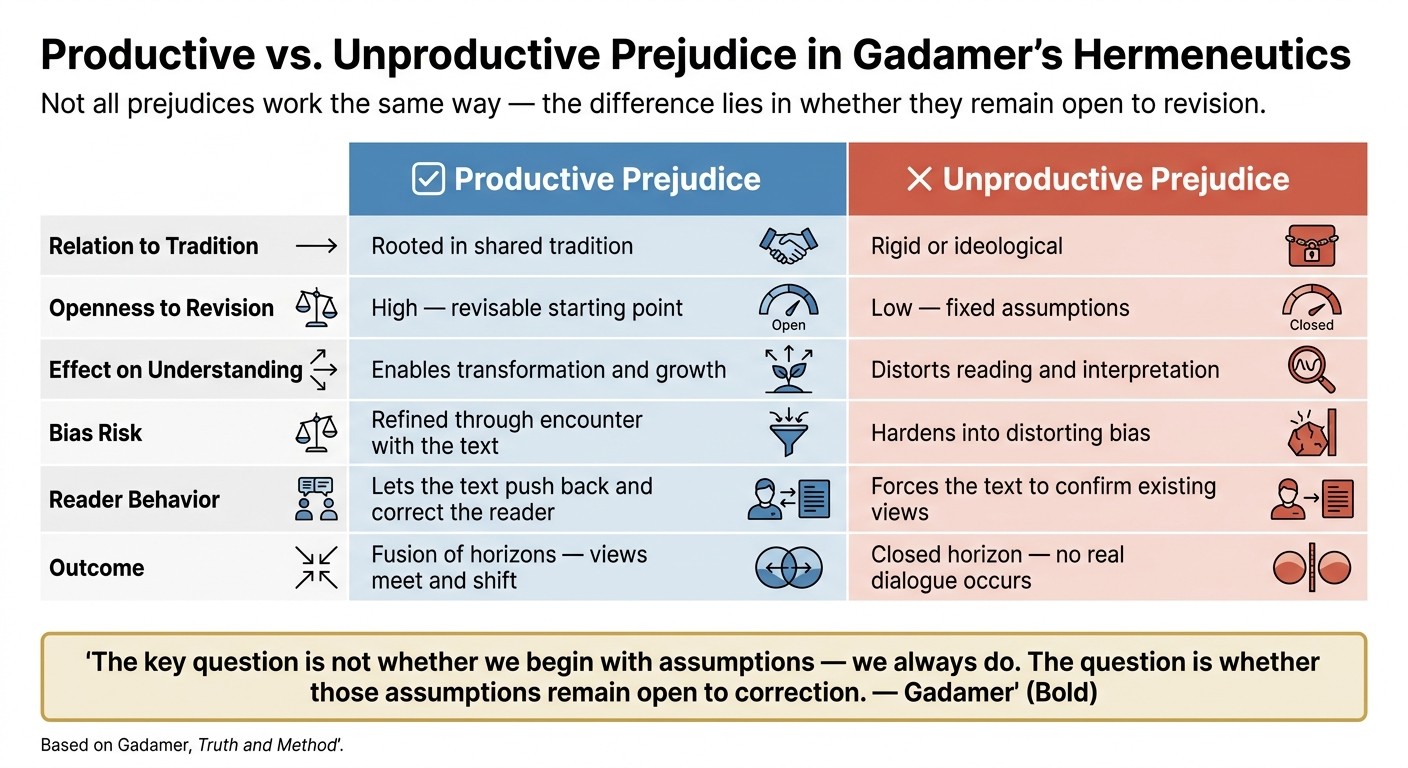
Not all prejudices work in the same way. Gadamer draws a line between prejudices that help understanding move forward and those that block it. That split sits at the center of his view. For Gadamer, the main issue isn't whether we inherit assumptions. We do. The issue is whether those assumptions can still be revised.
How Productive Prejudices Make Understanding Possible
Productive prejudices are starting points you can change. They guide interpretation, but they don't lock it in place. You begin with an early sense of what a text is doing, then you let the text answer back. If it resists your first reading, you shift your view.
Understanding, then, works like a back-and-forth exchange between what you already bring to the text and what the subject matter says. Productive prejudices make that exchange possible because they stay open to correction within a shared tradition. That's the key link between Gadamer's view of prejudice and his view of interpretation.
How Unproductive Prejudices Distort Reading
The same starting point turns harmful when it stops changing. An unproductive prejudice no longer responds to the text. The text can't correct the reader. Questions that should open things up get shut down before they even come into view. What do you get then? A reading that just confirms what the interpreter already thought.
In cross-cultural reading, this is the line between interpretation and distortion.
Type | Relation to tradition | Openness to revision | Effect on understanding | Bias risk |
|---|---|---|---|---|
Productive | Shared tradition | High; revisable starting point | Enables transformation | Refined through encounter with text |
Unproductive | Rigid or ideological | Low; fixed assumptions | Distorts reading | Becomes bias in the distorting sense |
The point isn't whether interpretation starts with assumptions, but whether those assumptions remain open to correction.
Horizon, Fusion of Horizons, and Bias in Interpretation
Why Every Interpretation Has a Horizon
If prejudice is where understanding starts, then horizon is the range those prior judgments create. Gadamer uses this term to describe the historical, cultural, and linguistic boundaries within which interpretation happens. In plain terms, we always read from somewhere. We never arrive as blank slates or from a neutral, assumption-free position.
Those prior judgments shape what we notice, what we miss, and what feels obvious to us. That set of limits is the interpreter’s horizon. This matters most when interpretation moves across cultural and linguistic differences, because that’s where our own standpoint stops feeling invisible.
Fusion of Horizons in Cross-Cultural Interpretation
In cross-cultural reading, the key issue is whether a horizon can shift without forcing the other person, text, or culture into sameness. For Gadamer, real understanding asks us to let the other perspective push back against our own assumptions.
Fusion of horizons names that back-and-forth process. It is a dialogue where each side can revise its assumptions rather than just defend them. At its best, this is not about winning an argument or flattening differences. It is more like learning to hear a new rhythm without making it sound like your own song.
Still, that ideal only works if the encounter is actually equal. If one side sets the terms from the start, the dialogue may look open while staying one-sided.
Main Critiques: Power, Ideology, and the Risk of Erasing Difference
Gadamer’s framework has faced criticism from ideology critique and postcolonial theory. Critics of ideology argue that horizons are shaped by power and by institutional imbalance, which can allow dominant frameworks to steer the dialogue.
Postcolonial critics press the point further. They warn that fusion can slip into assimilation, where marginalized voices are absorbed into a dominant horizon instead of being heard on their own terms. From this view, the main danger is not just misunderstanding. It is cultural domination carried out through interpretation.
That is why these critics stress the need to name difference and keep space for strangeness, rather than smoothing it over or folding it into a single shared view.
Conclusion: What Gadamer's View Means for Serious Study
For Gadamer, bias tied to history can't be escaped. It can only be examined. His point is plain: interpretation starts within history, not somewhere outside it. Prejudice isn't just an error to scrub away. It's the place you begin, and then test.
That shifts the task of reading. You have to sort out which assumptions help you read and which ones get in the way. You usually spot bias when a text pushes back against your first take. That's the working test of hermeneutics: let the text change what you thought you knew.
Study Implications for Readers of Philosophical Texts
If you're reading philosophy in a serious way, it helps to name your fore-understandings before you start. Put your starting assumptions on the table. Then bring in context, because context helps you see where your horizon ends and the text's horizon begins.
Why Annotated and Bilingual Editions Support Hermeneutic Reading
Annotated bilingual editions make this process easier to see because translation puts interpretive choices right in front of you. You're not just reading the text. You're also seeing where meaning had to be decided, line by line. In a bilingual edition, you can spot where translation forces a choice.
Its books are bilingual, annotated, and supported by editorial introductions and the Logos Reader, a supplemental publication with scholarly essays and commentary that situates each text within its own tradition.
That setup fits Gadamer's view of reading as disciplined revision. You return to the same text as your horizon shifts, and on each pass, you notice what you missed before.
FAQs
How can I tell if my prejudice is productive or distorting?
In Gadamer’s hermeneutics, prejudice isn’t always a bad thing. It’s a built-in part of how understanding works.
It becomes productive when it helps you approach a text or idea with openness and stay receptive to what it might be saying. It becomes distorting when it shuts that openness down. In that sense, productive prejudice gives interpretation a starting point while still leaving room for a fusion of horizons.
What does fusion of horizons look like in practice?
In practice, fusion of horizons takes place when someone reads a text as its own horizon of meaning. They don’t throw out their own perspective or prejudices. Instead, they let their horizon meet the text’s.
As that meeting unfolds, the two horizons come together into a new, shared understanding. So interpretation isn’t detached or purely objective. It’s an active process where different frames of meaning meet and are worked into each other.
Does Gadamer think objective interpretation is impossible?
Yes - if by objective interpretation we mean understanding that is completely free of the interpreter’s own assumptions. Gadamer says that kind of reading isn’t possible. Every act of understanding is shaped by the interpreter’s horizon, including the prejudices they already bring to the text.
But he doesn’t treat those prejudices as junk that must be cleared away first. Instead, he sees understanding as a fusion of horizons: a meeting point between the interpreter’s own context and the text’s possible meanings.