Translation Challenges in Philosophy Publishing
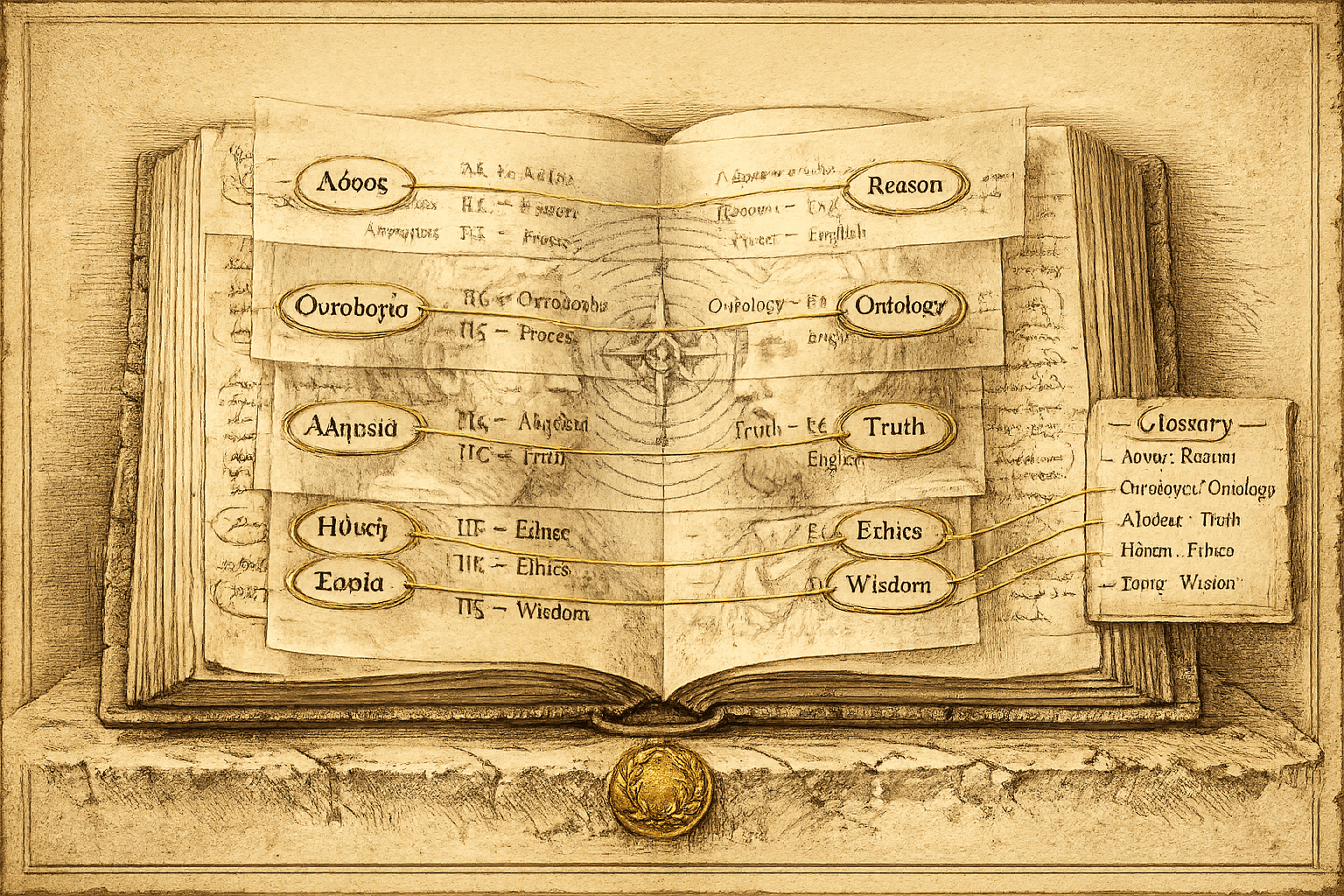

Translating philosophical texts is one of the most complex tasks in publishing. Why? Because philosophy is deeply tied to the original language's structure, logic, and cultural context. Here's a quick breakdown of the main issues:
Philosophical Terms Are Hard to Translate: Words like logos or to on carry layered meanings that don't always have equivalents in other languages.
Consistency in Terminology Matters: Philosophers choose their words carefully, and inconsistent translations can distort their ideas.
Cultural and Historical Context: Philosophical ideas are rooted in their time and place, making direct translation tricky.
Translation Equals Interpretation: Every choice a translator makes reflects their understanding of the text, which can influence the final meaning.
To tackle these challenges, annotated study editions with glossaries, historical notes, and bilingual formats are essential. These tools help preserve meaning and ensure readers grasp the original intent. Translating philosophy isn’t just about language - it’s about understanding and conveying ideas accurately.
Ganesh Thite - Challenge and Change in Translating Philosophical Texts
Main Challenges in Translating Philosophy
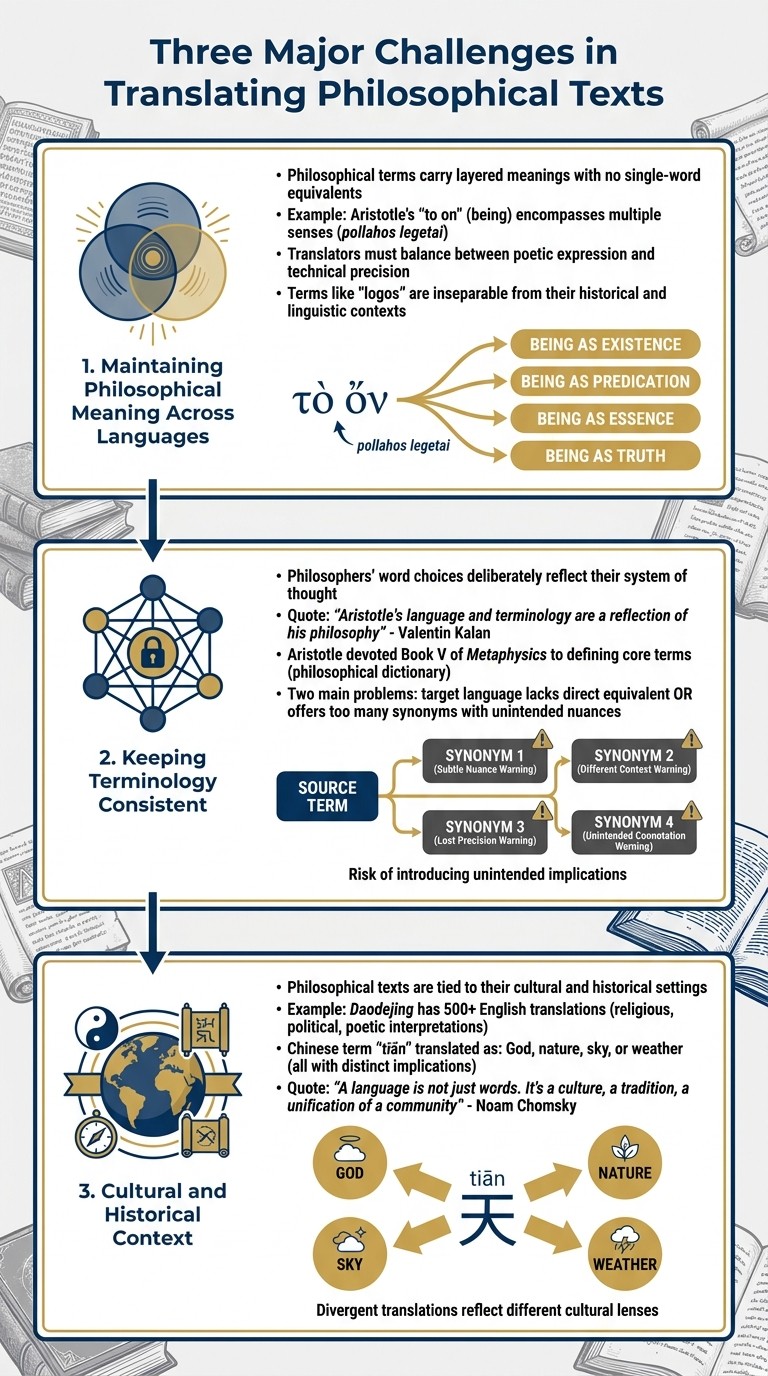
Three Major Challenges in Translating Philosophical Texts
This section dives into three major hurdles translators face when working on dual-language editions of philosophical texts.
Maintaining Philosophical Meaning Across Languages
Philosophical terms often carry layered meanings, making it nearly impossible to find a single word in another language that captures their full essence. Take Aristotle's concept of "being" (to on) as an example - it encompasses multiple senses (pollahos legetai), so any translation inevitably narrows its original scope.
Philosophical language exists in a unique space, balancing between poetic expression and technical precision. Words like Harmony, Cosmos, or God require translators to decide whether to approach them as scientific terms needing exact definitions or as poetic ideas that resist direct translation. This tension makes the translator's role as much interpretive as linguistic.
Some concepts are so deeply rooted in their original language and culture that they defy direct translation altogether. Heidegger pointed out that foundational Greek terms like logos are inseparable from their historical and linguistic contexts, making literal translation inadequate. Translators must interpret the intent behind the text to choose the most fitting words.
On top of preserving meaning, maintaining consistent terminology is another critical task for translators.
Keeping Terminology Consistent
Consistency in terminology is vital because a philosopher’s word choices are often deliberate reflections of their system of thought. As Valentin Kalan explained:
Aristotle's language and terminology are a reflection of his philosophy.
When translators use different equivalents for the same term, they risk obscuring the underlying philosophical framework.
This issue becomes particularly tricky with terms that carry precise technical meanings. For instance, Aristotle devoted Book V of his Metaphysics to defining the various meanings of his core terms, effectively creating a philosophical dictionary. Translators often face two main challenges here: either the target language lacks a direct equivalent for the original concept, or it offers too many synonyms, each introducing unintended nuances that were absent in the source text.
But terminology isn’t the only hurdle - translators must also navigate the cultural and historical context of the text.
Cultural and Historical Context in Translation
Philosophical texts are deeply tied to the cultural and historical settings in which they were written. These contexts often don’t align neatly across languages. For example, Western philosophy typically separates mind and body, while Classical Chinese philosophy operates within a completely different framework, where characters often represent socially and historically constructed concepts rather than purely mental constructs.
The Daodejing highlights this difficulty. It has been translated into English over 500 times, resulting in interpretations that range from religious to political to poetic. These variations show how different cultural perspectives can produce vastly different understandings of the same text. For instance, the Chinese term tiān has been translated as God, nature, sky, or weather, but none of these are true synonyms - they each carry distinct implications that can shift the meaning of the philosophical argument.
To fully grasp a term’s meaning, one must understand its inference patterns - how it connects to related ideas within its original cultural context. As Noam Chomsky aptly noted:
A language is not just words. It's a culture, a tradition, a unification of a community, a whole history that creates what a community is.
Without this understanding, translators risk imposing foreign frameworks onto texts, distorting their meaning even if every word is technically accurate. Recognizing these challenges is crucial for producing study editions that faithfully convey the original philosophical ideas. This process often requires rigorous translation and peer review to ensure scholarly accuracy.
How Philosophers View Translation
Translation serves as a fascinating lens for examining meaning, identity, and how we understand the world. Its connection to philosophy runs much deeper than it might initially appear.
Translation as Philosophical Metaphor
Philosophers have often used translation as a metaphor to explore the ways we interpret and make sense of the world. Hans-Georg Gadamer famously compared reading to translating, suggesting that interpretation itself is a form of translation - one that bridges the world of the text with our own. Walter Benjamin expanded on this idea, describing translation as the "afterlife" of a text. He saw it as a stage where the original work achieves fulfillment through a "pure language" that transcends the boundaries of individual tongues.
Martin Heidegger took a different angle, believing that a philosopher's thoughts on translation reveal something fundamental about their broader philosophical outlook. He expressed this sentiment with the statement: "Sage mir, was du vom Übersetzen hältst, und ich sage dir, wer du bist. [Tell me what you think of translation, and I will tell you who you are.]". Philosophers like Emmanuel Levinas and Jacques Derrida explored translation as a way to engage with the ethical encounter of the "Other", delving into the complexities of fidelity and the impossibility of achieving perfect equivalence.
Through these perspectives, translation becomes more than just a linguistic process - it becomes a gateway to deeper philosophical questions about meaning and understanding.
Philosophy and Translation Theory
The relationship between philosophy and translation theory is complex and often fraught with tension. Lawrence Venuti refers to translation as "the dark secret of philosophy", highlighting how philosophical discourse depends heavily on translated ideas while often overlooking the transformative nature of the act itself. Analytical philosophers like W.V.O. Quine and Donald Davidson used the concept of "radical translation" to examine the indeterminacy of meaning, while Continental philosophers often treat translation as a metaphor for existence and interpretation.
This tension underscores the profound impact translation has on philosophical thought, even if it sometimes goes unacknowledged.
Major Philosophical Texts and Their Translation Problems
Some philosophical works have become infamous for the challenges they pose to translators. For instance, Kant's Critique of Pure Reason and Hegel's Phenomenology of Spirit are filled with dense, technical language that resists straightforward translation. Heidegger's writings present even greater difficulties, as his philosophical ideas are so deeply rooted in the nuances of the German language that translating them into English often requires significant interpretation.
Interestingly, some philosophers have taken on the task of translating their own work. This practice allows them to refine their ideas, offering a unique opportunity to "translate" not only the text but also their own philosophical voice into a different cultural and linguistic context . In this way, translation becomes more than a technical challenge - it becomes a deeply personal and philosophical act.
These issues underscore the importance of tools like detailed annotations and bilingual editions, which help preserve the integrity and richness of philosophical texts across languages.
Methods for Solving Translation Problems
Translating philosophical texts requires a careful mix of human expertise and modern tools. Over the years, publishers and translators have developed practical approaches to address the specific challenges philosophy poses.
The process often begins with collaboration. Collaborative translation and peer review involve selecting translators who are not only skilled linguists but also have deep knowledge of philosophy. The Ludwig Wittgenstein Project emphasizes the importance of starting with high-quality work:
No number of qualified revisions can make a poor or mediocre translation into a good one.
This highlights the need for accuracy from the outset. Many publishers use multi-stage proofreading, where different team members review the text both before and after typesetting. Additionally, external peer reviews are often conducted to ensure the translation meets scholarly standards. Partnering with academic societies, such as the British Wittgenstein Society, can provide access to experts who bring the necessary depth of understanding to the review process.
For handling terminology, glossaries and contextual research are indispensable. Philosophy often involves terms with nuanced meanings, and translating them requires what scholar Valentin Kalan refers to as:
a preliminary interpretation.
A well-organized glossary helps manage terms with multiple meanings, standardize synonyms, and maintain consistency throughout the text. Contextual research further refines this process by categorizing terms into historical, social, or literary frameworks, ensuring the translation aligns with the original context. This approach allows translators to bridge cultural differences while keeping the text readable and elegant.
Modern technology also plays a role. AI tools with human oversight are increasingly used to handle repetitive or high-volume sections of text. As Cerenbal notes:
AI is now a legitimate partner in scaling localization, but it is not a replacement for human judgment. Think of it as a high-speed train. It can take you far and fast, but you still need a driver who knows the route.
AI can quickly generate translations, but human oversight ensures the output meets the rigorous standards of philosophical work. This approach, often referred to as "solve-verify asymmetry", allows AI to handle the initial translation while experts focus on refining and verifying the results. Without this human involvement, there’s a risk of falling into the "rubber stamp" problem, where AI output is approved without meaningful review. A study on machine translation of culture-specific terms found that even the most advanced AI systems identified fewer than 24% of the terms flagged by professional translators. This underscores the irreplaceable value of human expertise.
These methods are most effective when used together. For example, Logos Philosophy Club integrates all these strategies in its bilingual study editions, combining rigorous reviews, detailed glossaries, and a commitment to philosophical accuracy to produce high-quality translations.
Why Study Editions and Annotated Texts Matter
Study editions, especially those with annotations and bilingual formats, help bridge the gaps that naturally arise in translation. These enriched editions play a key role in addressing the challenges of interpreting complex philosophical texts.
How Annotations Help Readers Understand Philosophy
Annotations go beyond defining words - they provide the historical, linguistic, and cultural context necessary to grasp an author's true intent. Benjamin Jowett, Master of Balliol College, captured this difficulty when he said:
Translation from Greek into English is a work of continual loss.
Greek terms like δέ, γάρ, and μέν, along with abstract concepts such as arete (virtue) and sophia (wisdom), often lose their layered meanings when translated into English. Editorial notes help restore some of this depth by explaining how specific terms are interpreted, outlining the dramatic structure of philosophical dialogues, and preventing misinterpretations. For example, without proper commentary, Socrates - known for his wit and irony - might be mistakenly viewed as a solemn prophet or a precursor to Christian moralism.
Additional tools like glossaries and indices further assist readers in navigating complex terminology. Editorial prefaces also set the stage by highlighting the text’s importance in the broader context of Western philosophy.
John Roche, a member of the Logos Philosophy Club, shared his appreciation for these features:
I love my copy. The book is sturdy and very well bound, but so far the scholastic commentary is the real gem.
Bilingual Editions for Side-by-Side Comparison
Bilingual editions complement annotations by allowing readers to compare translations directly with the original text. Philosophy sits at the intersection of literature and science, combining deep ideas with precise language that can be difficult to convey in a single translation. By presenting the original Greek, Latin, or German text alongside its translation, bilingual editions enable readers to cross-check meanings and maintain the scholarly rigor essential for studying philosophy.
How Logos Philosophy Club Produces Study Editions

To address these challenges, Logos Philosophy Club creates study editions that preserve the depth of philosophical works through expert translation and meticulous editorial work. Each edition is presented bilingually (or trilingually) and cross-referenced with critical editions, such as those by John Burnet (Oxford) and K. J. Dover for Platonic texts, ensuring a high level of accuracy. These editions include detailed editorial notes, glossaries of key philosophical terms, and indices to help readers navigate complex ideas. Some releases also feature the Logos Reader, which offers essays and additional scholarly context to enrich the reading experience.
The books themselves are designed for durability, with hardcover bindings and ribbon markers, making them ideal for long-term use. Recent publications, such as Plato's The Symposium, exemplify this approach with bilingual texts and detailed annotations. Priced at $45 per copy, Logos Philosophy Club also offers flexible subscription plans to its growing community of over 20,000 members.
Conclusion
Translating philosophical texts is no simple task - it goes beyond just knowing the language. It requires a deep understanding of philosophy itself. As William F. Vallicella puts it:
To translate Adorno it does not suffice to know German, one must also have read Kant, Hegel and Co..
Without this philosophical grounding, translators risk misrepresenting the original arguments.
A key challenge is maintaining the inferential roles that define philosophical terms. If translators rely only on dictionary definitions without grasping the underlying logic, the translation may unintentionally reshape the original meaning. This highlights the importance of prioritizing clarity and conceptual precision over stylistic flourishes.
High-quality editions address these challenges by offering tools like glossaries and side-by-side texts. These features help preserve technical details and historical context, allowing readers to better understand the author’s intent.
In response to these complexities, philosophical translation has become more professionalized. The growing involvement of academic philosophers, including more women, ensures greater conceptual accuracy in translations. Paired with study editions featuring detailed notes and cross-references, this shift supports a deeper and more rigorous engagement with philosophical works. These efforts make philosophical texts both accessible and faithful to their original depth and intent.
FAQs
Why can’t philosophical terms be translated literally?
Philosophical terms are often layered with meaning and closely linked to their original contexts. A literal translation can strip away the intended subtleties, altering the style or nuance of the text. To address this, annotated and commentary-rich study editions are invaluable. They help maintain the original depth and accuracy, ensuring the essence of the text remains intact.
How do annotations and glossaries prevent mistranslations?
Annotations and glossaries play a key role in avoiding mistranslations. They provide clear explanations for complex terms, offer contextual notes, and include important clarifications. These tools act as a guide for translators, helping them interpret the original text accurately and minimize the chances of errors or misinterpretations.
When is AI useful for translating philosophy, and when isn’t it?
AI can be a great tool for translating philosophy, particularly when dealing with initial drafts, large amounts of text, or straightforward content such as scientific terms. However, it often stumbles when faced with metaphors, idiomatic phrases, or intricate ideas that demand a deeper grasp of context. For more nuanced philosophical works - especially foundational texts - human expertise is crucial to maintain precision and capture the original intent.