Translation and Peer Review in Philosophy Publishing


A bilingual philosophy edition should be reviewed as one scholarly package, not as “text plus translation.” If the source text, English translation, notes, glossary, and introduction are checked apart from each other, errors can slip into the argument itself.
Here’s the short version:
I see two jobs in review: checking the philosophy and checking the quality of the philosophy translation
I see three main review models: double-blind, single-blind, and editor-led review
I see three main quality checks for translation: accuracy, term consistency, and fit between notes and text
I see three workflow options: sequential, parallel, and integrated review
I see one clear rule: reviewers need the source text, translation, glossary, and translator’s explanation in hand
A few points stand out fast:
In philosophy, one term can change an argument
Long sentences often carry the logic, so rewriting them can shift meaning
Notes and introductions are part of the edition, not side material
Side-by-side layout helps readers compare line by line
Review records matter because they show how the edition was checked
Reading Like a Translator: A Philosophical Approach
Quick Comparison
Area | What I’d check | Why it matters |
|---|---|---|
Translation | Meaning, tone, key terms | Small wording shifts can alter claims |
Notes and intro | Accuracy, framing, term choices | Readers often rely on these to understand the text |
Workflow | Sequential, parallel, integrated | The process shapes what gets missed or caught |
Reviewer materials | Source text, translation, glossary, rationale | Without these, close review is weak |
Layout | Bilingual layout features like facing pages, clear notes, and cross-references | It affects study, teaching, and citation |
Bottom line: I’d treat peer review for bilingual philosophy editions as a combined check on language, argument, and editorial judgment. That is the core point of the article.
Standard Peer Review Models in Philosophy Publishing
Double-Blind, Single-Blind, and Editorial Review
Bilingual editions usually follow the same review paths used in philosophy publishing. But translation adds one more check.
Philosophy journals tend to use a few common models.
Double-blind review keeps both the author and the reviewer anonymous. The goal is to cut bias, which matters a lot in philosophy.
Single-blind review keeps the reviewer anonymous, but the reviewer can see who the author is.
Editorial review leans more on the editor’s judgment than on outside referees.
The main difference is how much outside scrutiny each model brings. With bilingual philosophy editions, that outside review also has to cover the translation.
Baseline Criteria for Philosophical Review
Across these models, reviewers look for argumentative rigor, linguistic precision, textual interpretation, and research integrity. In philosophy, word choice can affect whether an argument still says what it is supposed to say.
As one journal notes, philosophy often calls for especially precise English because interpretation and verbal argument sit at the center of the field.
Reviewers also look for translation plagiarism, where a work appears again in another language under a different name. Peer review works as a self-policing mechanism that helps protect the scholarly record from that kind of damage.
In bilingual editions, those same standards apply to the translation too.
Why Translation Adds a Second Layer of Review
A translated philosophical text is not just a copy in another language. It is also an interpretation of the source text. In philosophy, one mistranslated term, one missing nuance, or one shifted logical link can alter the argument itself.
That’s why bilingual editions need a second layer of review. Reviewers have to check the translation against the source text and assess the translator’s reasoning, not just whether the final version reads well.
As the Review of Philosophy and Psychology puts it:
"In philosophy, a standard approach to mitigating these risks is to seek critical feedback from a diverse range of individuals."
For bilingual editions, that means reviewers need both philosophical expertise and the ability to work with the source text.
How Translation Quality Is Evaluated in Philosophical Works
Accuracy, Terminology, and Conceptual Fidelity
Against those review standards, translation quality comes down to three main checks: accuracy, style, and scholarly apparatus.
Reviewers start with the core issue: does the translation preserve the source text's meaning? In philosophy, even a slight shift can alter the argument. A single word choice can move a claim, soften a distinction, or make a line sound more modern than it should.
So reviewers look closely at technical terms. Are they used the same way from start to finish? Does the translator avoid modern vocabulary that pulls the text out of its historical setting? As Alfred J. Freddoso, Professor at the University of Notre Dame, puts it:
"Technical terms should be used as consistently as possible; and, no, one should not import contemporary technical terms where these would clearly be anachronistic."
Reviewers also ask whether the translation is grounded in the work's historical and systematic context. That includes the author's intellectual forebears and successors.
Accuracy, though, is only part of the job. A translation also has to read in a way that carries the argument on the page.
Style, Register, and Readability
Readability matters, but not at the cost of fidelity.
This is where sentence structure comes under close review. Many philosophical texts rely on long conditional sentences, and those sentences do more than sound formal. They often carry the logic itself. Break them up the wrong way, and the shape of the reasoning can change. Freddoso notes:
"It is not at all clear that nothing is lost if one alters [a long sentence] to read 'A. B. C. D. So E.' [instead of 'Since A, B, C and D, it follows that E']."
Reviewers also pay attention to the author's voice. If a thinker writes with compression or restraint, that style is part of the method, not just a surface feature. Ockham's terseness, for instance, is not accidental. Judgments here should rest on scholars with strong linguistic and historical knowledge of the tradition.
That same standard carries into the material around the translation.
Notes, Variants, and the Translator's Reasoning
The scholarly apparatus around a translation - notes, glossary, and introduction - is part of what reviewers judge.
Notes can do work that the translation itself should not do. If a modern parallel helps readers, it can go in a note without changing the wording of the text. That line matters. The parallel belongs in a note or introduction, not in the translation.
Reviewers also check whether the introduction places the work within the philosopher's broader system. And a glossary of key terms, with reasons for each rendering, gives reviewers something solid to test. It helps them see whether the translation is internally consistent. Without that apparatus, there is no clear way to tell whether a term changed on purpose or by mistake.
Editorial Workflows for Peer Review of Bilingual Editions
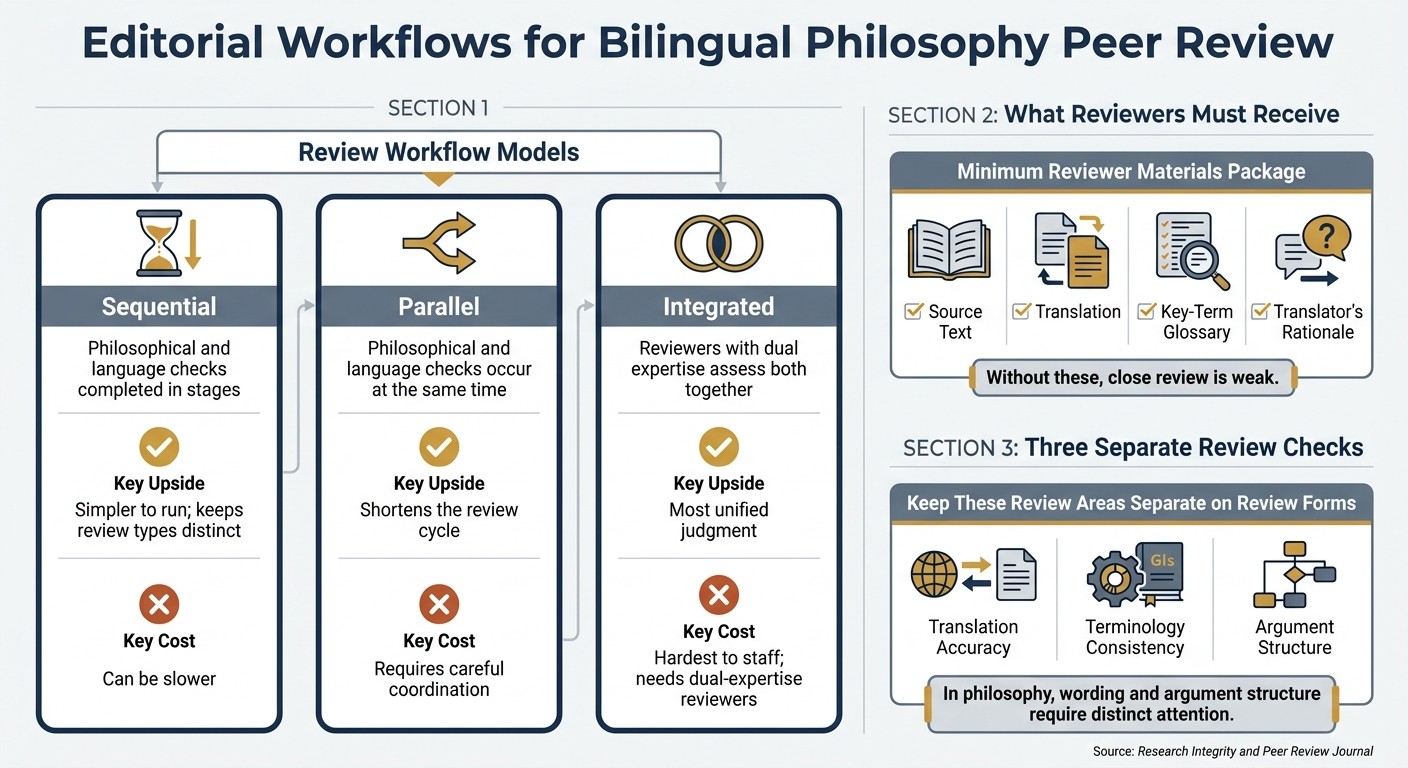
Peer Review Models for Bilingual Philosophy Editions: A Complete Comparison
Sequential, Parallel, and Integrated Review Models
Once a journal or editor has defined translation quality, the next step is the workflow. That workflow decides how the translation is checked and how problems are found.
In bilingual peer review, philosophical review and language review need to work together. The goal is to protect both conceptual fidelity and linguistic accuracy.
Model | Summary | Trade-off |
|---|---|---|
Sequential | Philosophical and language checks are completed in stages | Can be slower, but keeps the two kinds of review distinct |
Parallel | Philosophical and language checks occur at the same time | Can shorten the review cycle, but requires careful coordination |
Integrated | Reviewers with dual expertise assess both together | Hardest to staff because it requires dual-expertise reviewers |
Each model has a clear upside and a clear cost. Parallel review moves faster. Sequential review is simpler to run. Integrated review can give a more unified judgment, but it depends on finding reviewers with dual expertise.
Workflow choice also affects what materials reviewers need in hand from the start.
What Reviewers Need to Receive
Reviewers should get the full text package, not just the translated manuscript. At a minimum, that means the source text, the translation, a key-term glossary, and the translator's rationale. Without those items, reviewers can't properly compare the translation to the source text.
Review forms should also keep different checks separate. Translation, terminology, and argument review should not be folded into one vague set of comments. That split matters even more in philosophy, where wording and argument structure need separate attention.
Editors should keep records of the review method, reviewer workload, and reviewer qualifications as well. If questions come up later, that record lets others audit the process.
Timelines and Editorial Coordination
Translation-centered review usually takes longer than standard philosophy review, so editorial schedules need extra time built in.
The coordination load is heavier too. One reviewer may point to a language problem, while another may point to a philosophical problem, and those are not always the same thing. Editors need enough subject knowledge to sort out those comments without treating translation issues as if they were only argument issues. The manuscript's formatting also needs to make source-text comparison easy. Good documentation helps on both fronts because it makes the translation process open to review by editors and peer reviewers.
"Neglecting thorough documentation creates an unrecoverable information gap for peer reviewers. This prevents proper evaluation of translation validity - a core methodological checkpoint." - Research Integrity and Peer Review Journal
These editorial decisions also affect layout, annotation, and how readers use the final bilingual edition.
Bilingual Layout, Study Use, and the Value of Rigorous Review
How Side-by-Side Layout Affects Scholarly Use
Once the translation has been reviewed, the next thing that matters is the layout. In a bilingual edition, layout isn't just about looks. It shapes how the book can be used in study, teaching, and review.
When the source text and the English translation appear on facing pages, readers can compare wording line by line. They can track shifts in meaning, spot where a translator has made a clear interpretive choice, and test those choices against the original. That's a big deal in philosophy, where a single term can carry a lot of weight.
Terms that resist neat translation make this especially clear. Heidegger's Dasein is a well-known case: bilingual editions let readers check whether a term's philosophical nuance is preserved or lost in translation. This format also helps non-native English speakers, who often face a heavier reading load when working through dense academic prose.
Peer reviewers should look closely at a few practical points:
Whether key terms stay consistent across the edition
Whether commentary is clearly set apart from the primary text
Whether cross-references work in both directions
Good layout is what makes the edition dependable for close reading.
Why Annotations and Introductions Matter for Readers
That clear separation matters because commentary can easily blur into the main text. Annotations help readers and reviewers tell the difference between the original argument and later interpretation. As Bryan Van Norden put it in his review of the Mengzi edition, which includes a running commentary drawn largely from Zhu Xi (1130–1200 C.E.):
"Those who do not read the commentaries are doomed to repeat them."
His point lands hard. Without direct notes, readers can take later orthodox views or later historical readings as if they belonged to the source text itself. Good annotation helps prevent that mix-up.
The same standard applies to introductions and notes. They need to be easy to use, not just included to check a box. Peer review should ask whether introductions, terminology notes, and references help sustained study and accurate citation. For serious work, these parts are not add-ons. They are what make a bilingual edition usable over time.
Review should also ask a plain question: can this edition hold up in a seminar, in citation, and in close reading? That's the bar a serious bilingual edition should meet.
Conclusion: What Strong Peer Review Protects in Philosophy Publishing
Rigorous peer review of bilingual philosophical editions protects both the argument and the language at the same time. Reviewers need to give separate attention to terminology, apparatus, layout, and translation rationale, and they need the right background to do that well.
When that happens, the result is an edition that can stand up in seminars, in citations, and in private study for years after publication. Done well, philosophical and linguistic review turn a bilingual edition into a stable text readers can return to with confidence.
FAQs
Why can’t philosophy translations be reviewed separately?
Because in philosophy publishing, translation and revision usually happen together. A translated work often goes through several rounds of language and style editing, and those edits shape the text at every stage.
That makes the translation hard to separate from the broader revision process, and just as hard to assess on its own.
Who should review a bilingual philosophy edition?
A bilingual philosophy edition should be reviewed by people with a strong background in philosophy and a deep command of both the source language and the target language.
In most cases, reviewers who can read the original language are the best fit. They can check whether the translation is accurate, protect subtle shades of meaning, and make sure the arguments stay clear and faithful to the work’s philosophical and historical context.
What makes a translation reliable for study?
A translation works well for study when it stays close to the original meaning, has been edited with care, and comes from a team with strict editorial standards.
It also helps when the text includes clear notes and helpful context, so readers can understand difficult passages and study with more confidence.