Ultimate Guide to Premeditatio Malorum


If I want less anxiety and more steadiness, this Stoic exercise gives me a simple way to do it: I spend 5 to 10 minutes picturing one plausible setback, sort out what I can control, and decide how I’ll respond.
Here’s the short version:
Premeditatio malorum means preparing my mind for trouble before it happens.
It is not the same as worry, rumination, or doom-thinking.
The core move is simple: picture one setback, feel it briefly, make a plan, then return to the present.
Stoic writers like Seneca, Epictetus, and Marcus Aurelius used this to deal with loss, rude people, illness, conflict, and death.
The practice works best when it is brief, done in the morning, and tied to the dichotomy of control.
A daily version can take 5 minutes. A deeper weekly review can take 15 to 30 minutes.
It can help with work stress, money pressure, health fears, and family strain.
It can also build gratitude, because when I picture losing something, I notice its value now.
If it turns repetitive, draining, or intrusive, it has stopped being Stoic practice and started becoming rumination.
If someone has acute anxiety, trauma, or depression, this should be done with a mental health professional.
The big idea is simple: I don’t rehearse pain to feel worse. I rehearse it so I’m less shocked, more calm, and more ready to act.
A few lines from the article say it best:
Seneca’s point: the unexpected hits harder, so I should not let life catch me flat-footed.
Epictetus’s point: I should expect friction in ordinary life, not just disaster.
Marcus Aurelius’s point: I can start the day ready for difficult people instead of being surprised by them.
What this article gives me is not just Stoic background. You can also explore our curated philosophy editions for deeper study. It gives me a plain method I can use right away:
Choose one plausible problem
Picture it clearly
Separate what I control from what I don’t
Rehearse one or two calm next steps
Premeditatio Malorum: “The Pre-Meditation of Evils” (Stoic Exercise)
Quick comparison
Approach | What I do | How it tends to feel | Likely result |
|---|---|---|---|
Premeditatio malorum | I rehearse a plausible setback and my response | More steady, less shocked | Better planning and calmer action |
Worry | I loop through “what if” thoughts without an end point | More stress and dread | Freezing, avoidance, overthinking |
Naive optimism | I look only at the best-case outcome | Fine until something goes wrong | Weak backup plans |
Pessimism | I assume the worst is coming | Flat, defeated | Inaction |
Bottom line: this is a Stoic drill for calm under pressure. I use it to prepare, not to punish myself.
Stoic Origins and the Logic Behind the Practice
Seneca, Epictetus, and Marcus Aurelius on Hardship
This practice comes straight out of Stoic psychology: ready the mind before life puts pressure on it.
Premeditatio malorum is the Stoic exercise most closely tied to Seneca, Epictetus, and Marcus Aurelius. Seneca, the Roman statesman and philosopher, argued that a wise person should rehearse hardship ahead of time - exile, torture, war, shipwreck - so nothing lands as a total shock:
"If an evil has been pondered beforehand, the blow is gentle when it comes." - Seneca
Epictetus took that same exercise and applied it to ordinary friction: people shoving, scolding, and stealing at a public bath. The point was simple. If you expect these moments, you’re less likely to lose your composure when they happen. He pushed the idea even further:
"What harm is there while you are kissing your child to say softly, 'Tomorrow you will die'?" - Epictetus
Marcus Aurelius used a morning review to get ready for the ungrateful, arrogant, and dishonest people he might run into that day. Different examples, same goal: learn how to face disruption without handing over your judgment.
The Dichotomy of Control in Practice
That preparation works because Stoics judged events by control, not comfort.
They split life into two parts: what is up to us - judgment, choice, and action - and what is not - other people, illness, reputation, and death. That split gives premeditatio malorum its shape. When you picture a setback, you are not trying to predict the future or force an outcome. You are sorting the parts you can’t control from the parts that still belong to you: preparation, judgment, and response.
"Nothing happens to the wise man against his expectation... nor do all things turn out for him as he wished but as he reckoned - and above all he reckoned that something could block his plans." - Seneca
How Imagining Setbacks Can Strengthen Virtue
For the Stoics, health, wealth, and reputation were externals. Virtue was the only true good. So when a person rehearses losing those externals, the point is not to become gloomy. It is to train courage, resilience, practical wisdom, and self-control.
Put another way, this exercise helps a person stay steady when life stops cooperating. That idea turns into a day-to-day method in the next section. For those who want to learn from the great thinkers through curated editions, these practices offer a foundation for a resilient life.
How to Practice Premeditatio Malorum Step by Step
A Four-Step Method for Daily or Weekly Use
Once the logic clicks, the practice itself is pretty simple. It should be brief, on purpose, and it should end with a plan, not a spiral.
Choose a plausible difficulty: Pick one specific setback, like a presentation glitch or car trouble.
Picture the scenario vividly: See the moment in your mind. Where are you? What changes first? How does your body react in the first minute?
Sort by control: Separate what is up to you from what is not.
Rehearse a measured response: Pick one or two actions you would take. If the meeting goes poorly, for example, you might ask for a follow-up to address specific concerns.
Write the steps down, especially as if-then statements. That turns the exercise into something usable. Keep it short: about 5 minutes for a daily check-in and 15 to 30 minutes for a deeper weekly review.
You can use the same method for work pressure, health concerns, and family stress.
Applying the Method to Work and Personal Situations
This works best when the situation is real and close at hand. If you have a meeting coming up, rehearse how you'll stay calm if the other person pushes back. You are not trying to script every line. You're just making sure the moment doesn't hit you out of nowhere.
The same idea carries over to personal life. If you're dealing with a health scare or an unexpected medical bill, take a few minutes to ask, What remains in my control? Learn your treatment or payment options before you need them. Booker T. Washington used a similar morning rehearsal to stay steady under pressure.
Practice Formats Compared
Match the length of the exercise to the size of the risk.
Format | Time Required | Best Use Case | Main Benefit |
|---|---|---|---|
Daily Brief Visualization | 5 minutes | Morning routine; small daily irritations like a difficult commute or tense email threads | Builds steady composure |
Weekly Deep Reflection | 15–30 minutes | Larger concerns: career, health, finances, relationships | Restores perspective |
Event-Specific Rehearsal | 60–90 minutes | Before a major launch, negotiation, or medical procedure | Reduces surprise in high-stakes moments |
Research on team pre-mortems, a modern business use of the same exercise, found they help teams identify major risks that standard planning sessions miss.
Benefits, Misconceptions, and Modern Uses
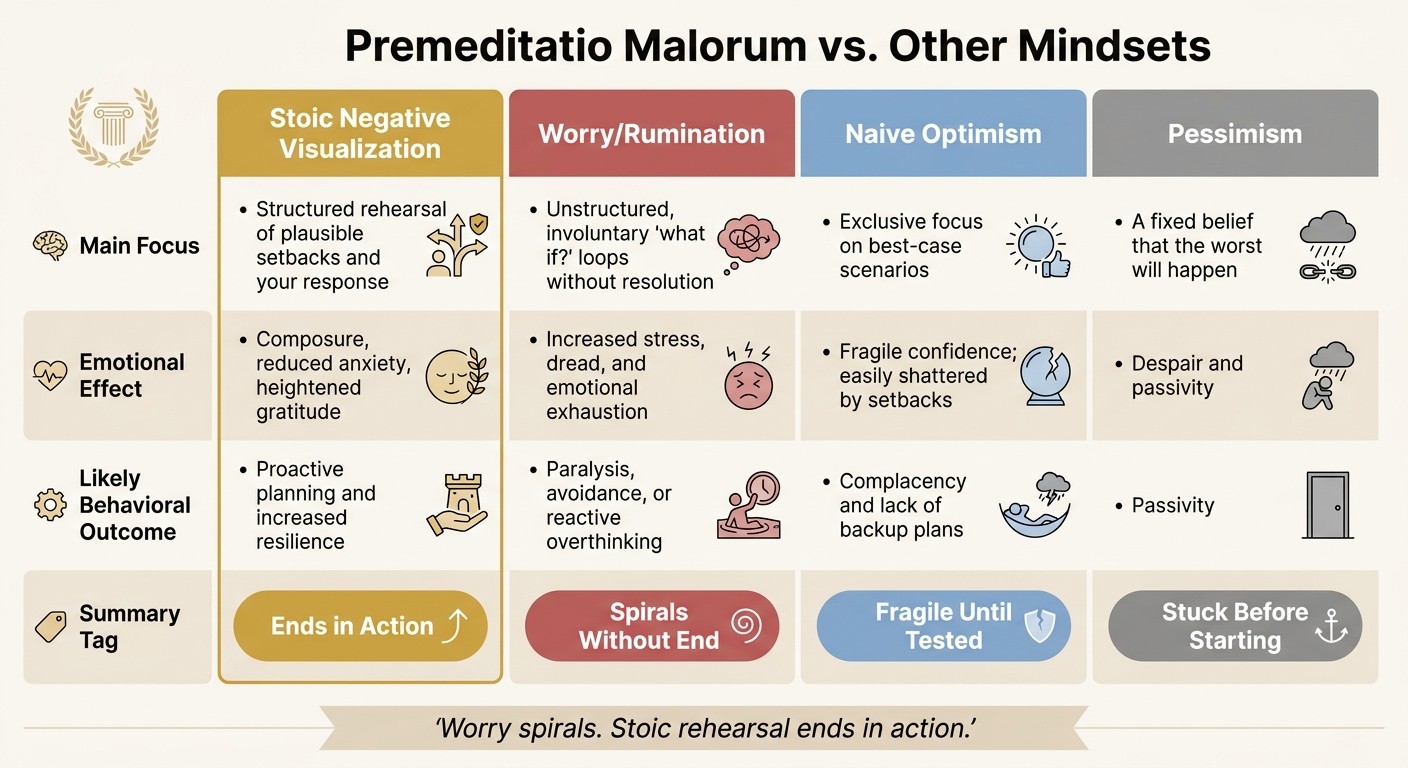
Premeditatio Malorum vs. Worry, Optimism & Pessimism: A Stoic Comparison
What the Practice Improves When Used Well
Because this exercise stays inside what you can control, the payoff is practical, not airy or abstract.
Used well, premeditatio malorum improves four things.
First, it turns vague dread into a short mental rehearsal. When you’ve already faced a setback in your mind, surprise loses some of its force, and your judgment stays steadier.
Second, it helps with decisions. If you’ve already thought through how you’d respond to a job loss or a cash shortfall, you’re less likely to freeze or panic. You move from a reactive state to a prepared one.
Third, it restores gratitude. Picture losing something ordinary - your health, your belongings, or a close relationship - and the numbness of familiarity starts to wear off. You notice what’s still here.
Fourth, it builds equanimity: steady composure when things go wrong.
The point is easy to miss. These gains come from practicing control - sorting what belongs to you from what doesn’t - not from simply imagining bad outcomes.
Premeditatio Malorum vs. Worry and Naive Optimism
The most common mistake is calling this “negative thinking.” It’s not the same thing at all.
The difference comes down to structure, intention, and result. Stoic rehearsal has a shape to it, and it ends with action. Worry doesn’t. It just keeps spinning.
Approach | Main Focus | Emotional Effect | Likely Behavioral Outcome |
|---|---|---|---|
Stoic Negative Visualization | Structured rehearsal of plausible setbacks and your response | Composure, reduced anxiety, and heightened gratitude | Proactive planning and increased resilience |
Worry / Rumination | Unstructured, involuntary "what if?" loops without resolution | Increased stress, dread, and emotional exhaustion | Paralysis, avoidance, or reactive overthinking |
Naive Optimism | Exclusive focus on best-case scenarios | Fragile confidence; easily shattered by setbacks | Complacency and lack of backup plans |
Pessimism | A fixed belief that the worst will happen | Despair and passivity | Passivity |
Worry spirals. Stoic rehearsal ends in action.
When to Be Careful with Negative Visualization
This exercise has a stopping point, and that line matters. If the visualization turns repetitive or intrusive, or if it pulls you away from action instead of toward it, it has slipped into rumination. Stoic writers saw that as a different problem.
A few guardrails help:
Practice in the morning, not at night, when anxious thoughts are harder to shut off.
Keep it short. 5 to 10 minutes is enough.
Always end by asking two things: what you could do if it happened, and what you have right now that you’d miss. That brings you back to the present.
If someone is dealing with acute anxiety, a trauma history, or clinical depression, this should be done only with professional guidance. For those people, the exercise can set off involuntary spirals instead of useful preparation.
The goal is preparation, not self-punishment.
Studying Stoic Texts and Bringing the Practice Into Daily Life
How Reading Primary Sources Sharpens the Exercise
The four-step method and the guardrails from earlier land better when they're rooted in Stoic ethics. These texts aren't just old books to admire from a distance. They're manuals for practice.
Seneca shows you how to rehearse loss. Epictetus teaches you to sort out what you control from what you don't. Marcus Aurelius shows what it looks like to start the day prepared. Together, they sharpen the method's core logic - control, rehearsal, response - in a way secondhand summaries often don't. Without that ethical base, the practice can slowly turn into just another self-management habit.
Read slowly. Mark the lines that connect to your own setbacks. If Seneca writes about a shipwreck, bring it down to earth: a deal falling through, a hard diagnosis, a friendship cracking, a job you might lose. That act of translation is where the practice stops being academic and starts becoming part of daily life.
"He robs present ills of their power who has perceived their coming beforehand."
"Begin the morning by saying to thyself, I shall meet with the busybody, the ungrateful, arrogant, deceitful, envious, unsocial."
Taken together, these texts turn a technique into a discipline.
A Note on Logos Philosophy Club for Serious Readers

If you want to work from the texts themselves, the edition matters. Logos Philosophy Club offers monthly bilingual editions of foundational philosophical works, with careful translation and annotation. Plans are $45/month or $420/year. The yearly plan also includes access to past releases at member pricing.
Conclusion: Key Points to Remember
Premeditatio malorum is a structured Stoic method. It is not the same thing as worry. A few points hold the whole practice together:
It rehearses plausible setbacks within the dichotomy of control.
It works best when it's brief - about 5–10 minutes - done in the morning, and always closed by returning to gratitude.
Its full meaning opens up through regular reading of the primary sources - Seneca, Epictetus, and Marcus Aurelius - not just secondhand summaries.
The goal is preparation and equanimity, not self-punishment or pessimism.
The practice is simple. Using it well takes discipline.
FAQs
How is this different from anxiety?
Premeditatio malorum is not the same as anxiety. The difference comes down to purpose, shape, and outcome.
Anxiety tends to show up on its own. It can spiral, stay vague, and repeat the same fears without leading anywhere. Premeditatio malorum, on the other hand, is done on purpose. You choose to do it, and you do it with a point.
It also follows a clear path: name a possible setback, decide how you’d respond, then finish with gratitude. That structure matters. It keeps the exercise from turning into aimless worry.
The point is simple: take some of the sting out of hard moments before they happen. Instead of feeling blindsided or flooded, you’re more likely to feel steady and ready.
What setbacks should I visualize?
Picture a whole range of setbacks, from small daily annoyances to life-changing blows. That can mean a tense conversation, a plan falling apart, a day when your energy is shot, getting interrupted in public, or losing money, status, or someone you love.
Focus on situations that trigger anxiety or other painful emotions, like illness, exile, or failure. The point is to toughen your mind, keep your expectations in check, and avoid getting caught flat-footed when life takes a turn.
Can beginners practice this safely?
Yes - beginners can do this safely if they treat it as a structured exercise with a clear purpose, not as a habit of spiraling into worry.
A good place to start is a short, focused session - say, five minutes in the morning. Picture one plausible challenge, then decide how you'd respond in a calm, steady way.
If you notice it starts to feed anxiety or rumination, pull back. You can shorten the session, try it with a therapist, or stop for now.