Starting a Philosophy Reading Habit: Complete Checklist

Reading philosophy can seem daunting, but it’s one of the best ways to sharpen your thinking and tackle big questions about life, morality, and existence. This guide breaks down how to get started, step by step:
Why Philosophy Matters: It’s not about finding definitive answers but about expanding your perspective and improving critical thinking.
Prepare Yourself: Assess your reading level, set clear goals, and create a focused reading space.
Start with Core Texts: Begin with accessible classics like Plato’s Republic, Aristotle’s Nicomachean Ethics, or Confucius’s Analects.
Read Effectively: Use active reading techniques, take structured notes, and focus on understanding over speed.
Use Resources: Annotated editions, podcasts, and book clubs can make complex ideas easier to grasp.
Track Progress: Keep a reading log or journal to reflect on what you’ve learned and adjust your approach if needed.
Philosophy isn’t about rushing through books - it’s a slow, thoughtful process. Start small, engage with the ideas, and let them challenge your thinking. Grab a book, read a page, and begin your journey today.
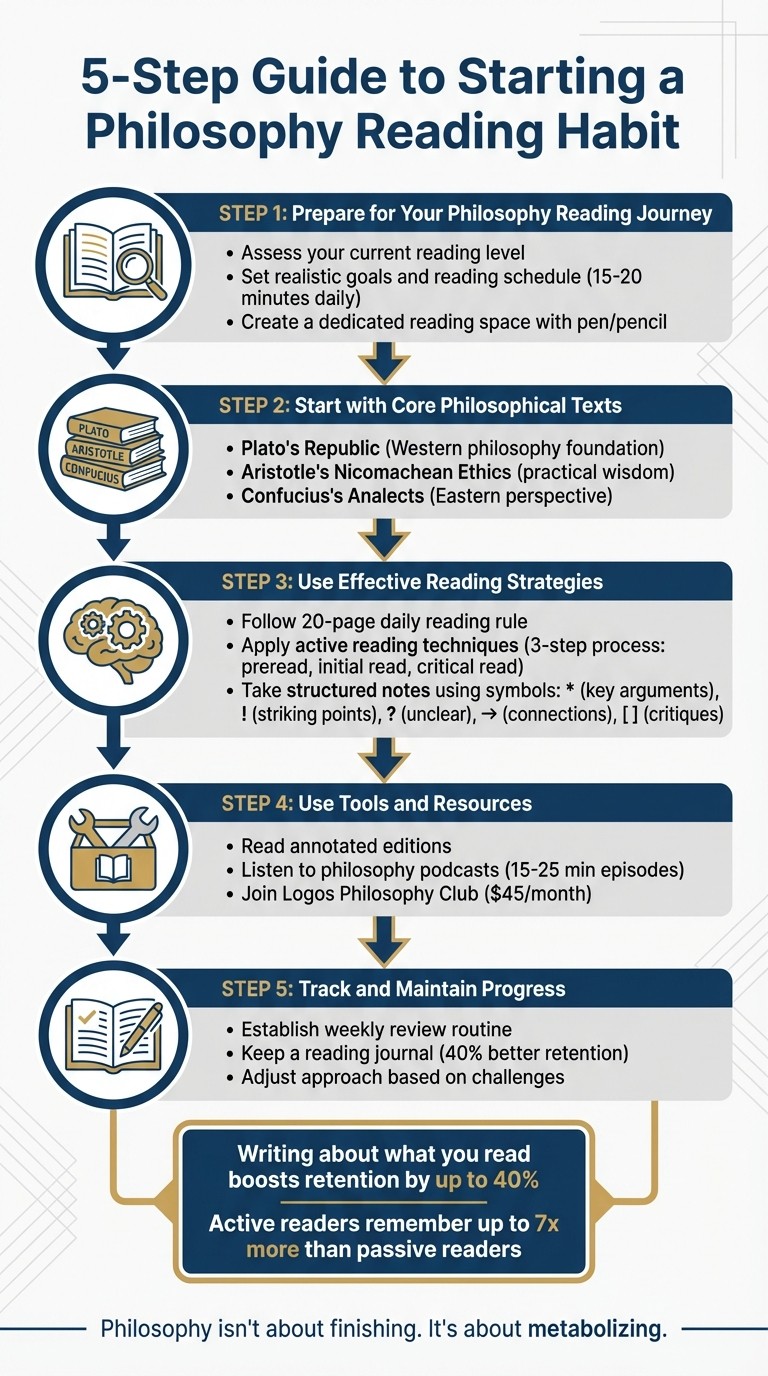
5-Step Guide to Starting a Philosophy Reading Habit
Step 1: Prepare for Your Philosophy Reading Journey
Assess Your Current Reading Level
Reading philosophy is a very different experience from picking up a novel or even a science textbook. Mona Mona, Ph.D. in Philosophy, captures this perfectly:
"If I were to ask you, 'Do you know how to read?,' you would probably say, 'Oh, yes, of course... But the thing is, if it is philosophy that you would like to read, reading philosophy is unlike reading anything else."
Think of it as learning a new language, where understanding comes through gradual translation.
To test your readiness, try reading a short passage sentence by sentence. If you find yourself stuck, ask whether the difficulty lies in the vocabulary, the philosophical jargon, or the author's distinct style. For example, dive into a few pages of Marcus Aurelius's Meditations or Epictetus's Enchiridion. If the text feels like sage advice from a trusted friend, you might be ready to tackle introductory philosophy books.
Here’s a helpful distinction to keep in mind: philosophy is not self-help. As Charlie Huenemann, Professor of Philosophy, explains:
"At a very general level, self-help books help you with the problems you shouldn't have; philosophy helps you with the problems you should have."
Once you’ve gauged your current level, set clear and manageable goals to guide your progress.
Set Realistic Goals and a Reading Schedule
Philosophy isn't something you rush through. Spending 5 to 10 minutes pondering a single page is completely normal. Your goal should be understanding, not speed. Robert Pirsig, author of Zen and the Art of Motorcycle Maintenance, puts it well:
"When you want to hurry something, that means you no longer care about it and want to get on to other things."
Start by creating a balanced reading plan that alternates between beginner-friendly texts, timeless classics, and guides on philosophical techniques. Even dedicating 15 to 20 minutes each morning to a "wisdom session" can have a profound impact on your intellectual growth. Make use of idle moments too - listen to philosophy podcasts during your commute or lunch break to turn downtime into learning time. And don’t hesitate to revisit challenging texts. Skim them first to get a sense of their flow, then dive in with a more analytical approach.
Once your schedule is in place, it’s time to set up a space that fosters deep, focused reading.
Create a Dedicated Reading Space
Philosophy calls for what Charlie Huenemann refers to as "active, adversarial reading." A well-designed reading space can help you engage with the text on this level. Find a desk or table where you can sit comfortably and keep a pen or pencil within reach. As Huenemann advises:
"Philosophy requires active, adversarial reading. To get the most out of reading philosophy, keep a pencil in hand, mark up your book, and challenge the author every chance you get."
Think of your reading space as a workshop for intellectual discovery. Keep a notebook or commonplace book nearby to jot down your thoughts, questions, and arguments as they arise. Caitlyn Richardson, author of milk fed, suggests:
"Your copy of the book should look like you lived inside it."
Equip your space with reference materials like the Stanford Encyclopedia of Philosophy or a reliable dictionary to help you unpack complex terms and ideas. Unlike reading a fast-paced thriller, philosophy benefits from an environment that encourages you to slow down and embrace the unknown. As Richardson aptly puts it:
"Philosophy isn't about finishing. It's about metabolizing. Let the ideas sink in. Allow confusion. Be suspicious of speed."
How to Read Philosophy (for Beginners)
Step 2: Start with Core Philosophical Texts
Now that you've set up your reading space and schedule, it's time to dive into some cornerstone philosophical works. These texts form the bedrock of both Western and Eastern philosophy, offering a rich starting point for deeper exploration. By beginning here, you'll gain a solid footing in the world of philosophical inquiry.
Start with Plato's Republic, a classic entry into Western philosophy. Ben Anar aptly describes its significance:
"Plato's thought set the stage for the more than two millennia of philosophy to follow".
This work introduces key ideas, like the famous "allegory of the cave", to examine justice - not just in society, but also within the individual. Its dialogue format makes it engaging and accessible, encouraging readers to reflect on profound questions. As Konstantinos Akritidis points out:
"Plato's Republic has something to say to every reader, whether advanced in philosophy or a beginner".
Next, explore Aristotle's Nicomachean Ethics, which shifts the focus from abstract ideals to practical wisdom. Philosophy professor Greg Sadler calls it:
"probably one of the most immediately accessible of his works for a beginner".
Unlike some of Aristotle's more challenging texts, this one offers clear guidance on living well. It revolves around the concept of eudaimonia - human flourishing achieved by cultivating virtues like courage and temperance. Aristotle emphasizes that:
"Virtue, for Aristotle, is a habit -- a stable disposition to act well that is developed through practice, not just intellectual understanding".
For an essential Eastern perspective, turn to Confucius's Analects. While Plato and Aristotle ask questions like "What is true?" and "How do I flourish?", Confucius focuses on "What is the right way to live within a community?". The Analects emphasizes social harmony, proper conduct, and the importance of relationships and rituals in cultivating virtue. Reading Confucius alongside Western texts enriches your understanding of different approaches to morality and ethics.
These three works provide a strong foundation for your philosophical journey. Start with the one that speaks to you most, and gradually engage with all three to deepen your perspective and understanding.
Step 3: Use Effective Reading and Comprehension Strategies
Philosophy isn’t written like your typical novel or non-fiction book - it’s more like a deep, ongoing conversation about abstract ideas that demands a slower, more thoughtful approach. Without the right reading strategies, it’s easy to get bogged down, collecting facts without fully grasping the arguments being made. Eddy, host of The Read Well Podcast, captures this perfectly:
"Philosophy isn't meant to be rushed. It's a lifelong conversation. If you're willing to be patient, it can change the way you see the world."
Follow the 20-Page Daily Reading Rule
Building a daily reading habit can make philosophy feel less overwhelming and more manageable. Because philosophical works often build complex ideas step by step, consistency is key - missing foundational concepts early on can leave you lost as you progress. Eddy’s 30-day "Deep Reading Class", held from November 3 to November 26, 2025, focused on Leo Tolstoy's The Death of Ivan Ilych. The program emphasized a structured approach, featuring 14 live reading sessions and starting with just five pages a day.
Take your time and don’t hesitate to reread sections if needed. Philosophy often requires you to pause and clarify abstract ideas. Keep a dictionary handy - misunderstanding even a single term can throw off your understanding of an entire passage. After reading each paragraph, try summarizing its main idea in your own words before moving on. These habits naturally lead to a deeper and more rewarding engagement with the text.
Apply Active Reading Techniques
Active reading involves treating the text as a dialogue rather than a one-sided lecture. Philosophy professor David W. Concepción explains:
"It is very common to read philosophy much slower than one reads other texts. Indeed, many philosophers stop at the end of sections, and sometimes paragraphs or even sentences, to check if they can restate the ideas in their own words."
A three-step reading process can help: start by prereading titles and headings to get a sense of the context, then do an initial read to map out the overall argument, and finally, go back for a closer, critical read. Use the principle of charity - assume the author is presenting their best argument before critiquing it. Pay attention to transitions where the author shifts from their own argument to addressing objections ("critics might argue...") and then back to their rebuttal ("by way of reply...") to avoid confusion.
Take Structured Notes
Good note-taking can save you from having to reread large chunks of text later. Develop a consistent system for annotating: use * to mark key arguments, ! for particularly striking points, ? for anything unclear, → to indicate connections to other thinkers or ideas, and [ ] for your own critiques or counterpoints. For dense material, consider writing a one-sentence paraphrase for each paragraph to track the argument’s progression.
Don’t just highlight or jot down vague reactions like "interesting." Engage with the text by asking questions: "Is this consistent?" or "Why does the author assume this is self-evident?" Record both the author’s claims and your own thoughts to turn the reading process into a meaningful conversation.
Step 4: Use Tools and Resources for Better Understanding
When tackling dense philosophical texts, tools like annotated editions, podcasts, and curated subscription services can make a world of difference. They provide context, break down complex ideas, and offer guidance to deepen your understanding.
Read Annotated Editions
Annotated editions are a great way to navigate challenging works. They provide historical context, clarify obscure references, and explain key terms as you read. A standout example is Plato: Complete Works, edited by John M. Cooper and D. S. Hutchinson. Michael D. Rohr from Rutgers University praises it, saying:
"The notes are at just the right level, and the index is very helpful. The translations are both readable and accurate".
Cooper’s introductory essay in the volume sheds light on Plato's chronology, the dialogue form, and effective ways to approach these ancient texts. For those taking a broader course-based approach, Classics of Western Philosophy (Eighth Edition), edited by Steven M. Cahn, offers expert introductions to major works spanning Plato to modern thinkers. If you're focusing on a single text, editions like Republic (Reeve Edition) deliver focused insights without being overwhelming.
Listen to Philosophy Podcasts
Philosophy podcasts can help simplify dense arguments and complement your reading. One popular choice is The History of Philosophy Without Any Gaps, hosted by Peter Adamson. With 37.1 million downloads and a 4.7/5 rating on Apple Podcasts, it provides a chronological overview of philosophical thought. Listeners describe it as both engaging and enlightening.
For more targeted discussions, The Panpsycast Philosophy Podcast delves into specific texts like Plato's Republic and Symposium, often providing PDFs and reader’s guides to enhance your experience. If you're short on time, Philosophy Bites offers quick 15–25 minute interviews with leading philosophers on topics like "Plato on Power". Revisiting episodes can help you better absorb their insights. To align your listening with your reading, try pairing episodes with specific texts - for example, episodes 44–46 of History of Philosophy Without Any Gaps match well with Aristotle's Nicomachean Ethics.
Join Logos Philosophy Club Subscription

The Logos Philosophy Club is a monthly subscription service that delivers a carefully selected philosophy work to your doorstep, making it easier to build a consistent reading habit. As the first philosophy book club of its kind in the United States, it eliminates the overwhelm of choosing where to start. Each book comes in a bilingual edition, translated from the original language, and some releases include the Logos Reader, which features essays and scholarly commentary to help unpack complex ideas.
Recent selections include Aristotle's Nicomachean Ethics (December 2025), Boethius's The Consolation of Philosophy (January 2026), and Plato's The Symposium (March 2026). One subscriber, John Roche, shared his thoughts:
"I love my copy. The book is sturdy and very well bound".
Memberships start at $45.00 per month with free shipping. Annual plans, priced at $420.00, offer additional perks like discounted access to past releases, making it easier to round out your collection of essential works.
Step 5: Track and Maintain Your Reading Progress
Developing a philosophy reading habit isn't just about checking books off a list - it's about making the ideas stick. Tracking your progress can turn isolated reading sessions into meaningful insights. In fact, writing about what you read can boost information retention by up to 40% compared to reading alone. Actively engaging with texts can even help readers remember up to seven times more than passive readers.
Establish a Weekly Review Routine
Dedicate time each week - like a "Sunday Reset" - to reflect on your reading. This practice shifts your habit from passive consumption to intentional engagement. Use a simple four-column log to document your progress, including:
Date
Book/Page
Emotional Response (e.g., "inspired" or "confused")
Lesson Learned (a one-sentence takeaway)
Prashant Mani, Founder of WordPandit, emphasizes the value of this approach:
"A reading log transforms fleeting experience into permanent record. It's not about documenting every detail - it's about capturing the essence of your engagement before it fades".
During your review, try paraphrasing complex passages in your own words. If a topic consistently confuses you, consult resources like the Stanford Encyclopedia of Philosophy for clarity. Over time, this habit helps you identify patterns - pinpointing which topics energize you and which feel draining - so you can fine-tune your reading choices. For deeper engagement, consider pairing this practice with a detailed reading journal.
Keep a Reading Journal
A reading journal goes beyond simple tracking. While a log captures basic details like titles and page numbers, a journal records your personal connection to the text - your reflections, favorite quotes, and moments of growth. Use a physical notebook to make the process feel more tangible. After finishing a chapter, summarize the main argument in your own words and add a sentence starting with "This means I should..." to turn abstract ideas into practical actions.
To reinforce your understanding, spend five minutes journaling immediately after reading. Mortimer Adler captures the value of this practice perfectly:
"Full ownership comes only when you have made [the book you're reading] a part of yourself".
Adjust Your Approach Based on Challenges
If your weekly reviews or journal entries reveal consistent struggles, tweak your reading strategy. For example, if you're feeling overwhelmed, focus on just one or two pages at a time. Rereading can also help - use the first read to grasp the basics, the second to find the rhythm, and the third to connect deeply. If a text feels too dense, switch to shorter or simpler works to regain momentum. And if you're mentally fatigued, try reading aloud or using text-to-speech tools to experience the material differently.
Keep track of books you don't finish (DNF). Recording why you set a book aside can help clarify your interests and highlight philosophical styles that may be too challenging for now.
Conclusion: Start Your Philosophy Reading Habit Today
You’ve got everything you need to begin: a cozy reading spot, a stack of classic texts, strategies to stay engaged, and tools to monitor your growth. The secret? Start small and stick with it. Philosophy isn’t about rushing through pages - it’s a journey of self-reflection that takes time. As Colin Allen, Professor of Philosophy, puts it: "Just like physical training, taking on intellectual challenges builds capacities that produce benefits many years later".
Pick a book that sparks your curiosity - maybe Plato's Republic, Aristotle's Nicomachean Ethics, or Confucius's Analects. Read just a page or two today. Scribble notes in the margins, question the arguments, and write down one thought-provoking question. Philosophy thrives when you treat it as a conversation, not a lecture.
The rewards go far beyond gaining knowledge. Bertrand Russell once said, "Philosophy is to be studied... for the sake of the questions themselves; because these questions enlarge our conception of what is possible, enrich our intellectual imagination, and diminish the dogmatic assurance which closes the mind against speculation".
Don’t wait for the perfect moment. Grab a book, read a single page thoughtfully, and let the ideas challenge and inspire you. Your philosophy journey begins today.
FAQs
Which philosophy book should I start with first?
Plato's dialogues, such as The Last Days of Socrates, serve as an excellent entry point for newcomers to philosophy. They tackle important philosophical questions in a way that's easy to grasp, all while laying the groundwork for understanding Western philosophical thought.
How do I know if a philosophy text is too hard for me right now?
To determine if a philosophy text matches your understanding, consider this: Can you keep up with its language, concepts, and arguments without feeling lost? If you're stumbling over unfamiliar terms or grappling with overly complex ideas, it might be a sign the text is too advanced for now. Beginning with more approachable works can help you strengthen your foundation. The right text should let you take your time, ask questions, and follow the progression of ideas without constant frustration.
What’s the best way to remember and apply what I read?
To truly absorb and apply philosophy, it's important to actively interact with the material. Start by re-reading key texts to deepen your understanding and take detailed notes as you go. Don't just passively read - critically question the ideas presented. Annotate passages that stand out, reflect on how the concepts connect to your own life, and engage in discussions about the key points.
Practicing critical thinking is another essential step. Debating philosophical ideas, either with others or even internally, helps cement your insights. This not only sharpens your understanding but also makes it easier to apply those ideas in everyday situations. Philosophy comes alive when you actively wrestle with it.


