Florentine Humanism and Text Preservation


Florentine humanism, spanning the late 14th to early 16th centuries, was a movement centered in Florence that sought to recover, preserve, and apply classical Greek and Roman texts to address societal challenges. This period saw scholars like Poggio Bracciolini and Francesco Petrarch rediscover ancient manuscripts, often neglected in European monasteries, and bring them back into intellectual circulation. The movement emphasized a return to original sources (ad fontes) and prioritized the study of subjects like grammar, rhetoric, history, poetry, and moral philosophy - collectively known as studia humanitatis.
Key points:
Rediscovery of Classical Texts: Manuscripts by authors like Cicero, Plato, and Aristotle were recovered and translated, with figures like Leonardo Bruni and Manuel Chrysoloras playing pivotal roles.
Shift from Scholasticism: Humanists moved away from medieval scholastic traditions, favoring critical analysis and practical applications of ancient knowledge.
Civic Humanism: Florence integrated classical learning into governance, framing it as essential for public virtue and state identity.
Patronage: Wealthy families, notably the Medici, funded manuscript recovery and public libraries, ensuring broader access to ancient works.
Printing Revolution: The invention of the printing press, spearheaded by efforts like Aldus Manutius's Aldine Academy, made classical texts widely available.
The legacy of Florentine humanism endures in modern education, where its methods of textual criticism and emphasis on the humanities continue to shape scholarship and democratic thought.
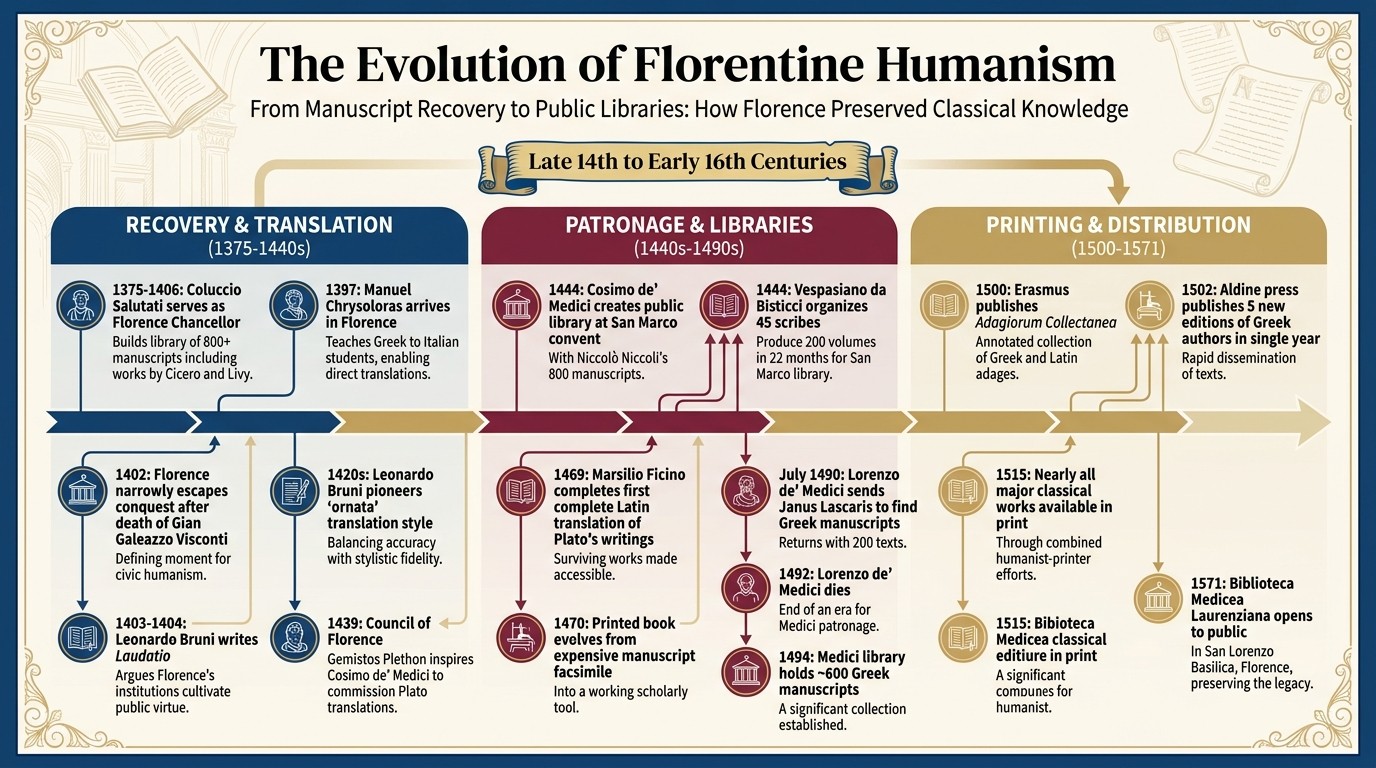
Timeline of Florentine Humanism: Key Figures, Events, and Achievements (1375-1571)
Civic Humanism: The Intellectual Framework for Preservation
Florence as a Center for Civic Humanism
In Florence, classical scholarship became more than an academic pursuit - it turned into a political necessity. The city's chancellors, Coluccio Salutati and Leonardo Bruni, used their positions to integrate the studia humanitatis into the fabric of state identity. Salutati, who served as Chancellor from 1375 to 1406, played a pivotal role. He not only shaped policy but also built a personal library of over 800 manuscripts, including key works by Cicero and Livy.
The year 1402 was a defining moment for civic humanism. Florence narrowly escaped conquest after the death of Milanese ruler Gian Galeazzo Visconti. This close call spurred intellectuals like Bruni to draw from classical texts, framing Florence as the rightful successor to the Roman Republic. By doing so, they connected the revival of ancient wisdom directly to the city's survival and identity. In his Laudatio (1403–1404), Bruni went further, arguing that Florence's institutions were purpose-built to cultivate public virtue.
This blending of classical knowledge with political life transformed preservation into a shared, public responsibility.
Preservation as Civic Duty
Florentine humanists moved beyond passive admiration of classical works, championing active citizenship. They believed classical learning should serve the greater good. As Guarino Guarini famously put it, "The Muses rule not only musical instruments but also public affairs". This mindset shifted the preservation of ancient texts from a private scholarly endeavor to a civic obligation.
Humanists reinforced Florence's identity by linking its origins to the Roman republican period, suggesting that recovering Roman texts was synonymous with reclaiming the city's heritage. These texts articulated ideals like liberty, justice, and equality. Historian Hans Baron noted that civic humanism "provided the vital vehicle for the translation of the exalted ancient idea of citizenship to the modern age".
Manuscript collection became more than an intellectual pursuit - it was seen as essential to the public good. The Florentine chancellery evolved into a hub for what modern scholars call "virtue politics", where classical models shaped leadership and governance. By embedding ancient wisdom into diplomacy and statecraft, Florence made the preservation of texts a cornerstone of its moral and political identity. This collaboration between scholars and their patrons ensured that the republic's intellectual and cultural legacy would endure.
Patronage and the Support of Humanist Scholars
Patrons as Supporters of Cultural Projects
The flourishing of Florence's humanist movement owed a great deal to the financial support provided by the city's wealthiest families. At the heart of this support was Cosimo de' Medici, who used his vast banking fortune to turn the preservation of classical texts into a coordinated effort. When humanist Niccolò Niccoli passed away in debt, Cosimo not only covered his financial liabilities but also transformed Niccoli's personal collection into a public treasure. In 1444, he deposited Niccoli's collection of about 800 manuscripts at the Dominican convent of San Marco, creating one of the first public libraries of the Renaissance.
To build this library, Cosimo enlisted Vespasiano da Bisticci, who organized a team of 45 scribes to produce 200 volumes in just 22 months. Cosimo's bank covered all expenses for materials and labor. Vespasiano later recounted:
One day when I was with him, Cosimo said: 'what plan can you suggest for the formation of my library?'... I engaged forty-five scribes and completed two hundred volumes in twenty-two months.
Patrons like Cosimo also funded the recovery of rare texts from far-off locations. For example, in July 1490, Lorenzo de' Medici sent scholar Janus Lascaris on a mission across Italy and Greece to locate Greek manuscripts. Lascaris returned with 200 texts, enriching the Medici collection significantly before Lorenzo's death in 1492. By 1494, the Medici library held around 600 Greek manuscripts. These acquisitions were more than simple purchases - they were efforts to rescue works that might otherwise have been lost to history. Such investments not only preserved cultural treasures but also provided essential resources for future scholarship. Additionally, this kind of patronage elevated the social standing of Florence's elite.
Patronage and Social Status
For the upper class in Florence, owning a collection of manuscripts was more than a scholarly pursuit - it was a symbol of cultural refinement and political influence. Historian Lisa Jardine described these books as:
a lavish spectacle... a sign of conspicuous consumption, and a source of visual and aesthetic delight.
Portraits from the period often depicted individuals holding manuscripts, further emphasizing their elevated cultural and social status.
The relationships between patrons and scholars were mutually rewarding. Wealthy families like the Medici provided the financial resources, while humanists contributed by offering their expertise in administration, diplomacy, education, and intellectual discussions. Researcher Liv Kenney pointed out:
Cosimo de Medici understood the power of patronage as a device to develop his political reputation, and believed that it was possible to achieve a posthumous fame through the commissioning of manuscripts.
These partnerships set the stage for similar collaborations throughout Renaissance Italy, strengthening the era's dedication to intellectual and cultural renewal. This exchange of resources and knowledge not only ensured the survival of classical texts but also solidified Florence's intellectual influence in the broader Renaissance movement.
Humanist Methods: Translation, Annotation, and Distribution
Translation Practices and Challenges
As part of their mission to recover and preserve classical texts, humanists developed more refined translation techniques that balanced accuracy with stylistic fidelity. Moving away from the rigid literalism of medieval translations, Florentine humanists introduced a new approach. Leonardo Bruni, for example, pioneered the "ornata" translation style in the 1420s, which sought to capture not just the meaning but also the stylistic essence of the original text. Laurence Bernard‐Pradelle explains this approach:
In his eyes, the meaning is transmitted as much by the words as by the style of an author, therefore it is less a matter of opposing ad verbum and ad sensum translation, than of exploring what precisely is meant by both.
The arrival of Manuel Chrysoloras, a Byzantine scholar, in 1397 was a pivotal moment for translation efforts. By teaching Greek to Italian students, he enabled direct translations from Greek texts, bypassing the inaccuracies of earlier Latin intermediaries. This shift allowed scholars like Marsilio Ficino to produce monumental works, such as the first complete Latin translation of Plato’s surviving writings in 1469, making these texts widely accessible to Western academics. Humanists also applied rigorous philological methods to restore classical standards and improve textual fidelity.
Annotations and Commentaries
To enhance understanding, humanists added detailed marginal notes that clarified cultural and philosophical contexts. These annotations often corrected errors introduced during the medieval period. For example, they reinstated the classical "h" in nihil (instead of the medieval nichil) and brought back the original "ae" diphthong that had been simplified to "e".
Desiderius Erasmus played a key role in this effort with his annotated collection, Adagiorum Collectanea, published in 1500. This work compiled Greek and Latin adages with explanations, making classical wisdom accessible to a broader audience. Other scholars, like Poggio Bracciolini and Niccolò Niccoli, improved manuscript readability by standardizing spacing and reducing abbreviations. Erasmus further advanced education by creating textbooks like On Copia, which taught students how to analyze and expand on classical models.
As historian Mark Cartwright noted:
Humanist scholars were not uncritical of ancient sources, on the contrary, just like many ancient thinkers, they approached any subject with critical analysis.
These efforts not only preserved the texts but also made them more useful for study and dissemination.
Collaborative Efforts in Text Distribution
The effort to preserve and distribute classical works was a collective endeavor involving manuscript hunters, scribes, patrons, and later, printers. Poggio Bracciolini, for instance, traveled across Europe, uncovering long-lost manuscripts in monastic libraries. His discoveries included works by Cicero, Quintilian, and Lucretius .
The invention of the printing press revolutionized this process. In Venice, Aldus Manutius established the Aldine Academy and, with Greek scholar Marcus Musurus, produced 27 first editions of Greek classics over 21 years. In 1502 alone, the Aldine press published five new editions of Greek authors. By 1515, the combined efforts of humanists and printers had made nearly all major classical works available in print. This collaboration turned rare manuscripts into standardized tools for scholars across Europe.
Modern initiatives, like the Logos Philosophy Club (https://logospublishing.com), continue this legacy by offering carefully translated and annotated editions of classical texts. These efforts ensure that the wisdom of antiquity remains accessible to today’s readers.
The Impact of Florentine Humanism on Renaissance Scholarship
Establishing Practices for European Scholarship
Florentine humanists reshaped European scholarship by introducing rigorous methods for studying classical texts. They emphasized textual criticism and philology, setting the stage for modern academic standards. Lorenzo Valla’s methods, for example, exposed forgeries and established new benchmarks for evaluating authenticity through evidence rather than relying on tradition. These practices spread across Europe, encouraging scholars to scrutinize sources with a critical eye.
The educational framework they developed, called studia humanitatis, marked a significant shift from religious instruction to subjects like grammar, rhetoric, history, poetry, and moral philosophy. These disciplines, now collectively known as "the humanities", remain central to university education worldwide. As historian Mark Cartwright noted:
Humanism transformed education and rejuvenated the world of ideas and art with its discovery, promotion, and adaptation of classical works.
The movement also fostered a network of scholars who exchanged ideas and manuscripts through correspondence, creating a shared intellectual community across Europe. By founding public libraries and standardizing scholarly methods, Florentine humanists made classical knowledge more accessible, breaking the traditional hold of elites over learning. These contributions not only unified European scholarship but also laid the groundwork for future intellectual advancements.
Influence on Modern Intellectual Thought
Florentine humanism also had a profound impact on political philosophy and education, influencing ideas that resonate in modern democratic thought. Leonardo Bruni’s Latin translations of Aristotle’s Ethics and Politics, along with six Platonic dialogues, introduced the concept of "Civic Humanism." This philosophy argued that education should cultivate virtuous citizens who actively engage in public life - a principle still fundamental to democratic societies.
In 1439, the Council of Florence and the scholar Gemistos Plethon inspired Cosimo de' Medici to commission Marsilio Ficino to translate Plato’s works into Latin. This effort led to the creation of the Platonic Academy in Florence, which blended Platonism with Christian ideas and spread these concepts across Europe. The humanist focus on moral autonomy and the belief in humanity’s ability to shape the world through reason and virtue became central to modern individualism. Furthermore, their emphasis on observation and systematic inquiry provided the intellectual foundation for the Scientific Revolution, influencing thinkers like Nicolaus Copernicus.
The collaboration between scholars and patrons during this period remains a powerful example of cultural preservation and intellectual progress. Modern efforts to continue this legacy, such as Logos Philosophy Club, reflect this enduring tradition. By offering carefully curated bilingual editions of classical philosophical texts, organizations like these ensure that the wisdom of the past remains accessible for serious study and future generations.
TPM Book Discussion: The Bookseller Of Florence
Conclusion: The Continued Relevance of Preserved Classical Texts
The efforts of Florentine humanists laid the groundwork for preserving and studying classical texts, creating a legacy that continues to influence modern scholarship. Their collections eventually gave rise to institutions like the Biblioteca Medicea Laurenziana, which opened to the public in 1571 and still houses these invaluable works within the San Lorenzo Basilica in Florence. As historian I. M. Wallerstein aptly noted:
The libraries of the Italian Renaissance gathered and preserved every important item in manuscript that survived the Middle Ages until the invention of the printing press could make them available to the world.
The techniques developed by these scholars - such as textual criticism, linguistic analysis, and systematic annotation - are still central to modern archival practices and historical research. These methods not only safeguarded ancient texts but also set a standard for verifying authenticity, a practice that remains crucial in today’s digital landscape. Beyond preservation, these approaches helped shape principles of governance and civic life that resonate even now.
The humanist belief that classical knowledge should guide governance has had a lasting impact on modern democratic ideals. As historian M. Jurdjevic explained:
Bruni and his fellow humanists had already fully articulated the belief that an ideal ruler in both a republican and monarchical context should be able to draw upon the deep and rich well of philosophy to ensure the sound governance of the state.
This intersection of scholarship and practical governance continues to inform civic leadership today.
Modern initiatives are also carrying forward the mission of making classical texts widely accessible. For example, organizations like Logos Philosophy Club (https://logospublishing.com) produce bilingual editions of foundational philosophical works, complete with translations and annotations to support serious study. As Hugh Lloyd-Jones observed:
By 1470, the book evolved from what was essentially an expensive facsimile of a medieval manuscript into a working tool for scholars.
The collaboration between scholars and patrons during the Florentine Renaissance underscores an enduring truth: preserving knowledge requires both intellectual dedication and institutional support. These principles remain vital to ensuring that future generations can engage with the wisdom of the past.
FAQs
Why did Florence link saving ancient texts to good government?
Florence linked the preservation of ancient texts to the idea of good governance because classical knowledge was thought to nurture virtues and moral integrity. These traits were seen as essential for effective leadership and for reinforcing the strength of the republic. This approach reflected humanist values, which highlighted the role of ancient wisdom in fostering stability and excellence within political and civic life.
How did patrons like the Medici shape which classics survived?
The Medici family played a key role in preserving classical works. By sponsoring humanist scholars, they provided the resources needed to study and interpret ancient texts. They also established libraries and amassed collections of these works, creating spaces where they could be safeguarded, copied, and shared. This support ensured that classical knowledge survived and could be passed down to future generations.
What changed when printing replaced hand-copied manuscripts?
The transition from hand-copied manuscripts to printed texts brought a new level of uniformity to calligraphy and improved the readability of written works. This innovation not only allowed classical texts to reach a much broader audience but also fueled the growth of philological studies, leaving a lasting impact on intellectual life throughout Europe.