Translator Subjectivity vs. Fidelity


Here’s the short answer: philosophical translation is never neutral. When I translate philosophy, I’m not just swapping words. I’m making choices about meaning, sentence form, and reader effect - and even a small shift can change the argument.
If you want the core point fast, it’s this:
Fidelity is more than literal wording. It can mean staying close to meaning, structure, or reader impact.
Subjectivity enters at every step. It shows up in word choice, syntax, background beliefs, and notes.
Philosophy makes the problem sharper. A term like Geist, Dao, yì, or aufheben can’t be handled casually, often requiring specific strategies for untranslatable terms.
History changed the standard. Think of the move from strict word-for-word rendering to sense-for-sense translation, from Cicero and Jerome to modern translation theory.
Tradeoffs are unavoidable. A translator may keep one term the same every time, or switch terms to fit the passage. Both choices shape the reader’s view.
Transparency is the fix. Prefaces, glossaries, annotations, and bilingual editions vs. English-only options help readers see what the translator did.
A few facts from the article make this plain. There are 500+ English translations of the Daodejing, which shows how much syntax and wording choices can differ. And in one Hegel case, aufheben was rendered with 13 different English verbs in a single translation. That is not a tiny stylistic issue. It changes how readers track the concept.
Quick comparison
Issue | Subjectivity side | Fidelity side |
|---|---|---|
Technical terms | Vary wording by context | Keep terms consistent |
Ambiguous passages | Pick one clear reading | Keep the ambiguity |
Source-language concepts | Use familiar English terms | Leave terms foreign or transliterated |
Reader guidance | Smooth the text for clarity | Show the text’s difficulty and structure |
So when I sum up the article in one line, I’d say this: good philosophical translation does not remove judgment - it makes judgment visible and disciplined.
How Views of Fidelity Have Changed Over Time
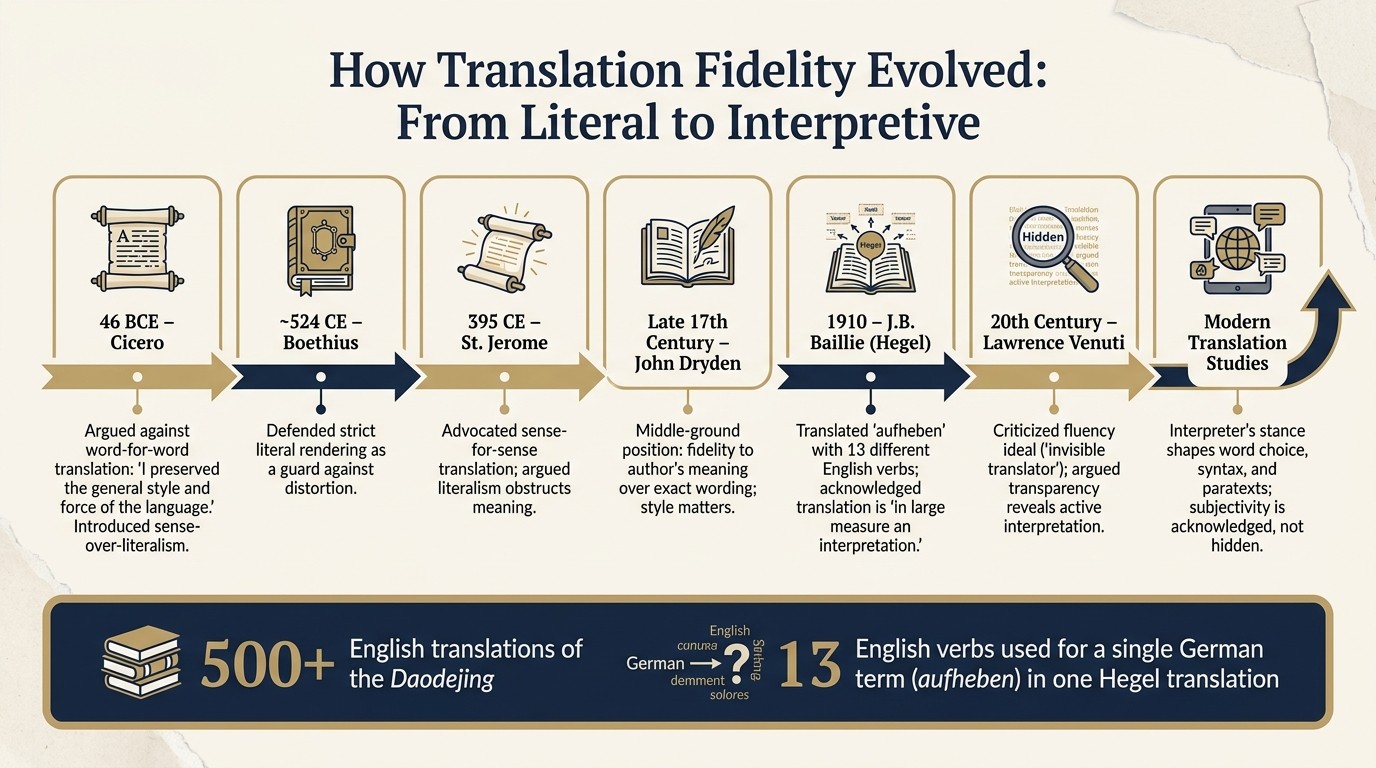
History of Translation Fidelity: From Literal to Interpretive
From Literal Accuracy to Fidelity of Sense
Early translation theory treated literal wording as the safest path to truth. Boethius defended strict rendering as a guard against distortion.
In 46 BCE, Cicero pushed back against word-for-word translation:
"And in so doing, I did not hold it necessary to render word for word, but I preserved the general style and force of the language." - Cicero, Roman Orator
In 395 CE, St. Jerome argued for sense-for-sense translation, saying that literalism often gets in the way of meaning. For philosophy, this point matters a lot. Meaning often hangs on technical terms, not just the general drift of a sentence.
John Dryden later took a middle position. He kept the author in view, but leaned toward sense and style over exact wording. By the late 17th century, fidelity had started to mean faithfulness to the author's meaning, not to each specific word.
So the center of gravity changed. Fidelity was no longer tied only to exact wording. It became a matter of interpretive judgment.
The Invisible Translator vs. the Acknowledged Interpreter
Once that happened, it became much harder to pretend the translator was invisible.
As translation theory developed, fluency came to be treated as an ideal. The best translation, in this view, was one that read so smoothly the translator seemed to disappear. Lawrence Venuti later criticized that kind of transparency because it hides the active interpretation involved in every translation.
Modern translation studies take a different view. They stress that the translator's interpretive stance shapes word choice, sentence structure, and even framing notes. James Black Baillie's 1910 translation of Hegel's Phenomenology shows this clearly. The German term aufheben appeared in 13 different English verbs, and choices such as "cancel" versus "transcend" reflected his engagement with British Idealism. Baillie admitted that such a translation is "in large measure an interpretation of the thought".
At that point, interpretation was no longer hidden in the background. It was out in the open, built into the act of translation itself. And once fidelity includes interpretation, the harder issue comes into view: where subjectivity enters the translation.
Where Subjectivity Eners and What Fidelity Requires
Lexical, Syntactic, Ideological, and Paratextual Choices
Once interpretation can't be avoided, the next issue is simple: where does it show up in the text?
The clearest place is word choice. Terms loaded with theory, such as Geist, Dao, and Ousia, can push a text toward one philosophical reading instead of another.
Classical Chinese syntax adds another layer. Translators have to decide where sentences begin and end, and what grammatical role each part plays. Those choices can change the argument itself. That's one reason there are more than 500 English translations of Laozi's Daodejing, with sharp differences between them: translators often parse the same lines in different ways.
A translator's philosophical commitments also shape how disputed passages are handled. And the influence doesn't stop in the main text. Paratexts - introductions, notes, glossaries, and layout - can guide readers toward one reading before the translation even starts.
Semantic, Formal, and Pragmatic Fidelity
Fidelity usually appears in three forms: semantic, formal, and pragmatic.
Semantic fidelity aims to preserve meaning and argument structure. In philosophy, that often means preserving the inferential role of a concept - how it connects to terms like truth, substance, or cause.
Formal fidelity aims to preserve structure, terminology, and rhetorical shape. That's why some translators insist on rendering Geist as "Spirit" every time. That kind of consistency can signal the scientific rigor of a philosophical system.
Pragmatic fidelity focuses on effect. Put plainly, does the translation produce the original's intended effect on its reader?
Each of these standards puts weight on a different part of the source text, and they often pull against one another. A translator who leans toward semantic fidelity may switch English terms to fit the sense of a passage. A translator who leans toward formal fidelity may stick with one term throughout, even if it sounds awkward in English. Neither move is automatically wrong. Each reflects a different judgment about what the reader needs most. This is particularly evident when comparing dual-language editions of ancient philosophy, where the layout itself serves a specific pedagogical or scholarly goal.
Common Tradeoffs in Philosophical Translation
The table below shows four recurring tradeoffs.
Problem Area | Subjectivity-Prioritizing Strategy | Fidelity-Prioritizing Strategy |
|---|---|---|
Technical Terms | Uses varied synonyms to match the context or stage of the argument, as in Baillie's 13 different English verbs for aufheben | Maintains strict one-to-one terminological consistency to reflect the system's rigor, as in Pinkard's consistent use of "Spirit" for Geist |
Ambiguous Passages | Resolves ambiguity by choosing one clear interpretation, making the argument easier to follow | Preserves the original's "cryptic grandeur" or opacity, leaving the ambiguity for the reader to work through |
Cultural References | Domesticates terms to fit the reader's frame, such as rendering tiān as "God" or "Heaven" | Foreignizes terms or uses transliteration, such as keeping Dao untranslated, to preserve the source culture's conceptual scheme |
The issue isn't that translators make choices. Of course they do. The issue is hidden choice. These tradeoffs matter most when readers can see what was chosen, and why.
How Translators and Readers Can Balance Subjectivity and Fidelity
Methods That Make Interpretation Transparent
The main issue isn't choice itself. It's hidden choice. That's why transparency matters so much.
Good translators don't pretend they're invisible. They show their hand through prefaces, glossaries, annotations, and even page design.
Reflexive prefaces are the clearest example. When Sir James Black Baillie translated Hegel's Phenomenology of Spirit, he wrote that "A translation of a work of such profundity... must necessarily be in large measure an interpretation of the thought as well as a rendering of the language of the text." That kind of plain honesty helps set expectations before the reader even starts.
Glossaries can pin down key terms. Annotations can explain why a word changes at a given moment, such as when the idea shifts or the tone changes. Then there are typographic signals, which are quieter but still useful. Writing "the Understanding" with a capital letter, instead of leaving "understanding" in lowercase, tells the reader that the term is doing specialized philosophical work. Scare quotes around phrases like "logical space" can also show that the phrase is being used in a figurative, not literal, way.
This applies even when the translator and the author are the same person. Self-translation brings author and interpreter into one role, but that doesn't remove the problem. It still needs editorial review, because concepts rooted in one language do not always move neatly into another.
Pros and Cons of Prioritizing Fidelity or Subjectivity
Fidelity helps scholars follow concepts across the source text. Subjective interpretation often makes a work easier for general readers to get through.
But each path has a price. Push fidelity too far, and the text can become hard to follow. Push interpretation too far, and the translator starts rewriting the work instead of translating it.
Why Curated Bilingual Editions Support Serious Study
A bilingual, parallel-text layout offers something a single-language edition can't. It makes the act of translation impossible to ignore.
When the source text and the target text sit side by side, the translation is no longer an invisible window. It becomes a visible layer between the reader and the original. That matters. A reader can stop and check whether Geist becomes "spirit" or "mind", whether tiān becomes "Heaven", and whether those choices shift the argument.
As Terry Pinkard noted, "Anybody trying therefore to pursue a close reading of the text only by relying on the English translation has a difficult task."
In practice, bilingual editions make this kind of checking much easier. Logos Philosophy Club pairs bilingual philosophical texts with annotations that show where translation choices are being made. That setup gives readers a way to judge fidelity for themselves instead of relying on one rendered version alone.
Conclusion: Fidelity Needs Interpretation, and Interpretation Needs Discipline
You can't strip subjectivity out of philosophical translation. Every word choice, every sentence shape, and every term a translator keeps in the original language reflects judgment. So the issue isn't whether subjectivity is there. It is. The issue is whether that judgment is disciplined and visible or hidden from the reader.
That discipline starts with a tighter sense of fidelity. Fidelity, in this case, does not mean copying words one by one. It means staying loyal to the original argument, tone, and effect. As George Steiner put it:
"Fidelity is not literalism or any technical device for rendering 'spirit'... Fidelity is ethical, but also, in the full sense, economic."
That ethical side is exactly why transparency matters. When a translation is transparent, readers can see the choices behind the text instead of being asked to treat those choices as neutral.
For readers who want that visibility built into the book itself, bilingual formats and other translation challenges can make a big difference. The best philosophical editions don't hide the translator's role. They put those decisions in plain view, and Logos Philosophy Club offers carefully translated, annotated bilingual editions made for that kind of serious study. Interpretation can't be avoided; discipline is what makes it answerable.
FAQs
Can a translation be both readable and faithful?
This is still one of the big tensions in philosophy and translation studies. At its core, the debate comes down to a hard choice: should a text read smoothly in English, or should it stay closer to the original author’s structure, nuance, and way of thinking?
Some people argue that readability can soften or even distort the source text. Others think a skilled translator can do both, as long as the work is careful, informed, and responsible.
Logos Philosophy Club speaks to that need with high-quality bilingual editions made for serious study.
Why are philosophical terms translated so differently?
Philosophical terms shift in translation because each language carries its own way of sorting ideas and building arguments. That means meaning, tone, and style never move from one language to another in a perfect one-to-one way.
A translator has to balance fidelity to the source with the text’s subjective style. In practice, that means every choice says something about the translator too - their philosophical leanings, their sense of context, the audience they have in mind, and whether they prefer more academic wording or a more literary voice.
How can I tell when a translator’s interpretation is shaping the text?
Look for places where the translator goes beyond a word-for-word rendering and leans into a particular philosophical or stylistic view. You’ll often spot this in translator’s notes, term choices, or shifts in syntax made for readability, emotional tone, or logical flow.
In philosophical translation, interpretation often lives inside small lexical choices. Logos Philosophy Club’s annotated bilingual editions can help readers study those nuances up close.