What Makes a Quality Philosophy Translation? Q&A
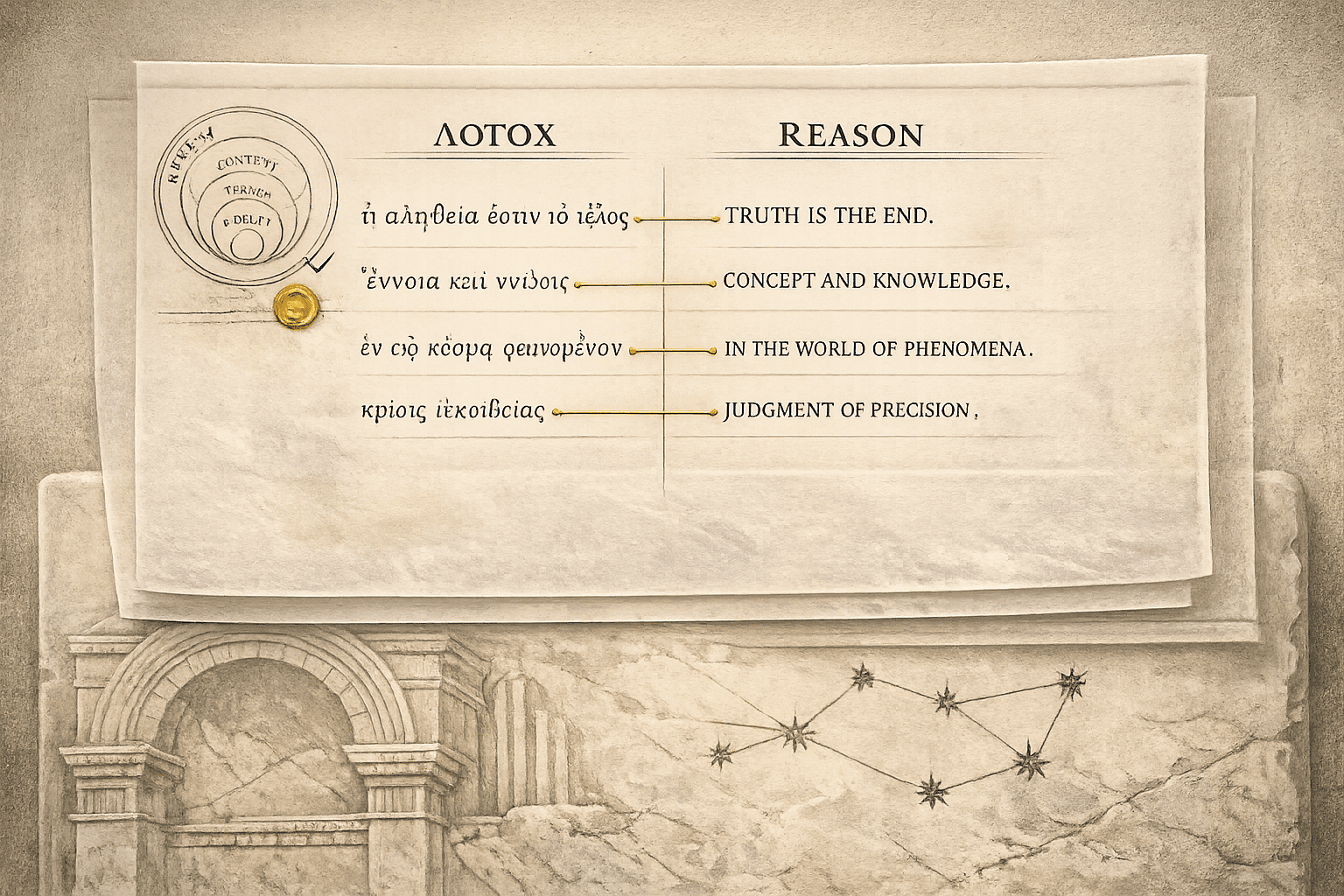

A great philosophy translation does more than just convert words - it preserves meaning, structure, and context. Translators face challenges like handling untranslatable terms, avoiding modern biases, and balancing readability with fidelity to the original. Here’s what defines a high-quality translation:
Faithfulness to Meaning: Retain the original ideas and logical flow, even in complex sentences.
Consistency in Terminology: Use the same terms for key concepts throughout the text to avoid confusion.
Cultural and Historical Awareness: Understand the philosophical and historical context to avoid misinterpretation.
Balance Between Literal and Interpretive Approaches: Stick to the original text when precision is needed but make adjustments for clarity when necessary.
Expert Reviews and Notes: Collaboration with subject matter experts ensures accuracy and provides helpful annotations for readers.
Key Takeaway: High-quality philosophy translations require precision, deep understanding of the source material, and thoughtful choices to make the text meaningful for modern readers while staying true to the original.
Damion Searls discusses 'The Philosophy of Translation' with Spencer Ruchti
Staying True to Original Meaning
5 Methods for Ensuring Quality in Philosophy Translation
What Does Fidelity Mean in Translation?
When it comes to translating philosophical works, staying faithful to the original text involves much more than simply matching words. It’s about achieving semantic equivalence - ensuring the meaning of individual words is preserved - and textual equivalence, which keeps the logical structure and flow intact. Alfred J. Freddoso, a Professor of Philosophy, captures this challenge perfectly:
"A good translation must strike a delicate balance between readability and faithfulness to the original."
This balancing act becomes even more complicated with polysemy, where philosophical terms in the source language carry multiple meanings but lack a direct English equivalent. Translators often face a tough choice: they can select different English terms to capture the nuances, which might disrupt the conceptual links, or stick to one term consistently, which could confuse readers. Either way, the reader’s understanding of the argument is impacted, making this one of the most intricate tasks in philosophical translation.
Difficulties in Preserving Philosophical Arguments
One of the biggest challenges in translating philosophy is avoiding what’s known as "philosophical provincialism" - the tendency to reinterpret historical authors in a way that aligns them with modern thought. This can result in over-interpretation or misrepresentation of the original ideas. Additionally, altering the logical structure of complex sentences, like splitting long ones into shorter ones, risks losing subtle philosophical nuances. Freddoso highlights this risk:
"When a sentence of such length is of the form 'Since A, B, C and D, it follows that E,' it is not at all clear that nothing is lost if one alters it to read 'A. B. C. D. So E.'"
In many cases, keeping the original sentence structure is essential to preserve the logical progression of the argument. Another critical issue is inconsistency in translating technical terms throughout a work. When terms like "substance" or "cogito" are translated inconsistently, the philosophical framework can unravel, making the author’s intent harder to grasp. These challenges emphasize the importance of using systematic approaches for comparing translations.
Methods for Comparing Source and Target Texts
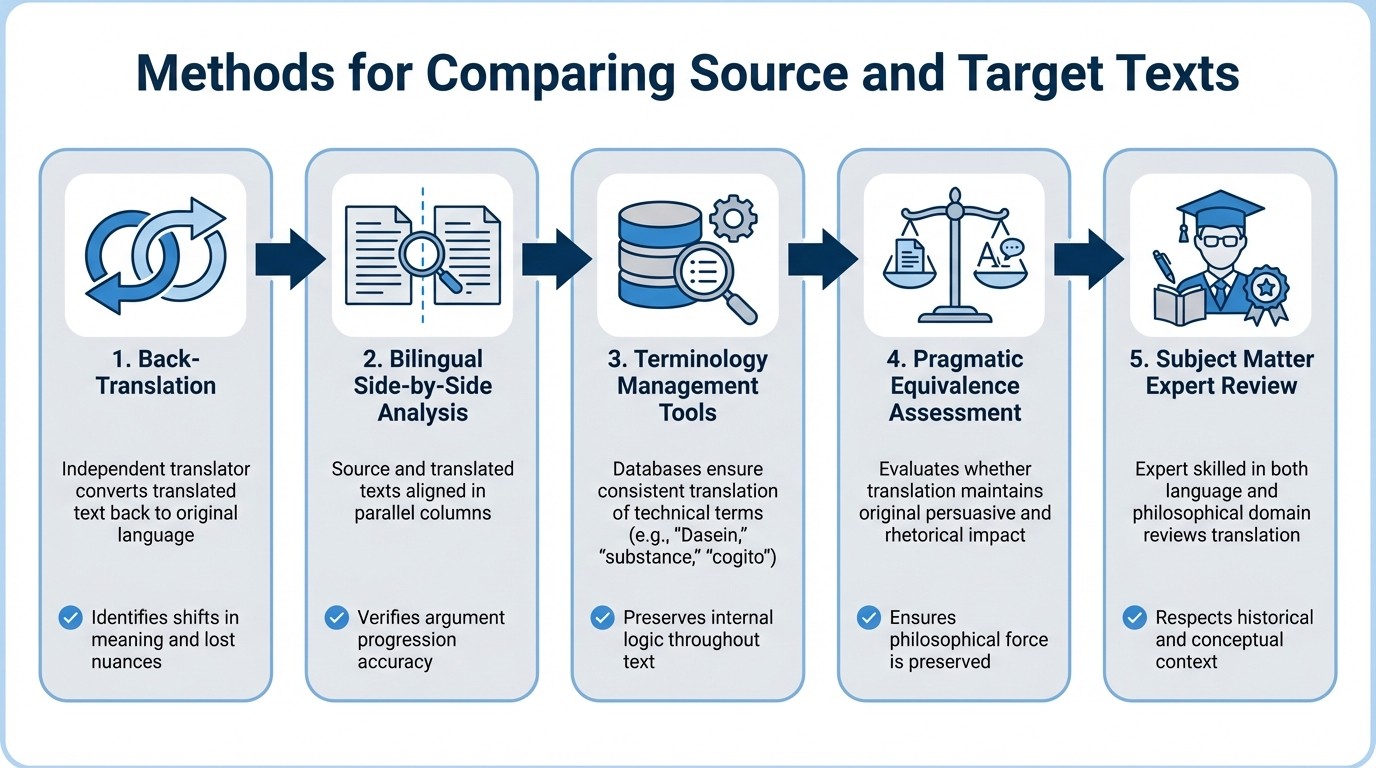
Several methods can help ensure translations remain true to the original text. For example, back-translation involves having an independent translator convert the translated text back into the original language. By comparing this version to the source text, any shifts in meaning or lost nuances can be identified. Another effective approach is bilingual side-by-side analysis, where the source and translated texts are aligned in parallel columns. This makes it easier to verify that the argument’s progression has been accurately maintained.
Consistency in technical terminology is also critical. Using terminology management tools, such as databases, ensures that terms like "Dasein", "substance", or "cogito" are translated the same way throughout the text, preserving the internal logic. Pragmatic equivalence assessment evaluates whether the translation maintains the original text’s persuasive and rhetorical impact. Finally, involving a subject matter expert - someone skilled in both the language and the specific philosophical domain - ensures the translation respects the historical and conceptual context of the work. Together, these methods provide a robust framework for producing accurate and meaningful translations of philosophical texts.
Language Precision and Consistency
Accuracy in Technical Terms
When it comes to philosophy translation, getting the technical terms right is non-negotiable. The structure of an argument often hinges on precise terminology. Unlike translations that might focus on capturing the essence or tone of a text, philosophical works demand formal equivalence - a method that aligns the translation's structure and terminology as closely as possible with the original text. This approach is crucial because, as researchers Bednárová-Gibová K. and Zákutná S. from the University of Prešov point out:
"The form and function of philosophical discourse is interconnected to such a degree that the form even constitutes a part of the text's function."
For ancient philosophical texts, developing a project-specific glossary is a must. Terms like logos, eidos, and ousia often have layered meanings that shift depending on the context. Consistently mapping these terms ensures the argument's internal logic remains intact. Specialized dictionaries can help maintain historical accuracy, while back-translation provides an additional layer of verification to preserve nuanced meanings. These strategies are essential to uphold the original philosophical intent.
Translation Standards and Review Methods
Precision in terminology is just the start. Adhering to rigorous review standards is equally important to protect the integrity of a philosophical translation. Philosophy translations often align with ISO 17100:2015 standards, which replaced the earlier EN 15038 framework. One key requirement of this standard is that the reviewer must have the same level of expertise as the translator, particularly in both the language and the philosophical tradition involved.
To tackle terminological inconsistencies, tools like Translation Quality Assessment models (such as Juliane House's framework) and comparative analysis are frequently employed. Given the complexity and expertise required, high-quality philosophy translations typically cost between $0.20 and $0.40 per word. These costs reflect the specialized knowledge and meticulous processes involved in delivering an accurate and faithful translation. Together, these methods form a solid foundation for addressing the challenges of maintaining quality in philosophical translation.
Cultural and Historical Background
Why Background Matters in Philosophy Translation
Philosophy doesn’t emerge in a vacuum - it’s deeply tied to the historical, cultural, and conceptual contexts that shape it. This creates significant translation challenges in philosophy publishing. Translators aren’t just converting words; they’re navigating entire frameworks of thought that might not align between languages.
Take the term "substance", for example. Its meaning has evolved through thinkers like Plato and Kant. A translator unfamiliar with this intellectual history risks misrepresenting the author’s intent, potentially replacing the intended meaning with definitions that came later and don’t fit the context. Philosopher Edith Stein captured this challenge perfectly:
"Linguistic confusion has become the cross those attempting to philosophize in modernity have been forced to bear, because we can scarcely use one word without fearing that someone will take it to mean something quite different from what we intend."
The difficulty grows when translating between cultures with vastly different philosophical traditions. Consider the Chinese term tiān. Translating it as "God" or "Heaven" might seem straightforward, but doing so adds theological or supernatural undertones that may not exist in the original text. Similarly, the term yì, often rendered as "righteousness", was used in distinct ways by Confucians, Daoists, and Mohists. These groups debated its meaning using modifiers like lǐyì (ritual morality) or rényì (benevolence morality). If these nuances are ignored, what was once a rich philosophical dialogue might appear as a mere misunderstanding.
Translating philosophy often involves what some scholars call "inter-temporal" work - bridging not just languages but centuries. For instance, the concept of "love" means something entirely different to a modern reader compared to someone in a medieval court. As Carmen Guarddon Anelo, Ph.D. in Cognitive Linguistics, explains:
"The translator makes a greater commitment with the reader... this would imply saying the same thing with different codes, maintaining the stylistic impact of the original. The translation would not simply be a question of linguistics."
This deep cultural and historical understanding is essential for adapting philosophical texts in a way that resonates with today’s readers. Many publishers ensure this quality through rigorous translation and peer review processes.
Adapting for Modern Readers While Preserving Original Text
Once the historical and cultural context is understood, the next challenge is making the text relatable to modern readers. Friedrich Schleiermacher outlined two main approaches: translators can either retain the author’s original style, requiring readers to adapt, or they can modernize the language, bringing the author closer to the audience.
A good example of this balance is Scott and Sterling’s translation of Plato’s Republic. They replaced the original’s long, participle-heavy sentences with shorter, clearer ones, making the text easier to follow without losing its depth.
Gary Saul Morson, a professor at Northwestern University, highlights an important distinction when it comes to translation:
"The work is the experience the text is designed to produce. It is entirely possible to read a text and miss the work."
To preserve this "work", translators often use modern idioms for everyday phrases in the original text. This ensures that the author’s unique or complex ideas stand out more clearly for contemporary readers. A purely dictionary-based approach won’t cut it - translators need to grasp the philosophical argument to choose the right word. For example, deciding between "feeling" and "sensation" in an epistemological discussion requires more than just linguistic knowledge.
Ultimately, the goal is to maintain the philosophical essence while ensuring that modern readers can engage with the text as vividly as the original audience might have. This delicate balance between historical depth and modern clarity is what brings these works to life for new generations.
Word-for-Word Accuracy vs. Readability
Literal Translation vs. Reader Access
When it comes to translating historical texts, especially in philosophy, one of the biggest challenges is finding the right balance between staying true to the original words and making the text accessible to modern readers. Translators often face a tough decision: should they stick rigidly to the original wording, or should they focus on creating a version that flows naturally in the target language? This debate is not new - it dates back to ancient Rome. Cicero, for instance, argued that translators should focus on conveying "ideas and rhetorical effects" rather than sticking to a word-for-word approach. Similarly, St. Jerome famously advised translating "sense for sense and not word for word".
Literal translation, often called formal equivalence or verbum e verbo, aims to preserve the sentence structure of the original text. This approach offers precision and provides readers with a direct view of the author's logical flow. On the other hand, interpretive translation, also known as dynamic equivalence or sensum de sensu, focuses on capturing the overall meaning and tone of the text. It uses natural, idiomatic language to make the text more engaging for readers. However, both approaches have their downsides. Literal translations can feel awkward, as they often impose foreign grammatical structures onto the target language. Meanwhile, interpretive translations run the risk of oversimplifying or introducing bias.
Author Vladimir Nabokov was a staunch advocate for literal translation, famously stating:
"The clumsiest literal translation is a thousand times more useful than the prettiest paraphrase".
Conversely, Gary Saul Morson, a professor at Northwestern University, offers a different viewpoint. He emphasizes that translators should focus on the "work" rather than just the "text":
"The text is no more the work than a score is music. The work is the experience the text is designed to produce".
This perspective highlights the importance of understanding the philosophical arguments deeply. For example, translating the Russian word oshchushchenie as "sensation" instead of "feeling" in certain contexts ensures the philosophical accuracy of the text.
A middle-ground approach, often referred to as optimal equivalence, combines the strengths of both methods. Translators stick to a literal approach when the meaning is clear but switch to a more dynamic style when a word-for-word translation might distort the original intent. This method acknowledges that some flexibility is necessary to preserve the original essence without losing clarity. The impact of these choices becomes especially evident when examining notable translations.
Examples of Quality Translations
The theory behind these approaches is brought to life in actual translation practices. Take Benjamin Jowett’s 1871 translation of Plato’s Republic, for example. It remained a go-to version for over a century because of its refined style. However, its Victorian-era phrasing now feels outdated to modern readers. In 1985, Scott and Sterling offered a new take by simplifying Plato’s complex, participle-heavy sentences and using standard English word order instead of mirroring Greek syntax.
But modernization comes with its own risks. For instance, the original 1952 English translation of Simone de Beauvoir’s The Second Sex by Howard M. Parshley omitted 145 pages from the French original and included technical mistakes. One glaring error involved translating the philosophical term existe pour soi as "true nature in itself", which completely flipped Beauvoir’s intended meaning. A revised translation by Constance Borde and Sheila Malovany-Chevallier in 2009 corrected these omissions and errors, restoring the missing pages. However, their strict adherence to a word-for-word approach resulted in awkward, unidiomatic English that, while precise, made the text harder to read.
These examples underscore an important point: translating philosophical works requires both accuracy and linguistic finesse. Translators need a deep understanding of the concepts to make thoughtful decisions that allow contemporary readers to connect with the text as effectively as its original audience did.
Expert Notes and Review Processes
Why Expert Notes Matter
Expert notes play a crucial role in connecting the historical and contemporary contexts of philosophical texts. These annotations clarify difficult passages and ensure that the original arguments remain intact. For instance, when translating the works of William of Ockham, expert notes can shed light on his references to earlier thinkers like Aquinas and Scotus. This helps readers understand the intellectual lineage and broader framework of his ideas. Alfred J. Freddoso, a Professor at the University of Notre Dame, highlights that annotations not only preserve historical accuracy but also draw connections to modern philosophical concepts. By explaining technical terms in a way that modern readers can grasp, these notes avoid introducing anachronistic terms while staying true to the text’s original meaning. Combined with these expert insights, the translation process is further enhanced through structured, multi-level reviews.
Multi-Stage Review Approaches
The translation process benefits significantly when multiple experts review the work in stages. Freddoso describes this as an "apprenticeship model", where translators improve their craft through practice and by submitting their work for evaluation by seasoned experts. As he puts it:
"those of us who are apprentices and journeymen can get good at translating only by constantly practicing and, just as importantly, by submitting the resulting work to the judgment of those who have in effect attained the status of master craftsmen".
This peer review system thrives on the creative tensions that emerge when experts disagree on what makes a translation faithful. These debates encourage translators to find innovative ways to balance accuracy with readability, meeting a range of valid expectations. A prime example of this collaborative approach is the Franciscan Institute's critical edition of William of Ockham's Opera Omnia. Freddoso underscores the importance of starting with reliable critical editions, stating:
"the availability of trustworthy critical editions is an absolute necessity if our efforts are to be intellectually sound".
This layered process, rooted in collaboration and rigorous standards, ensures the integrity and quality of translated works.
Common Errors and Quality Assessment Tools
Frequent Mistakes in Philosophy Translations
Philosophy translations often run into specific challenges that can alter the original meaning of a text. One major issue is using anachronistic terminology, where modern technical terms are inserted into historical works. This can misrepresent the original thinker’s intent and distort the philosophical context. Another frequent error is structural tampering, which happens when translators break down complex sentences into simpler parts. While this might make the text easier to read, it can disrupt the logical flow of arguments.
Another pitfall is conceptual projection, where translators impose their own cultural ideas onto foreign texts. For instance, applying Western concepts like "pure reason" to Chinese philosophy can lead to translations that prioritize dictionary definitions over how terms actually function in context. This approach risks turning nuanced debates into what appear to be miscommunications. Similarly, when schools of thought use specific modifiers for key ideas like "morality", translating these differently can create the illusion of logical inconsistencies that don’t exist in the original. These challenges highlight the need for effective evaluation methods to ensure accuracy.
Automated and Manual Assessment Tools
To address these errors, translators rely on a mix of automated tools and manual reviews. Automated metrics like BLEU compare translations to reference texts using n-gram matching, while advanced tools like METEOR and TER consider factors like synonyms, word stems, and editing effort to evaluate meaning more deeply.
An increasingly popular metric is Time to Edit (TTE), which measures how long it takes a professional editor to refine a translation. This provides tangible data on both efficiency and cost-effectiveness. For philosophical texts, however, manual review remains essential. It’s particularly important for verifying the accuracy of technical terms, where even small mistakes can significantly alter an argument’s meaning. The most reliable assessments use a systematic error typology, categorizing mistakes as critical, major, or minor. This ensures that reviewers focus on the most impactful issues.
Conclusion: What Makes a Quality Philosophy Translation
Core Qualities of a Good Translation
A strong philosophy translation is built on a few key principles that work together seamlessly. At its heart are accuracy and precision - translators need to stick closely to the original text, even if that means preserving some historical quirks. The goal is to maintain the original voice and logical flow of the work.
Achieving this balance requires both careful word selection and thorough research. Elizabeth Bishop captured this idea perfectly when she said:
"You really should repeat a line exactly if the original repeats it exactly... You shouldn't put in words that aren't there".
These foundational elements ensure the translation remains true to the original while being accessible to new readers.
The Translator's Responsibility
But translating philosophy isn't just about converting words. It’s about bridging gaps between cultures and eras. This means the translator must deeply understand both the source material’s context and the nuances of the target audience. They face an important choice: Should they recreate the unique world of the original text, or adapt the work to better fit the reader’s cultural lens?
The role of a translator goes beyond simply transferring meaning. They must honor the original text’s essence while also enriching the target language. A great translation doesn’t just rely on existing terms - it introduces new ways for readers to engage with unfamiliar ideas. This process treats the translation as both a faithful reflection of the original and a standalone literary piece. After all, translations don’t just convey ideas; they actively shape philosophical conversations, even if their influence often goes unnoticed.