How Translators Handle Untranslatable Philosophy


What makes a quality philosophy translation is not just about swapping words; it’s about interpreting complex ideas rooted in specific languages and histories. Terms like the Greek kosmos, Chinese tiān, or Heidegger’s Ereignis carry layers of meaning that resist direct translation. Translators face tough decisions: Should they keep the original term, approximate its meaning, or invent new words? Each choice impacts how readers understand the text.
Here’s what you need to know:
Philosophical terms are often tied to their language’s history and culture. For example, tiān has no perfect English equivalent, and translating it as "Heaven" can mislead readers.
Translation is an act of interpretation. Every decision, from word choice to sentence structure, shapes how ideas are conveyed.
Strategies vary: Translators might retain original terms with annotations, use approximate meanings, or create new words to better express ideas.
Paratexts like footnotes and glossaries are crucial. They provide context and help readers engage with the nuances of the text.
Ultimately, translating philosophy is about balancing accuracy with accessibility, ensuring that the original ideas remain intact while making them understandable to new audiences.
Damion Searls discusses 'The Philosophy of Translation' with Spencer Ruchti
Defining Untranslatability in Philosophy
When philosophers refer to an "untranslatable" term, they’re pointing to a word or concept that resists a straightforward, one-to-one translation due to its deep roots in specific cultural and historical contexts. The Dictionary of Untranslatables describes such terms as carrying meanings so tied to their origin that no single word in another language can fully convey their depth.
"One cannot always translate a foreign concept in one word, but one can always explain it. And when one has grasped the explanation, one has acquired the concept." - Le Figaro Littéraire
This perspective shifts the idea of untranslatability from being an outright barrier to being an interpretive challenge - a process of explanation and understanding.
Theoretical vs. Practical Untranslatability
Untranslatability operates on two different levels, each presenting unique challenges.
Theoretical untranslatability stems from the nature of language itself. For instance, Greek has been described as a language of "living thought in motion", while Latin tends toward "sharply defined summary findings". These linguistic tendencies reflect distinct philosophical approaches. Translating a concept between such traditions isn’t just about finding equivalent words - it’s about transferring ideas into a new intellectual framework.
Practical untranslatability, on the other hand, arises from specific linguistic features. Take Classical Chinese (Wenyan), which lacks markers for case, number, gender, or tense. As sinologist Chad Hansen notes, this "telegraphic terseness" means that even basic sentence parsing requires interpretation. German philosophical language poses a different issue: many of its terms are polysemous, connecting abstract ideas with vivid, concrete imagery. Translators often face tough decisions, forced to choose between equally valid interpretations.
Both types of untranslatability shape the translator’s work, influencing how ideas are conveyed across languages.
Examples of Untranslatable Philosophical Terms
Some terms highlight just how complex untranslatability can be, showcasing the layered challenges translators encounter.
Heidegger's Ereignis is a classic example in Western philosophy. English translations have ranged from "event" to "appropriation" to "enowning", but none fully convey its etymological intricacies. The term draws from roots like er-äugen (to catch sight of) and an-eignen (to appropriate). Heidegger himself acknowledged the difficulty:
"As so thought a guiding word [Ereignis] can no more be translated than the Greek guiding word logos and the Chinese Tao." - Martin Heidegger
The Chinese Dào (道) poses a different challenge. It encompasses meanings as diverse as a physical path, a way of life, and the act of naming or speaking. The Daodejing has been translated into English over 150 times, with each version reflecting a distinct interpretive angle. While "The Way" is a common choice, it simplifies a concept that functions simultaneously as a noun, verb, and cosmological principle.
Both terms illustrate what scholars call "terminological sedimentation" - the layering of meanings over centuries as different thinkers engage with a word. This accumulated history is what makes such terms not only difficult to translate but also endlessly fascinating to explore.
Strategies for Translating Untranslatable Philosophy
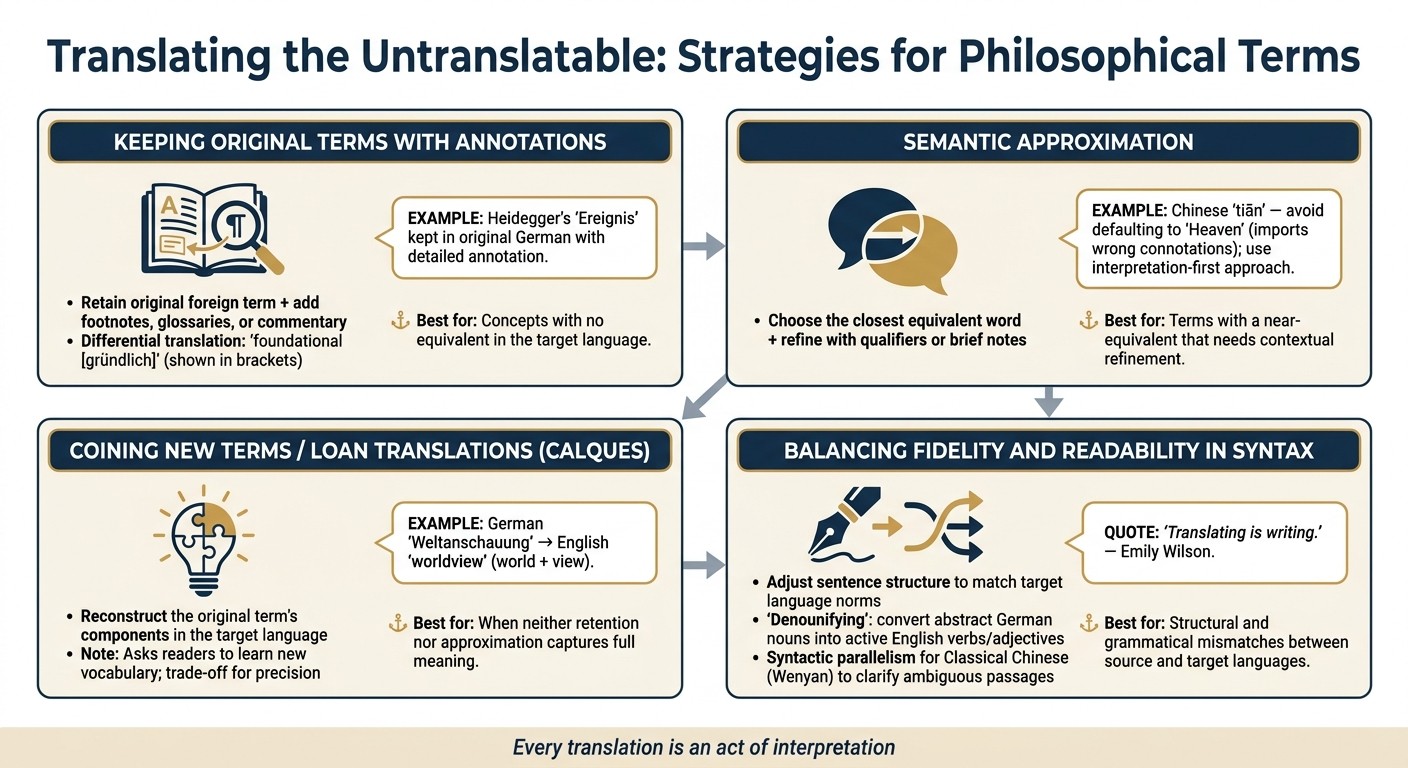
4 Strategies for Translating Untranslatable Philosophy Terms
Translating philosophical texts often involves grappling with concepts that resist easy interpretation in another language. Recognizing when a term is untranslatable is just the starting point - the real challenge lies in choosing how to handle it. Over time, translators have developed several techniques, each with its strengths and compromises.
Keeping Original Terms With Annotations
Sometimes, a concept is so deeply rooted in its original culture that no equivalent exists in the target language. In these cases, translators may preserve the original term and pair it with an explanation. This approach ensures readers engage with the original philosophy rather than a watered-down version.
This is a hallmark of thick translation, which relies on tools like footnotes, glossaries, and commentary to unpack a term’s cultural and historical significance. For example, the Dictionary of Untranslatables, edited by Barbara Cassin, offers detailed explanations of nearly 400 terms from various languages, helping readers grasp their full meaning. While a single-word translation might fail, a thorough annotation can bridge the gap.
A related method, often used in translating thinkers like Heidegger and Husserl, is differential translation. Here, translators provide an English equivalent while including the original term in brackets - e.g., "foundational [gründlich]" or "ground-like [gründlich]" - to show how the term’s meaning shifts depending on context. This approach keeps the conceptual nuances intact while maintaining readability.
Using Semantic Approximation
When retaining the original term feels too obscure, semantic approximation offers an alternative. This method involves selecting the closest English equivalent and refining it with qualifiers or brief notes to preserve the term's role in the larger argument.
Take the Chinese term tiān as an example. A "translation first" approach might default to "Heaven", importing its European theological connotations. In contrast, an "interpretation first" approach would choose an English term that aligns with the moral reasoning of the text. The wrong choice can subtly distort the original argument, making careful consideration essential.
Coining New Terms or Loan Translations
Sometimes, neither retaining the original term nor approximating it works. In these cases, translators may create entirely new words. Loan translations, or calques, reconstruct the original term’s components in the target language. For instance, "worldview" is a direct calque of the German Weltanschauung, combining "world" and "view" just as the German term does.
This strategy is especially useful when the target language lacks the conceptual tools to convey the original term’s full meaning. However, coining new words asks readers to learn unfamiliar vocabulary, a trade-off that can be worthwhile when precision is the goal.
Balancing Fidelity and Readability in Syntax
Translation isn’t just about word choice; sentence structure also plays a crucial role. For example, German philosophical writing often relies on abstract nouns and generic verbs, while English favors active verbs and concrete subjects. To address this, translators use denounifying, which involves converting abstract nouns into verbs or adjectives. This technique preserves the original intensity while avoiding awkward or overly formal prose.
Emily Wilson, a professor and translator, captures this challenge well:
"A translator's primary work isn't knowing what it means (that's a prerequisite, not the work itself). Translation is working out how to say it, how to write it. Translating is writing."
For Classical Chinese texts, syntactic parallelism serves a similar purpose. Since Wenyan (Classical Chinese) lacks punctuation and grammatical markers, translators often employ parallel syntax to clarify ambiguous passages and guide readers through the text’s argument. These adjustments ensure the translation remains both accurate and engaging for modern readers.
The Role of Paratexts in Philosophical Translation
When dealing with philosophical texts that resist straightforward translation, paratexts - like prefaces, footnotes, glossaries, and bilingual layouts - become essential tools. These elements address the translation challenges in philosophy publishing by offering clarity and context that help readers navigate complex ideas. They work hand-in-hand with translation strategies to deepen the reader's understanding and appreciation of the text.
How Glossaries and Notes Help Readers
Philosophical language often carries layers of meaning that go beyond what a dictionary can explain. Glossaries and notes help unpack these layers by providing the context needed to grasp why certain terms are significant.
Take, for example, the Classical Chinese word bian (辯). This term can mean "differentiation", "dispute", or "demonstration", depending on the context. A thoughtful footnote can show how all these meanings interact within the argument, instead of forcing a single interpretation that might miss key nuances. Hackett Publishing highlights this approach, stating, "Translators sometimes handle this with footnotes or bracketed words".
Paratexts also help correct common misunderstandings. For instance, the Chinese term yi (義) is often translated as "righteousness." However, this can obscure its closer connection to "morality" in its original context. A well-placed note can guide readers toward a more accurate understanding before misinterpretations take root.
"Such judgments of meaning cannot be based on grammar alone. They rely not only on a knowledge of grammar, but also on a sense of the larger arguments of the sentence, the paragraph, and the composition as a whole." - Michael A. Fuller, Author/Scholar
Bilingual Editions for Side-by-Side Study
Presenting the original text alongside its translation invites readers to engage more actively with the material. It allows them to see how structural elements - like rhythm and parallelism - shape meaning, which might otherwise be lost in a single-language edition.
This approach is particularly helpful for languages like Classical Chinese (Wenyan), where meaning is often embedded in the structure itself due to the absence of punctuation and explicit grammatical markers. A bilingual layout lets readers follow these structural patterns and understand the translator's decisions.
As theologian and scholar Catherine Moon explains, a strong translation "alerts us to objective connections in reality and serves as a source for more fully realizing values and finding units-of-meaning". Bilingual editions make these connections visible, enhancing the reader's comprehension.
This method not only clarifies the text’s structure but also sets the stage for more specialized editions, which can provide even deeper insights for scholars.
How Logos Philosophy Club Editions Support Deep Reading

Logos Philosophy Club takes these principles to heart by incorporating paratextual aids into their editions, designed for in-depth study. Each publication includes bilingual text, annotations, and companion essay collections, transforming the reading experience into an interactive study session.
One member, John Roche, shared his thoughts: "The scholastic commentary is the real gem".
Their upcoming 2026 release schedule showcases this commitment, featuring works like Boethius’s The Consolation of Philosophy in January and Saint Augustine’s Confessions in June. Membership plans are available on a monthly or annual basis, with the annual plan ($420/year) granting access to past releases at discounted member pricing.
Refining Philosophical Translations
The process of refining philosophical translations builds on techniques like thick translation, semantic approximation, loan translations, and syntactic adjustments. These strategies lay the groundwork, but the real challenge comes afterward - ensuring the translation faithfully bridges philosophical traditions. Even after completing a draft, the hard work begins: evaluating it against practical standards and seeking input from others to catch nuances a single translator might overlook.
Criteria for Evaluating a Translation
The cornerstone of any philosophical translation is conceptual fidelity. This means the translation should enable readers to draw the same inferences as the original, preserving the logical connections within the source text. According to the Stanford Encyclopedia of Philosophy, two principles guide this process:
The principle of charity, which encourages translators to interpret the text as logically sound.
The principle of humanity, which ensures readers can follow the author’s argument step by step.
"A good poetic translation may prioritize rhythm, rhyme, and emotion over philosophical insight and clarity. Philosophy values a coherent, comprehensive, and clear understanding." - Stanford Encyclopedia of Philosophy
Equally important is textual coherence. In languages like Classical Chinese, where syntax can be highly compressed, translators must integrate each sentence into the broader argument - whether that’s a paragraph, a chapter, or the entire work. Additionally, understanding a term’s etymological history is crucial. For example, the Latin term actus derives from the Greek energeia and entelecheia. Ignoring this lineage risks oversimplifying concepts that carry centuries of philosophical depth. These criteria serve as the foundation for the collaborative refinement process.
Improving Translations Through Collaboration
Once these standards are in place, collaboration becomes essential to fine-tune the translation. Philosophers test whether the inferential logic holds up. Linguists identify structural ambiguities. Experts on cultural contexts point out where conventional equivalents - like translating dào as "The Way" - might obscure moral debates rather than clarifying them.
Retranslation also plays a key role. In February 2024, translator Damion Searls released a new English version of Wittgenstein’s Tractatus Logico-Philosophicus. His goal? To correct what he saw as the "forbidding" and "cryptic" tone of the 1922 Ogden/Ramsey translation. Searls argued that Wittgenstein’s German was "forceful, earnest, fluid, and subtle" - qualities that had been lost over time.
The lesson here is simple: refinement is an ongoing process. A philosophical translation improves through multiple rounds of review, constructive critique, and a willingness to revisit even long-standing decisions.
Conclusion: Keeping the Philosophical Dialogue Alive Across Languages
Translating philosophy isn’t just about swapping words from one language to another - it’s about preserving meaning. The strategies we’ve explored aim to maintain the integrity of complex ideas, ensuring that translations stay true to their original essence. Together, they create a thoughtful approach to one of the most intricate challenges in academic work.
Paratexts play a critical role in this process. They provide context and guidance, helping readers navigate the layers of meaning within a translation. Without these supporting tools, even the most precise translations risk leading readers astray. In many ways, the annotations, introductions, and commentaries that accompany a translation are just as essential as the translation itself.
Collaboration and retranslation further enhance the quality of philosophical translations. No single translator holds the final word. Contributions from philosophers, linguists, and scholars with varied perspectives breathe new life into texts, and sometimes, a fresh translation is necessary to restore subtleties that may have faded over time. This ongoing effort ensures that philosophical works remain engaging and relevant.
A great example of this approach is the Logos Philosophy Club, which offers bilingual editions vs. English-only versions of key philosophical texts, such as Aristotle's Nicomachean Ethics and Saint Augustine's Confessions. These editions are not only carefully translated but also annotated for in-depth study, keeping readers closely connected to the original works. As John Roche, a member of the club, observed:
"The book is sturdy and very well bound, but so far the scholastic commentary is the real gem."
When it comes to so-called "untranslatable" terms, they don’t signal a dead end - they open a door. They prompt translators and readers alike to think harder, question assumptions, and engage in a richer dialogue across languages and cultures. This ongoing exchange of ideas is the heart of philosophy, and it’s a conversation worth preserving.
FAQs
What makes a philosophical term “untranslatable”?
Certain philosophical terms are labeled untranslatable because their meaning is so deeply rooted in a particular language, cultural background, or conceptual framework that no direct equivalent exists in another language. Attempting to translate these terms can alter their original meaning, require significant reinterpretation, or even necessitate inventing a completely new word (a neologism) to fill the gap. Literal translations often fall short of capturing the full depth and nuance of the term's philosophical context.
How do translators decide between keeping a term and translating it?
Translators juggle linguistic, cultural, and conceptual subtleties when deciding whether to translate a term or keep it in its original form. When no direct equivalent exists, they might include the original term in brackets or provide detailed contextual notes. These methods help maintain the term’s depth and prevent misinterpretation. At Logos Philosophy Club, our bilingual editions prioritize philosophical accuracy through meticulous translation and expert annotations.
How can I tell if a translation is philosophically reliable?
A good philosophical translation goes beyond just swapping words from one language to another. It requires a thorough grasp of the ideas and arguments presented in the original text. The best translations focus on effectively communicating the core concepts rather than sticking rigidly to a word-for-word approach. On the other hand, weak translations often lean too heavily on dictionary definitions, which can distort the meaning of specialized terms. A dependable translation captures the essence of the original work, ensuring both its message and the experience it conveys remain intact.