Marcus Aurelius and the Role of Justice in Governance


Marcus Aurelius tried to rule by justice, but empire set hard limits. In this article, I show the main point right away: he used Stoic ideas to guide law, restraint, and public duty, yet he still ruled inside a Roman system built on war, rank, slavery, and family succession.
If you want the short answer, here it is:
Justice was public duty, not just private self-control (often built through premeditatio malorum)
Law mattered, but so did mercy, intent, and even judgment
He aimed at equal rule, at least in principle
He showed restraint after revolt instead of using revenge for display
He tried to protect weaker people, including those with less status
He still kept Roman hierarchy in place
The clearest compromise came in 177 CE, when he made his 16-year-old son Commodus joint emperor
So my takeaway is simple: Marcus Aurelius ruled with a Stoic moral code, but he could not turn Rome into a just state from top to bottom. His reign shows what philosophy can do in government - and where it stops.
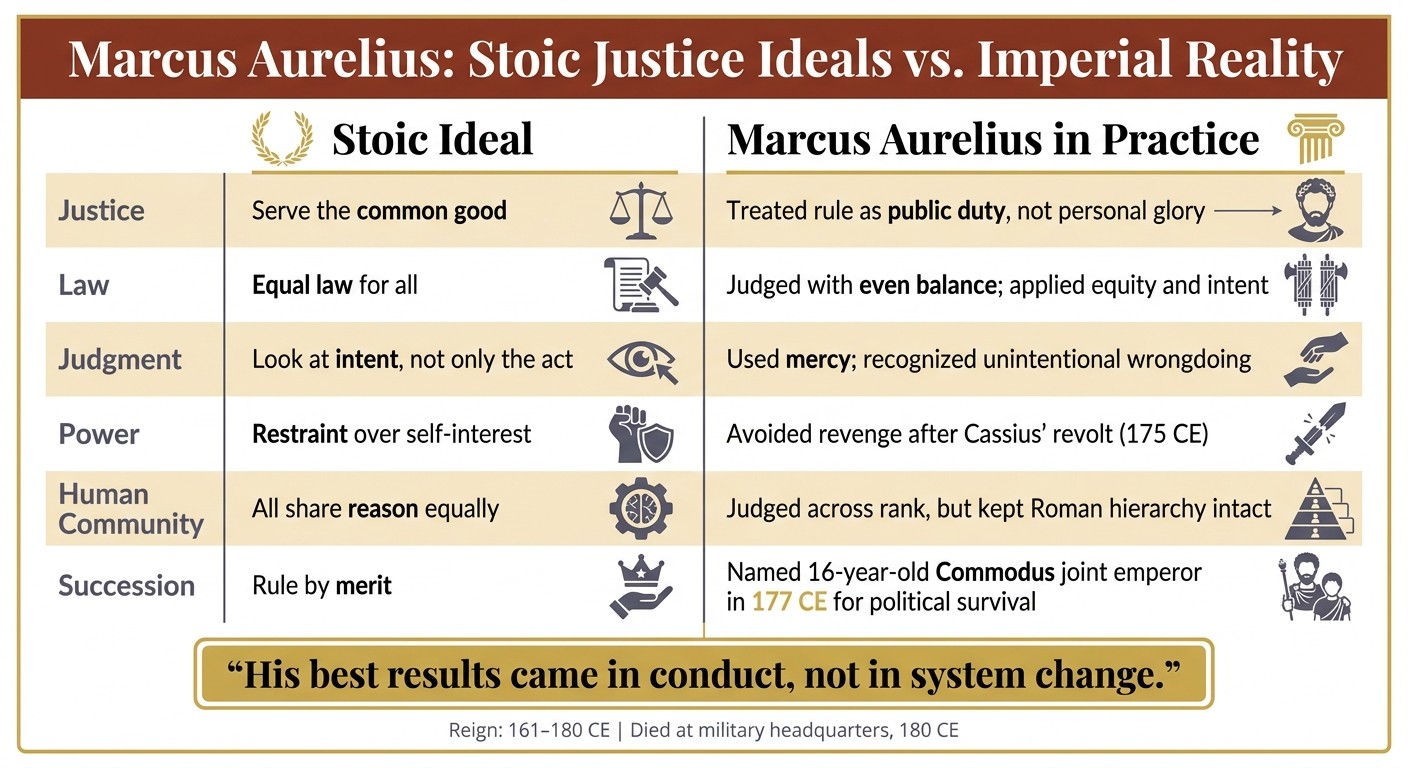
Marcus Aurelius: Stoic Justice Ideals vs. Imperial Reality
The Leadership SECRETS of Marcus Aurelius | Ryan Holiday | Stoicism
Quick comparison
Area | Stoic ideal | What Marcus did |
|---|---|---|
Justice | Serve the common good | Treated rule as duty |
Law | Equal law for all | Tried to judge with even balance |
Judgment | Look at intent, not only the act | Used mercy and equity in legal thought |
Power | Restraint over self-interest | Avoided revenge after Cassius' revolt |
Human community | All share reason | Judged across rank, but kept hierarchy |
Succession | Rule by merit | Named Commodus for political reasons |
One fact matters most: his best results came in conduct, not in system change. That is the lens I use for the rest of this piece.
Stoic Justice as a Standard for Governance
Justice, Reason, and the Common Good
For the Stoics, justice wasn't just a private trait. It was something you did in public life: conduct aimed at other people and the common good. Marcus Aurelius put it plainly:
"Justice, rendering unto others what they deserve... is the source of all other virtues and should guide conduct." - Marcus Aurelius
For rulers, that turns justice into a public duty. Stoicism tied justice to logos, the rational order of the world. Law, in this view, should reflect that order. To govern in line with logos meant ruling according to nature, not personal preference or private gain. Stoic thought gave public duty a clear philosophical base: power should answer to reason.
Marcus Aurelius made the same point in another sharp line:
"What injures the hive injures the bee." - Marcus Aurelius
The idea is simple. A ruler who puts self-interest over the people damages the same order that makes rule possible in the first place. And that logic doesn't stop at the city wall. It stretches outward to the whole human community.
The Cosmopolis and Its Role in Public Rule
Stoic thought pushed justice past the limits of any one city and toward the cosmopolis, a shared moral community of rational beings. Because all people share logos, Stoic duty extends beyond class, city, and status. In practice, that also meant public institutions had to check abuse and limit tyranny. For an emperor governing many peoples, the cosmopolis made justice an imperial duty, not merely a local one.
That point matters. A leader might be strict in private life and still rule unjustly if public decisions ignore the welfare of the community. For Marcus, self-command alone wasn't enough. Rule itself had to be measured by whether it served the people and the moral order they all shared.
Marcus Aurelius' Model of Rule
Rulership as Duty, Not Personal Glory
Historian John Anthony Crook presents Marcus as a ruler driven by duty, not fame. That idea fits the Meditations well. They weren't written for applause. They were private working notes Marcus used to keep himself in line while handling war and government.
He stayed in that role to the end. In 180 CE, he died at his military headquarters while still overseeing both war and administration. Duty wasn't a slogan for him. It shaped how he disciplined himself and how he made public choices.
Equal Law, Restraint, and the Public Good
Marcus ruled like an emperor who owed service to the people under his care. For him, justice meant applying the law evenly, not using it to reward favorites. That turned justice into a standard of government, not just a personal ideal.
Restraint mattered for the same reason. It checked arbitrary rule and kept attention on the public good. As he wrote:
"Just that you do the right thing. The rest doesn't matter. Cold or warm. Tired or well-rested. Despised or honored."
That line gets to the point. Marcus judged decisions by whether they were just, not by how they looked or how they might flatter his image.
You can see that in how he handled the revolt of Avidius Cassius in 175 CE. A rumor spread that Marcus had died, and Cassius rebelled. Marcus prepared for war, but Cassius was killed by his own soldiers before a major conflict began. After that, Marcus traveled through the East on a tour of pacification and inspection. He didn't lash out for show. He acted with restraint and moved to restore order.
This standard shows up even more plainly in his legal and administrative practice.
Case Study: Justice in Imperial Practice
That restraint mattered most when Stoic principle had to turn into legal judgment.
Legal Flexibility, Equity, and Fair Judgment
Marcus's test wasn't whether he spoke well about timeless ideas like justice. It was whether he could use it in law.
His Stoic training pushed him toward equity - the idea that a fair ruling may call for more than a strict reading of the law. Sometimes the letter of the law isn't enough. You also have to ask what is right in the case in front of you. He wrote:
"Patience with others' faults is itself a branch of justice, and that men sin without intending it."
That line helps explain why equity mattered to him: a judge should look at intent, not just the act itself.
He also drew on the Stoic reserve clause, which helped keep his judgment tied to the public good even when outside pressure made a case messy or hard.
That same measure shaped how he dealt with households, rank, and the people most exposed to imperial power.
Family Law, Status, and the Treatment of Vulnerable Groups
In imperial practice, justice showed up in rulings about status, family, and petitions from people with little leverage. Marcus's Stoic framework held that all rational beings belong to one moral community - the Cosmopolis. That gave him a basis for fairer judgment across lines of status.
He counted the costs, but he still accepted them when duty called for it. The standard he set for himself was stark:
"For our law, exactly impartial to all, is God."
That's a hard standard to live by. It didn't erase hierarchy, but it did give him an inner check on how power should be used inside that hierarchy.
Stoic Justice Ideal vs. Governance in Practice: A Comparison
The gap between ideal and practice shows up most clearly in his imperial decisions. In 177 CE, Marcus proclaimed his 16-year-old son Commodus joint emperor. That choice came less from philosophical merit than from political pressure. Historian John Anthony Crook put it bluntly: "Marcus had no choice in the matter: if he had not made Commodus his successor, he would have had to order him to be put to death."
That tension runs through his reign. The table below shows where the ideals held and where imperial reality pulled another way.
Category | Stoic Justice Ideal | Marcus Aurelius' Governance in Practice |
|---|---|---|
Common Good | Promoting the good of the whole and universal happiness | Reign marked by costly frontier wars and defensive campaigns |
Legal Flexibility | Using the reserve clause to adjust when obstacles arise | Applied patience as a branch of justice and recognized unintentional wrongdoing |
Equality and Hierarchy | Stoic universalism vs. Roman social rank | Marcus accepted hierarchy but tried to judge fairly within it |
In practice, Marcus showed justice most clearly through restraint and fair judgment, not structural reform. Those limits show how far Stoic justice could guide an emperor without changing the empire itself.
Limits of Stoic Justice in an Empire
Where Stoic Justice Reached Its Limit
The comparison above points to a bigger truth: Stoic justice shaped Marcus's conduct, but it did not reshape the empire itself. Military pressure, succession, and social rank drew the outer edge of what Stoic rule could do.
Marcus could act justly within the system, but he could not make the system itself just. You can see that limit in law and social status too. Stoicism did not end slavery or legal inequality. Roman law still treated enslaved people as property, and women still lived under male guardianship in many legal settings. Marcus's Stoicism pushed him toward compassion inside that hierarchy, not the removal of it.
So yes, Stoicism could sharpen judgment and encourage restraint. But it could not overturn imperial rank, remove military strain, or free an emperor from the need to hold power.
Conclusion: What Marcus Aurelius Shows About Justice in Government
Put together, these limits show both the reach and the boundary of Stoic government. Marcus was a serious Stoic ruler, but he ruled inside an empire that set hard limits on what even a well-meaning emperor could change.
As Marcus Aurelius wrote:
"If it is not right, do not do it; if it is not true, do not say it."
That standard shaped his personal decisions. Stoicism gave Marcus a moral rule for fair government; it did not give him the means to undo empire-wide inequality. It gave him an ethic of endurance: a way to govern decently under conditions he could not fully control. His reign shows that philosophy can improve the moral tone of government without remaking the structures beneath it.
For readers interested in Stoic political thought, Logos Philosophy Club offers carefully translated, annotated editions of foundational philosophical texts.
FAQs
Why was justice central to Marcus Aurelius’ rule?
For Marcus Aurelius, justice sat at the heart of good government. He tied it to human reason and to the fact that people are made to live with, and for, one another. That meant a ruler wasn't there to serve himself. His job was to serve the common good and look after the well-being of the whole community.
He didn't treat justice as a narrow legal duty or a box to check. He saw it as a day-to-day obligation. In practice, that meant acting with integrity and fairness in every situation, so his rule stayed in line with nature and helped everyone thrive.
Did Marcus Aurelius actually change Roman law or just apply it more fairly?
For the Stoics, justice meant more than rewriting laws. It was a moral duty: treat people fairly, act in line with reason, and keep the common good in view.
Marcus Aurelius put personal integrity at the center of that idea. He stressed using reason fairly, even when working within the limits of the law. His attention was less on legal reform and more on making justice the bedrock of good government and a life lived well.
Why did Marcus Aurelius choose Commodus if Stoicism favored merit?
Naming Commodus as his successor is often framed as a tragic paradox. But it wasn't a simple case of Marcus Aurelius turning his back on merit.
In practical terms, he had very little room to maneuver.
If Marcus Aurelius had refused to name his son, the alternative may well have been ordering Commodus's death. That's what makes the choice so grim. It grew out of the hard facts of imperial power, not some sudden lapse in judgment.
Seen that way, the decision fits the harsh world he ruled in. It was less a break from his Stoic sense of justice and the common good than a response to the brutal limits of his position.