Mill's Pleasures: Historical Context


John Stuart Mill transformed utilitarianism by arguing that not all pleasures are equal. Unlike Jeremy Bentham, who saw all pleasures as interchangeable and measurable only by quantity, Mill introduced a critical distinction: higher pleasures (intellectual, moral, and emotional pursuits) are superior to lower pleasures (physical or sensory gratification). His famous statement, "It is better to be Socrates dissatisfied than a fool satisfied", encapsulates this idea.
Mill's philosophy was shaped by:
Ancient Philosophy: Influences from Epicurus, Aristotle, and Plato emphasized intellectual and moral excellence.
Romantic Thinkers: Figures like Coleridge and Carlyle highlighted imagination, emotion, and self-growth.
Personal Struggles: A mental crisis in his youth led Mill to value emotional depth and intellectual fulfillment over mere calculation.
To support his claim, Mill developed the Competent Judges Test, where only those experienced in both types of pleasure could determine their value. While his theory sparked debate, it remains a cornerstone of moral philosophy, emphasizing personal and societal growth over simple comfort.
Bentham's Utilitarianism and Mill's Critique
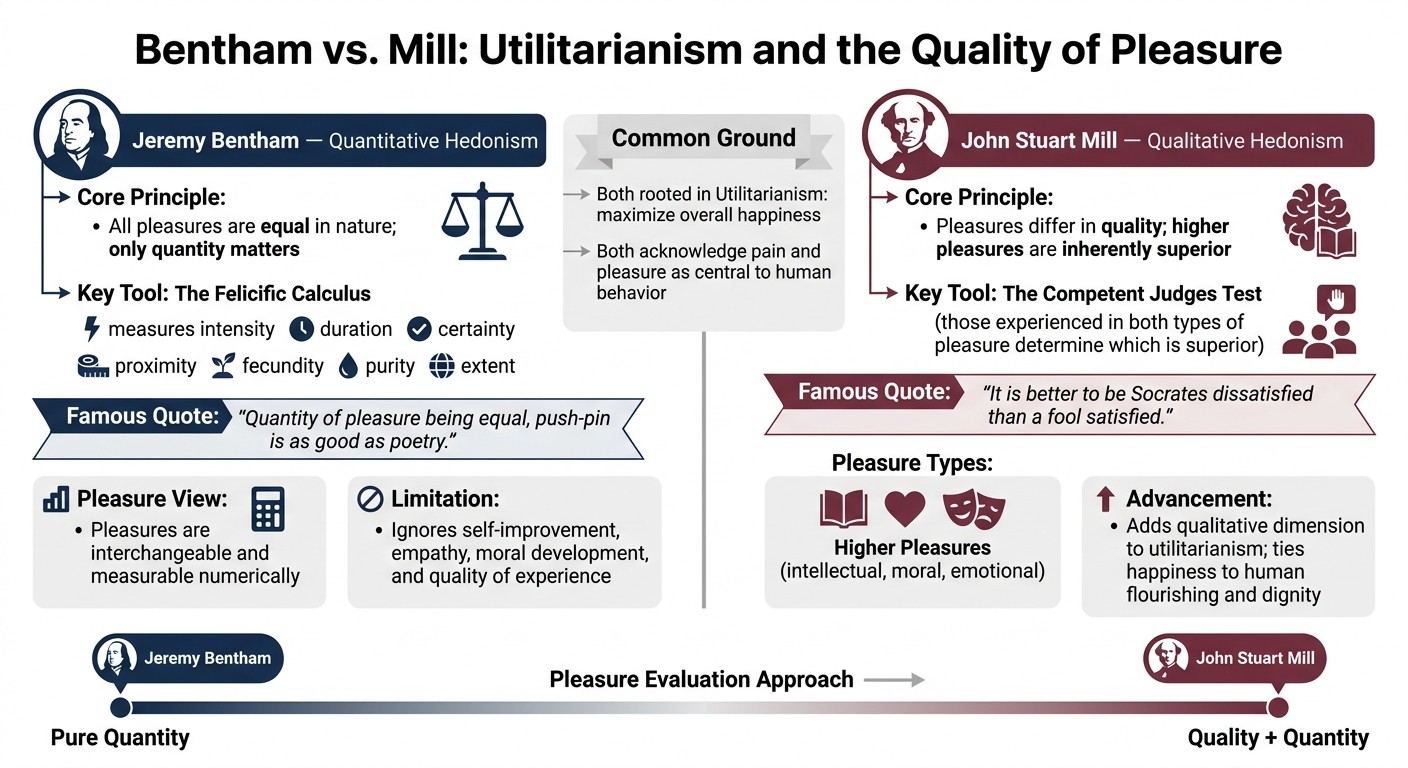
Bentham vs. Mill: Utilitarianism and the Quality of Pleasure
Exploring Bentham's perspective helps frame Mill's pivotal shift toward assessing the quality of pleasures.
Bentham's Quantitative Hedonism
Jeremy Bentham built his utilitarian philosophy on the idea that human behavior is governed by pleasure and pain. He famously stated:
"Nature has placed mankind under the governance of two sovereign masters, pain and pleasure. It is for them alone to point out what we ought to do, as well as to determine what we shall do."
Based on this principle, Bentham devised the felicific calculus - a method to evaluate the moral worth of actions by analyzing factors like intensity, duration, certainty, proximity, fecundity, purity, and extent. Importantly, he treated all pleasures as fundamentally equal in nature. His often-quoted line illustrates this view:
"Quantity of pleasure being equal, push-pin is as good as poetry."
In other words, whether one finds joy in a simple game or a profound work of art, the two are morally equivalent if the total pleasure they produce is the same. However, this purely quantitative approach left certain aspects of human experience unaddressed - a gap Mill sought to fill.
Mill's Response to Bentham's Limits
While Mill appreciated Bentham's framework, he believed it failed to capture the full complexity of human aspirations. Bentham's model overlooked elements like the desire for self-improvement, empathy, and moral development.
Even though Bentham acknowledged that mental pleasures could be superior due to their lasting effects and lower risks, these advantages were seen as external rather than inherent. To address this, Mill introduced a qualitative distinction, arguing that intellectual and moral pleasures hold a higher value, independent of their quantity. This marked a significant evolution in utilitarian thought, moving beyond Bentham's purely numerical focus. Readers interested in exploring these timeless ideas can find curated editions of these foundational texts.
Historical Influences on Mill's Philosophy
Mill's ideas about pleasure and happiness weren't formed in a vacuum. His philosophy was shaped by a blend of intellectual traditions and personal experiences, each contributing to his nuanced understanding of what it means to live a fulfilling life.
Classical Philosophical Roots
Mill's thinking was deeply rooted in ancient philosophy. Epicureanism, with its distinction between higher pleasures (intellectual, emotional, and imaginative) and lower pleasures (physical sensations), provided a foundation for his ideas. Mill aligned himself with this framework, emphasizing the superiority of higher pleasures. Aristotle also played a key role, particularly his concept of eudaimonia - a life of flourishing through the exercise of higher faculties. Mill's focus on qualitative differences in pleasure reflects this Aristotelian influence. Furthermore, scholars have noted how Mill's "competent judges" test parallels Plato's Republic, where only philosophers are deemed fit to evaluate the best ways of living.
Romantic and Humanistic Influences
The Romantic movement had a profound impact on Mill, reshaping his perspective on human happiness. Thinkers like Samuel Taylor Coleridge and Thomas Carlyle emphasized the importance of imagination, emotion, and personal growth - elements missing from Bentham's more rigid utilitarianism. These ideas pushed Mill to see the cultivation of character as essential to true happiness. This shift marked a departure from narrow rationalism, steering him toward a more holistic view of what people need to thrive.
Mill's Personal Crisis and Intellectual Development
Mill's philosophy was also shaped by his own struggles. Between 1826 and 1830, he experienced a severe mental breakdown, which revealed the limitations of his father's strict, logic-driven education. His recovery was sparked by the poetry of William Wordsworth, which Mill described as:
"a medicine for my state of mind."
Wordsworth's work taught him the importance of nurturing the inner life, reinforcing Mill's belief that happiness cannot be reduced to rational calculation alone. As he later wrote:
"Capacity for the nobler feelings is in most natures a very tender plant, easily killed, not only by hostile influences, but by mere want of sustenance."
This period of self-reflection and emotional growth deeply influenced Mill's broader understanding of human well-being.
Mill's Higher and Lower Pleasures: Key Features
Higher vs. Lower Pleasures: The Core Distinction
In Utilitarianism, Mill makes a bold claim: not all pleasures are equal. He categorizes them into higher pleasures, which involve intellectual and emotional engagement, and lower pleasures, which are tied to physical sensations. Unlike earlier utilitarian thinkers who treated all pleasures as interchangeable, Mill argued that the quality of pleasure is far more important than its quantity. He considered it irrational to measure pleasure solely by how much there is when quality matters in so many other aspects of life. For Mill, a life filled with intellectual and moral growth is far superior to one focused solely on physical comfort.
Mill illustrated this with his famous comparison: it is better to be "Socrates dissatisfied than a fool satisfied." Humans, with their advanced faculties, cannot find complete fulfillment in basic sensory pleasures once their higher capacities are awakened. This leads directly to Mill's method for assessing the value of pleasures: the Competent Judges Test.
The Competent Judges Test
Mill knew that simply claiming higher pleasures were superior wasn’t enough - he needed a way to prove it. His solution was the Competent Judges Test, where individuals familiar with both higher and lower pleasures are asked which they prefer. If nearly all who have experienced both types choose one - even if it comes with more dissatisfaction - that pleasure is deemed superior.
"Of two pleasures, if there be one to which all or almost all who have experience of both give a decided preference, that is the more desirable pleasure."
Mill relied on observation rather than abstract theory to support his argument. He believed the judgment of those who had experienced both types of pleasure was final:
"From this verdict of the only competent judges, I apprehend there can be no appeal."
However, Mill also recognized that people sometimes choose lower pleasures - not because they truly prefer them, but because their ability to enjoy higher pleasures can diminish due to external factors, like lack of time, opportunity, or unfavorable circumstances. This acknowledgment highlights the practical challenges in achieving higher pleasures but reinforces Mill's commitment to a richer understanding of human happiness.
Pleasures and Human Flourishing
Mill’s emphasis on the quality of pleasure is central to his vision of a fulfilling life. For him, higher pleasures not only elevate the individual but also reflect the dignity required for a truly human existence. He argued that beings with higher faculties need more to achieve happiness. And while they may experience deeper suffering, they would never willingly trade their enriched experience for a life of simple, sensory comfort.
"A being of higher faculties requires more to make him happy, is capable probably of more acute suffering... but in spite of these liabilities, he can never really wish to sink into what he feels to be a lower grade of existence."
Mill extended this idea to society as a whole. He believed that cultivating qualities like education, meaningful work, and moral character not only benefits individuals but also strengthens the community.
"Utilitarianism, therefore, could only attain its end by the general cultivation of nobleness of character, even if each individual were only benefited by the nobleness of others."
In Mill's view, higher pleasures are not just for philosophers or intellectuals - they are essential for building the kind of society he envisioned, one where individuals and communities thrive through shared growth and dignity. Explore our curation of philosophy to learn more from the great thinkers.
Victorian Context and Later Interpretations
Moral and Social Debates in Victorian England
John Stuart Mill's distinction between higher and lower pleasures wasn't just a philosophical exercise - it was his way of addressing the heated cultural debates of Victorian England. Critics like Thomas Carlyle famously dismissed Bentham's utilitarianism as "pig philosophy", claiming that measuring pleasure purely by quantity reduced human life to something unworthy of its potential. Mill took this criticism head-on, introducing his qualitative approach to elevate the discussion.
Victorian society placed immense value on moral refinement, education, and the pursuit of self-improvement. Mill argued that the more noble aspects of human nature needed careful cultivation and could easily wither under unfavorable social conditions. For him, education and social reform weren't optional - they were essential for advancing humanity. His influence during this time was so profound that philosopher Henry Sidgwick remarked:
"I should say that from about 1860–65 or thereabouts he ruled England in the region of thought as very few men ever did: I do not expect to see anything like it again."
Mill's commitment to equality also stood out. In 1867, he sought to amend the Reform Bill, advocating for the word "man" to be replaced with "person." This reflected his unwavering belief that women were equally capable of higher intellectual and moral development. His critiques of societal norms and his push for reform naturally sparked intense philosophical debates about the coherence of his ideas.
Philosophical Responses to Mill
Mill's theory, while groundbreaking, faced sharp scrutiny from his contemporaries. Critics like F.H. Bradley and T.H. Green questioned its internal logic. They argued that if pleasure is the sole intrinsic good, there seems to be no consistent reason to favor one type of pleasure over another, apart from simply measuring which produces more.
The "competent judges" test, a cornerstone of Mill's framework, also drew criticism. Some viewed it as circular and elitist since it relied on the preferences of an educated minority to define superior pleasures. John Skorupski, a Professor of Moral Philosophy at the University of St. Andrews, summarized this tension well:
"Mill's idea of [happiness] is altogether more romantic and liberal than that of earlier utilitarians."
Modern interpreters have tried to address these challenges with fresh perspectives. Troy Booher from the University of Utah suggested a "capacity reading", which focuses on comparing an individual's ability to experience pleasure rather than treating pleasures as isolated events. This interpretation avoids rigid hierarchies where intellectual pleasures always outweigh physical ones. Meanwhile, Christoph Schmidt-Petri argued that Mill's distinction is more about practicality than metaphysics, serving as a tool to identify better pleasures rather than making claims about their inherent nature.
These debates underscore how Mill's ideas continue to inspire and challenge moral philosophy, keeping his framework alive and relevant in modern discussions.
Conclusion: Mill's Lasting Influence on Pleasure and Happiness
John Stuart Mill’s evolution from Bentham’s strictly numerical view of pleasure to a more nuanced, qualitative approach reshaped moral philosophy. By proposing that some pleasures are superior in kind, Mill pushed us to consider a deeper question: What does it truly mean to live well?
His ideas were shaped by a blend of historical and personal influences. Classical philosophy emphasized that true human flourishing comes from engaging our distinctively human abilities, while Romanticism highlighted the role of emotions and imagination. Mill’s own personal struggles reinforced these lessons, showing him that intellectual pursuits alone cannot fulfill the human spirit.
Mill’s philosophy endures because it ties happiness to growth and self-improvement, rather than mere comfort or ease. As he famously stated:
"It is better to be a human being dissatisfied than a pig satisfied; better to be Socrates dissatisfied than a fool satisfied."
This isn’t a bleak outlook - it’s a challenge to strive for our highest potential. Mill’s work continues to connect historical wisdom with modern debates about what it means to thrive.
An example of this philosophy in action is the Logos Philosophy Club, which offers monthly editions of carefully translated and annotated philosophical works, from Aristotle to Nietzsche. By encouraging deep, sustained engagement with these texts, the club embodies Mill’s belief in nurturing the "nobler feelings", a capacity that requires consistent effort to truly develop.
FAQs
How do higher pleasures differ from lower pleasures in real life?
Higher pleasures stand out because they offer a deeper sense of fulfillment - whether intellectual, moral, or emotional. These are the kinds of joys that people who have experienced both higher and lower pleasures tend to favor. On the other hand, lower pleasures are simpler and tied to physical or sensory satisfaction. This idea aligns with John Stuart Mill's belief in prioritizing activities that enrich the mind and spirit over those that provide only physical gratification.
Who counts as a “competent judge,” and why trust them?
A capable judge is someone who has personally experienced both types of pleasures being evaluated and can genuinely appreciate and enjoy each one. Mill places confidence in their judgment because their direct experience gives them a unique perspective. When such individuals agree on which pleasure is superior, their consensus creates a reliable standard, as they would never exchange this preferred experience for any amount of a lesser one.
Does Mill’s view make utilitarianism elitist or unfair?
Mill identified higher pleasures - those tied to intellectual, moral, and aesthetic experiences - as more enriching to human happiness than lower pleasures, which are more physical in nature. This distinction has drawn criticism, with some arguing it reflects an elitist perspective that dismisses the preferences of individuals with less exposure to intellectual or cultural pursuits. Mill, however, maintained that education could bridge this gap, allowing everyone the opportunity to appreciate higher pleasures. In his view, this approach could lead to a more inclusive and balanced pursuit of happiness.