Justice in Plato's Republic: Utopia or Dystopia


Plato’s Republic is one of history’s most debated philosophical works. It outlines a society ruled by philosopher-kings, where justice is defined as everyone fulfilling their natural role. But is this vision an ideal society or a warning against authoritarianism? Here’s a quick breakdown:
Utopian View: Society is merit-based, with leaders chosen for their wisdom. Justice ensures harmony, and corruption is minimized by banning private property for rulers.
Dystopian View: Individual freedom is sacrificed for order. Rigid class roles, censorship, and state-controlled reproduction create a system that feels oppressive.
The tension lies in balancing collective harmony with personal liberty. Plato’s ideas challenge us to consider whether true justice can exist without freedom. Let’s explore both sides.
Plato's Republic and the Theme of Justice
1. The Utopian Case for Plato's Republic
Plato's Republic presents a vision of justice that goes beyond mere legality, framing it as a structural cornerstone for an ideal society. At its heart lies the principle of oikeiopragia, or "doing one's own work", which ensures that every individual contributes to the community by focusing on their unique role.
"Justice is the having and doing of one's own and what belongs to oneself." - Plato, Republic 434a
This concept extends to Plato's proposed societal framework, which divides the population into three distinct groups: Rulers (Philosopher-Kings), Auxiliaries (Warriors), and Producers (Farmers and Artisans). These classes correspond to different human faculties and work together to maintain societal balance. This structured division forms the backbone of the Republic's vision of collective harmony.
A standout feature of this model is its meritocratic nature. Through the "Myth of the Metals", Plato emphasizes that individuals are not permanently fixed within their class. Instead, their placement depends on their abilities and contributions, ensuring that the most capable individuals fill roles where they can serve the community most effectively.
Leadership under this system is both rigorous and idealistic. Philosopher-Kings, the ultimate decision-makers, are chosen based on their mastery of true knowledge (episteme). To prepare for this role, they must undergo an intense 50-year education in subjects like mathematics, dialectic, and philosophy. To safeguard their impartiality, these guardians are forbidden from owning private property or forming traditional families, dedicating themselves entirely to the welfare of the state.
Justice, in this framework, acts as the unifying force that binds the virtues of wisdom, courage, and temperance into a cohesive whole. Plato's utopian vision culminates in Kallipolis - a "beautiful city" designed to maximize the collective happiness of its citizens.
2. The Dystopian Case Against Plato's Republic
At first glance, Kallipolis might seem like an ideal society. But dig deeper, and its foundations reveal a chilling vision of control. Speech, family, and even reproduction are tightly regulated. For many modern readers, this isn't a utopia - it looks more like a manual for authoritarian rule.
Take Plato's principle of "doing one's own work." While it promotes specialization, it also locks individuals into rigid roles, stripping away the freedom to explore other paths. In this system, stepping outside your assigned class isn't just frowned upon - it’s labeled as injustice. This framework leaves no room for personal growth or deviation.
The social order is upheld through deliberate deception. The Noble Lie, or Myth of the Metals, isn't about creating a fair society. Instead, it’s a state-sponsored narrative designed to cement a rigid hierarchy and discourage questioning. This enforced order seeps into every aspect of life.
Even reproduction is under state control. Pairings are carefully arranged to ensure that only the "best" individuals produce offspring. Plato writes:
"The best of either sex should be united with the best as often [as possible], and the inferior with the inferior as seldom as possible... these goings-on must be a secret which only the rulers know."
Education and culture are also tightly regulated. Poetry, music, and myths are censored to align with state-approved ideals. Stories portraying gods as flawed or death as frightening are banned outright. By shaping cultural narratives, the state eliminates dissent. For the guardian class, family ties are severed entirely - children are raised collectively, ensuring loyalty to the state over personal relationships. This erasure of traditional bonds strengthens the state's control.
At the top of this structure sit the philosopher-kings, ruling with unchecked authority. By claiming exclusive access to "The Good", they justify absolute power, leaving no room for individual voices or challenges to their rule.
Sir Karl Popper, in his 1945 book The Open Society and Its Enemies, offered a stark critique of this system:
"Plato's ideal state is totalitarian, with little freedom of expression allowed, little diversity, and a perverse commitment to a Spartan-like regimentation of social life."
The irony is hard to ignore. A society built on the promise of harmony risks fueling resentment. When self-determination is stripped away, and individuals are forced into roles defined by myths and rigid systems, the stability Plato envisioned could collapse under its own oppressive weight.
Pros and Cons
Plato's Republic: Utopia vs. Dystopia Compared
Plato's Republic offers thought-provoking strengths alongside significant challenges. Let's break down the main advantages and drawbacks of Plato's vision.
On the utopian side, the system emphasizes logic and fairness. Roles in society are assigned based on natural abilities, promoting a kind of meritocracy. The concept of philosopher-kings, leaders who undergo years of rigorous education, is a sharp contrast to rulers motivated by popularity or personal gain. Additionally, the prohibition of private property for the guardian class aims to remove one of the major causes of political corruption. As Socrates explains:
"I think that justice belongs in the best class [of goods], that which should be loved both for its own sake and for the sake of its consequences by anyone who is going to be blessed."
However, the dystopian elements of Plato's vision cannot be ignored. The pursuit of harmony comes at a steep cost - individual freedom is subordinated to the needs of the state. Core components of his system, such as state-controlled reproduction, the abolition of private family life, and strict censorship, are not incidental but essential to maintaining order. Philosopher Chris Wright draws parallels between Plato's ideas on breeding and historical practices seen in societies like Sparta.
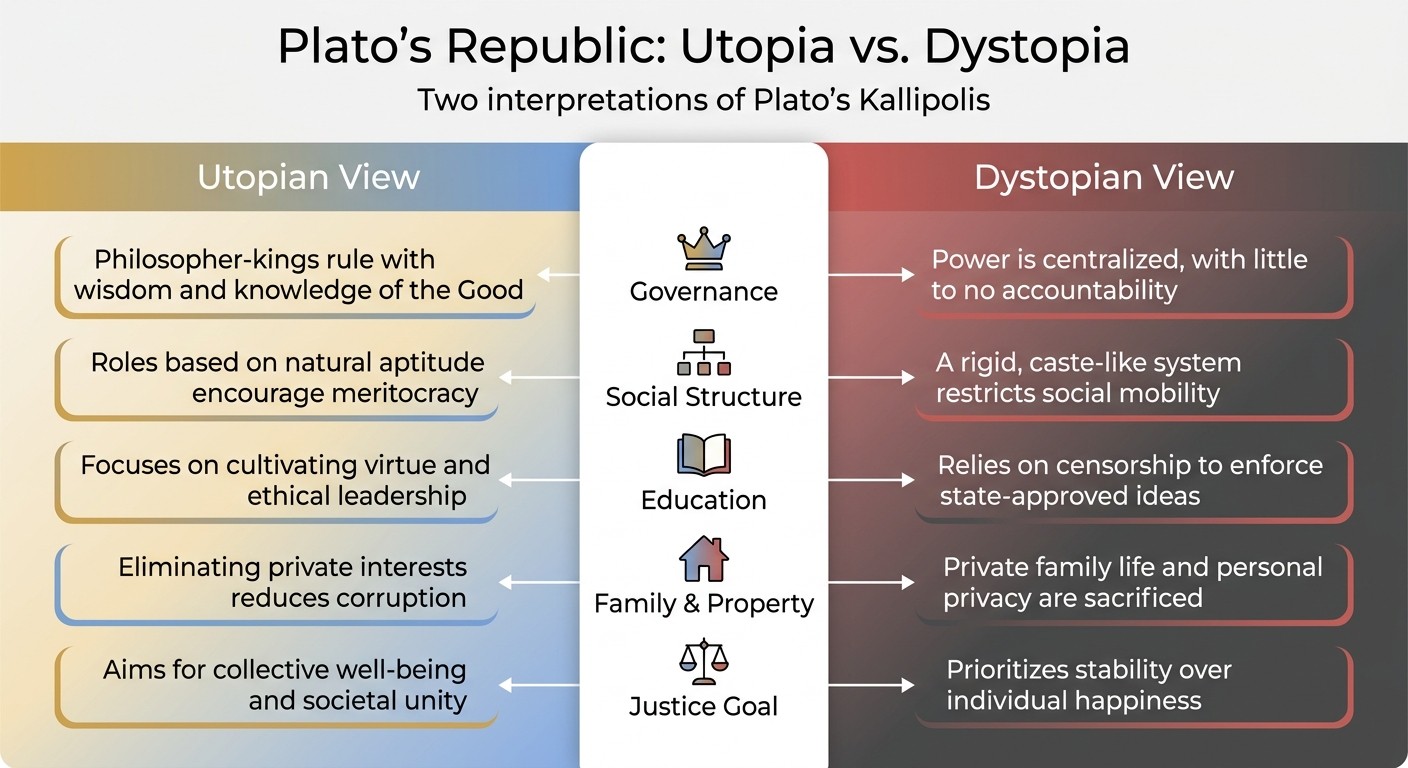
Here's a quick comparison of the utopian and dystopian aspects of Plato's system:
Aspect | Utopian Interpretation | Dystopian Interpretation |
|---|---|---|
Governance | Philosopher-kings rule with wisdom and knowledge of the Good | Power is centralized, with little to no accountability |
Social Structure | Roles based on natural aptitude encourage meritocracy | A rigid, caste-like system restricts social mobility |
Education | Focuses on cultivating virtue and ethical leadership | Relies on censorship to enforce state-approved ideas |
Family & Property | Eliminating private interests reduces corruption | Private family life and personal privacy are sacrificed |
Justice Goal | Aims for collective well-being and societal unity | Prioritizes stability over individual happiness |
This table highlights the core conflict between order and personal freedom. Plato's system places collective wisdom and societal good above individual autonomy, a stance that clashes with modern democratic ideals. Neither perspective is entirely wrong - they simply approach the question of justice from opposing angles.
Conclusion
Plato's Republic offers a thought-provoking exploration of an ideal society, balancing visionary governance with the risks of authoritarian control. It paints a picture of a world where wisdom leads, individuals fulfill specific roles, and justice is defined as harmony rather than strict adherence to rules - ideas that continue to inspire debates on governance, social structure, and education.
Yet, these ideals reveal a darker side, as many elements lean toward authoritarianism. Philosopher Sir Karl Popper famously critiqued Plato's vision, arguing that his proposed state is fundamentally totalitarian.
By examining both the aspirational and restrictive aspects of Plato's model, we confront a timeless question: Can true justice exist without individual liberty? Plato's emphasis on collective harmony often clashes with modern values that prioritize personal freedom. This tension pushes us to reflect on whether societal order and personal liberty can ever coexist seamlessly.
For a deeper dive into Plato's arguments, consider exploring annotated editions available through Logos Philosophy Club.
FAQs
Does Plato’s idea of justice leave room for personal freedom?
Plato’s idea of justice revolves around creating harmony in society by ensuring individuals stick to their assigned roles. In this framework, personal freedom takes a backseat, especially for those who may not align with the roles they’re given. The state’s priority is clear: collective order outweighs individual autonomy, placing structure above personal preference.
Are philosopher-kings accountable to anyone in the Republic?
Philosopher-kings in Plato's Republic operate without being answerable to any external authority. Their governance is rooted in their profound grasp of the Good and eternal truths, which serve as the foundation for their decisions. Their power comes from their philosophical wisdom and deep understanding of justice, rather than from any need for external validation or oversight.
Is the “Noble Lie” ever morally justified in a just society?
The concept of the "Noble Lie" sparks debate, but it can find moral justification in a just society when its aim is to promote social harmony and unity. Rather than being a tool for malicious deception, its purpose is to communicate a deeper philosophical truth and encourage collective agreement. However, its justification hinges on the condition that it serves the greater good without eroding trust or compromising fairness.