Montesquieu's Spirit of Laws: Study Guide

Montesquieu's The Spirit of Laws (1748) is a cornerstone of political theory, introducing the separation of powers that shaped modern democracies like the U.S. Constitution. This study guide breaks down its key ideas:
Government Types: Republics (virtue-driven), Monarchies (honor-driven), and Despotisms (fear-driven).
Separation of Powers: Dividing government into legislative, executive, and judicial branches prevents tyranny.
Laws and Society: Laws align with factors like climate, religion, commerce, and a nation's "general spirit."
Influence: Inspired the U.S. Constitution, especially through checks and balances and independent judiciary principles.
Montesquieu's work remains relevant in understanding governance, civil liberties, and how external factors shape laws. Dive deeper into his analysis of government structures, societal influences, and their lasting impact on political systems.
Montesquieu's Life and Historical Background
Montesquieu's Biography
Charles-Louis de Secondat, better known as Montesquieu, was born in 1689 near Bordeaux into a noble family. This privileged background afforded him an elite education, first at the Oratorian Collège de Juilly and later at the University of Bordeaux, where he earned a law degree in 1708. His life took a pivotal turn when he inherited the title of baron and the position of Président à Mortier in the Bordeaux Parlement after his uncle's death. For 11 years, he presided over the criminal division, gaining firsthand insight into the misuse of state power.
This period profoundly shaped his political thinking, particularly his focus on preventing tyranny through institutional checks. Scholars often describe this concern as his "liberalism of fear" - a belief in designing systems to limit arbitrary authority. Montesquieu's personal library at the Château de la Brède, holding over 3,000 volumes, became a vital resource for his intellectual development.
Between 1728 and 1731, Montesquieu embarked on a Grand Tour of Europe. His two-year stay in England was especially influential, exposing him to the workings of a constitutional monarchy and the principle of separation of powers. These observations, along with discussions with figures like Viscount Bolingbroke, deeply informed his later writings, particularly Book XI, Chapter 6 of The Spirit of Laws.
The Enlightenment and Its Influence
Montesquieu's ideas took shape during the Enlightenment, a time when thinkers sought to apply scientific reasoning to human society. As a member of the Academy of Bordeaux from 1718 to 1721, he presented papers on topics ranging from "the renal glands" to "the weight of bodies." This empirical mindset carried over into his political philosophy, where he viewed laws as products of physical and social conditions rather than divine will.
The Glorious Revolution of 1688–1689 in England served as a real-world example of his theories in action. Montesquieu expanded on John Locke's ideas from Second Treatise of Government, refining the concept of dividing executive and legislative powers. Drawing from classical sources like Herodotus and Tacitus, as well as contemporary travel accounts, he explored how factors like geography, climate, and culture shape a nation's character or "spirit." His personal background, which included a Catholic education, Huguenot ancestry, and marriage to Protestant Jeanne de Lartigue, likely influenced his advocacy for religious tolerance.
Writing The Spirit of Laws
Montesquieu dedicated nearly two decades to researching and writing The Spirit of Laws. Living through the transition from Louis XIV's centralized rule to Louis XV's reign, he witnessed how the weakening of intermediary institutions like the nobility and parlements could lead to unchecked power. These observations fueled his emphasis on checks and balances as critical tools to prevent despotism.
The reception of The Spirit of Laws highlighted its impact. By the late 18th century, Montesquieu was one of the most frequently cited authorities on government in colonial America, second only to the Bible. His life's experiences, combined with his meticulous research, laid the groundwork for the revolutionary ideas that would shape political thought for generations to come.
Montesquieu: The Spirit of Separation - Enlightenment | Academy 4 Social Change
Core Concepts in The Spirit of Laws
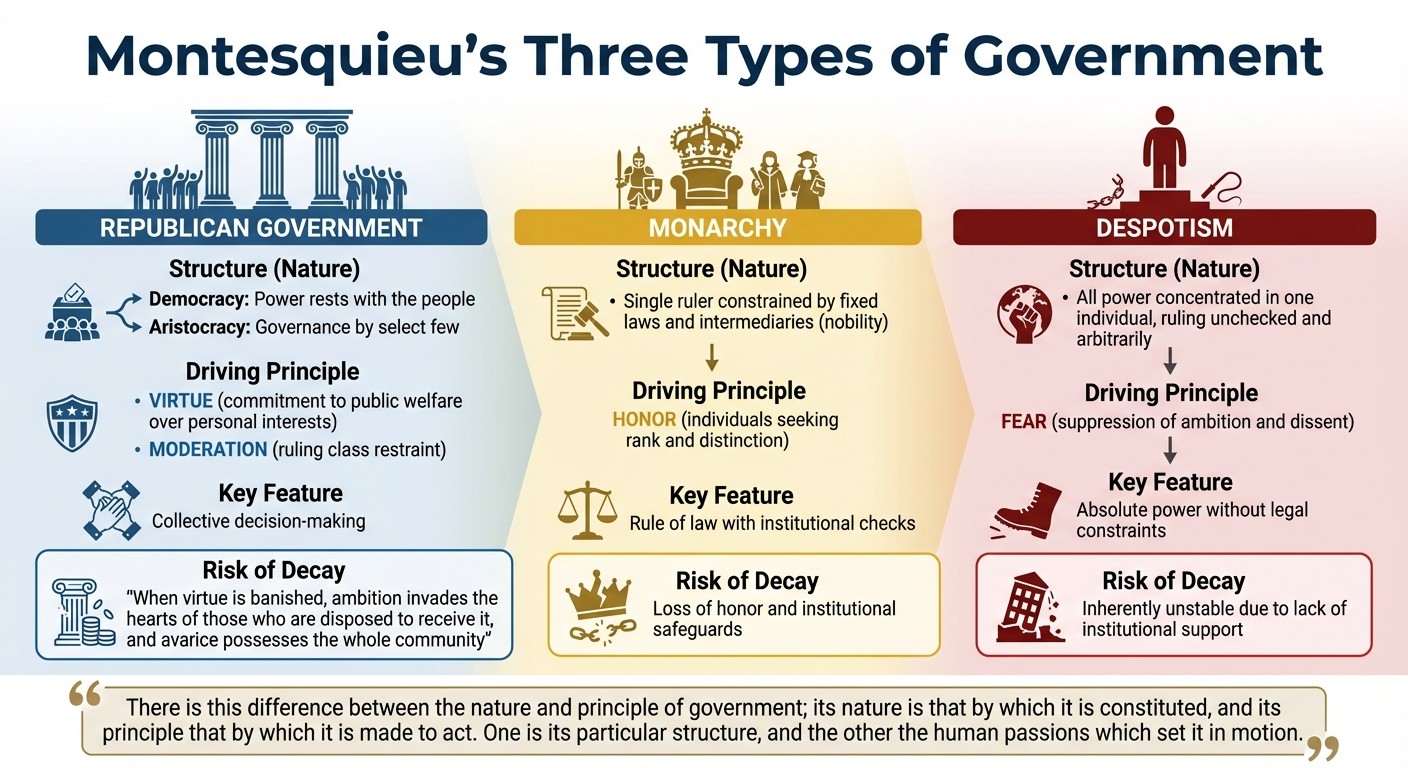
Montesquieu's Three Types of Government: Structure, Principle, and Characteristics
The 3 Types of Government
Montesquieu's exploration of government begins with a simple yet profound idea: every government has two defining aspects - its nature (its structural framework) and its principle (the driving human passions behind it). He explains this distinction clearly:
"There is this difference between the nature and principle of government; its nature is that by which it is constituted, and its principle that by which it is made to act. One is its particular structure, and the other the human passions which set it in motion."
From this foundation, Montesquieu identifies three main forms of government.
Republican governments divide further into democracies, where power rests with the people, and aristocracies, where governance is controlled by a select few.
Monarchies operate under a single ruler, but one constrained by fixed laws and intermediaries such as the nobility.
Despotic governments concentrate all power in one individual, ruling unchecked and often arbitrarily.
Each type of government functions based on a specific principle. Democracies rely on virtue - a commitment to public welfare over personal interests. Aristocracies depend on moderation to ensure the ruling class doesn't exploit its power. Monarchies thrive on honor, with individuals seeking rank and distinction. Despotisms, however, sustain themselves through fear, suppressing ambition and dissent. When these principles weaken, governments begin to decay:
"When virtue is banished, ambition invades the hearts of those who are disposed to receive it, and avarice possesses the whole community."
This classification sets the stage for understanding how laws must align with societal conditions to maintain stability.
Laws and Their Relation to Society
Montesquieu believed that laws are most effective when they reflect a society's unique characteristics - its climate, geography, religion, customs, and commerce. For example:
Climate: Colder regions might foster discipline and resilience, requiring laws that emphasize these qualities. Warmer areas, with their more relaxed lifestyles, may need different legal approaches.
Geography: Arid regions often need water management laws, while coastal areas might prioritize maritime regulations.
Religion and commerce: Religion shapes moral values that influence legislation, while commerce fosters interdependence, which can stabilize political systems.
Montesquieu emphasized that laws must fit the cultural and social realities of the people they govern. A law that works well in one country may fail in another if it clashes with local traditions or values. As societies change, their legal systems must evolve to remain relevant and effective.
The Spirit of a Nation
One of Montesquieu's most intriguing ideas is the concept of the "general spirit" (esprit général), which represents the collective character of a nation. This character is shaped by a mix of factors, including climate, religion, laws, government principles, historical precedents, morals, and customs. Importantly, these influences vary widely:
"Mankind are influenced by various causes: by the climate, by the religion, by the laws, by the maxims of government, by precedents, morals, and customs; whence is formed a general spirit of nations."
In some societies, nature and climate play a dominant role (as seen in so-called "savage" communities). In others, customs or laws exert greater influence, such as in China or Japan.
Montesquieu argued that great legislators must work with this "spirit" rather than against it. He distinguished between laws - formal rules established by lawmakers - and the broader customs and manners that define a nation's identity. Trying to impose laws that conflict with a nation's spirit risks tyranny. This principle is reflected in the wisdom of Solon, an Athenian lawmaker, who famously said:
"I have given them the best they were able to bear."
This statement underscores the importance of tailoring laws to a society's capacity and character rather than pursuing abstract ideals. Legislators, according to Montesquieu, should guide change gradually, respecting the natural tendencies of their people. These ideas set the stage for his groundbreaking theory of the separation of powers, which we will explore next.
The Separation of Powers Doctrine
3-Part Structure of Government
Montesquieu's most impactful idea in political theory is the division of government into three separate branches. He believed political liberty - described as "a tranquility of mind" that stems from a citizen feeling secure - can only exist when government power is divided in such a way that "one man need not be afraid of another" [17,19]. This concept led to the establishment of three distinct branches: the Legislative (responsible for creating laws), the Executive (tasked with enforcing laws and managing foreign affairs), and the Judicial (focused on interpreting laws and resolving disputes) [17,18].
Montesquieu strongly cautioned against combining any two of these branches, whether it be legislative and executive, legislative and judicial, or judicial and executive. He argued that such a merger would pave the way for tyranny, as unchecked power could lead to oppressive lawmaking, arbitrary enforcement, and unjust rulings. As he put it, "There would be an end of everything, were the same man or the same body... to exercise those three powers, that of enacting laws, that of implementing public policy, and of trying the causes of individuals".
To prevent this, Montesquieu emphasized that "power must be a check to power". He advocated for each branch to have constitutional tools to defend its authority against encroachment by the others. For instance, the executive branch should have veto power, the legislature should maintain control over financial resources, and the judiciary must remain an impartial and independent interpreter of the law. This separation of powers not only protects individual freedoms but also became a cornerstone for modern constitutional governments.
Influence on Modern Political Systems
Montesquieu's clear framework for a three-branch government became a guiding principle for modern constitutional design. His ideas had a profound impact on the United States Constitution. Between 1760 and 1800, he was the most frequently referenced secular thinker by the American founders. His writings were a key source of inspiration for the framers of the Constitution in 1787 [17,18]. Prominent figures like Benjamin Franklin, John Adams, Thomas Jefferson, and Alexander Hamilton owned copies of his works, and Jefferson even transcribed 28 pages of excerpts from The Spirit of the Laws into his personal Commonplace Book by 1776.
In February 1788, James Madison expanded on Montesquieu's theories in Federalist No. 51, arguing that "ambition must be made to counteract ambition" to ensure the independence of the branches. This idea influenced several critical constitutional mechanisms, including the presidential veto, legislative impeachment powers, and Senate confirmation of appointments. The Constitution itself reflects Montesquieu's model, with Article I addressing Congress, Article II outlining the Presidency, and Article III establishing the Courts.
Additionally, Montesquieu's vision of an independent judiciary came to life in the landmark 1803 Supreme Court case Marbury v. Madison, which introduced judicial review. This decision empowered the judiciary to act as a check on the other branches, further solidifying the principles Montesquieu championed.
Key Themes in The Spirit of Laws
Montesquieu’s exploration of government structures doesn’t stop at the separation of powers. He delves into how external forces - like geography, religion, and commerce - shape legal systems. These themes underline his belief that laws are not created in a vacuum but are deeply influenced by the physical and societal context in which they exist. By examining these factors, Montesquieu provides a more nuanced view of how societies function. For those who wish to learn from the great thinkers like Montesquieu, exploring curated editions of their work is essential.
The Role of Climate and Geography
Montesquieu draws a connection between climate, geography, and the character of nations. He suggests that climate affects the body and, in turn, influences temperament. For instance, colder climates, according to him, strengthen the body and foster courage, while warmer climates lead to physical and mental lethargy.
"If it be true that the temper of the mind and the passions of the heart are extremely different in different climates, the laws ought to be in relation both to the variety of those passions and to the variety of those tempers."
He believed that lawmakers should account for these natural tendencies. For example, if a climate encourages idleness, laws should promote work and productivity. He also observed patterns like increased drunkenness in colder, wetter regions and noted how warm climates in Eastern countries often led to resistance to change, reinforcing ancient customs. While such theories may feel outdated today, they highlight Montesquieu’s attempt to link environmental factors with societal behavior.
Religion and Its Impact on Laws
Montesquieu saw religion as a powerful force in shaping laws and restraining authority. He argued that religion could act as a check on rulers, particularly those who disregard human laws.
"A prince who loves and fears religion is a lion, who stoops to the hand that strokes... He who has no religion at all is that terrible animal who perceives his liberty only when he tears in pieces and when he devours."
He believed that different religions aligned with specific forms of government. Christianity, for example, suited moderate governments because of its emphasis on gentleness, while Islam, he argued, was more compatible with despotism due to the absolute power it often granted rulers. Within Christianity, Montesquieu noted that Catholicism worked well with monarchies, whereas Protestantism reflected the independent spirit of republics. He also emphasized that religious and civil laws should complement each other - if religion is lenient, civil laws must step in to maintain order.
Commerce and Its Role in Society
Commerce, in Montesquieu’s view, played a key role in shaping societal values by fostering mutual dependence and stability. He saw trade as a force for peace, as nations engaged in commerce rely on one another - buyers need sellers, and vice versa.
"Commerce is a cure for the most destructive prejudices; for it is almost a general rule that wherever we find agreeable manners, there commerce flourishes; and that wherever there is commerce, there we meet with agreeable manners."
Montesquieu also observed that commerce took on different characteristics depending on the type of government. In republics, it thrived on frugality and steady gains, encouraging ambition and long-term planning. Monarchies, on the other hand, often tied commerce to luxury and status, while in despotic regimes, trade was stifled as people focused more on survival than acquisition. He praised England as an example where religion, commerce, and liberty coexisted harmoniously, noting their ability to balance these forces better than any other nation.
Study Tips for Reading The Spirit of Laws
Montesquieu's The Spirit of Laws is a dense and complex work, spanning 31 books. For first-time readers, it can feel like a daunting challenge. But with a thoughtful approach, you can make your way through its pages without feeling overwhelmed. As Montesquieu himself cautioned:
"I beg one favour of my readers... that they will not judge by a few hours reading of the labour of twenty years; that they will approve or condemn the book entire, and not a few particular phrases."
Here’s how to tackle this monumental text with greater clarity and purpose.
Focus on Key Sections First
Start with Part I (Books 1–8), where Montesquieu introduces his core ideas and categorizes forms of government. Pay special attention to Book I ("Of Laws in General"), where he defines laws as "necessary relations arising from the nature of things" and distinguishes between natural and positive laws. In Books 1–4, Montesquieu explores the "springs" that drive different types of government: virtue for republics, honor for monarchies, and fear for despotisms.
Before diving too deeply, read the Advertisement to understand Montesquieu's use of terms. For instance, "virtue" here refers to "political virtue" - a love of country and equality - rather than moral or religious virtue.
Use Annotated Editions
Montesquieu's writing style, often aphoristic and fragmented, can be challenging to follow. Annotated editions are invaluable for clarifying his arguments and providing historical context for his numerous references to Roman, Frankish, and medieval law. Look for editions that include helpful tools like a timeline of Montesquieu's life, a bibliography, and an index of sources.
A widely recommended option is the Cambridge Texts edition (translated by Cohler, Miller, and Stone), praised for its clear translation and insightful annotations. For readers seeking a deeper dive, the Logos Philosophy Club offers annotated bilingual editions of foundational texts, along with editorial support to help navigate intricate works like this one.
Connect Themes Across Sections
Once you’ve mastered the basics with the help of annotations, take an active approach to connect ideas across the text. There’s no need to read strictly in order. Instead, link each law Montesquieu discusses to its corresponding "spring" - whether virtue, honor, or fear.
For example, when studying commerce in Part III, think back to the government types in Part I that Montesquieu associates with thriving economies. Similarly, revisit earlier discussions on how climate, geography, and customs shape the "spirit of a people" to better understand his later historical analyses. Treat the detailed sections on Roman and French laws as case studies that illustrate his broader theories. This approach will help you see the text as a cohesive whole rather than a collection of isolated ideas.
The Lasting Influence of Montesquieu
Montesquieu's ideas have left an enduring mark on modern constitutional democracies. His influence extends far beyond the Enlightenment era, serving as a foundational guide for governments across the globe. By the late 18th century, his work was widely referenced in England, France, and America, despite these nations adopting vastly different governmental systems. In 1827, British historian Thomas Babington Macaulay remarked:
"Montesquieu enjoys, perhaps, a wider celebrity than any political writer of modern Europe".
Impact on the American Founders
When crafting the framework for a new government, the American Founders turned to Montesquieu's The Spirit of Laws, particularly Book XI, Chapter 6. This work became a practical guide for designing institutions that could withstand the dangers of tyranny. Montesquieu's cautionary words resonated deeply:
"constant experience shows us that every man invested with power is apt to abuse it... it is necessary from the very nature of things that power should be a check to power".
Inspired by these principles, the Founders established a system grounded in the separation of powers. They implemented mechanisms like the executive veto, legislative control over budgets, and an independent judiciary to ensure no single branch could dominate. This innovative structure not only defined early American democracy but also became a model for future governmental reforms.
Relevance in Contemporary Politics
Montesquieu's influence remains evident in modern governance. His definition of political liberty as:
"a tranquillity of mind arising from the opinion each person has of his safety",
continues to shape discussions on civil rights and the dangers of unchecked authority. For instance, the erosion of judicial and legislative independence in countries like Venezuela highlights the risks of ignoring these principles.
Today, Montesquieu's insights extend to various legal and policy frameworks. His focus on safeguarding individual freedoms underpins regulations like the GDPR, which protects against digital threats to privacy. Similarly, his ideas inspire global initiatives like the Arctic Council's integration of indigenous knowledge with international law to address challenges posed by changing maritime routes. Political scientists Steven Levitsky and Daniel Ziblatt have noted:
"Montesquieu believed the hard architecture of political institutions might be enough to constrain overreaching power - that constitutional design was not unlike an engineering problem".
This perspective continues to guide efforts to reform institutions and tackle contemporary concerns about government overreach, reaffirming Montesquieu's lasting relevance.
Conclusion: Mastering The Spirit of Laws
Diving into The Spirit of Laws is no small feat, but it’s an endeavor that offers profound rewards. With its 1,086 pages spread across 31 books, Montesquieu’s monumental work requires more than a surface reading. To truly understand it, you need to immerse yourself in its historical backdrop: his critique of absolute monarchy in pre-revolutionary France, the influence of the English constitution he observed during his travels, and the Enlightenment’s embrace of reason. As Swiss scientist Charles Bonnet once said of Montesquieu:
discovered the laws of the intellectual world as Newton had those of the physical world
.
A systematic approach can help make this complex text more approachable. Begin with Book XI, Chapter 6, where Montesquieu outlines the separation of powers - a concept that later inspired the U.S. Constitution, ratified in 1788. His idea that laws reflect a nation’s "general spirit", shaped by elements like climate, religion, commerce, and historical traditions, is another key to unlocking the text’s depth.
Annotated editions are invaluable for navigating the intricacies of Montesquieu’s arguments. For instance, the critical edition by W. B. Allen, published by Anthem Press in March 2024, addresses earlier translation issues. Allen described the work as:
the Bible of modern politics, now made more accessible to English readers than it ever has been
.
For those looking to delve even deeper, curated study resources can be a game-changer. Logos Philosophy Club, for example, offers bilingual editions of foundational philosophical works, complete with expert translations, annotations, and editorial commentary. Their annual subscription, priced at $420, also provides access to past releases at discounted rates - an excellent investment for building a robust philosophical library.
The effort to understand The Spirit of Laws is well worth it. This work has profoundly influenced the development of constitutional democracies and continues to shape discussions around civil rights and government structures. With the right tools and historical context, you’ll not only grasp Montesquieu’s ideas but also appreciate why David Hume predicted it would:
win the admiration of all the ages
.
FAQs
How is “political virtue” different from moral virtue?
Political virtue is all about loving one’s country and valuing equality. It motivates citizens to put the public good ahead of their personal interests, which is crucial for a republican government to function effectively. On the other hand, moral virtue focuses on individual moral traits or Christian values, but these aren't the basis for political decision-making or action.
Why does Montesquieu say merging branches leads to tyranny?
Montesquieu contends that combining branches of government paves the way for tyranny by eroding the principle of separation of powers. This principle is essential to curbing the misuse of authority. When the branches fail to remain distinct and independent, there’s no mechanism to ensure accountability or protect individual freedoms, resulting in unchecked and concentrated power.
How can I start reading The Spirit of Laws without feeling lost?
To dive into The Spirit of Laws without feeling overwhelmed, it’s helpful to start with a quick look at its central ideas, such as the separation of powers and checks and balances. Begin by reading the introduction and preface to understand Montesquieu’s purpose and the context of his work. After that, move on to Of Laws in General in Book 1, which lays the foundation for the rest of the text. Taking your time and focusing on Montesquieu’s overarching goals will make it easier to follow his arguments and the logical flow of his themes.