How to Build a Philosophy Library: 7 Essential Steps

Building a philosophy library is a rewarding way to explore intellectual history and develop critical thinking skills. Here’s a quick guide to getting started:
Define Your Focus: Decide on a theme, branch, or set of thinkers to guide your collection, such as ethics, existentialism, or Eastern philosophy.
Select Core Texts: Start with foundational works like Plato’s The Republic, Aristotle’s Nicomachean Ethics, or Confucius’ Analects. Include modern classics like Descartes’ Meditations or Kant’s Critique of Pure Reason.
Find Rare and Translated Works: Use tools like viaLibri, WorldCat, or academic databases to locate rare editions and high-quality translations.
Organize Your Collection: Arrange books by theme, philosopher, or chronology. Use systems like Dewey Decimal or Library of Congress for larger collections.
Use Reference Resources: Rely on tools like the Stanford Encyclopedia of Philosophy or the Cambridge Dictionary of Philosophy to clarify complex ideas and terms.
Maintain and Expand: Keep your collection in good condition by controlling temperature and humidity. Regularly review and update your library to reflect your evolving interests.
Leverage Subscription Services: Consider book clubs like Logos Philosophy Club for curated monthly additions, including bilingual editions and scholarly commentary.
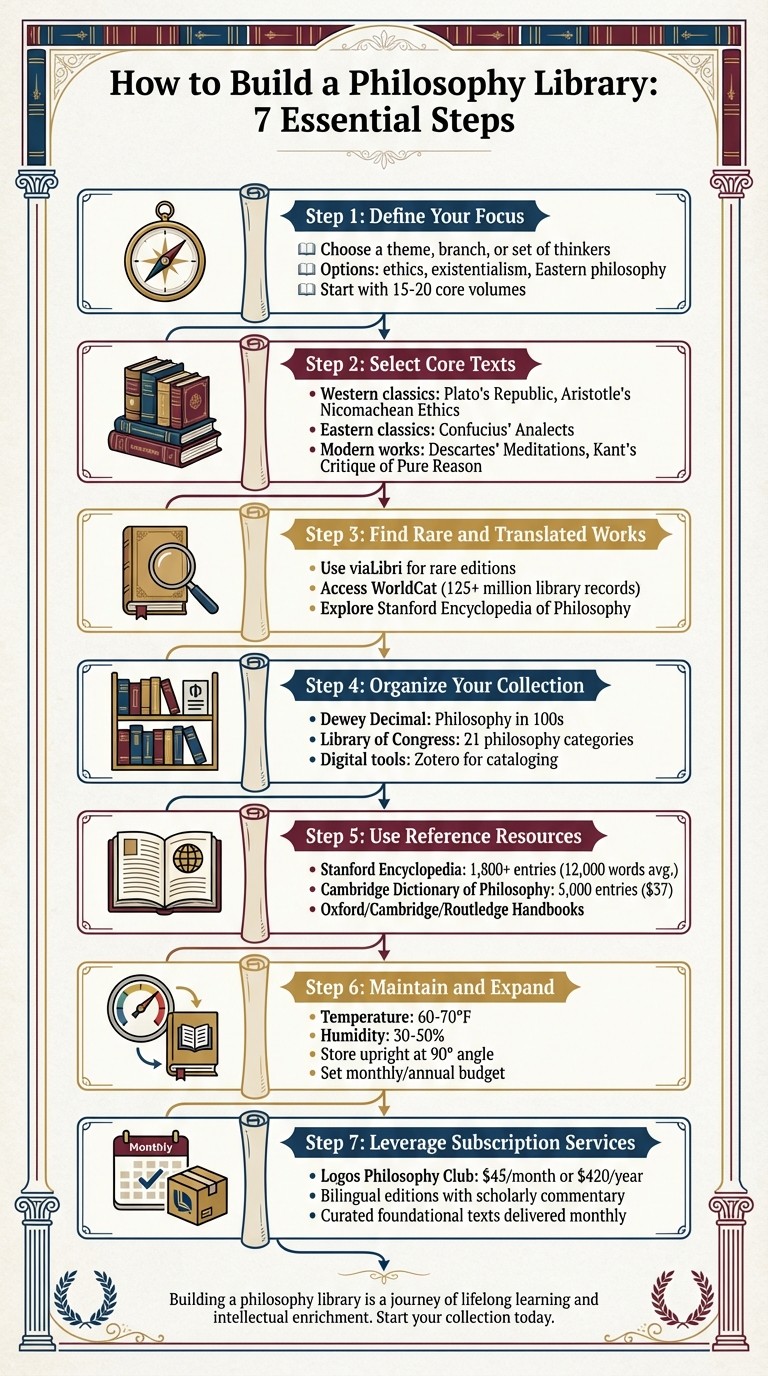
7 Essential Steps to Build a Philosophy Library
philosophy: library tour
Step 1: Define Your Library's Focus
Before diving into book purchases, take a moment to define the focus of your philosophy library. This step ensures your collection reflects your personal interests rather than becoming a haphazard assortment of titles.
"What distinguishes a library from a random pile of books is the considered process of curation." - Freya Howarth, Production Editor at Aeon Media
Begin by exploring a comprehensive history of philosophy. A general overview of major branches, schools, and movements can act as a roadmap to pinpoint specific areas of interest - whether it's existentialism, Stoicism, or pre-Socratic thought. If a brief introduction to a topic resonates with you, that's a sign to dig deeper into that area.
Your library's focus can take many forms. You might zero in on a particular branch, like ethics, epistemology, or political philosophy. Alternatively, you could organize your collection around a central theme such as justice or free will. Another option is to dedicate sections to individual thinkers - Plato, Nietzsche, or Schopenhauer, for instance. You could even compare traditions and regions, such as Western philosophy alongside Eastern perspectives like Buddhism or Confucianism.
To refine your focus further, start by cataloging your current collection. Group your books into categories and see which subjects naturally create the most subcategories. This process often reveals your strongest interests. Pay attention to your "personal classics" - the books you revisit time and again. Use these as the foundation for your collection, starting with a solid core of 15–20 volumes before branching out into other areas. Let your genuine curiosity guide you, as it will fuel your engagement over time.
With this focused approach, you'll lay the groundwork for a well-curated library and be better prepared to select foundational texts in the next step.
Step 2: Select Core Texts
After defining your library's focus, the next step is to pick the cornerstone texts that will shape your collection. These works act as the backbone, offering key insights and context into the evolution of philosophical thought. By aligning these texts with your chosen theme, you ensure your collection has a strong intellectual foundation.
Start with the classics. For Western philosophy, Plato's The Republic (3.97/5) is indispensable, delving into justice, the theory of Forms, and the concept of an ideal state governed by philosopher kings. Aristotle's Nicomachean Ethics (4.00/5) is another must-read, laying out the principles of virtue ethics and the pursuit of a balanced life. For Eastern philosophy, Confucius' Analects provides timeless wisdom on ethical leadership and social harmony. These works not only anchor your collection but also set the stage for deeper exploration into your chosen themes.
Modern philosophy adds a new dimension. René Descartes' Meditations on First Philosophy (3.73/5) introduces systematic doubt and establishes "I think, therefore I am" as a pivotal idea. Immanuel Kant's Critique of Pure Reason (3.96/5) bridges rationalism and empiricism, emphasizing how the mind structures experiences through concepts like space and time. David Hume's An Enquiry Concerning Human Understanding champions empiricism, asserting that knowledge stems from sensory experiences. Meanwhile, John Stuart Mill's Utilitarianism and On Liberty offer enduring discussions on ethics and individual freedoms.
To deepen your understanding, consider annotated and bilingual editions. Expert-edited versions from publishers like Oxford University Press or Hackett often include introductory essays and commentary, making complex arguments more accessible. Bilingual editions are especially helpful for advanced readers, as they preserve subtle linguistic distinctions that single-language translations might overlook. Comparing multiple translations of the same work can also help you avoid relying too heavily on one translator's interpretation.
For those new to philosophy, anthologies can be a great starting point. These collections often focus on major subfields like ethics or metaphysics, featuring key excerpts with expert annotations while skipping overly technical sections. If diving straight into dense texts feels daunting, try Plato's shorter dialogues like the Apology or Crito - they're more approachable and provide a solid introduction. As you read, consider adding your own notes and creating a personalized index to quickly reference important passages.
Step 3: Find Rare and Translated Works
Adding rare and well-translated editions to your collection can deepen your understanding of philosophical texts. Here's how to locate these valuable resources using specialized tools and databases.
Start with viaLibri. This platform gathers listings from various websites and allows you to set up a "Libribot", which sends email alerts when rare editions become available.
For authoritative translations, explore academic databases like Intelex Past Masters and Oxford Scholarly Editions. Intelex Past Masters includes comprehensive works by Aristotle, Plato, Plotinus, and Presocratic philosophers in both their original languages and English. Meanwhile, Oxford Scholarly Editions provides texts from major classical thinkers such as Seneca, Cicero, and Marcus Aurelius. When searching for English translations in library catalogs, use the keyword "Works" alongside the author’s name (e.g., Author: Wittgenstein, Title: Works) to locate complete collections rather than individual pieces. If these databases don’t meet your needs, borrowing options can help you access the texts you’re after.
Interlibrary loan (ILL) services are a great way to borrow materials not available in your local library. Many university libraries offer "Request" services to source rare or specialized texts from institutions worldwide. These requests often have quick turnaround times. To locate rare texts before making an ILL request, use WorldCat, which searches over 125 million library records globally.
For free digital resources, the Stanford Encyclopedia of Philosophy is an excellent source for background information on rare philosophical ideas and figures. The Perseus Digital Library offers primary texts in their original languages alongside English translations, and the Open Library provides access to over 7,800 works tagged as "rare books" for digital borrowing or reading. Additionally, the Thesaurus linguae Graecae (TLG) is an invaluable resource for studying classical philosophy, containing over 80 million words of ancient Greek texts spanning from Homer to A.D. 1453.
Step 4: Organize Your Collection
Getting your philosophical texts in order is key to creating a library that’s both functional and inspiring. By combining physical organization with digital cataloging, you can turn your collection into a resource that’s easy to navigate and supports your ongoing exploration of philosophy.
For physical organization, consider using established classification systems. The Dewey Decimal system places philosophy in the 100s, with subdivisions like 110–119 for Metaphysics, 120–129 for Epistemology, 160–169 for Logic, 170–179 for Ethics, 180–189 for Ancient/Medieval/Eastern Philosophy, and 190–199 for Modern Western Philosophy. For larger collections, the Library of Congress system provides even more detailed categories, with 21 options specifically for philosophy. You can also organize by philosopher or arrange texts chronologically to reflect the historical development of ideas. Once you choose a system, apply it consistently to bring order to your library.
To complement your physical setup, dive into digital cataloging. Free tools like Zotero can help you manage your collection efficiently. Zotero integrates with databases and word processors, making it easy to create searchable metadata for authors, titles, and ISBNs. You can even tag books with terms like "existentialism" or "virtue ethics" to locate them quickly. Zotero also offers plugins for MS Word and Google Docs, which can automatically generate bibliographies as you write. While some institutions, such as Barnard and Columbia, have phased out support for EndNote, Zotero remains a reliable alternative as of July 2025.
"As long as a person can track down the books he needs his method is a success." - Tim Challies
For digital cataloging, tagging is far more effective than relying solely on folders. Consider creating a "Personal Classics" shelf for the works you consult most frequently and use a "read vs. unread" system to keep track of your progress. Another option is LibraryThing, which offers free cataloging for up to 200 books.
Finally, don’t forget to care for your physical books. Maintain a temperature between 60°F and 70°F with about 65% relative humidity to ensure they stay in good condition. A well-organized and preserved collection will make your library a source of inspiration for years to come.
Step 5: Use Reference and Background Resources
Reference materials are crucial for grasping the nuances of complex philosophical topics. They help define technical terms, provide historical and intellectual context, and guide you in selecting the right primary texts for your research.
Start with online encyclopedias that feature content curated by experts. The Stanford Encyclopedia of Philosophy (SEP) is a standout resource. As of Summer 2023, the SEP offers nearly 1,800 entries, each maintained by specialists to reflect the latest research. These entries, averaging 12,000 words, come with bibliographies that can guide further exploration. Many bibliographies include "Primary Literature" sections, helping you locate the most authoritative editions of a philosopher's works. This makes the SEP an invaluable tool for both quick definitions and in-depth study.
For a reliable dictionary of philosophical terms, consider the Cambridge Dictionary of Philosophy (available digitally for $37.00). With around 5,000 entries spanning both Eastern and Western traditions, this resource excels at breaking down technical terminology, making dense primary texts more approachable.
"Authors should see their mission as that of introducing advanced undergraduates... to the main issues and arguments... so as to bring their readers to a state where they can read that literature with insight and understanding." - Stanford Encyclopedia of Philosophy
To dive deeper into specific areas, use academic companions and handbooks. Collections like the Oxford Handbooks, Cambridge Companions, and Routledge Handbooks provide essays that bridge the gap between general overviews and primary texts. For specialized fields, resources such as the International Encyclopedia of Ethics (covering over 700 entries across nine volumes) or the Dictionary of Logic are particularly helpful. These tools not only explain philosophical ideas but also place them within the broader context of intellectual history.
When using the SEP, take advantage of its quarterly archives (updated on March 21, June 21, September 21, and December 21) for consistent citations. The "Related Entries" sections are also worth exploring - they connect you to related topics and offer contrasting perspectives. Whether in print or bookmarked online, keeping your go-to reference materials close at hand ensures you're always prepared to clarify unfamiliar terms or verify historical developments.
Step 6: Maintain and Expand Your Library
Creating a philosophy library is just the start - keeping it in good shape and growing it thoughtfully ensures its long-term value. Physical books need specific care to avoid damage. Aim for a stable temperature between 60–70°F and relative humidity levels of 30–50% [63–65]. If humidity climbs above 60%, mold and warping can occur, while levels below 30% can make paper brittle [61,63]. Using a portable thermohygrometer can help you track these conditions. Once you've got the environment under control, focus on proper storage and handling.
Books should be stored upright at a 90° angle, with enough space to allow air circulation but not so much that they lean or tip over [62,64]. Oversized books (larger than 18 inches) are best stored flat, stacking no more than three high to evenly distribute the weight [64,65]. Protect your collection from UV damage by using LED lighting and installing UV-blocking window films, as sunlight and fluorescent lighting can cause fading, yellowing, and brittle pages [64,65]. Regular dusting is also key - use a chemical-free duster or a soft paintbrush, brushing away from the spine to avoid pushing debris into the pages [62,64].
"The most effective and economical preservation measures are preventive: proper storage, environment, and handling." - Jon Sweitzer-Lamme, Technician, Conservation Division, Library of Congress
Expanding your library requires careful planning and budgeting. Set a clear monthly or annual spending cap to avoid overspending. For cost-effective additions, check out used bookstores, library sales (where books often go for as little as $1), or online platforms like Biblio and AbeBooks [9,68].
It's also important to regularly review your collection to keep it aligned with your interests. Take time to sort through your books, placing them into "keep" and "donate" piles. Keep the ones you love or plan to revisit, and donate those that no longer resonate with you. This process not only maintains the quality of your collection but also frees up space - and funds - for more meaningful additions. To stay organized, consider adopting a one-in, one-out rule: for every new book you add, remove one.
Step 7: Use Subscription Services
Once your collection is organized and well-maintained, subscription services can be a smart way to steadily grow your philosophy library. Building a comprehensive library of philosophical works can feel overwhelming, but a curated subscription service simplifies the process by delivering key texts directly to you. For instance, the Logos Philosophy Club is the first subscription book club in the U.S. devoted exclusively to philosophy. Supported by a Brazilian publishing group with over 20,000 monthly subscribers, it’s a standout option for philosophy enthusiasts.
Subscribers receive a carefully chosen foundational text every month, such as Plato's The Symposium in March 2026. These works are translated directly from the original languages and come in bilingual editions, making them accessible and authentic. The books are beautifully bound, and some editions include the Logos Reader, which features essays, commentary, and historical insights to deepen your understanding of the text. This is especially helpful when learning how to read philosophy books effectively. Members often highlight the excellent quality of the translations, the scholarly commentary, and the added bonuses like collectible posters.
The club offers two pricing tiers: $45 per month for a monthly plan or $420 annually, which saves $120 compared to the monthly rate. Annual subscribers also gain access to past releases at special prices. For serious collectors, this service eliminates the hassle of hunting for essential texts while ensuring you receive high-quality editions. It’s a perfect complement to your curated collection, helping you consistently acquire important works without the guesswork.
Conclusion: Building a Library as a Lifelong Journey
Creating a philosophy library is more than just accumulating books - it's an ongoing, personal journey that mirrors your intellectual growth over time. It’s not a static collection but one that requires regular reflection and adjustment.
Think of your library as a living, changing entity. As Freya Howarth puts it:
"A library will tend to grow richer and more rewarding through strategic pruning".
This means periodically letting go of books that no longer resonate with you while keeping track of your evolving thoughts by starting a philosophy reading habit with a journal or digital log.
Don’t underestimate the value of your unread books - your "antilibrary." These unread titles hold the promise of future learning and spark curiosity for new ideas. Organizing your collection in a way that encourages exploration can help you tap into this potential.
Focus on curating "personal classics" - books you revisit often - while leaving room for unexpected discoveries. Whether it’s a recommendation from a book club, a second-hand gem, or a subscription service find, these surprises add fresh energy to your library. Balancing intentional choices with serendipity ensures your collection stays vibrant and aligned with your intellectual journey.
Let your library grow alongside you, adapting to your changing interests and continuously inspiring new paths of learning.
FAQs
Which translation should I buy for a classic philosophy text?
When selecting a translation, focus on accuracy and how faithfully it captures the philosopher’s original intent. Seek out versions crafted by seasoned scholars or translators with deep expertise in the language and historical context of the work. For intricate texts, such as those by Aristotle or Nietzsche, the translator’s approach can heavily influence the meaning, as even slight shifts in wording can alter interpretation. Choosing respected and widely recognized translations is key to ensuring the work stays true to its source.
What’s the best way to catalog my philosophy books digitally?
The easiest way to catalog your philosophy books is by using a book cataloging app or software. These tools are designed specifically for organizing book collections, making the process both simple and efficient.
Start by gathering your books and use the app to scan their ISBN barcodes. This feature automatically pulls in key details like the author, title, and subject, saving you time and effort. While spreadsheets might seem like an option, they lack the functionality and user-friendliness of dedicated cataloging tools. With these apps, you can maintain your collection in a searchable and well-organized format.
How can I store old books without damaging them?
To keep old books in good condition, it's important to store them in a stable environment. Aim for consistent temperature and humidity levels, and keep them out of direct sunlight, which can cause fading and damage. For rare or antique books, use acid-free materials to protect them from deterioration. Depending on their condition, books should be stored either upright or flat to avoid unnecessary strain. Always handle them with clean hands, and be gentle - avoid bending delicate pages or forcing them open too far to help preserve their structure over time.