Bilingual Editions vs. English-Only: Which to Choose?


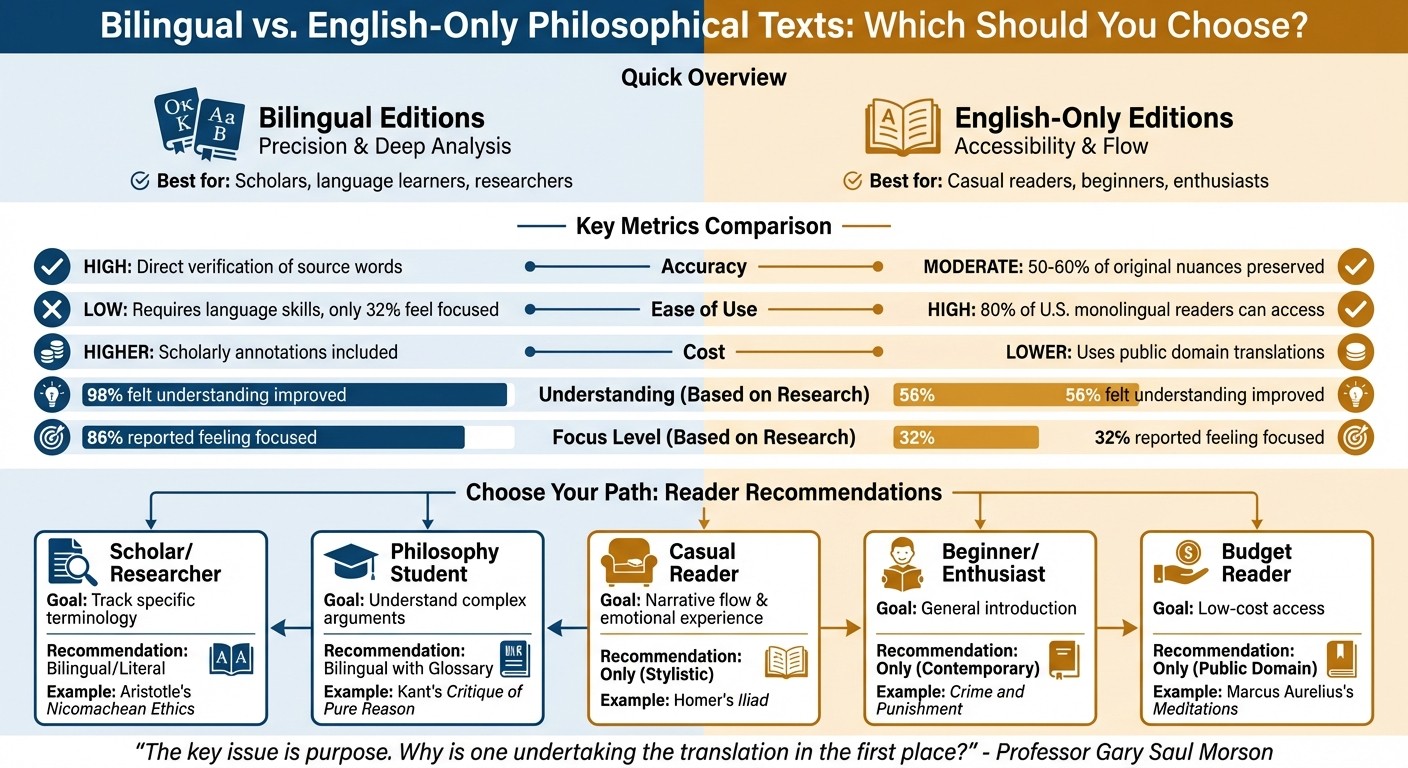
When deciding between bilingual and English-only editions of philosophical texts, your choice depends on your goals and preferences. Bilingual editions include the original language alongside the translation, offering a deeper look into the text's nuances and translation choices. They're ideal for advanced readers or those studying the original language. English-only editions, on the other hand, prioritize accessibility and readability, catering to casual readers or beginners.
Key Points:
Bilingual Editions: Great for detailed analysis and language learners; more expensive and require familiarity with the original language.
English-Only Editions: Easier to read and budget-friendly; rely entirely on the translator's interpretation.
Quick Comparison:
Factor | Bilingual Editions | English-Only Editions |
|---|---|---|
Accuracy | High, allows direct comparison | Moderate, depends on translator |
Ease of Use | Low, requires language skills | High, no extra knowledge needed |
Cost | Higher | Lower |
Best For | Scholars, language learners | Casual readers, beginners |
Choose bilingual editions for precision and deeper study. Opt for English-only editions if you want a straightforward reading experience without diving into the original language.
Bilingual vs English-Only Philosophical Texts: Complete Comparison Guide
Bilingual Editions: Pros and Cons
Why Choose Bilingual Editions
Bilingual editions offer a unique opportunity to engage with a philosopher's original words while also considering how translators interpret them. This dual access sheds light on whether a translator has chosen to "foreignize" the text - keeping its original structure and nuances - or "domesticate" it, making it more fluid and accessible in English. For example, reading Heidegger's Being and Time with both the German and English texts allows you to explore how complex terms like Dasein are handled. This word carries a depth of meaning that a single English equivalent can't fully convey, and seeing both versions side by side reveals how translators navigate such challenges.
Another advantage lies in uncovering ambiguities inherent in the original language. Translators often resolve these ambiguities differently, which can lead to fascinating interpretive differences. Take the Hebrew word keren, which means either "horned" or "radiant." St. Jerome's Latin translation opted for "horned", a choice that famously influenced Michelangelo's depiction of Moses with horns - a motif that endured in Christian art for over a millennium. With a bilingual edition, you can pinpoint moments where a translator had to make a decision and reflect on what was emphasized or lost.
These editions also allow for side-by-side comparisons of interpretations. As Lawrence Venuti, a noted translation theorist, points out, "the more fluent a translation, the more invisible the translator". By having the original text in view, you can identify where subtleties might have been smoothed over or adapted for contemporary readers. High-quality bilingual editions often include detailed scholarly notes, offering insights into the translator's choices and reasoning. However, these benefits come with some notable drawbacks.
Limitations of Bilingual Editions
One key limitation of bilingual editions is that they assume some familiarity with the original language. Without a basic grasp of Greek, German, or another source language, the additional text may not add much value.
Cost is another hurdle. Bilingual editions tend to be more expensive, partly due to the extra content and scholarly annotations. Publishers often release new translations when older ones enter the public domain, but these updated editions usually come with a higher price tag. For students or readers on a tight budget, this can make bilingual editions less accessible.
Additionally, juggling two texts at once can be mentally demanding. The process of switching between languages can slow your reading pace and make it harder to follow the broader themes of a work. For instance, if you're tackling Plato's Republic for the first time, the added complexity of a bilingual edition might disrupt your understanding of its overarching arguments. The following table outlines the main pros and cons of bilingual editions.
Bilingual Editions: Comparison Table
Factor | Bilingual Editions | Considerations |
|---|---|---|
Accuracy | High; allows direct verification of source words and syntax | Requires some familiarity with the original language |
Preservation of Meaning | High; retains original ambiguities and context | May reveal multiple valid interpretations |
Ease of Use | Low; requires managing two texts and language skills | Better suited for advanced study |
Price | Higher due to scholarly notes and content | Reflects the cost of added annotation and editing |
English-Only Editions: Pros and Cons
Why Choose English-Only Editions
English-only editions break down language barriers, making philosophical works accessible to roughly 80% of monolingual readers in the U.S.. You don’t need to be fluent in Greek, German, or Latin to delve into the ideas of Aristotle, Kant, or Cicero - translators have already tackled that challenge for you. This approach opens up the world of philosophy to anyone with an interest, regardless of their linguistic skills.
Another big advantage is cost. Publishers like Wordsworth Editions keep prices low by using older, out-of-copyright translations - typically those created at least 70 years after the translator’s death. This strategy allows them to offer these works at prices far below those of bilingual scholarly editions. Modern translations also tend to update outdated language, replacing archaic words and structures with more contemporary phrasing. This makes the texts easier to understand and less intimidating for readers.
For readers who prioritize ease of reading over strict academic accuracy, translations by novelists or poets can offer a smoother, more engaging experience. These versions often focus on capturing the essence and tone of the original work.
Limitations of English-Only Editions
The biggest downside is that you’re engaging with the translator’s interpretation, not the philosopher’s original words. This can lead to the loss of subtleties like stylistic nuances, wordplay, or cultural references, which may be altered or omitted in the English version.
Readers are also at the mercy of the translator’s subjective decisions about what to emphasize and what to simplify for the sake of readability. Philosophical terminology, in particular, can vary widely between translations, and without access to the original text, it’s hard to judge how faithfully the translator has conveyed the author’s intent.
Research supports these challenges. A study conducted in June 2025 at King Saud bin Abdulaziz University for Health Sciences examined 323 first-year medical students. Among those taught exclusively in English, only 56% felt their understanding improved, compared to 98% in a bilingual group. Additionally, just 32% of the English-only group reported feeling focused, versus 86% in the bilingual environment. While this study focused on scientific instruction, it highlights how relying solely on translations can make grasping complex ideas more difficult.
The table below provides a quick comparison of the pros and cons of English-only editions:
English-Only Editions: Comparison Table
Factor | English-Only Editions | Considerations |
|---|---|---|
Accessibility | High; no need to know the source language | Perfect for the 80% of U.S. readers who are monolingual |
Preservation of Meaning | Moderate; captures about 50–60% of original nuances | Relies heavily on the translator’s interpretation |
Ease of Use | Lower; only 32% reported feeling focused | May increase mental effort for understanding complex material |
Price | Lower; uses out-of-copyright translations | More affordable compared to bilingual or scholarly editions |
Guide to Philosophy Books: Editions, Translations, and Aesthetics
How to Choose the Right Edition
Building on the pros and cons discussed earlier, these guidelines can help match your reading goals to the most suitable edition.
Best Uses for Bilingual Editions
Bilingual editions are perfect when precision and detailed analysis are your priorities. For example, if you're a philosophy student examining Aristotle's use of the Greek term energeia (which can mean "activity" or "being at work", depending on the translator), having the original text alongside the translation is invaluable.
These editions are also a treasure for those learning ancient languages. As one translator describes, they act like a "stained-glass window", offering direct access to the original text while keeping the English translation as a guide. In works where every word carries weight, bilingual formats help catch nuances that English-only translations might simplify for readability.
Interestingly, even native speakers of a language sometimes prefer a translation. German philosophy students, for instance, often turn to Norman Kemp Smith's English version of Kant's Critique of Pure Reason because it clarifies passages that are dense in the original German. This demonstrates the value of comparing texts across languages for deeper understanding.
Best Uses for English-Only Editions
English-only editions are ideal when your goal is grasping the bigger picture rather than dissecting every word. For casual readers just starting with philosophy, the parallel Greek or Latin text can feel overwhelming. Modern translations also avoid the "old-fashioned or unfamiliar idioms" common in 19th-century versions, making complex material more accessible.
For time-pressed readers diving into something like Homer's Iliad, a clear English translation provides a smooth narrative experience without the need to navigate ancient Greek. Similarly, these editions are a budget-friendly option. Publishers like Wordsworth Editions offer affordable, public-domain translations that have stood the test of time.
"The reader of the translation should be able to experience, as closely as possible, what a sensitive reader of the original might experience." - Gary Saul Morson, Professor of Slavic Languages and Literatures
Which Edition Should You Choose? Decision Table
The table below organizes these insights to help you choose the right edition based on your needs.
Reader Type | Primary Goal | Recommended Edition | Example Texts |
|---|---|---|---|
Scholar / Researcher | Tracking specific terminology and verifying translations | Bilingual / Literal | Aristotle's Nicomachean Ethics (Sachs), Plato's Republic |
Philosophy Student | Understanding complex arguments and technical concepts | Bilingual with Glossary | Aquinas's Summa Theologica, Kant's Critique of Pure Reason |
Casual Reader | Narrative flow and emotional experience | English-Only (Stylistic) | Homer's Iliad (Fagles), Tolstoy's Anna Karenina |
Beginner / Enthusiast | General introduction with limited study time | English-Only (Contemporary) | Crime and Punishment (Katz), The Master and Margarita (Burgin/O'Connor) |
Budget Reader | Low-cost access to philosophical works | English-Only (Public Domain) | Herodotus's Histories (Rawlinson), Marcus Aurelius's Meditations |
Conclusion
Deciding between bilingual and English-only editions boils down to your purpose and goals. As Professor Gary Saul Morson aptly states, "The key issue, in short, is purpose. Why is one undertaking the translation in the first place? Who is its intended audience? What is the most important thing to preserve if the purpose of translating is to be accomplished?". Scholars who need to analyze terminology may prefer the precision of bilingual editions, while casual readers might favor the smoother storytelling of English-only versions. If you're looking for an easier, uninterrupted reading experience, English translations can remove language barriers and keep the narrative flowing.
At Logos Philosophy Club, these preferences are taken into account. They offer bilingual editions with direct translations alongside the Logos Reader, which includes essays and expert commentary. Member John Roche highlights how the commentary adds depth and clarity for those diving into serious study. Membership plans are available at $45 per month or $420 annually, providing access to editions designed to help you build a comprehensive philosophical library.
The edition you choose will shape how you connect with philosophy. Whether you're dissecting Aristotle's concept of energeia or diving into Plato's dialogues for the first time, selecting the format that aligns with your goals, schedule, and budget will enrich your philosophical exploration.
FAQs
How much of the original language is needed for a bilingual edition?
The proportion of the original language in a bilingual edition often hinges on striking a balance between maintaining philosophical accuracy and ensuring the text remains easy to understand. Ideally, enough of the original text is preserved to capture its essential meanings and subtle nuances, while the translation may adjust certain aspects to enhance clarity. This approach allows readers to connect with the authenticity of the text while still finding it approachable.
How can I tell if an English translation is trustworthy?
To determine if an English translation can be trusted, keep these points in mind:
Translator's expertise: The translator should have a deep understanding of the source language and its cultural nuances.
Balance in translation: A good translation strikes a balance between staying true to the original text and being easy to read in English.
Recent updates: Updated or revised translations often reflect better accuracy and alignment with modern language use.
Bias checks: Watch out for translations that omit or alter content in ways that could misrepresent the original meaning.
Which edition is best for my first read vs. close study?
For an initial read, a bilingual edition can be incredibly useful. It allows you to compare the original language with its translation, offering a deeper grasp of the text's subtleties and ensuring a closer connection to its original meaning.
However, for a more detailed study, an English-only edition is often the better choice. These versions typically provide a refined translation that prioritizes clarity and precision, which is crucial when delving into complex arguments or intricate ideas.
A good approach? Begin with the bilingual edition to establish context, then switch to the English-only version for a more focused and thorough analysis.