Best Philosophy Books for Beginners: 12 Must-Reads

Philosophy can help you tackle life's big questions - like finding purpose, understanding ethics, and navigating uncertainty. But starting out can feel overwhelming. This guide highlights 12 beginner-friendly philosophy books that simplify complex ideas and make them practical for everyday life.
Key Picks:
Sophie's World by Jostein Gaarder: A novel that blends philosophy with storytelling, introducing 3,000 years of Western thought.
The Problems of Philosophy by Bertrand Russell: A concise guide to fundamental philosophical questions, focusing on how we know what we know.
Meditations by Marcus Aurelius: A Stoic classic offering practical advice on resilience and self-control.
The Republic by Plato: A dialogue exploring justice, morality, and the famous Allegory of the Cave.
The Story of Philosophy by Will Durant: A narrative overview of 19 major thinkers, from ancient Greece to modern times.
What Does It All Mean? by Thomas Nagel: A short, clear introduction to philosophy's biggest questions.
Think by Simon Blackburn: A beginner's guide to key philosophical ideas like free will and skepticism.
Philosophy: The Basics by Nigel Warburton: Covers essential questions like God’s existence and the nature of art.
Justice: What's the Right Thing to Do? by Michael J. Sandel: Applies moral philosophy to modern dilemmas like income inequality.
The Elements of Moral Philosophy by James & Stuart Rachels: A straightforward look at ethical theories, from utilitarianism to Kantian ethics.
A Little History of Philosophy by Nigel Warburton: A story-like journey through 2,000 years of Western thought.
The Daily Stoic by Ryan Holiday: Daily meditations inspired by Stoic philosophers, offering practical lessons for modern life.
These books mix classic and modern works, offering something for every reader - whether you prefer storytelling, practical advice, or philosophical debates. Philosophy isn't about having all the answers; it’s about learning to ask better questions.
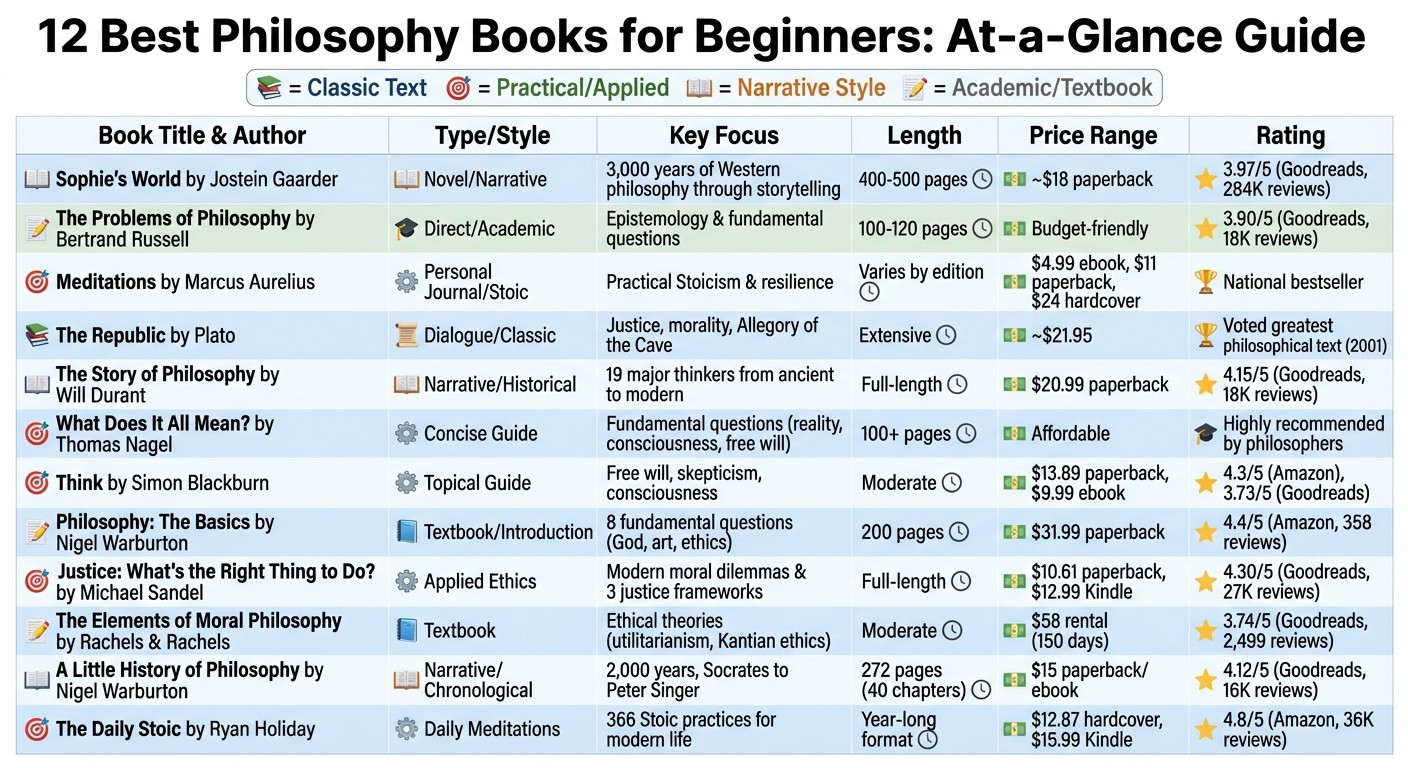
12 Best Philosophy Books for Beginners: Quick Comparison Guide
Best Philosophy Books for Beginners! || How to Start Reading Philosophy
If you're ready to commit, follow our philosophy reading habit checklist to stay consistent.
1. Sophie's World by Jostein Gaarder
Jostein Gaarder's Sophie's World turns philosophy into a gripping mystery novel. The story centers on 14-year-old Sophie Amundsen, a Norwegian teenager who begins receiving mysterious letters with questions like, "Who are you?" and "Where does the world come from?" These letters lead her into a correspondence course with Alberto Knox, a mysterious philosopher who guides her through 3,000 years of Western philosophy, from the early pre-Socratics to Jean-Paul Sartre. This setup creates the foundation for a story that’s both educational and engaging.
What makes Sophie's World stand out is how it seamlessly blends philosophical teachings with an intriguing plot. Instead of presenting abstract ideas in a textbook format, Gaarder incorporates them into a narrative filled with twists - including a metafictional element where Sophie and Alberto realize they are characters in a book. The Daily Telegraph describes this combination perfectly:
"A simply wonderful, irresistible book... a cross between Bertrand Russell's History of Western Philosophy and Alice in Wonderland."
Since its release, Sophie's World has captivated readers globally. It has sold over 40 million copies, been translated into 59 languages, and was the best-selling book of 1995. On Goodreads, it holds a 3.97 out of 5-star rating from 284,794 reviews. Priced around $18 for the paperback, the book spans roughly 400–500 pages and introduces readers to philosophical topics like Socratic ethics and existentialism in an approachable way.
Described as a "light-hearted textbook", Sophie's World gives readers a foundation to explore philosophy further. While the early chapters on historical context may feel slow, they build a strong base for the more complex ideas that follow. As author Madeleine L'Engle put it, "Sophie's World is sheer delight. How I wish I'd had it during my college freshman survey of philosophy!"
2. The Problems of Philosophy by Bertrand Russell
Bertrand Russell's The Problems of Philosophy takes a straightforward approach to exploring philosophy. Instead of embedding complex ideas in a narrative, Russell directly tackles fundamental questions with remarkable clarity. Published in 1912, he referred to this book as his "shilling shocker" - a short, affordable guide meant for everyday readers rather than academic scholars. At just 100–120 pages, it’s one of the most concise introductions to philosophical thought.
The book begins with a question that immediately grabs your attention: "Is there any knowledge in the world which is so certain that no reasonable man could doubt it?". To illustrate his ideas, Russell uses relatable examples - like a wooden table - to explore the contrast between appearance (how things seem to us) and reality (what they truly are). He points out how the table’s appearance changes based on lighting and perspective, leading to the surprising conclusion: "The real table, if there is one, is not immediately known to us at all, but must be an inference from what is immediately known". These tangible examples make complex ideas more accessible and set the stage for deeper philosophical discussions.
What makes this book especially approachable for beginners is its emphasis on epistemology - the study of knowledge - rather than diving into abstract metaphysics. Russell introduces key concepts like knowledge by acquaintance (what you experience firsthand) versus knowledge by description (what you know indirectly, through others). He also addresses the problem of induction, questioning how we can justify believing that the future will mirror the past. These foundational ideas are presented in a way that encourages readers to think critically about how we know what we know.
The book has received strong reviews, holding a 3.90 out of 5-star rating on Goodreads from 18,782 reviews and a 4.4 out of 5-star rating on Amazon from 1,278 reviews. It’s widely available in budget-friendly editions, making it easily accessible to readers.
Russell wraps up with a compelling argument for the importance of philosophy, emphasizing that its value lies not in providing definitive answers but in raising meaningful questions. As he eloquently puts it:
Philosophy, if it cannot answer so many questions as we could wish, has at least the power of asking questions which increase the interest of the world, and show the strangeness and wonder lying just below the surface even in the commonest things of daily life.
Even today, The Problems of Philosophy is a staple in introductory philosophy courses and remains Russell’s most widely read work.
3. Meditations by Marcus Aurelius
Meditations is a deeply personal journal written by Roman Emperor Marcus Aurelius during military campaigns between 170 and 180 AD, as he faced battles against barbarian tribes on Rome's northern frontier. Interestingly, Marcus never intended these writings for publication; the original title, Ta eis heauton, translates to "To Himself". This unfiltered glimpse into his thoughts allows readers to connect with one of history's most influential leaders as he confronts universal struggles like stress, difficult relationships, and finding purpose during hardship. The result is a timeless guide filled with practical wisdom for everyday life.
The book is especially approachable for beginners. Marcus focuses less on abstract theories and more on actionable advice, offering exercises to help control your thoughts, accept what you cannot change, and live with integrity. A core theme is the "inner citadel", the idea that while we cannot control external events, we have complete authority over our judgments and reactions. As Marcus himself puts it:
Your ability to control your thoughts - treat it with respect. It's all that protects your mind from false perceptions - false to your nature, and that of all rational beings.
For modern readers, the Gregory Hays translation in contemporary English makes the text more accessible. This edition has become a national bestseller and has received praise from both everyday readers and prominent figures. Arnold Schwarzenegger, for example, recommends dipping into it:
a page or two anytime you feel like the world is too much.
Meditations is an excellent starting point for exploring Stoic philosophy, which has seen a revival as a practical framework for handling today's fast-paced, tech-heavy world. The book is available in various formats - paperback ($11), hardcover ($24), and ebook ($4.99). Its lessons resonate with readers from all walks of life, including world leaders like Bill Clinton and historical figures such as Frederick the Great and General James Mattis, who reportedly carried it into battle. This blend of historical insight and practical guidance makes it a must-read for anyone seeking clarity and resilience in challenging times.
4. The Republic by Plato
Written around 375 BC, The Republic is Plato's longest and most influential work. In a 2001 survey, it was even voted the greatest philosophical text ever written. At its core, the dialogue grapples with an age-old question: What is justice, and is it always better to be just than unjust?. Through a lively conversation led by Socrates and his companions, Plato explores this question in a way that feels both thought-provoking and surprisingly approachable. The dialogue format breathes life into ancient debates, making them relevant and engaging even today.
One of the text's standout features is its use of storytelling to explore complex ideas. Instead of diving straight into abstract theories, Socrates challenges the notion that "might makes right" by constructing an ideal city. This city serves as a model for examining justice - both in society and within the individual. Plato breaks the soul into three parts - reason, spirit, and appetite - and argues that justice arises when reason takes charge. The famous Allegory of the Cave also makes its appearance here, capturing the journey from ignorance to enlightenment in a vivid and unforgettable way.
The work is filled with intriguing thought experiments. Take the Ring of Gyges, for instance - it asks whether someone would remain just if they could act without fear of consequences. Philosopher Julian Baggini notes that while The Republic might be "wrong on almost every point", the questions it asks are foundational to Western philosophy. Even Martin Luther King Jr. once named The Republic as the one book he'd want on a desert island, aside from the Bible.
For modern readers, accessibility isn’t an issue. Affordable translations, like the R.E. Allen version priced at $21.95, and free public domain editions make it easy to dive in. Some suggest starting with Plato’s shorter work, Apology, to get a feel for Socrates' style before tackling this more extensive dialogue. The beauty of The Republic lies in how it methodically challenges assumptions, offering readers a chance to uncover deeper truths alongside Socrates.
5. The Story of Philosophy by Will Durant
First published in 1926, The Story of Philosophy quickly became a sensation, selling millions of copies and introducing countless Americans to the world of philosophy. Will Durant's approach makes philosophy approachable by weaving together the personal lives, adventures, and historical contexts of 19 major thinkers.
The book began as a series of affordable pamphlets aimed at educating workers, written in a straightforward and engaging style. Durant explores the ideas of influential figures like Plato, Aristotle, Nietzsche, and even 20th-century philosophers such as Bertrand Russell and John Dewey.
"Durant's insight and wit never cease to dazzle; The Story of Philosophy is an essential book for anyone who wishes to understand the history and development of philosophical ideas in the Western world." – Simon & Schuster
Durant’s writing is lively and filled with vivid descriptions that breathe life into figures like Socrates and the dramatic world of ancient Greece. The New York Times described the book as "a delight", and it maintains a strong 4.15-star rating on Goodreads, based on over 18,000 reviews. Readers have also praised the book for popularizing motivational quotes that continue to resonate.
At $20.99 for the trade paperback, it’s both affordable and captivating - an excellent starting point for anyone curious about the evolution of Western thought. Durant’s ability to mix storytelling with philosophical insight makes this book a perfect companion to other accessible works in the field.
6. What Does It All Mean? by Thomas Nagel
Published in 1987, What Does It All Mean? is a short and approachable book designed for those new to philosophy. At just over 100 pages, it serves as an excellent introduction to the subject, requiring no prior knowledge. Thomas Nagel, known for influential works like Mortal Questions and The View From Nowhere, crafted this concise guide to make philosophy accessible to all.
This book covers some of philosophy's most fundamental questions, such as the nature of reality, consciousness, language, free will, ethics, justice, death, and the meaning of life. Nagel doesn’t try to provide definitive answers; instead, he encourages readers to think deeply about these topics. His approach reflects Socrates' famous idea that wisdom begins with recognizing how much we don’t know.
Nagel’s work has received widespread praise for its clarity and simplicity. British philosopher Nigel Warburton strongly recommends it as a perfect starting point for beginners. He highlights the book's "almost Orwellian" clarity, calling the prose "completely unpretentious, unpatronizing, and clear." Warburton also emphasizes how the book captures the universal human urge to question life's mysteries, describing it as:
"It's the kind of book you could read in an evening, but at the same time you'd really have a flavor of what philosophy is."
Nagel himself acknowledges the ever-evolving nature of philosophy, stating, "Philosophy is a somewhat dizzying activity, and few of its results go unchallenged for long." This honest perspective, combined with the book's straightforward style, makes it an inviting and thought-provoking read for anyone curious about life's big questions.
7. Think by Simon Blackburn
Published by Oxford University Press in 1999, Think serves as an accessible introduction to major philosophical questions, guided by Simon Blackburn, a former Cambridge professor and the author of the Oxford Dictionary of Philosophy. Impressively, the book sold over 30,000 hardcover copies in its early years. Each chapter is designed to stand alone, making it easier for readers to dive into specific topics without feeling overwhelmed.
The book's structure is one of its greatest strengths. Each chapter delves into a core philosophical issue, such as skepticism, consciousness, free will, or the existence of God. Blackburn doesn’t just explain these abstract ideas - he also shows how influential thinkers like René Descartes, David Hume, Immanuel Kant, and Ludwig Wittgenstein wrestled with these very questions. This blend of philosophical concepts and historical context helps readers grasp even the most challenging ideas.
What sets Think apart is its focus on practical application. According to the MIT Press Bookstore:
Think dispels this myth [that philosophy is purely academic] and offers a springboard for all those who want to learn how the basic techniques of thinking shape our virtually every aspect of our existence.
Blackburn’s approach equips readers with the tools to explore philosophy further, even without prior training.
With a 4.3/5 rating on Amazon and 3.73/5 on Goodreads, Think has been praised by prominent philosophers like Mark Sainsbury and Anthony Quinton. Priced at approximately $13.89 for the paperback and $9.99 for the eBook, it’s an affordable way to engage with philosophical thought. For anyone curious about timeless debates, Think provides a clear, approachable entry point.
8. Philosophy: The Basics by Nigel Warburton
Philosophy: The Basics by Nigel Warburton stands out as a highly accessible introduction to philosophy. First published in 1992 and now in its 5th edition (released in December 2012), the book tackles eight fundamental questions, such as "Does God exist?" and "What is the nature of art?" - all within a compact 200 pages. Stephen Law, author of The Philosophy Gym, praises it:
"Philosophy: The Basics deservedly remains the most recommended introduction to philosophy on the market. Warburton is patient, accurate and, above all, clear. There is no better short introduction to philosophy."
The book covers essential topics like ethics, politics, science, and the mind, offering clear explanations of key arguments. Notably, the 5th edition includes a new chapter on the philosophical treatment of animals, reflecting current discussions in the field.
Warburton, who also co-hosts the popular Philosophy Bites podcast, designed this book to bridge the gap between casual interest and the more challenging works of philosophers like Hume, Descartes, and Mill. Each chapter concludes with a "Further Reading" section, making it easier for readers to dive deeper into the subject.
Readers often highlight its clarity and brevity as major strengths. On Amazon, the book holds a 4.4/5 rating from 358 reviews, while Goodreads users rate it 3.84/5 based on 2,865 ratings. The paperback version is priced at $31.99, with eBook options also available.
9. Justice: What's the Right Thing to Do? by Michael J. Sandel
Michael J. Sandel’s Justice: What's the Right Thing to Do? brings moral philosophy out of the classroom and into real-world challenges, forcing readers to rethink their assumptions. Drawing from Sandel’s famous Harvard course, attended by over 15,000 students since 1980, the book tackles questions like: Is it ever acceptable to sacrifice one life to save five? Should laws stay neutral on moral issues? What responsibilities do we bear as citizens?
Using the Socratic method, Sandel walks readers through three key approaches to justice: Utilitarianism, which seeks the greatest good for the most people; Libertarianism, which prioritizes individual rights and freedoms; and Virtue Ethics, which emphasizes moral character and the common good. These frameworks are applied to pressing modern debates, such as affirmative action, same-sex marriage, physician-assisted suicide, and the ethics of market practices. For instance, Sandel revisits the chaos following Hurricane Charley in 2004, where $2 bags of ice were sold for $10, igniting a debate over free-market principles versus the moral idea of a “just price”.
What sets this book apart is its ability to make dense philosophical ideas approachable. Sandel distills the works of thinkers like Aristotle, Kant, Mill, and Rawls into conversational, engaging language without watering down their complexity. Jonathan Rauch of The New York Times praised Sandel for explaining these philosophers' ideas "with clarity and immediacy" that’s rare in the field of philosophy. Walter Isaacson even called the book "absolutely indispensable for anyone who wants to be a good citizen", highlighting its relevance in navigating today’s conflicting values.
Readers have embraced Sandel’s work for its accessibility and thought-provoking content. On Goodreads, the book boasts a 4.30/5 rating from 27,938 ratings, while on Amazon, it holds an impressive 4.6/5 from 3,527 reviews. Sandel, who earned the 2025 Berggruen Prize, crafted this book to push beyond partisan divides and advocate for a "politics of the common good." Pricing is reasonable: the paperback costs $10.61, the Kindle edition $12.99, and the hardcover $22.12.
10. The Elements of Moral Philosophy by James Rachels & Stuart Rachels
The Elements of Moral Philosophy provides a straightforward and engaging introduction to ethical theory. First published in 1986, this textbook has been updated through its 10th edition (2023) and translated into at least 10 languages, including Chinese, Italian, Persian, and Norwegian. Its clear explanations and approachable style have made it a perennial favorite among students and educators alike.
The book is particularly celebrated for its concise and jargon-free writing. As McGraw-Hill Education highlights:
James Rachels is widely admired as a stylist; his prose is remarkably free of jargon and clutter.
Covering a range of moral frameworks - such as Cultural Relativism, Ethical Egoism, Social Contract Theory, Utilitarianism, Kantian Deontology, Virtue Ethics, and Feminism/Ethics of Care - the book uses relatable examples, like debates over euthanasia and famine relief, to illustrate these theories.
At its core is the concept of the "Minimum Conception of Morality", which suggests that morality involves guiding actions with reason while considering the interests of everyone affected. This idea reflects the book's focus on encouraging balanced and thoughtful ethical reasoning. Each chapter is self-contained, allowing readers to dive into topics like Utilitarianism or Kantian ethics without following a strict sequence. Rather than advocating for one "correct" theory, the text explores the strengths and weaknesses of each approach.
On Goodreads, the book has a rating of 3.74/5, based on 2,499 ratings and 235 reviews. Readers often commend its clarity and organization, though some have pointed out instances where the authors' personal views, particularly on religion and morality, come through. The paperback is affordably priced, with rental options starting at $58.00 for 150 days.
11. A Little History of Philosophy by Nigel Warburton
This book offers an engaging way to dive into philosophy, weaving a narrative that traces Western thought from Socrates all the way to modern figures like Peter Singer. A Little History of Philosophy, published by Yale University Press, packs 2,000 years of ideas into 272 pages. It’s divided into 40 short, story-like chapters, each spotlighting one or two influential thinkers. The book has been translated into over 20 languages and holds an impressive 4.12/5 rating on Goodreads from more than 16,000 reviews.
What makes Warburton’s approach stand out is his focus on "intellectual biographies." Instead of diving straight into abstract theories, he uses personal stories and quirky details about the philosophers to bring their ideas to life. As Sarah Bakewell puts it:
A primer in human existence: philosophy has rarely seemed so lucid, so important, so worth doing and so easy to enter into [[51]](https://www.antoineonline.com/intr/en/p/A Little History of Philosophy-Nigel Warburton Warburton Nigel/9780300187793).
Warburton aimed to make philosophy accessible to everyone, including teenagers as young as 14 or 15. He explains:
I've tried to bring in some aspects of the philosophers' lives and context. The idea was that an intelligent 14 or 15 year old could get a lot out of the book without being intimidated by dense language or advanced ideas.
This approachable style also makes the book a great fit for adult beginners looking for a straightforward introduction without getting bogged down in academic jargon. The chronological setup helps readers see how ideas build on one another - like how Bentham’s utilitarianism influenced Mill’s later work.
For those interested, the paperback and eBook versions are priced at $15.00, and the audiobook, which runs about 7.5 hours, offers another way to enjoy the content.
12. The Daily Stoic by Ryan Holiday
The Daily Stoic offers a meditation for every day of the year - 366 in total - crafted by Ryan Holiday and Stephen Hanselman. The book has been a hit, selling over two million copies and spending 11 weeks on the Wall Street Journal bestseller list, where it peaked at #2 overall.
Each daily entry includes a translated quote from renowned Stoic philosophers like Marcus Aurelius, Seneca, Epictetus, Zeno, and Musonius Rufus. These quotes are paired with modern commentary and historical context to make the teachings relevant for today. The book is divided into three key themes of Stoic practice: The Discipline of Perception (January–April), The Discipline of Action (May–August), and The Discipline of Will (September–December). This layout ensures readers can focus on one foundational concept at a time, making it especially approachable for those new to Stoicism.
Ryan Holiday sums up the essence of Stoicism with this thought:
"The single most important practice in Stoic philosophy is differentiating between what we can change and what we can't. What we have influence over and what we do not."
What makes this book stand out is its straightforward tone and practical advice, which help readers handle stress and maintain focus. Gregory Hays, a respected translator of Marcus Aurelius, commended the book for guiding readers to "find your still center" regardless of their career or life situation. Like other books in this guide, The Daily Stoic transforms ancient wisdom into actionable insights for modern life.
The book has earned high praise from readers, holding a 4.8 out of 5 rating on Amazon from 36,304 reviews. On Goodreads, it scores 4.37 out of 5, based on 52,961 ratings. The hardcover edition is priced at $12.87, while the Kindle version costs $15.99. The audiobook, narrated by Tim Ferriss, is available for free with an Audible trial. For those who want to deepen their Stoic practice, the companion volume, The Daily Stoic Journal, offers writing prompts and weekly exercises to complement the main book.
How Logos Philosophy Club Supports Your Reading
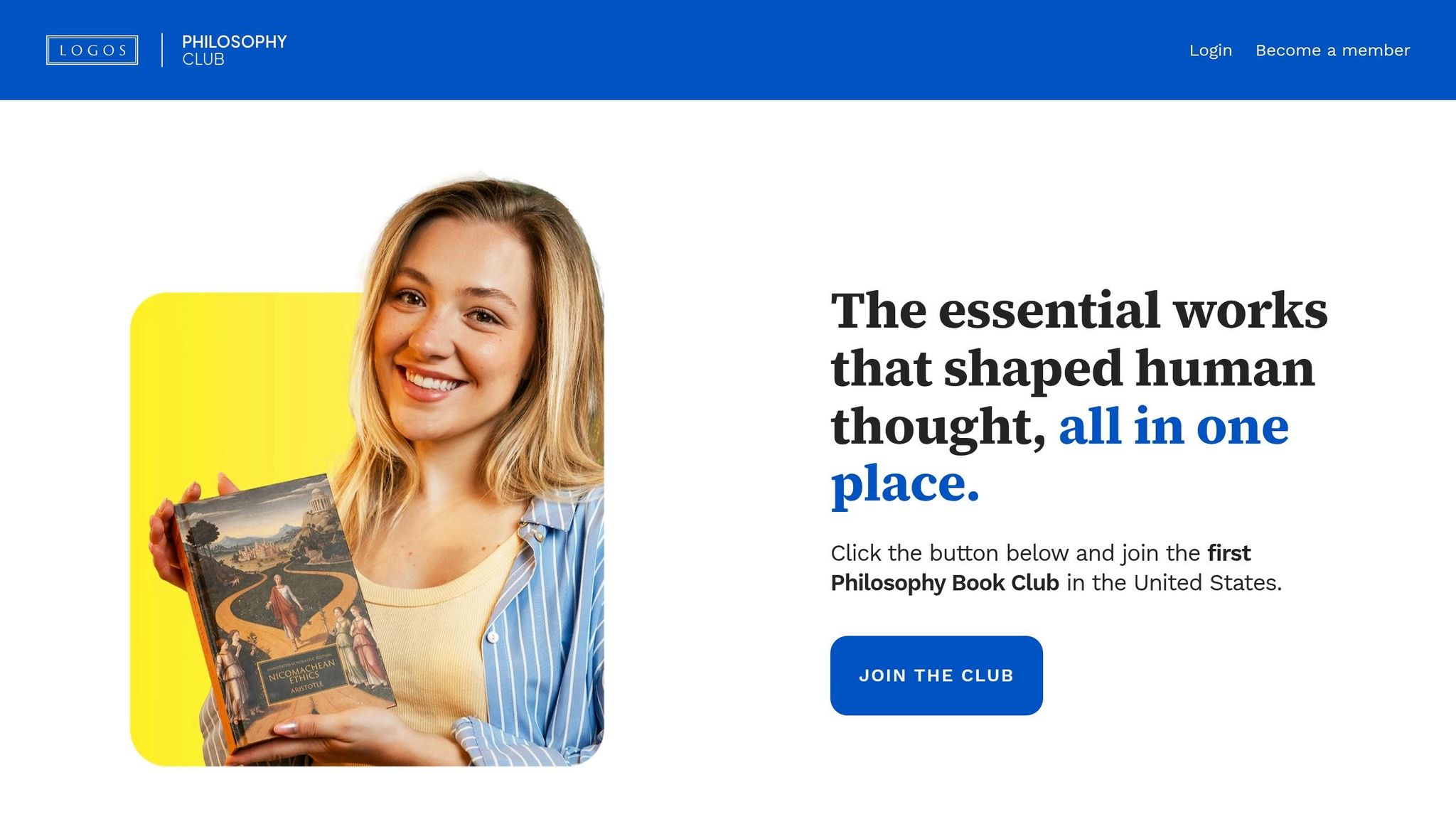
Diving into philosophy on your own can feel like navigating a maze - dense arguments, unfamiliar terms, and complex ideas can leave you feeling stuck. That’s where Logos Philosophy Club steps in, transforming solitary study into a guided and enriched journey. As the first philosophy subscription book club in the U.S. focused exclusively on foundational works, it’s backed by a parent publishing group in Brazil with over 20,000 monthly subscribers.
Each month, members receive bilingual editions of foundational texts, meticulously translated from their original languages. These side-by-side editions allow you to compare the translation with the source text, which is especially helpful when tackling works like Plato’s The Symposium (set for March 2026) or Aristotle’s Nicomachean Ethics (coming December 2025). This format not only enhances understanding but also reflects the club’s dedication to providing high-quality materials.
The books themselves are built to last. Member John Roche praised their craftsmanship, saying:
The book is sturdy and very well bound, but so far the scholastic commentary is the real gem.
To deepen your engagement, the club includes The Logos Reader with select releases. This supplementary volume features essays, annotations, and scholarly insights that bridge the gap between ancient philosophy and modern readers. It’s perfect for those moments when you’re stuck on a challenging passage. Some packages even include extras like posters inspired by the texts. Member Spencer Simons shared his excitement:
The poster is a nice perk I wasn't aware of. I'm going to grab a frame tomorrow and hang it on my bedroom wall.
Beyond the books, Logos connects you with a global network of readers, translators, and scholars, fostering a sense of community and shared learning. This collaborative approach makes philosophy more accessible and engaging, moving it beyond the confines of solitary academic study.
At its core, the club aims to revive philosophy as a living, disciplined tradition, offering a richer, more connected way to explore these timeless works.
Logos Philosophy Club Subscription Plans
Logos Philosophy Club keeps things simple with two subscription options designed to fit different reading habits and budgets. The Monthly Plan is priced at $45 per month, offering flexibility without a long-term commitment. For those ready to dive deeper, the Yearly Plan costs $420 per year, breaking down to $35 per month - saving you $120 annually compared to the monthly option.
Both plans provide the same enriching experience. You'll receive one carefully curated bilingual philosophical work each month, delivered with free shipping. Some editions even come with special extras like posters or bookmarks to enhance your collection.
Here’s where the plans differ: Annual members get exclusive pricing on past releases, making it easier to complete your collection or catch up on books you missed before joining. Monthly subscribers can also buy past books but without the discounted rate.
Switching plans is hassle-free through your account settings, with any existing balances adjusted on a prorated basis.
No matter which plan you choose, you'll join a global community of over 20,000 readers and receive the same high-quality editions praised for their durability and scholarly insight. Your decision comes down to your budget and how deeply you want to engage with the club's offerings.
Conclusion
These 12 books offer a thorough introduction to the major branches of philosophy. From Bertrand Russell's insights into epistemology to Michael Sandel's ethical dilemmas and Marcus Aurelius's Stoic reflections, they showcase philosophy as an ongoing conversation rather than a collection of static, isolated ideas. With such diversity, there's something here for every type of reader.
What makes this collection stand out is its variety. If academic writing feels overwhelming, you can ease into philosophy with the narrative style of Sophie's World or the approachable storytelling in A Little History of Philosophy. On the other hand, if you're ready to jump straight into foundational works, Plato's The Republic is a surprisingly accessible classic. As philosopher Skye Cleary points out:
The main way to dip your toes into philosophy is by reading about philosophers historically, and for that, I recommend A Little History of Philosophy by Nigel Warburton.
Philosophy doesn’t demand formal training - just curiosity and a willingness to engage. Beyond abstract ideas, it offers practical rewards: reading philosophical texts hones critical thinking, enhances problem-solving skills, and strengthens your ability to craft logical arguments in everyday life.
FAQs
Which book should I start with first?
Plato's The Last Days of Socrates is a fantastic entry point for those new to philosophy. The dialogues are written in a way that's easy to follow, presenting important philosophical concepts in an engaging and straightforward manner. It's a great choice for anyone looking to dive into the world of philosophical thought.
Do I need any background knowledge to read these?
These books are written with beginners in mind and don’t assume any prior knowledge. They offer an easy-to-understand introduction to important philosophical concepts and notable thinkers, making them perfect for those just starting to explore the subject.
What should I read after finishing these 12?
After finishing the 12 books, you might want to check out Sophie’s World by Jostein Gaarder, which provides an engaging journey through the history of philosophical ideas. For something more grounded, Meditations by Marcus Aurelius offers practical and timeless reflections on ethics and personal growth. If you're ready to delve into more intricate concepts, A Theory of Justice by John Rawls presents challenging and thought-provoking discussions on fairness and morality. These works expand on foundational ideas while introducing a variety of perspectives and traditions.