Ancient vs. Modern Philosophy: Key Differences Compared
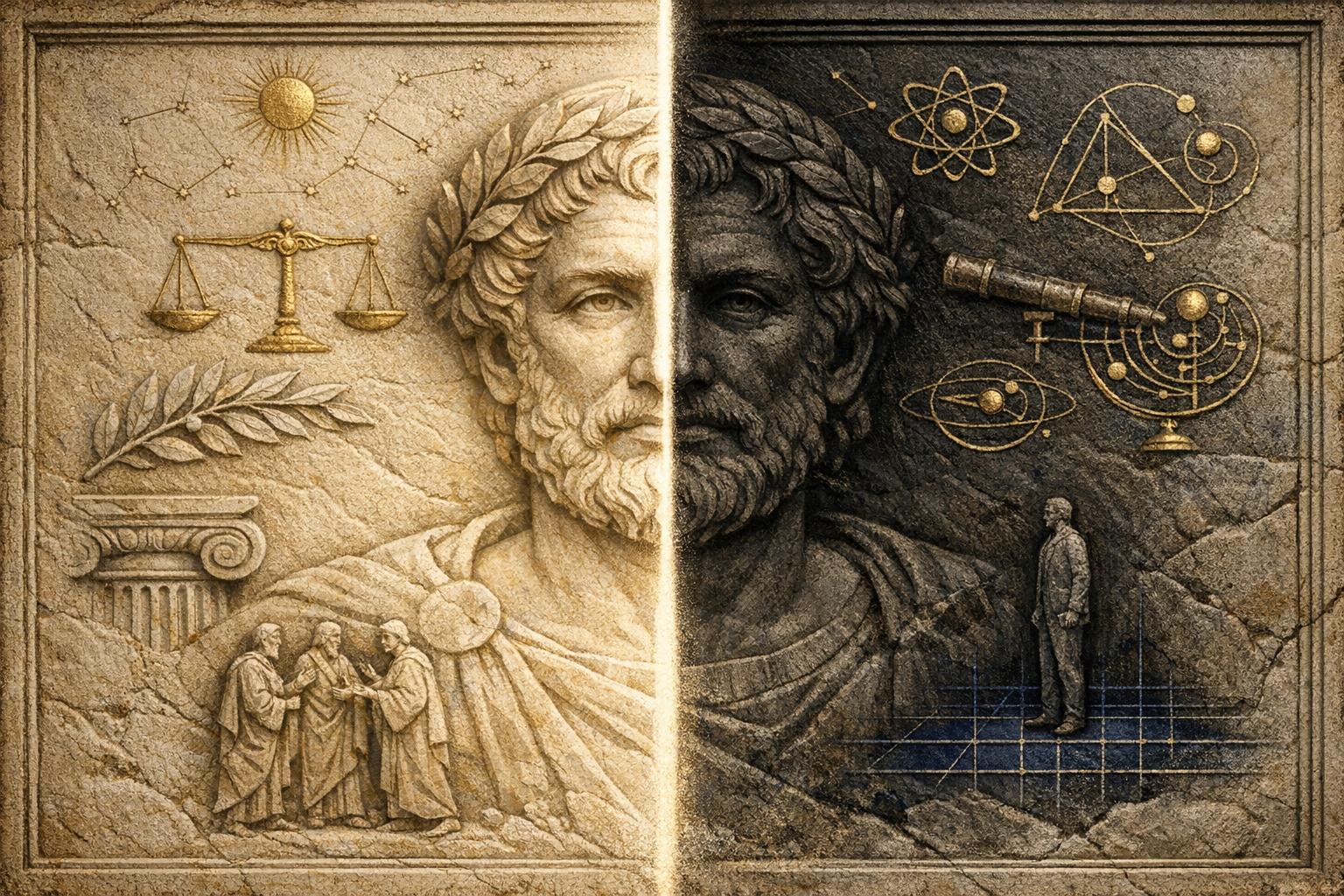

Ancient and modern philosophy differ in their approach to reality, knowledge, and ethics. Ancient thinkers like Plato and Aristotle focused on metaphysics, virtue ethics, and sensory experience, emphasizing harmony and character development. Modern philosophers such as Descartes and Kant shifted toward individual reasoning, scientific methods, and the mind-body connection, exploring knowledge through analytical reasoning and empirical data.
Key Differences:
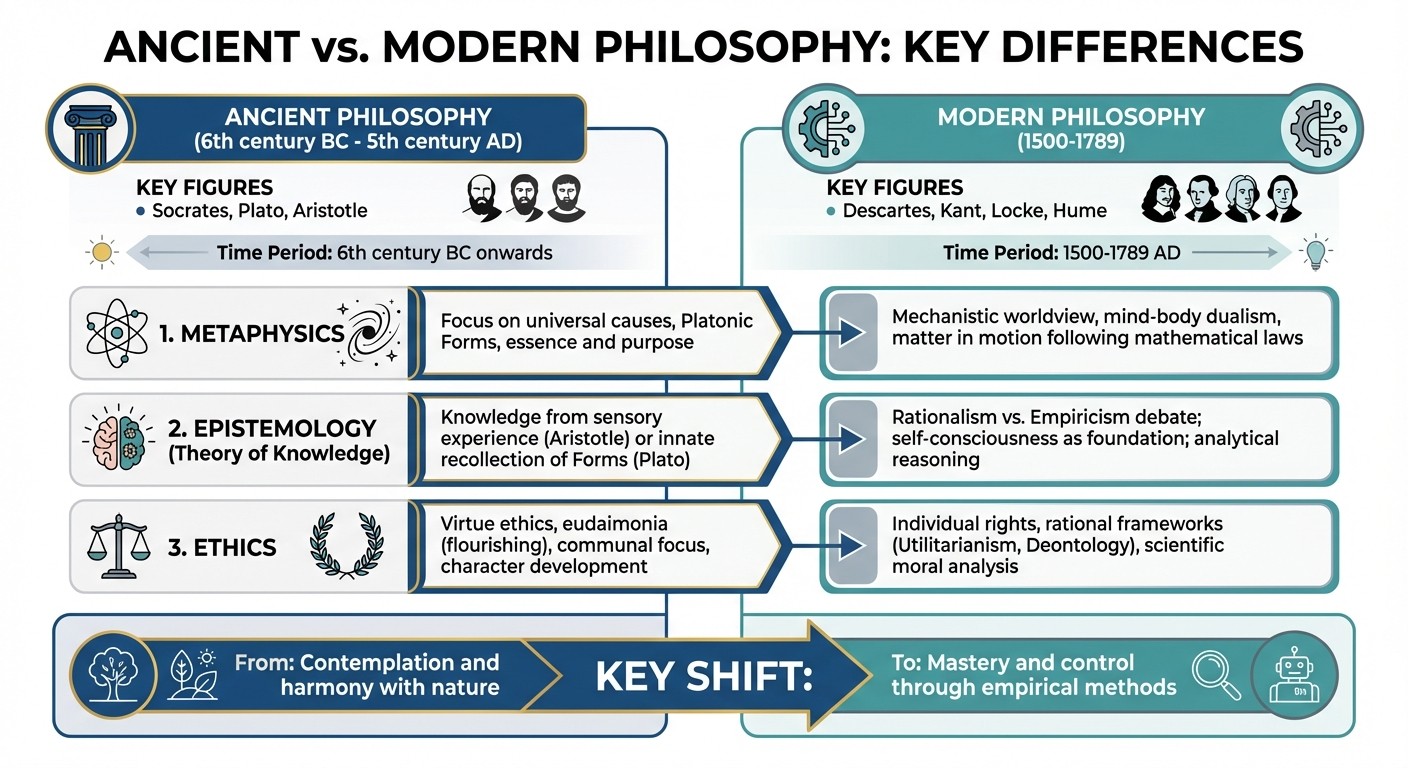
Metaphysics: Ancient philosophy explored universal causes and forms; modern philosophy examined mechanisms and dualism (e.g., mind vs. body).
Epistemology: Ancient thinkers valued innate ideas or sensory experience; modern philosophers debated reason (Rationalism) vs. sensory perception (Empiricism).
Ethics: Ancient ethics emphasized communal virtues and flourishing, while modern ethics prioritized individual rights and rational frameworks.
Quick Comparison:
Aspect | Ancient Philosophy | Modern Philosophy |
|---|---|---|
Metaphysics | Focus on universal causes, Forms, and essence | Mechanistic view, mind-body dualism |
Epistemology | Sensory experience, innate ideas | Rationalism vs. Empiricism, self-consciousness |
Ethics | Community virtues, flourishing (eudaimonia) | Individual rights, scientific moral analysis |
Both traditions influence today’s discussions on science, morality, and consciousness. Combining ancient ethical focus with modern analytical tools can address complex modern challenges effectively.
Ancient vs Modern Philosophy: Key Differences in Metaphysics, Epistemology, and Ethics
1. Ancient Philosophy
Historical Context
Ancient Greek philosophy began to take shape in the 6th century BC with the Milesian school, which introduced the idea that a single material element - like water or air - formed the foundation of the universe. This marked a shift from mythological explanations to natural, rational ones. As cities grew and societies became more complex, philosophical focus expanded from the cosmos to questions about human life and societal values. Socrates, in particular, steered philosophy toward ethics, asking how people should live and initiating methods of systematic inquiry that were later developed by Plato and Aristotle. These early changes set the stage for deeper explorations into metaphysics and other areas of thought.
Metaphysics
Plato introduced the idea that ultimate reality exists in perfect, unchanging Forms or Ideas - abstract concepts like Beauty or Justice that exist independently from the material world. He saw the physical world as an imperfect reflection of these higher realities. Aristotle, on the other hand, took a different approach. He described metaphysics as the study of "being qua being", focusing on what it means for something to exist. Unlike Plato, Aristotle argued that universals, like the essence of a thing, exist within objects themselves. He also created a detailed system to categorize reality into key elements like substance, quality, and quantity.
Ethics
Ethics in ancient philosophy revolved around the idea of eudaimonia, often translated as "flourishing" or "living well." This was achieved by fulfilling one's potential and practicing virtues, or arete, which referred to excellence of character. Core virtues included courage, moderation, justice, and piety. Rather than focusing on isolated actions, this approach emphasized the development of moral character. Socrates famously argued that virtue is a kind of knowledge - if someone truly understands what is good, they will naturally act in alignment with that understanding. Mistakes, he believed, stem from ignorance. Building on this, Plato proposed that the soul consists of three parts - Reason, Spirit, and Appetite - and that justice is achieved when these elements are in harmony. This emphasis on character and understanding laid the groundwork for later philosophical discussions about knowledge.
Epistemology
Socrates employed the elenchus, a method of cross-examination, to challenge and refine ethical beliefs. Plato distinguished between two types of understanding: doxa (belief), tied to the constantly changing sensory world, and episteme (knowledge), which comes from the soul's recollection of unchanging Forms experienced before birth. Aristotle, rejecting Plato's idea of innate knowledge, argued that the mind starts as a blank slate and that all knowledge comes from sensory experience (aisthesis). He emphasized the importance of observation and inductive reasoning as the basis for understanding. These differing approaches to knowledge became foundational for the evolution of Western philosophy.
2. Modern Philosophy
Historical Context
Modern philosophy, which developed between 1500 and 1789, marked a clear departure from the traditions of Medieval Scholasticism. This period coincided with the Scientific Revolution, which emphasized skepticism and reason as tools for understanding the world. René Descartes famously advocated starting from a clean slate, doubting all inherited beliefs to uncover absolute certainty. During the Age of Enlightenment, intellectuals began challenging the dominance of religious and political authorities, promoting reason as the foundation for progress. Unlike the medieval scholars who were often tied to universities, key modern philosophers - including figures like Francis Bacon and David Hume - operated as independent thinkers, lawyers, or diplomats. This intellectual shift opened new avenues for examining knowledge, reality, and ethics.
Epistemology
Modern philosophy placed a strong emphasis on epistemology - the study of knowledge - as its starting point. While ancient philosophers often relied on sensory experience or innate recollection, modern thinkers sought to ground knowledge in analytical reasoning. For instance, Aristotle built his metaphysical systems on observations of the natural world, whereas Descartes aimed to establish metaphysics as the foundation supporting physics. Descartes’ focus on self-consciousness shifted the source of certainty from the external world to the individual thinking mind. This led to a major division between Rationalists, such as Descartes, Spinoza, and Leibniz, who believed knowledge stems from innate ideas and reason, and Empiricists, like Locke and Hume, who argued that knowledge arises solely from sensory experience. John Locke introduced the idea that the truth of a concept depends on its origins in experience, a "genetic" criterion. Later, Immanuel Kant bridged these opposing views by asserting that while knowledge begins with experience, the mind provides the necessary categories to organize it. This new approach to understanding knowledge significantly influenced metaphysical thought.
Metaphysics
In modern metaphysics, the ancient view of inherent purposes gave way to a mechanistic perspective, where "matter in motion" followed mathematical laws. Descartes redefined metaphysics as the groundwork for physics, introducing a dualistic framework that separated the mind (a spiritual essence) from matter (the physical realm of spatial extension). This division created the enduring "mind-body problem." Spinoza, in contrast, proposed a monistic view, describing a "single infinite substance" that he identified as God or Nature. Leibniz countered with a pluralistic model of infinite "monads", or indivisible units of reality. Francis Bacon also reshaped metaphysical ideas, replacing the ancient concept of "form" with enduring geometric or mechanical structures, reflecting the era's focus on mathematics and science. These developments set the stage for new approaches to ethics.
Ethics
Modern ethical theory shifted away from the ancient focus on virtue ethics, emphasizing individual rights and rational analysis instead. This change mirrored broader societal transformations. Ethical frameworks during this period developed into schools of thought like Utilitarianism (Mill, Bentham), Deontology (Kant), and Social Contract theory (Hobbes, Locke, Rousseau). While ancient Greek philosophers emphasized civic engagement and achieving the "good life" through character development, modern thinkers concentrated on individual autonomy and the scientific study of human behavior. Influenced by the Scientific Revolution, figures like Hobbes analyzed human emotions and actions as mechanical processes rather than as expressions of intrinsic purpose. This new focus on practical mastery over nature aimed to improve human life, grounding morality in the study of the human mind and sensory experience.
Thinking About Thinking IV: Quarrel Between Ancient & Modern Philosophy II
Pros and Cons
Ancient and modern philosophy each bring their own strengths and weaknesses to the table when it comes to tackling fundamental questions about reality, knowledge, and ethics. Ancient philosophy offers a broad framework that ties together different aspects of life, focusing on character development and the pursuit of eudaimonia (the good life). As one scholar pointed out, it provides a stable and coherent guide for personal behavior. Ancient Realism, which emphasizes sensory experience and internal consistency, stands in contrast to the dualistic approaches often found in modern thought.
On the other hand, modern philosophy shines in its analytical precision and its reliance on scientific methods. Francis Bacon famously declared that "knowledge is power - over nature, which was to be conquered for 'the relief of man's estate,'" reflecting the modern drive to harness empirical investigation to master the natural world. This era also gave rise to ethical frameworks like Utilitarianism and Deontology, which focus on individual rights and universal duties - marking a clear departure from the virtue ethics of ancient philosophy. However, both traditions face limitations when applied to contemporary issues.
Ancient virtue ethics, while excellent for shaping personal character, struggles with modern technical dilemmas. As the Internet Encyclopedia of Philosophy notes, "The traditional moral theories are not sufficiently well equipped to deal with completely new problems such as issues concerning nuclear power, gene technology, and cloning". In response, philosophers like Rosalind Hursthouse have developed neo-Aristotelian approaches to adapt ancient ideas to address topics like abortion and environmental concerns.
Modern philosophy, for its part, often leans too heavily on abstraction and specialization. Its evolution from a way of life into a highly specialized academic discipline has distanced it from everyday practical concerns. Additionally, the Cartesian mind–body split introduced a lasting divide between mental and physical knowledge - something ancient Realism managed to avoid.
A balanced approach that combines the ethical focus of ancient philosophy with the analytical tools of modern philosophy can provide a more comprehensive framework. Ancient ethics offers guidance and meaning, while modern methods supply the scientific and analytical resources needed to address today's complex challenges. Together, they form a more integrated way to navigate the demands of the modern world.
Conclusion
Ancient and modern philosophy provide two contrasting ways of understanding the world. Ancient thinkers approached nature with a sense of awe and contemplation, while modern philosophers shifted toward mastering and analyzing nature through empirical methods. This transition from reflection to control mirrors broader societal changes - from the communal life of Greek city-states to the rise of the scientific method and nationalism.
Despite their differences, the core questions of both traditions remain surprisingly interconnected. As The Realist Guide puts it, "The Greeks came up with all of the major themes of philosophy and also of metaphysics. Everything since then has just been a variation on one of those themes". This continuity highlights the ongoing dialogue between ancient and modern thinkers.
Incorporating both perspectives into daily life can be transformative. Ancient virtue ethics, particularly Aristotle’s concept of phronesis (practical wisdom), offers timeless guidance for personal growth and character development. Meanwhile, modern analytical methods provide the tools to address pressing challenges like environmental issues or ethical dilemmas in technology.
FAQs
Why did modern philosophy shift focus from metaphysics to epistemology?
Modern philosophy transitioned its focus from metaphysics to epistemology largely due to the rise of scientific methods and logical analysis between the 17th and 20th centuries. Movements like empiricism and logical positivism challenged the validity of many metaphysical questions, labeling them as unverifiable and instead prioritizing knowledge that could be observed and tested. As a result, epistemology - the study of knowledge and belief - took center stage. Even so, some modern philosophers contend that metaphysics still holds importance, particularly within analytic philosophy, which examines these questions through detailed and rigorous analysis.
How does Kant reconcile rationalism and empiricism in everyday terms?
Kant combines the ideas of rationalism and empiricism by showing that knowledge arises from both reason and sensory experience. According to him, the mind has built-in structures that organize sensory information into meaningful perceptions. This means we depend on both logical reasoning and our experiences to make sense of the world. However, our understanding is not purely objective - it’s influenced by the mind’s natural categories, which shape and structure how we perceive reality.
Which approach fits modern dilemmas better: virtue ethics or rights-based ethics?
Rights-based ethics often aligns more effectively with modern challenges because it emphasizes individual rights, autonomy, and justice. These principles are crucial when tackling issues such as human rights, privacy, and equality. While virtue ethics plays an important role in fostering personal moral development, it may seem less practical or actionable in scenarios that demand clear protections or legal structures. In contemporary decision-making, rights-based ethics tends to provide a more straightforward and applicable framework.