Kant on Forms of Intuition: 9 Questions


Kant’s main point is simple: space and time come from the way I experience objects, not from objects as they are on their own. In this article, I explain 9 core questions that lead to that result.
Here’s the short version:
Intuition means the direct way an object is given to me.
Sensibility receives what is given; understanding thinks it by means of concepts.
Space and time are the a priori forms of intuition.
Space orders outer experience; time orders inner experience and all representations.
Kant treats space and time as intuitions, not concepts, because each is one whole with many parts.
They are empirically real for experience, but transcendentally ideal with respect to things in themselves.
Appearances can be known; things in themselves mark the limit of what I can know.
Knowledge needs both intuition and concepts - not one without the other.
One line sums up much of the article: “Thoughts without content are empty; intuitions without concepts are blind.” That gives me the basic split: receiving is not the same as thinking.
Question | Short answer |
|---|---|
What is intuition? | The immediate way an object is given |
What are the forms of intuition? | Space and time |
Why is space pure? | Outer experience already depends on it |
Why is time pure? | Inner experience already depends on it |
How do they differ? | Space orders outer sense; time orders all representations |
Why intuitions, not concepts? | They are single wholes, not general classes |
Are they in things themselves? | No |
Appearance vs. thing in itself? | What I can experience vs. what I cannot know directly |
How do they make knowledge possible? | They supply what concepts then think |
So if I had to boil the whole piece down to 2 claims, it would be these: (1) human knowledge applies to objects as they appear, and (2) space and time set the frame for 100% of that experience.
That’s the lens for everything that follows.
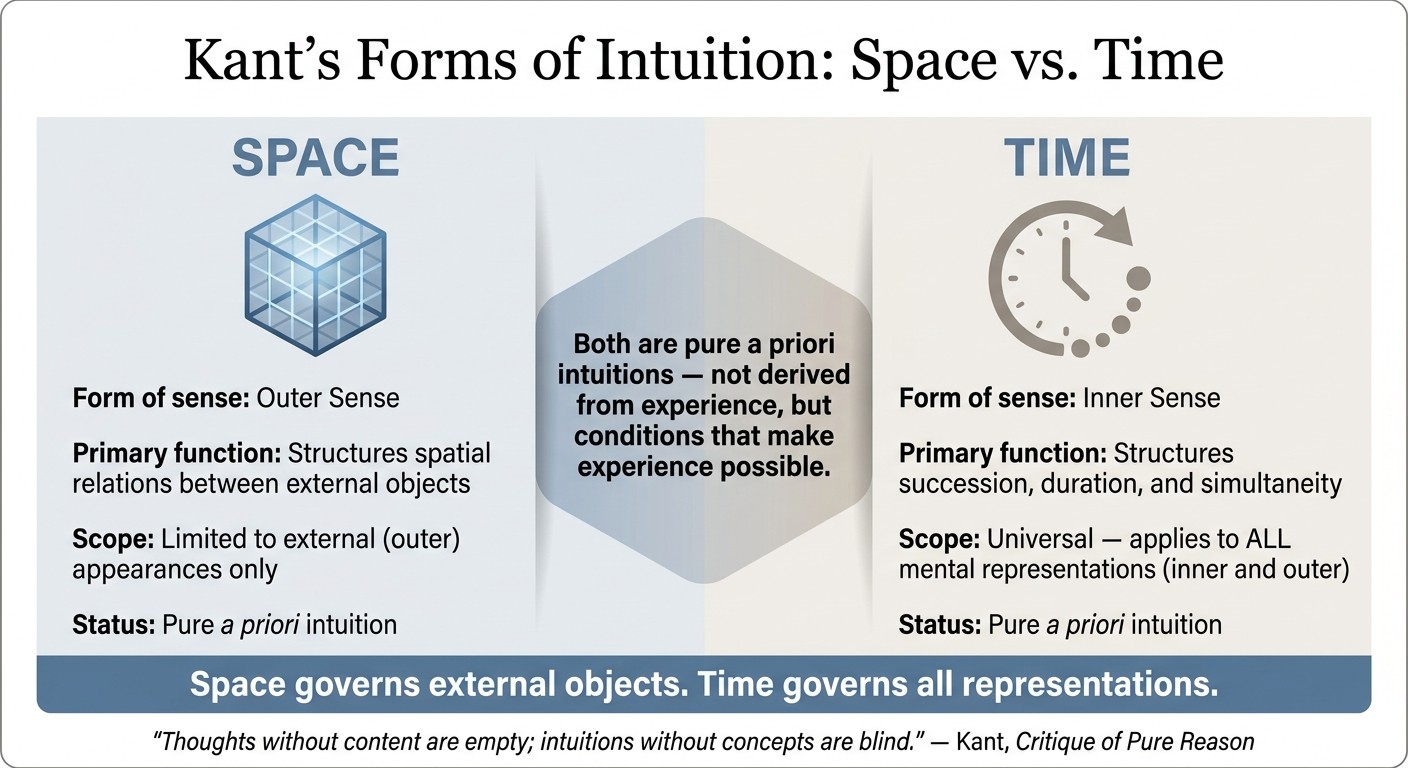
Kant's Forms of Intuition: Space vs. Time Explained
Why Space & Time Are Illusions - Critique of Pure Reason, Immanuel Kant (Summary) - #2
1. What does Kant mean by intuition?
For Kant, intuition doesn't mean a hunch or gut feeling. It means the direct, immediate way an object is given to the mind. That point matters because this is where Kant places the mind's receptive side.
Before the understanding can think an object, that object has to be given through sensibility. This distinction matters because Kant is separating two different things: receiving and thinking.
Intuition, sensibility, and concept
Kant draws a line between two faculties. Sensibility is the receptive faculty. It takes in what is given. The understanding thinks objects by way of concepts.
Put simply: sensibility gives, and the understanding thinks. Sensibility supplies the raw given, while space and time show the way that given is arranged. Kant calls that receptive arrangement the forms of intuition. The next step is to see what those forms are.
2. What are the forms of intuition?
Sensibility takes in what is given. But it doesn't do that in a raw, shapeless way. It needs a built-in way to receive what shows up. For Kant, those forms are space and time. They are the a priori structures of sensibility. In plain English, they don't come from experience; they are what make experience possible in the first place.
You can think of space and time as the basic frame that sorts sensory input. Without them, sensation would still be there, but it would not yet count as experience in any knowable sense.
Matter and form in sensibility
Kant splits sensibility into two parts: matter and form.
Matter is the content of sensation.
Form is the ordering structure that lets that content appear as a coherent experience.
Kant calls space and time pure forms because we do not learn them from sensation.
So space and time are the mind's a priori structures of sensibility. From there, the next step is to see why space counts as a pure form of intuition.
3. Why is space a pure form of intuition?
If space and time are forms of sensibility, the next step is to see why space has to be one of them. For Kant, space is a priori because outer experience already rests on it. We don’t first observe objects and then build the idea of space from those observations. It works the other way around: space is the form through which external objects appear to us.
That matters because it explains why some spatial claims can be necessary, not just learned by watching the world. Kant’s reply to Hume turns on that point. Instead of asking what comes from experience alone, he asks what the mind must already provide for experience to happen at all.
Geometry studies that very structure. So its claims are not just analytic, and they are not pulled from experience either. They can be synthetic and a priori. That is why geometry can state synthetic a priori truths about space.
4. Why is time a pure form of intuition?
The case for time follows the same basic path as the case for space, but it applies to a different domain. Space is the form of outer sense. It gives shape to how objects outside us appear. Time, by contrast, is the form of inner sense. It orders how we experience our own thoughts, feelings, and mental states. In that sense, time is the inner match to space.
Kant’s core idea is pretty direct: we do not learn succession and simultaneity from experience. Time has to be there first, or experience could not show us one thing coming after another, or several things existing at once. So time is pure because we do not pull it out of separate events by abstraction. We already rely on it whenever we experience anything at all.
From there, Kant makes a broader claim about inner sense. Temporal order is not something the mind figures out after the fact. It is one of the conditions that makes experience possible in the first place.
This contrast stands out even more when time is set alongside space.
5. How do space and time differ?
Kant’s distinction gets easier to see once you separate the kind of experience each one orders. The difference comes down to scope. Space orders outer experience. Time orders both outer and inner experience.
Space is the form of outer sense. It shapes how external objects appear as located and related in space. Time is the form of inner sense. It shapes how our mental states show up as successive or simultaneous.
That split leads to an important result: time applies to all representations. Even outer experience has to pass through the mind, so it also comes under the conditions of inner sense. Space applies only to external appearances. Kant therefore treats time as a condition of inner experience, not as a feature of external things.
Feature | Space | Time |
|---|---|---|
Form of sense | Outer sense | Inner sense |
Primary function | Structures spatial relations | Structures succession, duration, and simultaneity |
Scope | Limited to external objects | Universal - applies to all mental representations |
Status | Pure a priori intuition | Pure a priori intuition |
So the short version is this: space governs external objects, while time governs all representations. And that difference matters because Kant does not treat space and time as concepts formed by the understanding.
6. Why are space and time intuitions rather than concepts?
The short answer is this: space and time are single, immediate givens. That sets them apart from concepts.
A concept is general. It can apply to many objects. Space and time don't work like that. There is only one space and one time. What we call particular spaces aren't separate examples of some general class. They're parts within one space. The same is true of time. Each moment is a determination within one continuous time, not a separate instance of a concept.
That part-to-whole relation is the key clue. Concepts relate to objects as instances to a class. Intuitions relate to particulars as parts to a whole. That's why Kant puts space and time on the side of intuition, not concept.
And that point matters. It sets up the next issue: whether space and time belong to things as they are in themselves, or only to the way things appear to us.
This is why space and time belong to sensibility rather than the understanding.
7. Are space and time properties of things in themselves?
No. For Kant, space and time are not features of things as they are in themselves. After arguing that space and time are intuitions, he turns to a more pointed issue: what, exactly, do they apply to?
His answer is simple but easy to miss. Space and time belong to human sensibility. They shape the way we receive experience. They do not belong to things as they are in themselves.
Kant puts this in a sharp contrast: space and time are empirically real but transcendentally ideal. That means they hold for all possible experience, yet they are not properties of things apart from us. Time, then, belongs to our way of experiencing objects, not to objects as they are in themselves.
This doesn’t mean Kant denies that objects exist. That would miss the point. He denies that space and time belong to things in themselves. The spatial and temporal frame of experience comes from us; we do not find it sitting inside things as they are on their own.
That line leads straight to one of Kant’s main distinctions: the difference between appearances and things in themselves.
8. What is the difference between appearances and things in themselves?
Because space and time belong to sensibility, Kant draws a clear line between appearance and thing in itself. The same object can be taken in two ways: as it appears to us and as it is in itself.
An appearance is an object given under the conditions of human sensibility. In plain English, it is the object as we experience it in space and time. For Kant, appearances are the proper objects of human knowledge. That point matters, because appearance does not mean illusion. An illusion misleads us. An appearance, by contrast, has objective validity in experience.
That is why Kant insists on keeping appearance separate from illusion.
A thing in itself is the object considered apart from those conditions. It exists independently of space, time, and human perception. We cannot know it directly. It marks the boundary of cognition.
You can think of the distinction like this: appearance is the object as it shows up within the conditions of human experience; the thing in itself is the object apart from the way it shows up to us. Kant’s point is not that appearances are fake. It is that human knowledge reaches objects only as they are given through our mode of sensibility.
This distinction leads straight to the next issue: how appearances make knowledge possible.
Concept | What it is | Knowledge status |
|---|---|---|
Appearance | Object as given through human sensibility | Valid object of knowledge |
Thing in itself | Object as it exists apart from perception | Inaccessible; marks the boundary of cognition |
Illusion | A false or deceptive mental representation | Lacks objective validity |
9. How do forms of intuition make knowledge possible?
Space and time, by themselves, don’t give us knowledge. They present objects to us. Then the understanding steps in and judges those objects through concepts. So intuition on its own isn’t yet knowledge. Kant puts the point sharply in the Critique of Pure Reason (A51/B75):
"Thoughts without content are empty; intuitions without concepts are blind."
Take a falling apple. Its location and movement are given in space and time. But noticing that something moved already calls for concepts and judgment. Without them, you don’t have an object moving from one place to another. You just have a stream of sensations with no clear unity.
This link between intuition and concept also helps explain Kant’s synthetic a priori in mathematics and the boundaries of experience. Geometry works by constructing figures in pure space. Arithmetic works by building numerical succession in pure time. Since space and time belong to sensibility, they confine knowledge to appearances. Once we try to push spatial or temporal claims onto things in themselves, we move past possible experience. That boundary is what the conclusion will clarify.
Conclusion: What Kant's theory establishes
For Kant, space and time are part of how human perception works. They don't belong to things as they are in themselves. Instead, they are a priori conditions of sensibility, which is why they apply to every possible experience.
That point matters. Appearances - the objects we meet through these forms - are empirically real. They are not illusions. They are the objects that human knowledge can know.
And this limit on knowledge is not some failure or flaw. It's the very thing that makes knowledge possible in the first place. Space and time make appearances knowable, but they also set the line beyond which knowledge cannot pass.
So Kant's basic claim is this: experience is objective because it is shaped by the structure of our own sensibility, and it is limited because that structure is the only way objects can appear to us.