Historical Impact of Kant's Ethical Philosophy


Kant changed moral philosophy by moving the focus from results to duty, from outside rules to self-rule, and from desire to rational law. In this article, I show how that shift starts in the Critique of Pure Reason, takes shape in the Groundwork and Critique of Practical Reason, and then shapes later thinkers like Hegel, Rawls, Habermas, and O’Neill.
If you want the short version, here it is:
Kant made freedom easier to defend by limiting what theoretical knowledge can prove.
He based morality on autonomy: reason gives the moral law to itself.
He judged actions by maxims, not outcomes through the categorical imperative.
He argued that people must be treated as ends, never merely as means.
His view drew major criticism for being too strict and too abstract.
His ideas still shape human rights, dignity, public reason, and bioethics today.
A few dates show the path clearly: the Groundwork came out in 1785, the Critique of Practical Reason in 1788, and Kant’s influence has now stretched across more than 240 years. In this piece, I sum up how that happened, what objections came first, and why his moral language still shows up in law, politics, and ethics.
If you’re studying Kant, the main point is simple: his ethics did not appear on its own. It grew from his account of freedom, reason, duty, and the limits of knowledge.
Kant’s Ethics: The Idea of a Good Will Robert Stern (1962-2024)
How the Critique of Pure Reason Set the Stage for Kant's Ethics
The Critique of Pure Reason places limits on theoretical reason, and that move makes Kant's view of moral freedom easier to defend. This limit isn't some distant, abstract point. It's what allows Kant to answer a hard problem: if everything is ruled by causal law, how can human freedom still make sense?
Limits of Knowledge and the Space for Freedom
The Third Antinomy presents the clash between causal necessity and freedom, and in doing so, it opens room for moral responsibility. Kant keeps freedom in play by placing it outside empirical causality. The empirical world still operates under causal laws, but freedom is secured at the level of the thing-in-itself. Because theoretical reason reaches only as far as experience, it cannot disprove freedom. And that opening is exactly what makes moral responsibility philosophically defensible.
Once freedom is no longer reduced to mere causation, Kant can show how reason directs action.
How Reason Connects Knowledge and Action
Theoretical reason explains experience, while practical reason gives law to action. That link is what gives the moral law its authority, even with the limits placed on knowledge. Autonomy means reason gives itself the law instead of taking orders from instinct or outside pressure, and that idea becomes coherent only because the Critique has already blocked speculative metaphysics from overruling it. So the Critique doesn't just shield freedom. It also makes duty rationally intelligible. With freedom secured, Kant can go on to define duty, good will, and the moral law itself.
Kant's Ethical Theory and Its Earliest Responses
Duty, Good Will, and the Categorical Imperative
Once Kant has defended freedom, he shifts from how we know things to how we ought to act. Since freedom is not locked inside empirical cause and effect, he can ground morality in rational self-legislation. For Kant, a good will acts from duty, not from inclination, personal gain, or even good results. That is what gives an action its moral worth.
This is the heart of his view: he judges actions by their guiding principle, not by what happens afterward. Moral worth depends on the maxim behind the act, not on what the act produces. His Categorical Imperative asks whether that maxim could be willed as a universal law. If it cannot, then the action fails morally, no matter how well things turn out.
Autonomy and Treating Persons as Ends
Kant's moral law also says something basic about the standing of persons. Autonomy means rational agents give themselves the moral law. Because every rational person shares that capacity, no one should be treated merely as a tool for someone else's ends.
That idea gave moral philosophy a plain and forceful way to talk about dignity and respect. To treat persons as ends in themselves, never merely as means, became a major part of later moral and political thought. It helped shape modern human rights frameworks and theories of justice developed by thinkers like John Rawls and Jürgen Habermas.
Early Objections: Rigorism and Formalism
The first pushback focused on how strict and abstract the theory seemed. Early critics pressed Kant on two main points: rigorism, the charge that he made duty too detached from ordinary human life, and formalism, the charge that his test does not give enough concrete direction.
Hegel argued that Kant's moral subject is too empty to determine actual duties, which leaves room for arbitrariness. He then used that criticism as a starting point for his own idea of ethical life (Sittlichkeit), where morality is grounded in concrete social institutions instead of abstract rational form.
Those two objections went on to shape much of Kant's reception over the next two centuries. Later thinkers either tried to defend him against those charges or built new ethical views in reply to them.
Kant's Influence on Modern and Contemporary Moral Philosophy
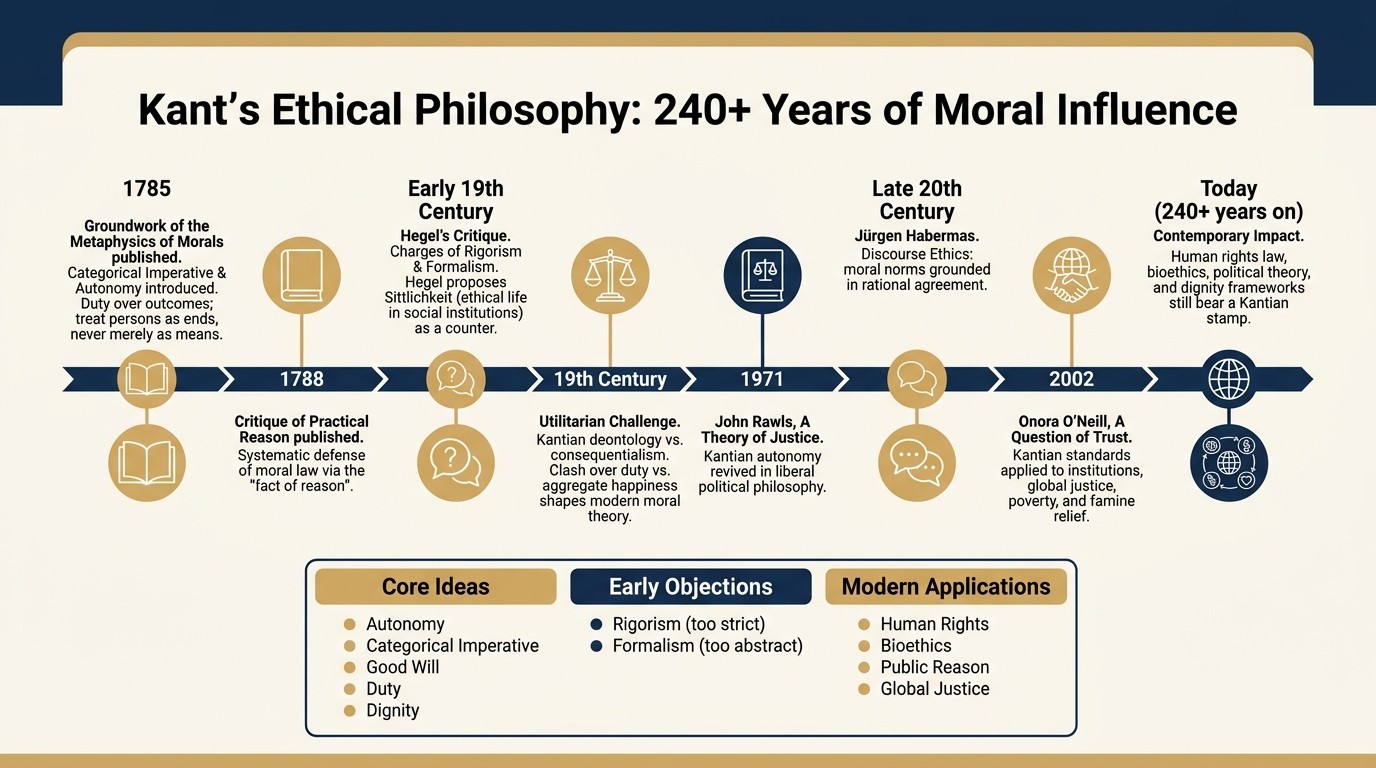
Kant's Ethical Philosophy: 240+ Years of Moral Influence
Kantian Deontology vs. Utilitarian Ethics
Kant's defense of autonomy didn't stop with his first critics. It carried into later arguments about duty, outcomes, and human dignity. In the 19th century, Kantian ethics became a main target for consequentialist criticism, especially from utilitarian thinkers. Kantian deontology judges actions by duty and universal law. Utilitarian ethics judges them by consequences and the happiness they produce. That clash helped set the terms for modern moral theory.
Why did this matter so much? Because Kant's ethics insisted that people must be treated as ends in themselves, not merely as tools for aggregate welfare.
The 20th-Century Return to Kantian Ethics
These debates didn't push Kantian ethics aside. If anything, they gave it new life. Kantian ethics returned in the 20th century through Rawls, Habermas, and O'Neill. Rawls drew on Kantian autonomy in A Theory of Justice. Habermas developed discourse ethics, grounding moral norms in rational agreement. O'Neill applied Kantian standards to trust in institutions in A Question of Trust.
Those revisions pushed Kantian ethics beyond private moral duty and into public reasoning and criticism of institutions.
Human Rights, Dignity, and Contemporary Moral Language
Kant's stress on treating humanity as an end in itself shaped the language of human rights, bioethics, and political theory. Current ideas of dignity, equal respect, and personhood often follow this Kantian pattern, even when his name never comes up directly. O'Neill's work on global justice carried that line of thought further by applying Kantian duties to international obligations tied to poverty and famine relief.
You can see Kant's mark in the moral language now used across law, politics, and institutional life: rights, dignity, respect, and the status of persons.
Conclusion: What Kant's Ethical Legacy Means for Study Today
Kant's ethics grew out of the Critique of Pure Reason, which made room for freedom and moral responsibility in a world still ruled by natural law. That starting point gave his ideas about duty, autonomy, the categorical imperative, and human dignity a clear philosophical base. His impact carried across two centuries, shaping debates about rights, dignity, and public reason, and then showing up again in the work of Rawls, Habermas, and O'Neill. Even now, the way people talk about rights, dignity, and equal respect in law, politics, and bioethics still bears a Kantian stamp.
Key Takeaways for Building a Kant Study Plan
That background also makes the main texts much easier to read in the right order. The best approach is to follow the way Kant built the system itself.
Start with the Groundwork of the Metaphysics of Morals for the categorical imperative, autonomy, and the demand to treat persons as ends in themselves. Then move to the Critique of Practical Reason, where Kant gives a more systematic defense through the "fact of reason". After that, read the Critique of Pure Reason - especially the "Third Antinomy" - to see how he grounds freedom against determinism. Finish with the Metaphysics of Morals, where those abstract ideas turn into concrete duties in law, justice, and virtue.
If Kant feels dense at the start, use the Prolegomena to Any Future Metaphysics first.
FAQs
Why does Kant link ethics to freedom?
Kant ties ethics to freedom for a simple reason: moral agency only makes sense if the will can choose. If our actions came only from natural causes, impulses, or passing desires, then praise, blame, duty, and responsibility would lose their force.
For Kant, that kind of freedom is autonomy. In plain English, it means the rational will can give itself moral law rather than just follow impulse. That self-rule is what makes moral obligation possible in the first place, and it’s also why people can be held responsible for what they do.
How is the categorical imperative applied in real cases?
It works by testing a proposed action, or maxim, in two ways: whether it could hold as a rule for everyone, and whether it respects people as ends in themselves rather than using them merely as tools.
In practice, that means you should act only on principles you could accept as a law for all. Duty can sit alongside personal inclinations or concern for outcomes, but it does not give way when they clash with moral requirement.
Why do critics call Kant’s ethics too abstract?
Critics say Kant’s ethics can feel too abstract. The main issue is that it grounds morality in principles of pure practical reason, not in the messy details of everyday life.
And that’s where the pushback starts.
On paper, this approach looks neat and strict. In practice, though, it can seem overly formal and general. It doesn’t always show, in a clear way, what someone should do in a specific situation with specific people, pressures, and stakes.
That also makes moral conflict harder to deal with. If two duties appear to pull in different directions, Kant’s framework can seem short on guidance about how to sort that out in an actual case.