8 Commentary Traditions in Philosophical Reading


I use commentary to check my reading - not replace the text. My first step: read a short passage, then separate what the author says from what the commentator adds.
These 8 approaches help me focus on different parts of a philosophical text:
Late Antique Greek: Follow quoted passages and compare them with the author’s other works.
Medieval Latin: Use glosses and outlines to follow the text’s structure.
Arabic philosophical: Track how translation and system-building shape concepts.
Sanskrit bhāṣya: Read compact source texts alongside explanations, objections, and replies.
Scholastic question-based: Separate the question, objections, answer, and replies.
Humanist philological: Check manuscripts, wording, and historical usage.
Modern critical: Test claims, assumptions, and reasoning.
Bilingual editorial: Compare the original, translation, and notes.
Quick Comparison
I choose my reading approach based on the question I need to answer:
Approach | Main focus | What I check |
|---|---|---|
Late Antique Greek | Passage-by-passage explanation | How passages fit together |
Medieval Latin | Glosses and text structure | Where explanation becomes a new argument |
Arabic philosophical | Translation and philosophical systems | How terms change across languages |
Sanskrit bhāṣya | Source text and layers of commentary | Who makes each claim or objection |
Scholastic question-based | Questions and replies | Whether the answer addresses each objection |
Humanist philological | Manuscripts and language | Which wording the sources support |
Modern critical | Claims and reasoning | Whether the argument holds up |
Bilingual editorial | Original text and translation | Which choices belong to the translator |
These categories overlap; they are not eight separate schools. Throughout, I keep one rule in view: <u>explanation, interpretation, and criticism are different tasks</u>.
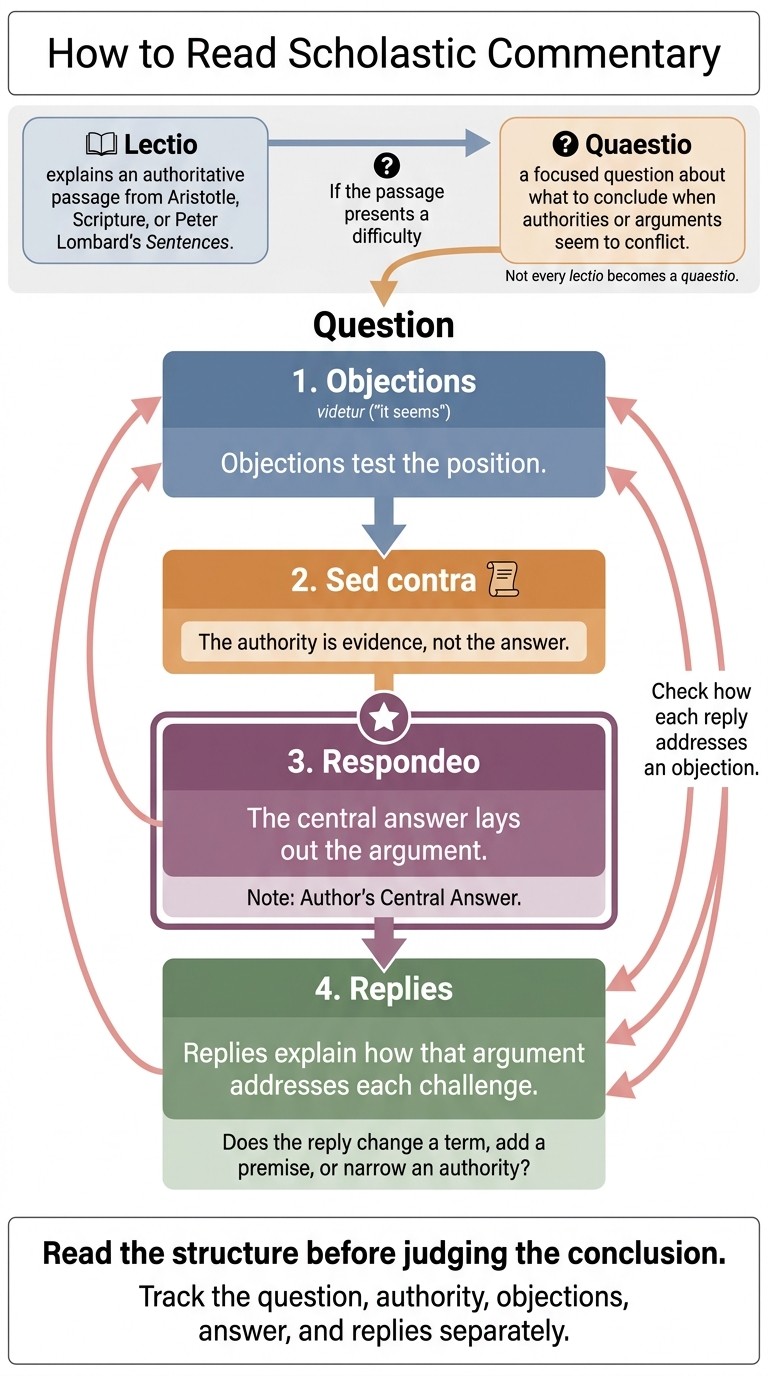
How to Read Scholastic Commentary
HoP 184 - Robert Wisnovsky on Commentary Culture
1. Late Antique Greek Commentary
Alexander of Aphrodisias became a model commentator on Aristotle. His main tool was the lemma: a short quotation followed by an explanation. He worked through selected passages in their original order, drawing on Aristotle’s other works to resolve inconsistencies. This approach teaches readers to follow the source text, its explanation, and the argument together.
Porphyry organized philosophical study into a curriculum. His Isagoge introduced logic and questions about genera, species, and universals before students read Aristotle’s Categories. Preparation came before close reading. In this Neoplatonic setting, Aristotle’s works served as stages in a broader philosophical education and were often treated as compatible with Plato.
Simplicius paired close reading with an account of earlier thought. To reconcile apparent conflicts, he often distinguished between wording, meaning, and context. His commentary on Aristotle’s Physics preserved fragments and reports from earlier Greek thinkers. Commentary thus became a way to preserve philosophy, not just explain it.
Keep each quoted passage beside its explanation. This layout is a hallmark of ancient philosophy dual-language editions used by modern scholars. Mark which words appear in the source, then note any assumptions the commentator adds. If a contradiction seems to disappear, check whether the passage uses a term differently - or whether the commentator supplies that distinction. These explanations often reflected the commentator’s own commitments. Later Latin and Arabic commentary drew on this Greek model, adjusting it for new texts and audiences.
2. Medieval Latin Commentary
Greek commentary followed a text line by line. Latin commentary made that approach a classroom method. From the 12th to 14th centuries, Latin masters used commentary both to explain authoritative works and to build on them. Glosses supplied short definitions in the margins or between lines. Paraphrase restated passages more freely, while continuous exposition followed the source’s argument in order.
Aristotle commentary shows how this method worked. Learn from the great thinkers by exploring our curated editions.
In Aquinas’s Physics commentary, a divisio textus maps the argument before the expositio textus explains each part in sequence.
The same approach shaped theological study.
By the early 13th century, Peter Lombard’s Sentences became the standard text for theological commentary at Paris. Its compilation of Scripture and Church Fathers left questions unresolved. Later commentators, including Aquinas and Bonaventure, used that framework to develop and defend their own answers.
To track what a commentator is doing, mark passages D, P, E, or A: division, paraphrase, explanation, or autonomous argument. An objection, distinction, or conclusion that does not appear in the source signals autonomous argument. Read the commentator’s divisions as a map of the text - not necessarily as the source author’s intended plan.
The forms differ in what guides the discussion. Commentary stays tied to a source text. Disputed questions arrange objections around a problem. A summa follows the author’s own plan. Check whether the source text or a new problem directs the discussion.
3. Arabic Philosophical Commentary
Arabic philosophers translated, paraphrased, and reinterpreted Greek philosophy, often through Syriac intermediaries. Aristotle’s Metaphysics circulated in several Arabic translations from the ninth through eleventh centuries. Readers therefore encountered multiple versions of Aristotle, not one fixed Arabic text. Writing commentary meant choosing among those versions. Arabic commentary was less a single tradition than a set of reading practices shaped by this layered textual history.
Al-Fārābī organized philosophy around the sciences, while Avicenna built inherited Aristotelian materials into a unified system. Both teach readers to identify a work’s subject, method, and philosophical purpose before working through its arguments.
Avicenna’s The Healing linked logic, natural philosophy, psychology, and metaphysics within a single system. Treat it as philosophical reconstruction, not just explanation of Aristotle.
Averroes’s commentaries on Aristotle’s Physics fall into three formats: the short jawāmiʿ summarizes central doctrines; the middle talkhīṣ paraphrases and clarifies the argument; the long sharḥ or tafsīr offers extended explanation. Commentary pairs text with gloss, paraphrase, or extended explanation depending on the format.
Use the short form to get your bearings, the middle to understand the argument, and the long for close comparison. These formats did more than explain Aristotle: they trained readers to move between text, doctrine, and system.
These works took shape amid theology, law, medicine, and grammar. Interpretation thus moved between demonstration, metaphysics, psychology, and revealed authority. Each author approached revelation and audience differently. Read each term in its disciplinary and theological setting, rather than treating it as a fixed equivalent.
Keep a translation log that records the source term, its translation, its definition, and its role in the argument.
For intellect, check whether it means a cognitive faculty, an acquired disposition, or an agent principle.
Track terms across Greek, Arabic, Latin, and English. Don’t assume that one English word names one concept. This attention to wording prepares readers for Sanskrit bhāṣya, where exact phrasing and inherited interpretation matter just as much, even though the textual conventions differ.
4. Sanskrit Bhāṣya Commentary
After tracing terms across languages, Sanskrit commentary shows how a compact source text can support a whole tradition of argument. A bhāṣya comments on a compressed root text, often a sūtra. It supplies missing definitions, premises, and transitions to reconstruct the larger argument. It also explains difficult terms and defends a school against rival readings. Later layers may include a vārttika, which critiques an earlier text or bhāṣya, and a ṭīkā, which clarifies or refines it. This sequence is not a universal template.
The structure varies by school. In Vedānta, commentary on the Upaniṣads, the Bhagavad Gītā, and the Brahma-sūtra focuses on Brahman, the self, the world, and liberation. Read an adhikaraṇa - a topic unit - as a whole, identifying its subject, doubt, opposing view, response, and conclusion.
Mīmāṃsā focuses on Vedic injunctions and language. Ask what a statement requires and how nearby passages determine its reading.
Nyāya spells out definitions, inference, objections, and replies. Later commentaries may defend both the root text and an earlier commentator. Label each passage by its role - claim, reason, objection, reply, or conclusion - to avoid mistaking an opponent’s position for the author’s own.
Buddhist Sanskrit commentary varies more in form but shares this close attention to the text. It ranges from explanations of root verses to more independent doctrinal arguments, including discussions of logic and knowledge. Before assuming the same layered structure applies, check whether a passage explains its source or develops an argument of its own.
When studying these texts, record what the root says, what the commentary adds, and what the gloss challenges or clarifies. Read the layers as a connected dispute rather than separate summaries.
5. Scholastic Question-Based Commentary
Scholastic commentary makes disagreement part of the method. It teaches readers to distinguish the text from the challenge to it and the answer that follows. A lectio explains an authoritative passage from Aristotle, Scripture, or Peter Lombard’s Sentences. If the passage presents a difficulty, it can become a quaestio: a focused question about what to conclude when authorities or arguments seem to conflict.
The usual sequence is objections, sed contra, respondeo, and replies. The authority is evidence, not the answer. Objections test the position; the central answer lays out the argument; replies explain how that argument addresses each challenge.
In Thomas Aquinas’s Summa theologiae I, question 2, readers can separate the objections introduced by videtur (“it seems”) from the contrary authority and the five ways supporting God’s existence. Then trace how the replies answer the objections. This makes Aquinas’s own position easier to distinguish from the arguments he examines.
Read the structure before judging the conclusion. Track the question, authority, objections, answer, and replies separately. Keep the authority distinct from the arguments it prompts, and note whether each reply changes a term, adds a premise, or narrows an authority.
6. Humanist Philological Commentary
While some commentators reconstruct arguments, humanists return to the words themselves. Humanist commentary first establishes what an author wrote, then interprets it. Renaissance scholars compared manuscripts, tracked variants, and tested Greek and Latin usage.
Lorenzo Valla tested philosophical terminology against common linguistic usage rather than accepting inherited technical meanings without question. His critique of the Donation of Constantine showed how linguistic and historical mismatch can expose a forgery.
This approach turns commentary into textual criticism.
When a claim depends on one term, check variant readings, compare bilingual editions vs. English-only translations, and consult historical usage. Keep manuscript evidence separate from editorial conjecture. A familiar translation or a single manuscript should not settle the meaning. These checks prepare readers for modern critical commentary.
7. Modern Critical Commentary
Philological commentary establishes what a text says. Modern critical commentary asks what it proves. It tests the text and its interpretations through close reading, historical context, conceptual analysis, and argument evaluation. This means examining how the text builds its claims, which assumptions support them, whether its reasoning is valid, and how later readers have interpreted or challenged it.
Start with the text’s own terms, then examine the argument. Identify the claim, trace the reasoning, and spell out unstated assumptions. Before calling two passages contradictory, compare their audiences, purposes, and qualifiers. Historical context can explain a claim without proving it.
A critical commentary on Descartes compares the stated method with the arguments that support it and checks whether later interpretations overstate the text.
Keep notes under three headings to distinguish evidence from interpretation and judgment:
Text says: Support textual evidence with quotations.
Commentator infers: State the premises behind the inferred meaning.
Commentator evaluates: Name the standard used to judge the argument, such as consistency or validity.
Test inherited readings against the whole work, not just familiar quotations.
8. Bilingual Editorial Commentary
Modern critical commentary evaluates arguments. Bilingual editorial commentary shows the translation choices behind them. It’s an editorial practice, not a single historical school. Side-by-side bilingual editions draw on glossing, comparison, and textual criticism.
Start with the preface. Then read the introduction, glossary, and footnotes for details about the source text, translation method, recurring terms, and disputed readings. Essays offer broader interpretations, but every part of this editorial material can shape how you read the text.
Once you understand that material, follow one recurring original-language term through the edition and compare its translations. Do different renderings reflect different contexts? Does one English word stand in for several original terms?
Separate translation choices from textual evidence. Note whether an annotation identifies a historical fact, reports a textual variant, or argues for a particular interpretation. Side-by-side pages make the source easier to consult; they don’t settle questions of grammar or meaning.
Logos Philosophy Club is a current example of this practice: bilingual editions with annotations and editorial notes that keep the source text central.
Use bilingual commentary as a reading aid, not a replacement for the source text. Keep the source, its translation, and editorial interpretation separate.
Comparison Table: Methods and Reading Habits
This table compares eight traditions by method, reading goal, and study habit. The methods are typical, but they often overlap.
Tradition | Primary textual method | Typical reading goal | Suggested study habit |
|---|---|---|---|
Late Antique Greek | Lemmata, paraphrase, and reconciliation. | Clarify a canonical text and test whether its parts fit together. | Reconstruct a lemma’s argument; compare nearby passages. |
Medieval Latin | Glosses, exposition, and curricular synthesis. | Organize inherited texts for study. | Separate the source text, gloss, authority, and interpretation. |
Arabic philosophical | Translation, paraphrase, and conceptual adaptation. | Understand and develop inherited philosophy in Arabic contexts. | Track translated terms and changes to concepts. |
Sanskrit bhāṣya | Close verbal explanation and doctrinal defense. | Clarify the root text and what follows from it. | Read the root text alongside the commentary; mark definitions, objections, replies, and conclusions. |
Scholastic question-based | Structured questions, objections, and replies. | Test a proposition through objections and replies. | First outline the question, objections, answer, and replies. |
Humanist philological | Manuscript comparison and linguistic analysis. | Recover the wording and its likely meaning. | Check variants, terminology, and historical context. |
Modern critical | Close reading and critical interpretation. | Explain how arguments work in context. | Separate textual claims from critical interpretation. |
Bilingual editorial | Parallel text, translation, and editorial notes. | Support precise reading across languages. | Compare the original with the translation; consult notes on key terms. |
Medieval Latin and scholastic commentary overlap; the table separates them by emphasis. Bilingual editorial commentary is an editorial format, not a single school.
Conclusion: Keep the Source Text in View
Across these traditions, the eight methods work together to keep readers anchored to the source text. They don’t form one universal method. Each directs attention to wording, argument, context, and translation. Ask what the commentary aims to do: defending inherited doctrine differs from reconstructing an argument.
To stay close to the source, separate three tasks: explanation clarifies what the passage says; interpretation proposes what it means; criticism tests its logic. When readers disagree, pinpoint whether the dispute concerns wording, context, or inference. Then ask whose assumptions shape the reading - the source author’s, the translator’s, or the commentator’s.
After each section, write a three-line reading record: the source’s claim and section reference; the commentator’s reasoning and supporting evidence; and one unresolved question. This reading habit keeps commentary useful without letting it replace the text.
FAQs
Which commentary approach should I try first?
There’s no required starting point. Where you begin depends on your goals and the text. Use the editorial materials in high-quality editions to guide your reading.
For core works, bilingual editions let you compare translations with the original language and work through complex terms. Editorial introductions and scholarly commentaries explain the history, language, and social context behind the text, giving independent study more structure and making it more rewarding.
How can I assess a commentator’s reliability?
Check whether the notes cite authoritative sources and clearly identify them, and whether the edition cross-references established critical texts. The introduction, notes, translator’s preface, and contextual materials should follow a consistent editorial standard rather than rely on unsourced commentary.
A side-by-side bilingual or trilingual edition also makes reliability easier to assess: you can compare the translation directly with the source text.
What should I do when commentaries disagree?
Treat disagreement as a reason to return to the primary text and examine its reasoning. In philosophy, no authority is beyond scrutiny. Disagreement is part of the work, not an obstacle to it.
Instead of aiming for a final consensus, use your edition’s notes, introductions, and Logos Reader to work through the arguments. Compare interpretations to deepen your understanding of the philosophical tradition and sharpen your own thinking.