How to Read Philosophy Books Effectively: A Guide

Reading philosophy books can feel overwhelming, but with the right approach, you can break down complex ideas and truly understand them. Here’s how:
Start with Preparation: Identify the book’s main questions, research its historical context, and gather tools like dictionaries and notebooks.
Use Active Reading Methods: Skim for an overview, annotate key points, and reread challenging sections to clarify ideas.
Analyze Arguments: Break arguments into premises and conclusions, question their logic, and compare ideas across philosophers.
Leverage External Resources: Use annotated texts, bilingual editions vs. English-only, and join discussions to deepen your understanding.
Philosophy isn’t about rushing to answers - it’s about engaging with ideas thoughtfully and consistently. With these steps, you’ll navigate even the toughest texts effectively.
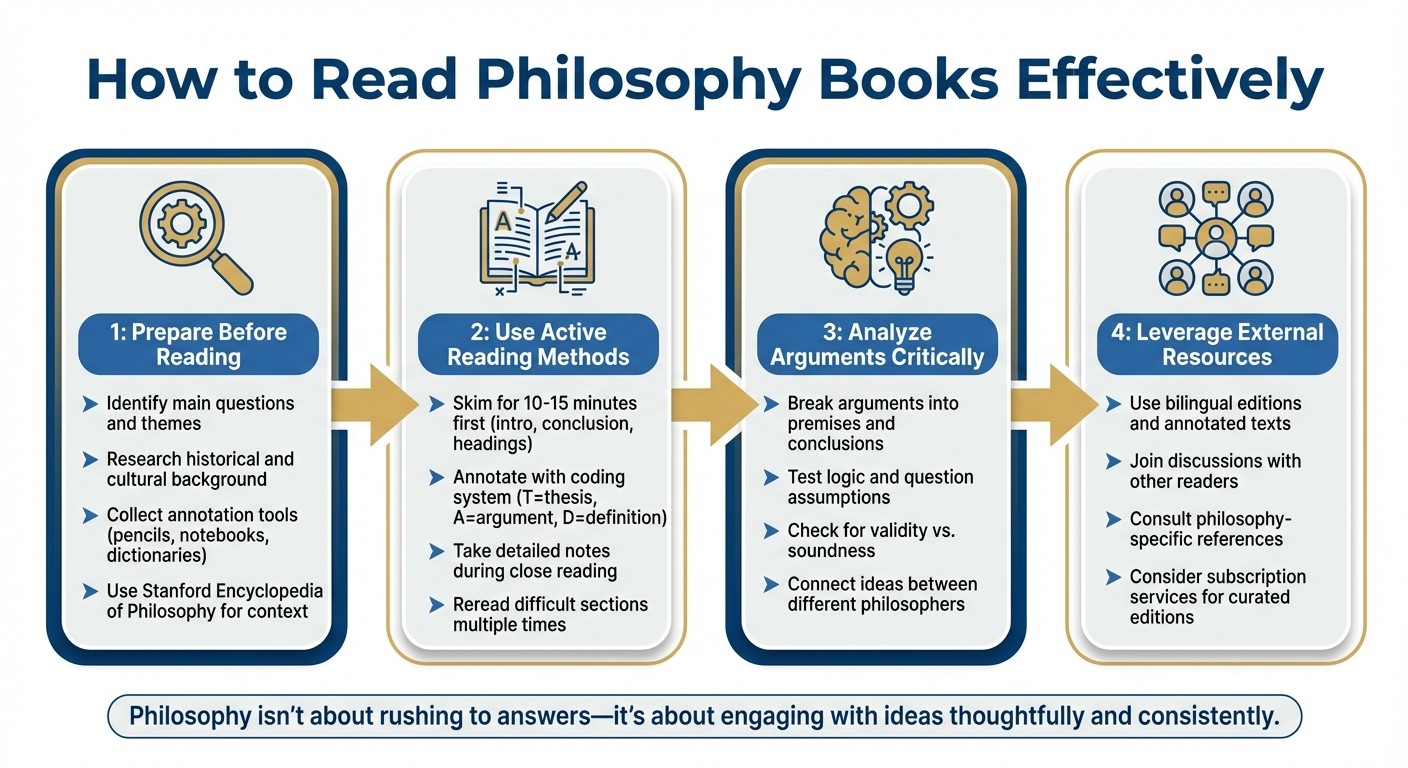
4-Step Process for Reading Philosophy Books Effectively
How to Read Philosophy in 6 Steps
How to Prepare Before Reading Philosophy Books
Approaching a philosophy book without preparation is like setting off on a journey without a map - it’s easy to get lost. A little groundwork can help you navigate complex arguments and make the experience much more rewarding.
Identify the Main Questions and Themes
Every philosophy book revolves around a central idea or thesis. Your first step is to figure out what that is. In modern works, the thesis is often laid out in the introduction, but older texts may take longer to reveal their main argument.
Once you think you’ve identified the thesis, try rephrasing it in your own words to confirm your understanding. Then, look for the supporting arguments or premises. Use the table of contents and section headings to get a sense of how the book is structured. Pay attention to “signpost” words like because, nevertheless, and hence - these often indicate key logical connections.
Philosophy professor Charlie Huenemann offers a helpful way to engage with philosophical claims:
"There are ultimately two replies to any philosophical claim: 'Oh yeah?' and 'So what?!'"
The “Oh yeah?” approach encourages you to challenge the argument by finding counterexamples, while “So what?” prompts you to consider its broader relevance. Using these questions as you read can help you think critically and avoid simply absorbing the material passively.
Also, keep an eye on technical terms and definitions introduced by the author. These are often the building blocks of their argument. Be careful not to confuse objections the author is addressing with their actual position - this is a common pitfall for readers.
Research the Historical and Cultural Background
Philosophy is a conversation that spans centuries. For instance, Kant’s work responds to Hume, and Hegel builds on Kant. Knowing this context can help you understand why a philosopher makes certain arguments and what issues they’re trying to address.
Historical context is also crucial for understanding terminology. Words often change meaning over time, and older texts may use expressions differently than we do today. Resources like the Stanford Encyclopedia of Philosophy and the Internet Encyclopedia of Philosophy are excellent for exploring terms within their historical framework.
Before diving into the book, take time to “preread.” Look into the author’s background, the time period in which the book was written, and how it fits into their overall body of work. Check the bibliography to see which thinkers influenced them - this gives you a sense of the philosophical tradition they’re engaging with.
For translated works, comparing different translations can be incredibly helpful. Translators often interpret historical nuances differently, and reviewing multiple versions can clarify tricky passages. Secondary sources like podcasts (e.g., History of Philosophy Without Any Gaps) or introductory texts can also provide helpful overviews before you tackle the main text.
Collect Annotation Tools and Reference Materials
Reading philosophy effectively requires the right tools. Start with the basics: pencils are ideal for printed books because they let you revise your notes as your understanding evolves. You can also use pens, highlighters, or digital annotation tools, depending on your format.
Keep a notebook or journal handy to summarize sections, track arguments, and jot down your reactions. As David W. Concepción, a philosophy professor at Ball State University, explains:
"In my first philosophy course, I read every assignment slowly with a dictionary and thesaurus at my side"
A standard dictionary and thesaurus can help with dense prose, but you’ll also want philosophy-specific references. The Stanford Encyclopedia of Philosophy provides in-depth discussions, while the Internet Encyclopedia of Philosophy offers more concise explanations.
Develop a simple system for annotating as you read. For example, use “T” for thesis, “A” for argument, “D” for definition, and “!” for key points. This makes it easier to revisit important sections later. Avoid highlighting on your first read - wait until you’ve fully grasped the material to mark what’s truly important.
Secondary sources like Wikipedia, introductory texts, or video summaries can give you a head start. For translated works, bilingual editions can sometimes clarify confusing sections. While these tools won’t replace careful reading, they can make the process a lot smoother.
Armed with a clear understanding of the book’s themes and the right tools, you’ll be well-prepared to dive into active reading techniques.
Active Reading Methods for Philosophy
Once you've prepared, the next step is to dive into the text with intention. Philosophy demands more than passive reading - it requires active engagement. The following strategies can help you navigate even the most challenging passages.
Skim the Text First for an Overview
Before plunging into a detailed read, spend 10 to 15 minutes skimming the text. This isn't cutting corners - it's a smart way to set the stage for deeper understanding. As Jeff Maynes notes:
"If your goal is to actually understand the reading, however, a skim actually speed things up! Why? Because it helps you figure out how the parts of the article or book fit together."
Start with the introduction and conclusion. Philosophy isn't like a suspense novel - there are no spoilers here. Authors often state their main thesis upfront, giving you a clear sense of their argument's direction. Next, glance over the section headings to understand the structure. You can also skim the first and last sentences of paragraphs to get a sense of the argument's flow.
While skimming, keep an eye out for logical connectives like "therefore", "however", or "it follows that." These act as signposts, highlighting where the author draws conclusions or addresses objections. Take a moment to check the bibliography too - it can reveal which philosophers the author is engaging with, providing insight into the broader context.
Hold off on highlighting during this stage. Without a full understanding, you might mark too much and clutter your later notes. Instead, try to summarize the author's main point in your own words. If you can do this, you're ready to move on to a closer reading.
With this big-picture view in mind, you're better equipped to tackle the text line by line.
Annotate and Take Notes During Close Reading
Once you've got the overview, it's time to break things down. Read slowly and carefully, engaging with every sentence. A simple coding system can help - use shorthand like "dfn" for definitions, "arg" for arguments, "concl" for conclusions, or "??" for confusing sections. These symbols create a roadmap you can follow when revisiting the text.
Joshua Hochschild emphasizes the importance of questioning the material:
"Active reading, or 'engaging' a text, consists in asking questions."
Ask yourself: What issue is the author addressing? What are the key terms? What evidence supports their claims? You can jot these questions in the margins or a separate notebook. Use one color for paraphrasing the text and another for your personal reactions.
For intricate arguments, consider numbering the premises (1, 2, 3) in the margins and drawing arrows to show how they connect to the conclusion. If the author responds to a counterargument, label it as "counter" to avoid confusing it with their actual stance. At the end of each section, write a one-sentence summary in the blank space at the bottom of the page. This forces you to process the argument actively rather than passively reading.
If you still find parts unclear, it's time for a more focused reread.
Reread Difficult Sections Multiple Times
Philosophy isn't a one-and-done kind of reading. Even seasoned philosophers expect to revisit texts. Jim Pryor admits:
"I've been doing philosophy for more than ten years and I still have to read articles many times before I fully understand them."
When confusion strikes, don't just push ahead hoping it will resolve itself. Philosophical arguments build on each other, so skipping over unclear parts will only lead to more confusion. Pause, go back to the sentence where you lost track, and reread carefully. Try rephrasing the passage in your own words or coming up with a concrete example to make the abstract ideas more tangible.
If a specific term is causing trouble, consult a philosophy-focused resource like the Stanford Encyclopedia of Philosophy rather than a general dictionary. For translated works, comparing different translations of the same passage can often clarify the author's intent. Summarize each paragraph in your own words - if you can't, it's a sign you need to revisit it.
Colin Allen offers this encouragement:
"There are no short cuts. The subject matter is hard, the arguments are complicated, and the terrain is unfamiliar. Don't expect to get everything out of a piece of philosophy right away."
Rereading isn't a sign of failure; it's part of the process. Each pass through the text deepens your understanding and ensures the ideas stick with you long after you've finished reading.
How to Analyze and Think Critically About Philosophy
Once you've engaged with a philosophical text, the next step is to carefully examine its arguments to determine their strength and validity. This involves adopting a skeptical mindset and rigorously testing each claim for logical consistency.
Question Arguments and Test Their Logic
Start by understanding the difference between validity and soundness. An argument is valid if its conclusion logically follows from its premises. However, it is only sound if the premises themselves are true. For instance, take the argument: "All trees are blue; Oaks are trees; therefore, Oaks are blue." While the conclusion logically follows, the argument is unsound because the premises are false.
Use critical questioning to probe each claim. Imagine scenarios where the premises might hold true, but the conclusion fails. Keep an eye out for circular reasoning, where the argument assumes the conclusion it aims to prove. As F.A. Hayek suggests:
"From time to time it is probably necessary to detach one's self from the technicalities of the argument and to ask quite naively what it is all about."
This habit of questioning prepares you to dissect arguments more thoroughly in the next step.
Break Down Arguments Into Premises and Conclusions
To evaluate an argument fully, start by identifying its main conclusion. One effective method is the "Therefore Test" - look for the statement that logically follows the word "therefore" and write it down clearly.
Next, analyze the text line by line, isolating key premises and definitions while ignoring rhetorical examples or embellishments. Visualize the argument's structure by diagramming how these premises connect to the conclusion. Pay attention to any hidden assumptions or auxiliary arguments that the author may take for granted but fail to justify.
Approach the analysis as if you were the author's toughest critic. Challenge unstated assumptions and consider potential objections. John Stuart Mill highlighted the importance of this adversarial approach:
"Both teachers and learners go to sleep at their post, as soon as there is no enemy in the field."
Connect Ideas Between Different Philosophers
After evaluating individual arguments, the next step is to link ideas across various texts. Philosophy is like an ongoing dialogue that spans centuries, where ideas are debated, refined, and sometimes overturned.
Ask yourself, "If this conclusion is true, what follows?" This process can reveal contradictions when comparing different philosophical frameworks. For instance, utilitarianism focuses on outcomes and maximizing happiness, while Kantian ethics prioritizes universal moral laws and duties.
Rather than reading texts in isolation, try jumping between them to see how different thinkers define and approach similar concepts. Keeping a vocabulary journal can help you track these nuances. Additionally, secondary resources like the Stanford Encyclopedia of Philosophy can provide context on how modern ideas stem from earlier discussions.
Bertrand Russell captured this process of comparative thinking beautifully:
"Philosophy is to be studied, not for the sake of any definite answers to its questions... but rather for the sake of the questions themselves; because these questions enlarge our conception of what is possible, enrich our intellectual imagination, and diminish the dogmatic assurance which closes the mind against speculation."
Using External Resources to Improve Comprehension
Once you've applied active reading techniques, you can expand your understanding by turning to external resources. Some philosophical texts are notoriously dense, and even the most diligent readers can benefit from additional tools to clarify complex ideas.
Read Bilingual Editions and Annotated Texts
Philosophical works often lose nuance through translation or lack of context. Bilingual editions and annotated texts can bridge this gap. These editions present the original language alongside commentary that sheds light on tricky passages and historical shifts in word meanings. This dual approach helps prevent misinterpretation and provides a clearer grasp of the text's intent.
John Roche, a member of the Logos Philosophy Club, highlights the value of such resources:
"I love my copy. The book is sturdy and very well bound, but so far the scholastic commentary is the real gem."
Services like Logos Philosophy Club focus on producing high-quality editions of philosophical classics. They translate directly from the original language and include the Logos Reader - a collection of essays and commentary to enhance your study experience. Recent releases include Aristotle's Nicomachean Ethics (December 2025), Boethius's The Consolation of Philosophy (January 2026), Nietzsche's Thus Spoke Zarathustra (February 2026), and Plato's The Symposium (March 2026).
For deciphering technical terms, specialized philosophical dictionaries are invaluable. Unlike standard dictionaries, these resources explain the unique jargon of individual thinkers. For instance, the online platform 1000-Word Philosophy has garnered over 6 million views by offering concise, accessible definitions tailored to philosophy students and enthusiasts.
Join Discussions with Other Readers
Philosophy thrives on dialogue. Engaging with others - whether classmates, teachers, or fellow enthusiasts - can illuminate ideas that might otherwise remain elusive. As Gerald Jones, Dan Cardinal, and Jeremy Hayward explain in AQA AS Philosophy:
"Philosophy is a discursive subject; in other words it is about engaging with the thoughts and opinions and arguments of others, about debating arguments and clarifying concepts with others."
Discussions force you to articulate your understanding, making it easier to pinpoint gaps in your knowledge. Explaining an argument aloud often reveals whether you've truly grasped it or merely skimmed the surface.
During these conversations, apply the Principle of Charity - interpret arguments in their strongest, most logical form before critiquing them. Another effective approach is to work through small sections of a text with a partner, summarizing each part in your own words to ensure mutual clarity.
Charlie Huenemann, a philosophy professor at Utah State University, emphasizes the importance of this back-and-forth:
"Philosophy lives in this energetic back-and-forth, picking up on missed possibilities or raising new questions... That's the philosophical method: keep the conversation going, changing, evolving."
Subscribe to Services That Provide Curated Philosophy Books
Building a well-rounded philosophy library can be daunting, especially when trying to identify reliable translations and editions with helpful annotations. Subscription services simplify this process by delivering carefully curated works, complete with supplementary materials, directly to your door.
For example, Logos Philosophy Club offers a subscription model inspired by a successful program in Brazil, which has over 20,000 subscribers. Members receive hardcover editions featuring bilingual text, editorial notes, and exclusive collectibles. They can choose between a Monthly Plan at $45/month or a Yearly Plan at $420/year, with annual subscribers gaining access to past releases at discounted rates.
Conclusion: Making Philosophy Reading a Lifelong Practice
Reading philosophy isn’t about rushing to find answers. Instead, it’s about developing a steady, long-term habit that grows with you. The techniques we’ve covered - preparing with historical context, actively annotating, carefully analyzing arguments, and using reliable resources - are skills that sharpen over time with consistent practice.
To make philosophy a regular part of your life, carve out dedicated time each week. Even just 30 minutes of focused, deliberate reading can be far more impactful than hours of hurried skimming. Let your curiosity guide you when selecting what to read next; there’s no single “right” path, and personal interest helps keep the journey engaging.
Philosophy thrives as a conversation rather than a solitary exercise. It’s not just about taking in information - it’s about joining a dialogue that stretches across centuries. As you read, your understanding will deepen and evolve, much like the shifting perspectives found in Plato’s works. Philosophy professor Charlie Huenemann captures this idea well:
"It has been said that you are never done reading a great book because each time you read it you become a different person".
Keep a journal handy to jot down insights, and don’t hesitate to pair challenging texts with accessible tools like podcasts or annotated editions. Colin Allen offers an encouraging perspective:
"Just like physical training, taking on intellectual challenges builds capacities that produce benefits many years later, even if you aren't planning a career in philosophy".
The confusion you might feel now is paving the way for the clarity you’ll gain later. By consistently applying these methods, you’re not just reading - you’re actively participating in a centuries-old conversation that sharpens your thinking and broadens your perspective.
FAQs
What should I do when I don’t understand a passage?
When a passage feels unclear, take a moment to re-read it carefully - sometimes going over it multiple times can make all the difference. Break down complex sentences into smaller parts, and work through arguments step by step. Pinpoint the main conclusion and the structure of the reasoning. Start by skimming to get a general sense, then dive deeper for a thorough read. As you go, annotate key terms and definitions to keep track of important ideas. Engaging with philosophy requires practice, patience, and a commitment to staying actively involved with the material.
How can I tell the author’s view from objections they discuss?
To understand an author’s perspective, pay close attention to how they handle objections and counterarguments. Look for their main conclusion and examine the way they defend or justify it. In philosophical writing, authors often make their stance clear through their arguments and how they address critiques. By analyzing the structure of their reasoning, you can separate their viewpoint from the objections they discuss.
How do I know which parts of a philosophy book to annotate?
Annotating a text is an active way to engage with its content. It involves marking main arguments, identifying key concepts, and noting critical passages. This process helps you unpack the structure of the arguments, such as distinguishing between premises and conclusions, and pinpointing terms that may require clarification.
When annotating, it’s also essential to highlight significant ideas or points that stand out. These could be insights you find compelling or areas where the text feels unclear. This method not only sharpens your understanding but also encourages a deeper, more critical interaction with the material.