Annotated Translations: Ensuring Accuracy in Philosophy


If a philosophy translation can’t be checked, you’re being asked to trust it blind.
I’d sum up the article this way: in philosophy, accuracy is not just about matching words. It’s about keeping an argument’s meaning, tension, history, and term use in place - and showing those choices on the page. That’s why annotations, glossaries, indexes, and facing-page text matter so much in a bilingual edition.
Here’s the short version:
Word-for-word translation often fails because one term can carry more than one meaning, often requiring specialized strategies for untranslatable philosophy.
Annotations show why a translator chose one wording and what may have been left open.
Consistency across the full book matters because term drift can weaken an argument.
A strong bilingual edition gives you tools to verify the translation, not just read it.
Review usually happens in 4 stages: translation review, annotation review, proofreading, and textual verification.
The article uses 2 main examples:
A May 2026 bilingual edition of Leibniz’s Discourse on Metaphysics
A January 2026 trilingual edition of Boethius’s The Consolation of Philosophy
One point stood out to me: even when 100% of the sentences are translated, the text can still lose part of its argument if key terms shift or get flattened. In philosophy, that’s a big problem.
Part | What it does |
|---|---|
Annotations | Explain term choices and preserved ambiguity |
Glossary | Keeps recurring terms aligned |
Index | Lets readers track ideas across the book |
Facing-page layout | Makes source and English easy to compare |
Editorial intro | Places the work in historical and intellectual context |
So if I were boiling the piece down to one line, it would be this: a philosophy translation becomes more reliable when the editor shows their work.
Translation Approaches: Literal, Free, and Beyond
What Accuracy Means in Philosophy Translation
In philosophy, accuracy means preserving an argument’s distinctions, tone, and ambiguities - not just its vocabulary. That becomes clear fast when one term can point in more than one direction.
Why Word-for-Word Translation Falls Short
A word-for-word approach treats language like a code. Philosophical terms don’t work that neatly. Many key terms carry several defensible meanings, and if a translator picks one with no explanation, the other meanings can disappear.
You can see this most clearly in a text shaped by long argument and revision. Take Leibniz’s Discourse on Metaphysics. His terminology was shaped by a four-year exchange with the theologian Antoine Arnauld, during which he rebuilt and refined each argument in response to Arnauld’s logical objections. A word-for-word translation can hand you the conclusions while stripping away the path that leads to them. An annotated translation helps readers see those choices on the page while staying faithful to the source.
How Key Terms Accumulate Meaning Over Time
The problem gets harder when a term gathers more meaning through later readers and later texts. Philosophical language doesn’t stand still. A word like fortune in Boethius’s The Consolation of Philosophy wasn’t just a neutral concept - it became a central symbol in medieval ethics, interpreted and extended by later thinkers including Thomas Aquinas and Dante.
If a translation doesn’t stay consistent across the whole work, the meaning can drift, even when no single sentence looks wrong.
Why Annotations Matter
Annotations record the translator's choices: which meaning to favor, which terms to keep untranslated, and which ambiguities to preserve. That makes annotation an editorial tool, not a decorative extra.
Put simply, annotation explains a choice; revision changes the text itself.
What Annotations Do That Translation Alone Cannot
A translation has to read smoothly in English. And that usually means the translator must pick from several plausible meanings. Annotation is where that decision gets documented. It can explain why a term was left untranslated, why one reading was chosen over another, or how a philosopher's vocabulary comes from earlier traditions.
Leibniz's use of "monads", for instance, draws on Scholastic terminology. A note can identify that inheritance, show how Leibniz changed it, and keep the translation readable without flattening the argument. The translated text stays clear; the note carries the extra weight. This integrated approach is central to translation and peer review in scholarly publishing.
Annotations also help preserve or highlight ambiguity when the original text is meant to remain unsettled. In philosophical writing, a note can signal that a tension was kept on purpose rather than smoothed away.
Editorial Notes, Glossaries, and Indexes Compared
Different tools work at different levels of reading.
Format | Primary Purpose | Ideal Use |
|---|---|---|
Editorial notes / annotations | Clarify terminology and historical context | Explaining specific word choices at the point of reading |
Glossary entries | Define and standardize key terms | Providing a centralized reference for recurring philosophical concepts |
Index | Trace principal concepts across the text | Following how a specific idea develops across chapters |
Editorial preface | Introduce historical context and themes | Setting the stage before reading begins |
Annotations explain local choices. Glossaries standardize recurring terms. Indexes trace concepts across the volume. The next issue is maintaining quality philosophy translation by keeping those choices consistent across the full edition.
What a Reliable Bilingual Philosophy Edition Should Include
A reliable bilingual edition does more than give you a translation. It also gives you the tools to check what the translation is doing. That’s the whole point: readers should be able to test meaning on the page instead of taking editorial choices on faith.
The Editorial Components That Support Serious Study
The starting point is a facing-page layout: the original language on the left and the English translation on the right. This setup makes source-to-translation comparison much easier. You can stop at a sentence, a phrase, or even a single term and see how the translator handled it. In Logos Publishing's May 2026 bilingual edition of Leibniz's Discourse on Metaphysics, the original French appears alongside the English translation.
But facing pages alone aren’t enough. A reliable edition should also include a terminology glossary for recurring philosophical terms whose meanings have shifted over time, an editorial introduction that places the work in its intellectual, scientific, and religious setting, and an analytical index that follows major concepts and arguments across the full text.
Component | What It Does |
|---|---|
Facing-page layout | Direct source/translation comparison |
Terminology glossary | Standardizes recurring terms |
Editorial introduction | Frames historical context |
Analytical index | Tracks concepts across the volume |
Editorial annotations | Explains choices at the point of reading |
There’s a simple idea behind all of this: these tools only help if terms and arguments stay consistent from beginning to end. If a key concept shifts from chapter to chapter without explanation, even a strong layout starts to wobble.
Extra commentary can also matter, especially when a text has been read through different intellectual lineages or later versions. In January 2026, Logos Publishing produced a trilingual edition of Boethius's The Consolation of Philosophy with the original Latin, an English translation, and the Old English version attributed to King Alfred, supported by medieval scholastic commentaries that add added commentary on the work's reception across traditions.
How Logos Philosophy Club Fits This Model
Logos Philosophy Club builds its monthly editions around these core parts. Each release pairs the unabridged original-language text with an English translation, editorial annotations, a glossary, and a historical introduction.
The next thing to check is whether those editorial choices hold steady across chapters and from one edition to the next.
How Accuracy Is Checked Across the Full Edition
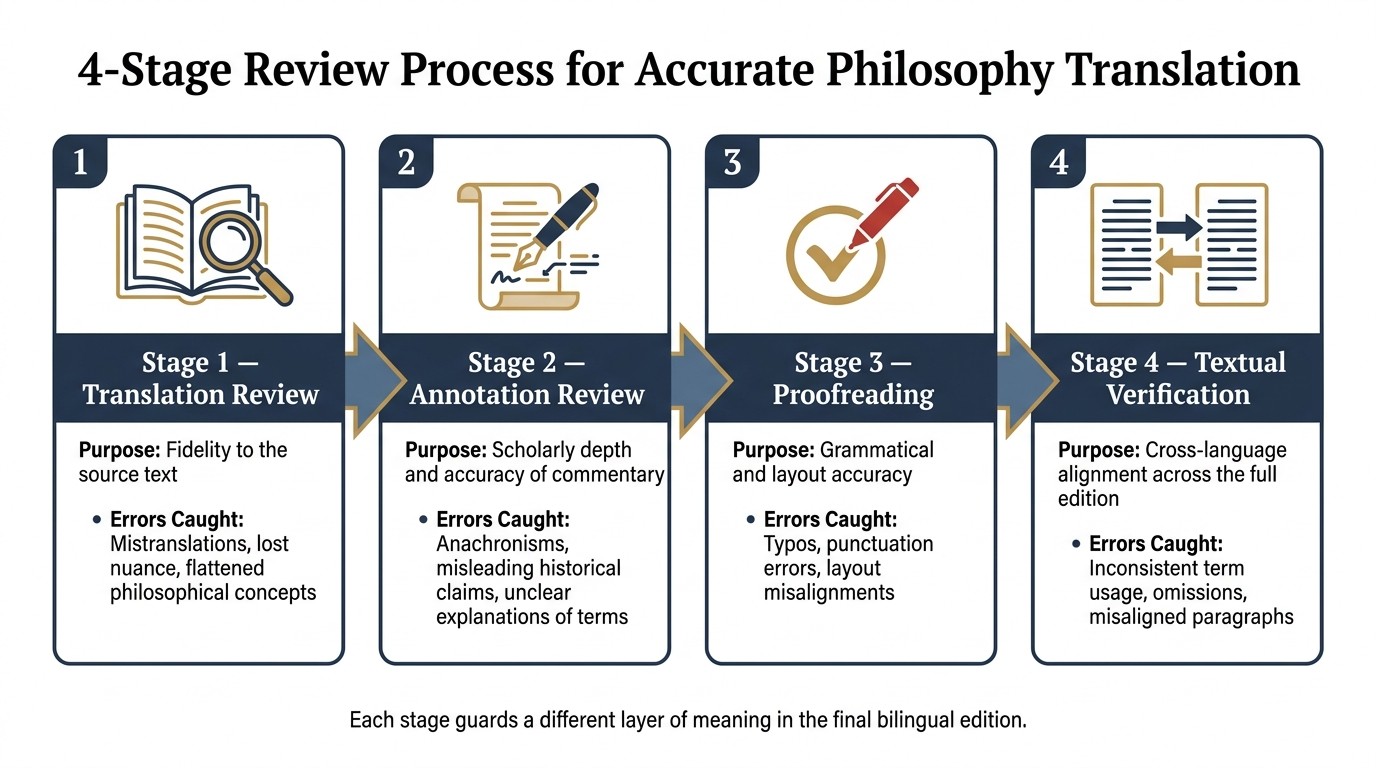
4-Stage Review Process for Accurate Philosophy Translation
A strong translation and sharp annotations still need a careful review before publication. Source, annotation, proofreading, and alignment each need their own check, especially when deciding between bilingual and English-only editions.
Review Stages That Protect Meaning
Editors start by verifying the source text itself. The translation must come from the original Latin, French, and German, not from another translation. In the Leibniz edition, the English translation was checked against the Henri Lestienne 1907 critical edition.
After that, the review moves through four separate stages. Each one guards a different layer of meaning.
Review Stage | Purpose | Errors Caught |
|---|---|---|
Translation Review | Fidelity to the source text | Mistranslations, lost nuance, flattened philosophical concepts |
Annotation Review | Scholarly depth and accuracy of commentary | Anachronisms, misleading historical claims, unclear explanations of terms |
Proofreading | Grammatical and layout accuracy | Typos, punctuation errors, layout misalignments |
Textual Verification | Cross-language alignment across the full edition | Inconsistent term usage, omissions, misaligned paragraphs |
These stages do different jobs. One may catch a mistranslation. Another may spot a weak note, a typo, or a paragraph that no longer lines up with the source.
Keeping Terms Consistent Across Chapters and Future Editions
Accuracy also goes past the sentence level. Editors have to keep terms steady across the full book. That sounds simple, but it rarely is. A word like substance or monad can show up again and again, and if the wording shifts without explanation, the argument can start to fray.
The same review system that catches mistranslations also helps stop term drift from chapter to chapter. Editors use the analytical index to track recurring terms across the full text. In the Leibniz edition, the index covers both the Discourse and the related correspondence, so readers and editors can check that a term is handled the same way throughout.
Glossary and index checks help keep terminology aligned across the volume.
Conclusion: How Annotations Make Philosophy Translation Reliable
Put it all together, and you get something simple but important: these checks are what make philosophical translation reliable.
In philosophy, accuracy isn't just about swapping one word for another. It means keeping an idea's ambiguity, its history, and its place in the argument intact. When a translation smooths over those layers, it doesn't merely simplify the text. It changes the text.
Annotations make those editorial choices visible. They show why a term was chosen and give readers the context behind that choice. Without that record, readers are asked to trust the translation with no clear way to check how its decisions were made.
A reliable bilingual edition brings together a verified translation, annotations, a glossary, and an index. That's the model Logos Philosophy Club follows.
Logos Philosophy Club uses that standard in each monthly bilingual edition. For serious study, the structure of the edition is part of the translation itself.
FAQs
Why aren’t facing pages enough on their own?
Facing pages place the original text next to the translation, which helps. But on their own, they often don’t give readers enough context to track dense philosophical arguments.
Annotations and scholarly commentary fill in those gaps. They clarify specialized terms, explain historical traditions, and shed light on the text’s specific circumstances. With that editorial support, a bilingual edition becomes much more useful for serious study.
How do annotations preserve ambiguity without confusing readers?
Annotations help readers without flattening a text into one fixed meaning.
Instead of forcing a single reading, they add editorial context and historical background. That extra context can clear up dense terms and explain the customs, ideas, or circumstances surrounding a work.
The result is simple but important: readers can track more than one layer of meaning at the same time while the original text keeps its depth and nuance. That matters a lot in serious philosophical study, where small shifts in wording can change how an argument is understood.
What causes term drift in philosophy translation?
Term drift happens when small changes in wording slowly alter what an argument means. As language changes and context shifts over time, terms in foundational texts can lose the precision they once had.
That creates a simple but serious problem: readers may view classical arguments through a modern lens instead of reading them as the author meant them. Annotations help keep the meaning in place by explaining historical terms and the context around them.