Ancient Philosophy in Dual-Language Editions


Reading ancient philosophy in dual-language editions offers a unique way to dive deeper into the original texts. These editions pair the original language (like Ancient Greek or Latin) with an English translation, helping readers grasp the nuances often lost in translation. These translation challenges in philosophy often require specialized editorial approaches to preserve the original meaning. Whether you're a student, scholar, or collector, choosing between bilingual editions vs. English-only resources can make a significant difference in your understanding and engagement.
Here’s a quick breakdown of three top options:
Loeb Classical Library: Affordable, compact, and widely available. Known for its facing-page format and updated translations. Each volume costs $26.00, with digital access starting at $195 annually.
Logos Philosophy Club: A subscription service delivering premium bilingual hardcovers monthly. Includes extras like essays and high-quality designs. Costs $420 annually or $45 monthly.
Hackett Editions: Academic-focused with detailed notes and affordable options. Offers both paperbacks (starting at $12) and durable hardcovers (up to $54).
Each option caters to different goals, from casual reading to rigorous study or building a personal library. Below is a comparison to help you decide.
Quick Comparison
Resource | Best For | Physical Format | Cost | Key Features |
|---|---|---|---|---|
Loeb Classical Library | General readers, libraries | Compact hardcovers | $26.00/volume | Facing-page layout, updated translations, digital access available |
Logos Philosophy Club | Collectors, enthusiasts | Premium hardcovers | $420/year or $45/month | Monthly delivery, curated essays, ribbon markers, exclusive collectibles |
Hackett Editions | Students, academics | Paperbacks & hardcovers | $12–$54 | Detailed glossaries, academic notes, budget-friendly for classrooms |
Choose the edition that aligns with your needs - whether it's affordability, premium quality, or scholarly depth.
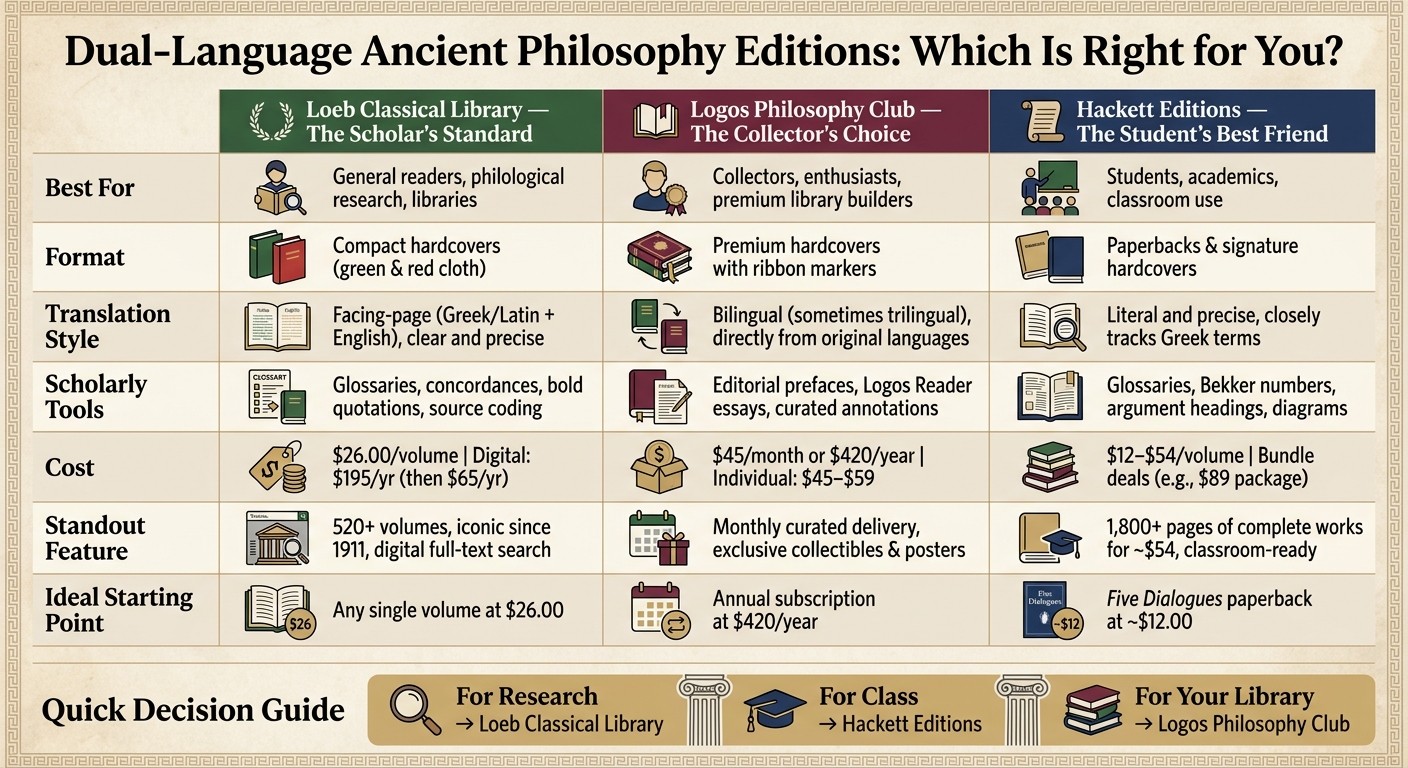
Dual-Language Ancient Philosophy Editions: Side-by-Side Comparison
Tilke Nelis – Two Latin Translations of Aristotle’s De anima Side by Side
1. Loeb Classical Library
The Loeb Classical Library (LCL), established in 1911 by James Loeb, has become a cornerstone for readers of Greek and Latin literature. Published by Harvard University Press since 1934, the collection now includes over 520 volumes, featuring works from major philosophers and other classical authors.
Translation Philosophy
The LCL was created with a simple yet ambitious goal: to make classical texts accessible to as many readers as possible. Modern editions emphasize translations that are clear and precise, avoiding excessive interpretation. This approach is especially important for philosophical texts, where translators retain the original ambiguities to reflect the author's intent. As General Editor Glenn W. Most remarked:
"Loeb editions started to become much more serious, but without losing their convenience and fun."
Earlier editions were often criticized for awkward English and censored content. However, modern revisions have addressed these issues, offering translations that are now more fluid and complete. These updates are further enhanced by robust scholarly tools.
Scholarly Apparatus
The academic tools included in the LCL have significantly improved over time. For example, the Early Greek Philosophy set spans nine volumes and 4,093 pages, featuring detailed glossaries of Greek and Latin terms, concordances linked to the Diels-Kranz standard, thematic outlines, and a coding system (P, D, R, T) to categorize sources - biographical, doctrinal, later reception, and thematic texts. Passages verified as direct quotations are highlighted in bold font, making it easy to identify original material. Interestingly, about 20% of the entries in this set - around 818 passages - were not included in the older standard, Die Fragmente der Vorsokratiker.
Physical Design and Durability
LCL volumes are known for their iconic green (Greek) and red (Latin) cloth covers. These hardbacks are compact, with the original text on the left and its English translation on the right. The books are well-constructed, making them suitable for both personal collections and institutional libraries. The consistent design, unchanged since 1912, ensures that older and newer volumes blend seamlessly on a shelf. One minor drawback is the challenge of cross-referencing within multi-volume works, which can sometimes be inconvenient.
Cost and Accessibility
Each hardcover volume is priced at $26.00, offering affordable membership plans for readers. For those seeking digital access, the Digital Loeb Classical Library launched in 2014, featuring full-text search across the entire collection. A personal subscription costs $195 for the first year and $65 for each consecutive year thereafter. For collectors, purchasing the entire printed library costs around $13,000. While this is a significant expense, most readers opt to buy individual volumes as needed. Both the print and digital editions are widely available through Harvard University Press, major booksellers, and university libraries across the U.S.
2. Logos Philosophy Club
Logos Philosophy Club takes a fresh approach to studying ancient philosophy by offering a subscription-based service that delivers curated philosophical works each month. Subscribers receive a carefully selected title delivered directly to their door. You can explore the club's offerings at Logos Philosophy Club. The club's mission is straightforward:
"To produce high-quality philosophical works - carefully edited, faithfully translated from the original languages, and designed for serious, sustained reading."
Recent selections have included Aristotle's Nicomachean Ethics (December 2025), Plato's Symposium (March 2026), and Saint Augustine's Confessions (June 2026).
Translation Philosophy
Logos Philosophy Club prioritizes authenticity by translating each text directly from its original language, whether Greek, Latin, or another, without relying on existing English versions. The books are presented in a bilingual format, with the original language on one page and the English translation on the opposite. Translations reference critical editions, such as those by John Burnet and K. J. Dover. Occasionally, a trilingual format is used, as seen with Boethius' The Consolation of Philosophy (January 2026), which includes Latin, modern English, and Old English, allowing readers to explore how the text has evolved over time.
Scholarly Apparatus
Each edition includes a detailed editorial preface that introduces the text's structure, literary form, and importance in Western philosophy. Annotations delve into historical, linguistic, and contextual details, while a glossary of philosophical terms and a selective index help readers navigate complex ideas. Some editions also feature the Logos Reader, a collection of essays and scholarly commentary. Subscriber John Roche shared his enthusiasm:
"I love my copy. The book is sturdy and very well bound, but so far the scholastic commentary is the real gem."
These features make the editions ideal for in-depth study and long-term reference.
Physical Design and Durability
The books are designed to last. Each hardcover volume is crafted with high-quality materials, including durable binding, premium paper, and a ribbon marker. These details ensure the books hold up to years of use. Subscribers also receive exclusive collectibles like thematic posters and custom bookmarks with their monthly deliveries.
Cost and Accessibility
Logos Philosophy Club balances scholarly depth with affordability. Subscriptions are available for $420 annually, which includes 12 editions, the Logos Reader, exclusive gifts, and free shipping. Alternatively, you can subscribe monthly for $45. Individual volumes are also available for purchase, priced between $45 and $59. Boxes ship the month after release, making it easy to plan your reading schedule.
3. Hackett Bilingual Editions
Hackett Publishing has earned respect in academic philosophy circles, particularly for its bilingual and complete-works editions tailored to students and researchers. Their collection includes major ancient thinkers like Plato and Aristotle, with editions designed for both classroom and library use.
Translation Philosophy
Hackett translators aim to stay as close as possible to the original Greek while crafting clear, precise English. For intricate works like Aristotle's Metaphysics, they use translations that carefully track key technical terms. In texts such as Plato's Republic, indirect dialogue is presented directly, making it easier for modern readers to follow .
Scholarly Apparatus
The editions include notes that balance foundational explanations with deeper commentary. This holistic approach reflects the standard for reviewing bilingual philosophy editions as integrated scholarly packages. Features like argument headings, Bekker numbers, technical glossaries, and even integrated diagrams enhance usability. Christopher Bobonich from Stanford University praised the notes, saying they are "more helpful than those in any other available translation" because they cater to both beginners and advanced readers without overwhelming either group.
This scholarly depth is paired with thoughtful physical design, ensuring the books meet the needs of both collectors and classroom users.
Physical Design and Durability
Hackett's premium editions, such as Plato: Complete Works, are crafted with high-quality materials like India paper, Smyth-sewn cloth bindings, and elegant typography to ensure they last for years. For more budget-conscious users, their paperback editions provide an affordable option for classroom use, though they are less durable.
"Hackett has lavished great care in the production of this volume: fine India paper, elegant typography, sewn binding, and cloth boards. . . . It should be in every library and on the shelves of all lovers of Plato."
Steven J. Willett, Syllecta Classica
Cost and Accessibility
Hackett balances its academic rigor and durable designs with student-friendly pricing. Individual volumes are reasonably priced, and package deals, like Plato: Complete Works bundled with The People of Plato for $89.00, offer excellent value for academic users. With its focus on translation precision, detailed scholarly tools, quality production, and affordability, Hackett continues to make a meaningful contribution to bilingual editions for serious study.
Pros and Cons of Each Resource
The table below provides a side-by-side comparison of the three resources, highlighting their strengths and weaknesses across key features.
Resource | Translation Style | Scholarly Apparatus | Physical Format | Cost |
|---|---|---|---|---|
Loeb Classical Library | Varies; newer editions are clearer, older ones can feel verbose | Minimal to moderate; newer editions like Laks-Most include reception history | Compact hardcover with facing-page layout | $26.00 per volume |
Logos Philosophy Club | Bilingual, tailored for focused individual study | Editorial notes, Logos Reader essays, curated annotations | High-quality hardcover with ribbon markers and posters | $45/month or $420/year |
Hackett Editions | Precise and literal; closely tracks Greek terms | Extensive scholarly tools, including glossaries and essays | Paperback & Signature Hardcover | $12–$54 depending on edition |
Below, we delve into the nuances of each resource to better understand their advantages and limitations.
The Loeb Classical Library is ideal for readers who want reliable access to original texts alongside translations. Its facing-page format makes it simple to cross-reference Greek or Latin with the English text, making it a favorite for casual and intermediate readers. However, older translations can sometimes over-explain or lose the sharpness of Aristotle's original prose. Richard Wallace captures this challenge perfectly:
"The translator of Aristotle has an unhappy task, in that in many cases to produce an attractive and comprehensible translation is to misrepresent the nature of Aristotle's Greek."
For those looking for a more immersive experience, the Logos Philosophy Club combines beautifully crafted physical editions with additional tools like the Logos Reader and curated annotations. It’s a great option for readers who want to build a long-term collection with a premium feel. However, its scholarly apparatus, while detailed, may not meet the needs of those engaged in rigorous academic research.
Finally, Hackett Editions stands out as the go-to choice for academic purposes. With its detailed glossaries, interpretive essays, and argument headings, it provides a wealth of resources for in-depth study. That said, the sheer volume of notes can feel overwhelming for readers who are new to ancient philosophy. Still, its affordability - offering complete works with over 1,800 pages for around $54 - makes it a hard-to-beat option in terms of value.
Conclusion
The analysis above highlights the unique strengths of each option, helping you decide which dual-language edition aligns best with your study goals.
The Loeb Classical Library is ideal for those focused on philological research. Its facing-page format has long been a scholarly standard, and the Laks-Most Early Greek Philosophy collection is crucial for exploring pre-Socratic thought. At $26.00 per volume, it allows you to build a comprehensive library without requiring a subscription.
For classroom use or undergraduate study, Hackett Editions are a practical choice. Beginners may find the Five Dialogues a great starting point at about $12.00, while the Complete Works of Plato, priced around $53.87, provides excellent coverage for broader exploration.
The Logos Philosophy Club caters to collectors and those building a premium personal library. At $420 per year (or $45 per month), it offers beautifully crafted hardcovers with ribbon markers and access to the exclusive Logos Reader commentary.
These editions balance accurate translations with scholarly insights, showcasing the value of dual-language texts for in-depth philosophical study. The table below summarizes the key features and costs of each option:
Reader Goal | Best Fit | Starting Cost |
|---|---|---|
Philological research | Loeb Classical Library | $26.00/volume |
Classroom & survey courses | Hackett Editions | ~$12.00 |
Personal library building | Logos Philosophy Club | $420/year |
Whether you're diving into pre-Socratic philosophy, enhancing your classroom resources, or curating a distinguished library, there's a dual-language edition suited to your needs.
FAQs
Do I need to know Greek or Latin to use a dual-language edition?
No, you don’t need to be fluent in Greek or Latin. Dual-language editions provide the original text alongside an English translation, making it easier to follow the arguments while examining the language. These editions are great for clarifying terms, understanding translation decisions, and gaining a better grasp of the author’s intent. The Logos Philosophy Club even offers annotated bilingual editions to make studying these texts more approachable and engaging.
How do I choose a dual-language edition for my goal (class, research, or collecting)?
Choosing a dual-language edition comes down to what you need it for. If you're diving into research, go for editions that offer accurate translations alongside the original text - this helps you catch subtle details and meanings. Students should look for versions that come with helpful tools like glossaries, cross-references, and commentary to make studying easier. If you're a collector, focus on editions with sturdy bindings and well-done typography. Steer clear of cheaply made reprints or versions created by AI. The best editions strike a balance between intellectual depth and quality craftsmanship, making them a worthy addition to your library.
Should I use print or digital dual-language editions for serious study?
For in-depth study, high-quality physical bilingual editions are an excellent choice. They provide a hands-on, immersive experience with a side-by-side format that helps reinforce vocabulary and improve fluency. Logos Philosophy Club offers carefully translated and annotated editions, crafted to support thoughtful exploration and intellectual growth. Plus, physical books bring a sense of permanence and weight that aligns beautifully with the depth of the ideas they explore.