Kant's Synthetic A Priori: Key Insights

Kant's concept of synthetic a priori judgments changed how we understand knowledge. These judgments combine two features: they add new information (synthetic) while being universally true and independent of experience (a priori). For example, "7 + 5 = 12" or "every alteration has its cause" are truths that are not derived from observation but are necessary for organizing knowledge.
Kant classified judgments into four types:
Analytic A Priori: Based on definitions, like "All bachelors are unmarried."
Synthetic A Posteriori: Based on experience, like "The sun is warm."
Synthetic A Priori: Expands knowledge without relying on experience, like basic math or causality.
Analytic A Posteriori: Impossible, as it contradicts Kant's framework.
Kant's idea bridges rationalism (reason-based certainty) and empiricism (experience-based knowledge). It explains how fields like math and science rely on principles that are both necessary and informative. His theory also introduced the distinction between phenomena (what we experience) and noumena (what exists beyond our perception), showing that our minds actively structure reality using tools like space, time, and causality.
In short, Kant's synthetic a priori judgments highlight how the mind shapes knowledge, offering insights into math, science, and morality while defining the limits of human understanding.
Kant's Framework: How He Classified Judgments
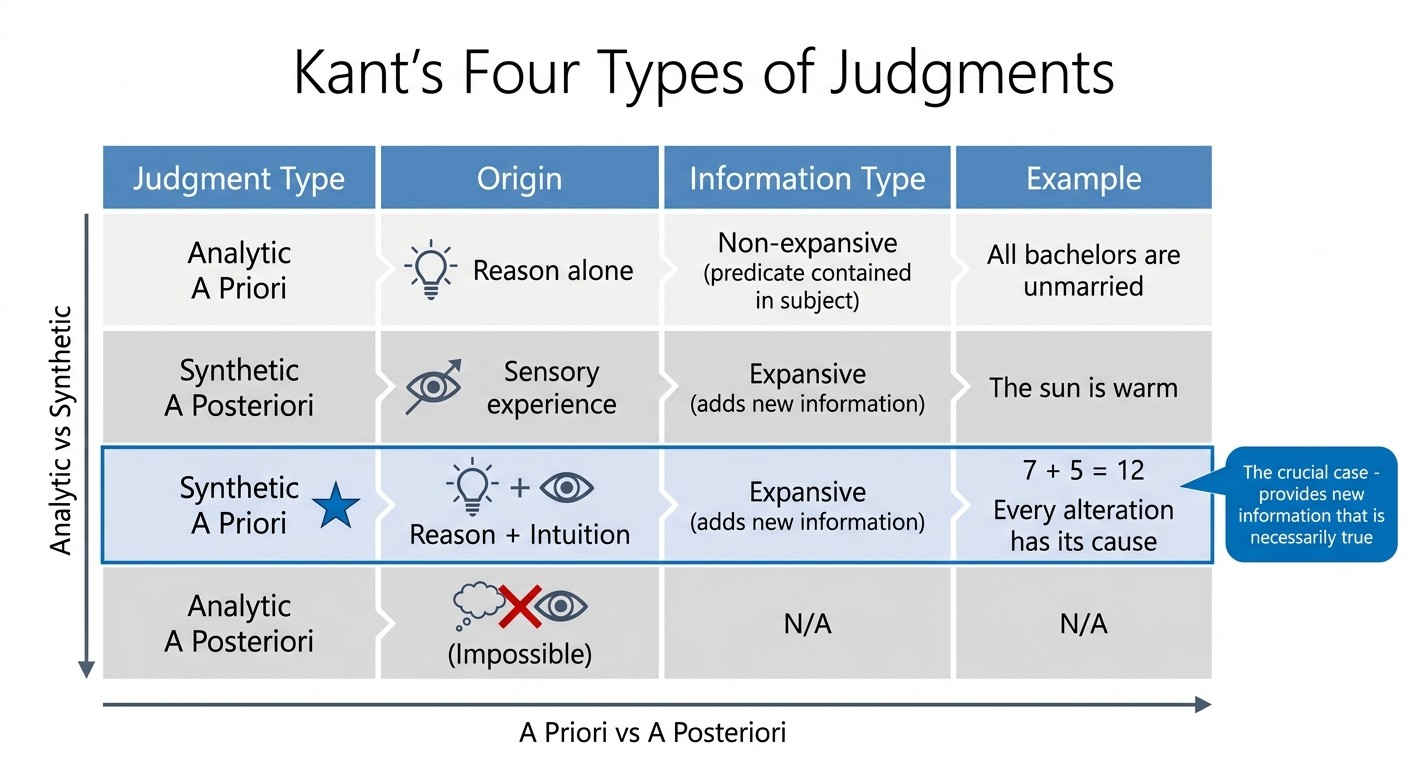
Kant's Four Types of Judgments: Classification Framework
Kant broke down judgments into two key distinctions: one between analytic and synthetic judgments, and another between a priori and a posteriori knowledge. Together, these distinctions form a groundbreaking system for understanding how we acquire and process knowledge.
This structure is essential for grasping the unique role of synthetic a priori judgments in human understanding.
Analytic vs. Synthetic Judgments
Judgments, according to Kant, either clarify existing concepts or expand them.
Analytic judgments don’t introduce new information. Instead, the predicate is already contained within the subject. For instance, in the statement "All bachelors are unmarried," the idea of being unmarried is inherently part of what it means to be a bachelor. Denying such a judgment results in a logical contradiction because it goes against the very definition of the subject.
On the other hand, synthetic judgments add new information to our understanding. They link a predicate to a subject in a way that isn’t inherently obvious. Take the statement "All bodies have weight." The idea of weight isn’t inherently part of the concept of a body - it’s something we come to understand through observation or intuition. Synthetic judgments expand our knowledge by connecting concepts that weren’t previously linked.
A Priori vs. A Posteriori Knowledge
Kant’s second distinction focuses on the source of knowledge.
A priori knowledge is independent of sensory experience. It is defined by its universality and necessity - truths that hold without exception. Mathematical principles, such as 2 + 2 = 4, are classic examples of a priori knowledge. These truths are understood through reason alone and don’t rely on empirical observation.
In contrast, a posteriori knowledge comes entirely from experience. For example, the statement "Crows are black" is based on sensory observation. This type of knowledge is contingent - it depends on what has been observed and lacks the universality of a priori truths.
Kant's Combination: Synthetic A Priori
Kant combined these distinctions to create a framework with four possible categories of judgment:
Judgment Type | Origin | Information Type | Example |
|---|---|---|---|
Analytic A Priori | Reason alone | Non-expansive | "All bachelors are unmarried" |
Synthetic A Posteriori | Sensory experience | Expansive | "The sun is warm" |
Synthetic A Priori | Reason + Intuition | Expansive | Basic arithmetic truths |
Analytic A Posteriori | (Impossible) | N/A | N/A |
Among these, synthetic a priori judgments hold a special place in Kant’s philosophy. As Garth Kemerling explains, they are "the crucial case, since only they could provide new information that is necessarily true." These judgments combine the expansive nature of synthetic judgments with the universality and necessity of a priori knowledge. Fields like mathematics and fundamental scientific principles - such as "every alteration has its cause" - fall into this category.
This framework bridges the gap between Rationalism, which often fails to engage with practical experience, and Empiricism, which struggles with uncertainty. It underscores the active role of the mind in shaping how we experience and understand the world.
Why Synthetic A Priori Judgments Matter
Synthetic a priori judgments play a key role in Kant's philosophy because they tackle a long-standing challenge in Western thought. Before Kant, philosophers faced a tough choice: either rely on the certainty of rationalism or accept the experiential yet uncertain insights of empiricism. By introducing synthetic a priori judgments, Kant offered a new way to think about knowledge, breaking the stalemate between these two schools of thought.
Moving Beyond Empiricism and Rationalism
Rationalists like Descartes and Leibniz believed that reason alone could provide certainty. On the other hand, empiricists like Hume argued that knowledge comes from sensory experience, though this approach often led to uncertainty and limitations in understanding. Kant's idea of synthetic a priori judgments bridges this gap. These judgments combine the necessity and universality of rationalism with the new, non-observable insights often associated with empiricism. This approach not only addresses the weaknesses of both perspectives but also lays the groundwork for disciplines like mathematics and natural science.
The Role of Necessity and Universality in Knowledge
Kant emphasized that a priori knowledge is both universal and necessary. For instance, noting that the sun rises every day is merely an empirical observation of past events, which lacks necessity. Empirical claims are contingent - they depend on experience and could be otherwise.
Synthetic a priori judgments, however, operate differently. Their validity does not come from experience but from the fundamental structures of human cognition. This idea, often referred to as Kant's "Copernican Revolution" in philosophy, suggests that objects conform to the mental conditions we impose, rather than our concepts merely mirroring external objects. As a result, principles in fields like mathematics and natural science are not derived from observation but instead serve as necessary foundations for making sense of experience.
Where Synthetic A Priori Knowledge Applies
Kant's idea of synthetic a priori judgments isn't just a theoretical concept - it has real-world relevance in fields like mathematics, natural science, and morality. These areas rely on principles that are both informative and universally binding, offering insights beyond what logic or sensory experience alone can provide.
Mathematics as Synthetic A Priori
Kant believed that mathematical truths are synthetic a priori because they expand our understanding while being universally necessary. For example, take the statement "7 + 5 = 12." The concept of "12" isn't simply found in the combination of "7" and "5"; instead, it requires a mental process, like counting, to arrive at the sum.
This is where pure intuition becomes essential. Geometry relies on our intuitive sense of space, while arithmetic depends on a sequential sense of time. For instance, the idea that a straight line is the shortest distance between two points isn't something you can deduce from the definition of a straight line - it requires spatial reasoning. Kant explained this clearly:
Arithmetical judgments are therefore synthetical, and the more plainly according as we take larger numbers; for in such cases it is clear that, however closely we analyze our concepts without calling visual images to our aid, we can never find the sum by such mere dissection.
Modern advancements, like non-Euclidean geometries and Gödel's incompleteness theorems, further support Kant's view by showing that some mathematical axioms can't be derived purely from definitions - they are synthetic in nature.
Natural Science and A Priori Principles
Scientific laws do more than just describe observed patterns - they require underlying principles to organize these observations into universal truths. Take the law of causality: we don't actually see causality when observing fire followed by smoke. Instead, our mind imposes a necessary connection between the two, forming the basis for scientific understanding.
Kant argued that Categories - such as Substance and Causality - are pure concepts that structure our experiences and make scientific reasoning possible. He famously stated:
Without intuitions, concepts are empty; without concepts, intuitions are blind.
In this system, mathematics provides the spatio-temporal framework (with space and time as pure forms of intuition), while the Categories supply the conceptual tools needed to develop scientific laws. This approach not only explains how we perceive the natural world but also establishes a foundation for metaphysics and moral philosophy.
Metaphysics and Morality
In metaphysics and ethics, synthetic a priori judgments help establish universal truths that go beyond logical definitions or empirical observations. While Kant argued that we can't have theoretical knowledge of transcendent entities like the soul or God, he believed that synthetic a priori "ideas of reason" play a guiding role. These ideas help us pursue systematic, unified knowledge.
Similarly, moral principles, like the Categorical Imperative, are synthetic a priori. They don't come from observing human behavior (which only shows what is) but are rooted in reason, defining what ought to be. These principles carry an unconditional, universal obligation that informs both moral and metaphysical frameworks, shaping our understanding of duty and ethical action.
How Synthetic A Priori Knowledge Works: Transcendental Idealism
To understand how synthetic a priori knowledge works, we need to dive into Kant's concept of transcendental idealism. This framework lays the foundation for his explanation of synthetic a priori judgments.
Phenomena and Noumena
Kant draws a key distinction between phenomena - things as they appear to us - and noumena - things as they exist independently of our perception. Phenomena are shaped by the mind's structures and are the objects of our experience. Noumena, however, exist beyond the reach of our sensory and cognitive frameworks.
This distinction matters because synthetic a priori knowledge applies only to phenomena. We can know certain truths about the world with certainty, not because they reveal the nature of things-in-themselves, but because they reflect how our minds must organize experience. Kant put it this way:
The proud name of an Ontology that presumptuously claims to supply... synthetic a priori knowledge of things in general... must, therefore, give place to the modest title of a mere Analytic of pure understanding.
Kant also differentiates between two senses of noumena. In the negative sense, noumena are things that are not objects of our sensory perception. In the positive sense, they represent objects of intellectual intuition - something humans lack. While we can think about noumena (concepts like the soul or God), we cannot know them through experience. This is why traditional metaphysics often falters; it tries to apply principles like causality, which are valid for phenomena, to things beyond possible experience.
The Mind's Structures
Kant explains that the mind is not a passive recipient of sensory input. Instead, it actively organizes this input using its own internal structures, which include the forms of intuition and the categories of understanding.
Forms of Intuition: Space and time are not features of the external world but rather frameworks within the mind that shape how we perceive everything. Since all sensory data is filtered through space and time, we can make synthetic a priori judgments about areas like geometry and mathematics with certainty.
Categories of Understanding: The mind applies 12 categories, such as causality, substance, and unity, to structure sensory data into coherent experiences.
Central to this process is the Transcendental Unity of Apperception, the "I think" that must accompany all representations. As Kant explains:
It must be possible for the 'I think' to accompany all my representations; for otherwise something would be represented in me which could not be thought at all.
Through this active structuring, the mind imposes its laws - like causality - onto sensory data, creating "objects of experience". To connect abstract categories with concrete sensory data, the mind uses schemata. These are rules that interpret categories in terms of time, acting as a bridge between abstract concepts and sensory input. This mechanism reinforces Kant's argument for the possibility of synthetic a priori knowledge.
Conclusion
Kant's idea of synthetic a priori judgments changed how we think about knowledge by combining elements of rationalism and empiricism. He demonstrated that knowledge could be both necessary and informative. His famous "Copernican Revolution" in philosophy shifted the focus from how our concepts match the external world to how the structure of our concepts shapes our experience of that world.
This framework helps explain why fields like mathematics and natural science offer universal truths that go beyond simple observation. It shows that the mind isn't just a passive observer but an active participant, organizing sensory input through structures like space, time, and causality.
Kant's ideas still resonate today. His distinction between phenomena (what we can experience) and noumena (what lies beyond our experience) continues to shape modern debates about the limits of human knowledge. Cognitive science now supports his view of the brain as an active processor of sensory information. In the philosophy of mathematics, discussions about "concept construction" and intuition in proofs often trace back to Kant's theories. Even his concept of the "transcendental unity of apperception" - the "I think" that unifies all our experiences - remains influential in discussions about self-awareness and consciousness.
Kant also redefined metaphysics. By arguing that synthetic a priori principles apply only to possible experiences, he explained why traditional metaphysical claims about the soul, God, or the universe often fail - they try to extend mental structures beyond their proper scope. Instead, Kant reframed these ideas as "regulative" principles, guiding systematic inquiry rather than describing ultimate reality.
Kant's work on synthetic a priori judgments remains central to understanding knowledge and reality. Explore our curated philosophy editions to dive deeper into these timeless ideas. It highlights how certainty and discovery can coexist, how the mind actively shapes experience, and where the boundaries of human understanding lie.
FAQs
Why did Kant think math is synthetic a priori?
Kant argued that mathematics is synthetic a priori because it goes beyond merely dissecting concepts to expand our understanding. Mathematical judgments are necessarily true, yet they aren't based solely on definitions. Instead, they merge the certainty of a priori knowledge with the broadening characteristic of synthetic judgments.
How can causality be a priori if we learn from experience?
Causality is viewed as a priori because, as Kant explains, it provides a necessary structure for organizing our experiences. Concepts like causality exist outside of direct empirical observation, acting as the foundation for universal and necessary knowledge about how phenomena are connected through cause and effect. These concepts are essential - they shape the way we perceive and make sense of the world, enabling the very possibility of experience.
What can we know about noumena, if anything?
Kant suggests that although we cannot directly understand noumena, we can recognize their existence as "things-in-themselves" - realities that exist beyond what our senses can grasp. These remain inherently beyond our comprehension because our knowledge is confined to phenomena, which are filtered and shaped by the way we perceive and interpret the world.