Husserl on Time-Consciousness


Husserl’s main point is simple: I do not experience time as isolated split-second “nows.” I experience a flowing present that holds the just-past, the now, and the next moment together.
That claim does most of the work in this topic. It explains why I can hear one melody instead of 5, 10, or 20 detached notes. It also shows why time is a problem for phenomenology: if experience comes as flow, then any account of consciousness has to explain how that flow appears.
Here’s the short version:
Husserl is not explaining clock time.
He is asking how experience stays one experience across change.
His answer is the “living present.”
That living present has 3 linked parts:
primal impression: what appears now
retention: what has just passed, still held in view
protention: what is about to come
This structure lets me hear a sentence or melody as one whole.
It also gives phenomenology a way to describe duration, succession, and change.
One way to see the point: if experience were only a chain of single instants, then a melody would break into separate sounds. But that is not how experience shows up. I hear continuity, order, and flow.
A quick fact from the article’s core model: Husserl’s account turns on 3 moments, not 1. So instead of a point-like present, he describes a present with temporal span.
Part | What it does | Simple example |
|---|---|---|
Primal impression | Gives what is here now | The note sounding now |
Retention | Holds the just-past as just-past | The note I still hear fading behind the current one |
Protention | Aims toward what comes next | My sense that another note is about to follow |
The article also points to a second issue: this is not only about time. It is about method. If phenomenology wants to describe how things appear, then it has to start from the way experience is given in temporal flow. That is why Husserl links time-consciousness to bracketing, lived duration, pre-reflective self-awareness, and levels of constitution.
So if you want the shortest possible takeaway, it is this: Husserl says temporal unity is already built into experience, and that is what makes phenomenological description possible.
You Have Never Experienced the Present - Husserl's Proof
Husserl's Problem of Internal Time
The melody example shows why internal time matters: a sequence can be heard as one whole only if consciousness holds it together.
Objective Time, Lived Time, and Internal Time-Consciousness
Phenomenology sets aside clock time and looks instead at how temporal objects and temporal flow show up in consciousness. That shift matters. Objective time doesn't explain how experience is lived as a single stream, which is why temporal structure becomes a core problem for phenomenology.
Why a Punctual Present Cannot Explain Experience
A punctual present can't account for duration, succession, or change. If experience were nothing more than a string of isolated "nows", a melody would fall apart into separate notes.
Phenomenology tackles a different issue: not how time is measured from the outside, but how temporal experience is given at all.
Husserl answers this by analyzing the living present.
The Living Present: Primal Impression, Retention, and Protention
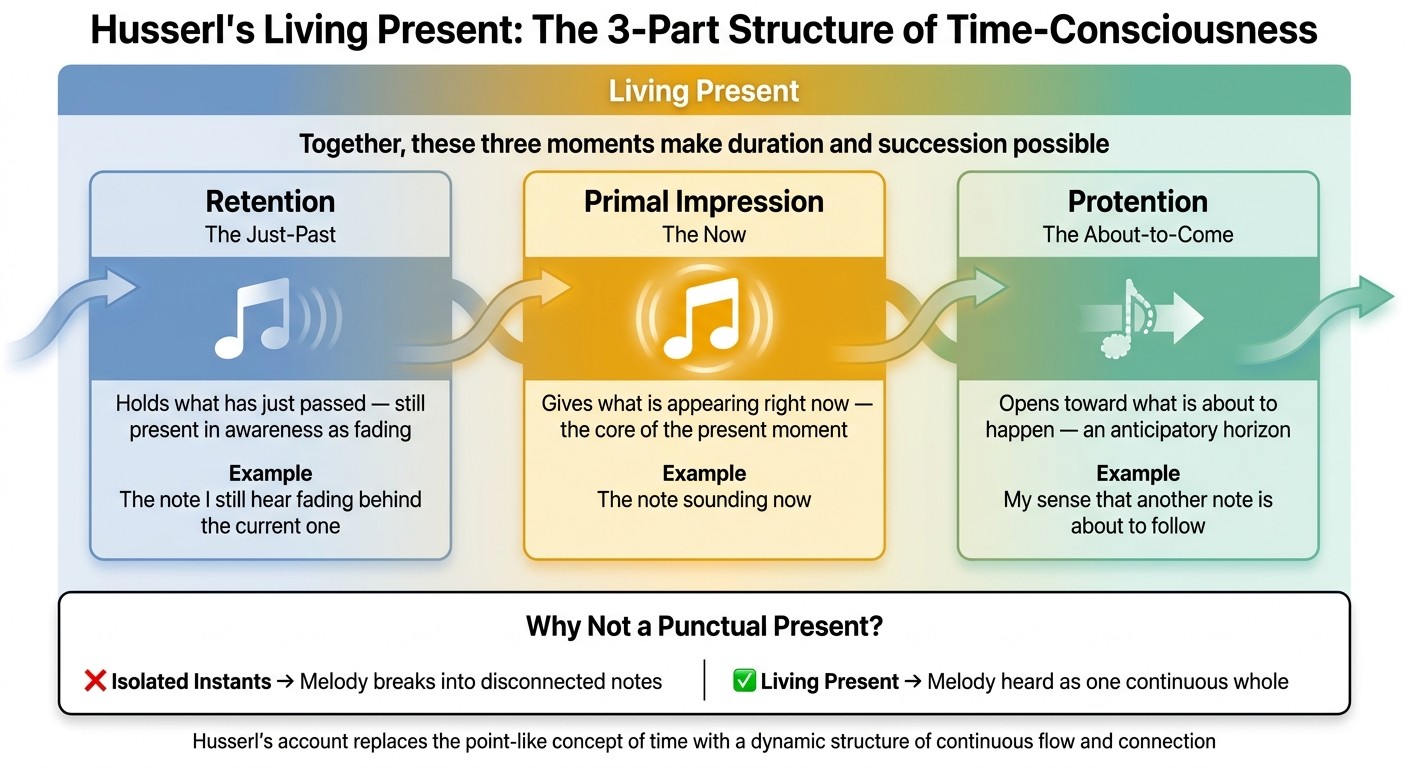
Husserl's Living Present: Primal Impression, Retention & Protention Explained
Husserl answers the punctual-now problem with the living present: a thick, lived present rather than a point-like now. Instead of treating the present as a single dot in time, he treats it as something with span. Husserl breaks this structure into three inseparable moments.
Primal Impression, Retention, and Protention Defined
Husserl analyzes the living present through three inseparable moments: primal impression, retention, and protention. Primal impression gives what is now appearing. Retention holds the just-past as just-past. Protention opens toward what is about to happen. Together, they make duration and succession possible.
Put simply, experience doesn’t arrive in disconnected bits. What shows up now still carries the trace of what just happened and leans toward what comes next. That’s what gives time its felt flow.
How the Living Present Constitutes Temporal Objects
This triad explains how temporal objects remain unified in experience. That’s how a melody or sentence stays together across time. You don’t hear each note or word as a sealed-off instant. You hear each one against what has just passed and in light of what seems ready to follow.
This structure lets phenomenology describe lived duration instead of isolated instants.
Time-Consciousness as a Base for Phenomenological Method
For Husserl, the living present is the key to method. Phenomenology can describe how things appear only if it can account for temporal unity. So the issue is no longer just time itself. The deeper issue is how phenomenological description becomes possible in the first place.
Reduction, Bracketing, and the Description of Appearing Duration
The epoché brackets objective time so phenomenology can focus on duration as it appears. From there, phenomenology describes lived duration: the way temporal objects show up as stretched out and unfolding over time.
That is the job of Husserl’s account of primal impression, retention, and protention. The point is not abstract time taken on its own, but the way duration is given in experience.
Pre-Reflective Self-Awareness and the Stream of Consciousness
Consciousness is temporal all the way through. Husserl calls this pre-reflective self-awareness. It is not a matter of stepping back and observing oneself. It belongs to the living present itself.
Consciousness does not have to turn back on itself for its temporal life to be given. Its self-manifestation is already there within the flow of experience. This self-givenness lets Husserl mark off different levels of constitution.
Levels of Constitution in Husserl's Analysis
Husserl also marks different levels of constitution. This summary stays with the level where temporal objects are first given in the living present. Even here, the structures are still disputed, especially when it comes to retention, protention, and the absolute flow.
Key Debates and a Practical Reading Path
Debates on Retention, Protention, and the Absolute Flow
These structures are still debated in Husserl scholarship. Readers and scholars disagree about retention, protention, and the absolute flow: whether retention is a separate part or the flow's self-awareness, how protention belongs within the living present, and how to speak about the absolute flow without turning it into a thing. The absolute flow is the hardest idea to pin down because it names the most basic layer of temporal appearing.
How to Read Husserl's Texts in Order
If you want to track the argument in Husserl's own texts, it helps to read with these three structures in mind. Start with Husserl's lectures on internal time-consciousness. Then go back and reread the passages on primal impression, retention, and protention.
Only after that should you bring in a small set of focused secondary sources. Robert Sokolowski's Phenomenology of the Human Person is a good next step for clarifying Husserl's account of experience and agency. As you read, organize your notes around three axes:
the levels Husserl distinguishes
the structure of the living present
the methodological role of time-consciousness in phenomenological description
Logos Philosophy Club's annotated bilingual editions support this kind of slow, text-first reading.
Conclusion: What Husserl's Analysis of Time Explains
Husserl shows that temporal unity is not added onto experience after the fact; it is what makes phenomenological description possible.
FAQs
What is the living present?
The material provided here does not define Husserl’s living present.
If you want to study core phenomenological texts in more depth, Logos Philosophy Club offers a monthly subscription with high-quality bilingual editions made for close, serious reading.
How is internal time different from clock time?
The search results don’t explain Husserl’s distinction between internal time and clock time.
If you want to study big philosophical questions in more depth, Logos Philosophy Club offers bilingual, annotated editions of major philosophical texts for serious monthly reading.
Why does time-consciousness matter for phenomenology?
Time-consciousness matters because it is the basic structure through which experience takes shape. Husserl shows that consciousness holds onto the immediate past while leaning toward the future. That movement is what makes objects appear as continuous rather than scattered moments. It also helps explain why the self feels like the same self across time.
For phenomenology, this matters because it points to the inner temporal framework beneath every act of perception and thought. Without that structure, experience would break apart into isolated fragments instead of forming a lived stream.