Spinoza's View on Necessary Existence

Spinoza's philosophy centers on the idea that everything in existence follows a rational, unchangeable order. He believed that God, or Nature, is the only substance that exists necessarily and independently. This means God cannot not exist, as existence is part of His essence. Spinoza also argued that all finite things, like humans or objects, are modes or expressions of this infinite substance, relying on it for their existence.
Key points from the article:
God as Necessary Being: Spinoza defines God as the only self-caused, infinite substance. Nothing else can exist independently of God.
Substance and Modes: Substances exist in themselves, while modes depend on external causes. Modes are like waves on the ocean, with the ocean being the substance (God).
Determinism: Everything in the universe, including human actions, is determined by the nature of God. Free will, as traditionally understood, does not exist.
Human Freedom: True freedom for Spinoza means understanding the rational order of the universe and acting in harmony with it.
Spinoza's ideas challenge traditional views of God and free will, offering a unified vision of reality where everything is interconnected through a single, necessary substance.
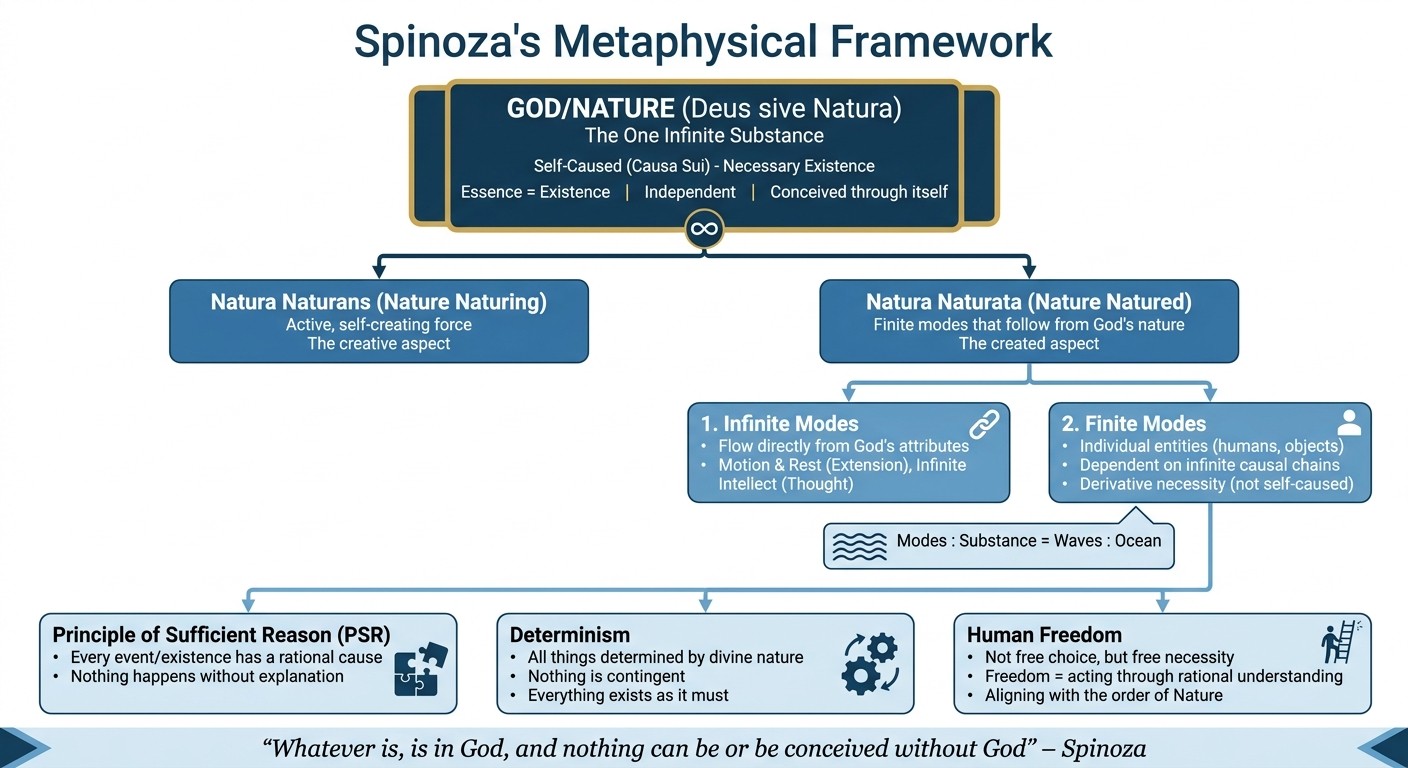
Spinoza's Metaphysical Framework: Substance, Modes, and Necessary Existence
The Principle of Sufficient Reason in Spinoza's Philosophy
What is the Principle of Sufficient Reason?
The Principle of Sufficient Reason (PSR) is a fundamental concept in Spinoza's metaphysics. It states that every event or existence has a rational cause. In other words, nothing happens without an explanation.
Martin Lin suggests that Spinoza applies the PSR specifically to existential truths - focusing on why something exists rather than why it behaves a certain way. He argues that Spinoza uses this principle to demonstrate God's necessary existence. According to this reasoning, if there is no cause preventing God's existence, then God must exist.
The PSR also underpins Spinoza's argument for monism, which asserts that all of reality is governed by a single, unified principle. This approach rejects purpose-driven (teleological) explanations in favor of causal ones. As Kelley L. Ross, Ph.D., explains:
Spinoza's God does not make choices, does not really have a will... God's eternal nature necessitates the things that happen, which happen just as they must and cannot happen otherwise.
This principle becomes even more striking when applied to Spinoza's distinction between substance and modes.
How PSR Applies to Substances and Modes
Spinoza draws a clear line between substances and modes based on their causes. Substances are self-caused (causa sui), meaning their existence is justified internally. Modes, on the other hand, depend on external causes for their existence.
For Spinoza, a substance is defined as something that exists "in itself" and is "conceived through itself." Its existence is necessary because nothing external can prevent it from existing. This self-contained nature makes substance the foundation of reality.
Modes, by contrast, are like ripples on the surface of this foundational substance. They cannot exist independently and rely on external causes within the framework of the substance. Martin Lin provides a helpful analogy:
Modes stand to substance as waves stand to the ocean, fists stand to hands, and wrinkles stand to carpets.
Just as waves cannot exist without the ocean, modes depend entirely on substance. Their existence is contingent, determined by the causal chain within the single substance - what Spinoza identifies as God or Nature. This relationship between substance and modes further supports Spinoza's monism, emphasizing the interconnectedness of all things within one unified reality.
Substance and Self-Causation
Substance as Self-Existent
Spinoza, building on the Principle of Sufficient Reason, describes substance as something fundamentally self-caused. He defines it as "that which exists and is conceived in itself" (Ethics, Part I, Definition 3). Unlike modes - such as humans, tables, or any individual entities - that rely on external causes for their existence, substance is completely independent. Its existence is not shaped or influenced by anything outside itself.
Spinoza introduces the term causa sui, meaning self-causation. He explains it as "that whose essence involves existence" or "that whose nature cannot be conceived except as existing". In simpler terms, the very nature of substance inherently includes its existence. It's not something that might exist - it must exist because its essence demands it. This idea of self-causation is central to Spinoza's philosophy and leads directly to the conclusion that such a substance necessarily exists.
Why Self-Caused Entities Must Exist
Spinoza argues that self-caused entities must exist based on the Principle of Sufficient Reason, which holds that everything must have a reason for its existence. Since substance cannot depend on anything external for its existence, the reason for its being must lie entirely within itself. Spinoza states, "Substance cannot be produced by anything external, it must therefore, be its own cause - that is, its essence necessarily involves existence, or existence belongs to its nature" (Ethics, Part I, Proposition VII).
The only way a substance could fail to exist would be if its concept were inherently contradictory, like the idea of a "squared circle." However, since the concept of substance is internally consistent, its non-existence is impossible. For Spinoza, existence is not just an optional feature of substance - it’s a fundamental part of its nature. Any substance that can be conceived must necessarily exist. This reasoning ultimately leads to the conclusion that God, as the infinite substance with infinite attributes, exists out of absolute necessity through self-causation. This idea of self-causation is key to understanding why Spinoza sees God as the ultimate, necessary being. Explore our curated philosophy editions to dive deeper into these timeless ideas.
God as the Only Necessary Substance
Spinoza's Definition of God
Spinoza defines God as an infinite substance with limitless attributes that express its eternal essence. This idea challenges traditional views of God as a transcendent creator. Instead, for Spinoza, God is not separate from the world but is the all-encompassing reality itself - a self-contained existence.
In Spinoza's framework, God's essence inherently includes existence, making it impossible for God not to exist. He famously declares, "Except God, no substance can be or be conceived". This statement flows directly from his definition of substance.
While Descartes proposed three distinct substances - God, mind, and matter - Spinoza rejects this multiplicity. He argues that only one infinite substance can exist, as the existence of another would impose limits on God's infinity, which is logically untenable.
This conception of God as the sole self-existing substance forms the foundation for Spinoza's vision of a unified reality, where God and Nature are inseparable.
God and Nature as One
Spinoza expresses his monistic philosophy with the phrase Deus sive Natura ("God or Nature") [13,15]. He presents reality as a single, unified, and determined system. In this system, everything exists either as the one substance (God) or as a mode, which is a specific expression of that substance.
He further divides this unity into two aspects: Natura naturans ("nature naturing") - the active, self-creating force - and Natura naturata ("nature natured") - the finite modes that necessarily follow from God's nature [14,15]. This distinction reinforces his earlier discussion of modes, emphasizing that all finite manifestations are expressions of the same infinite substance. As Spinoza explains, "Whatever is, is in God, and nothing can be or be conceived without God".
Causal Chains and Finite Modes
Infinite and Finite Modes Explained
Spinoza categorizes modes into two types: infinite modes and finite modes. Infinite modes flow directly from God's attributes, such as motion and rest (linked to Extension) or the infinite intellect (linked to Thought). These modes reflect God's universal attributes. On the other hand, finite modes are individual entities - like a person or a table - whose existence depends on an endless chain of causes rather than directly from God's attributes.
For instance, the existence of a human body is shaped by prior physical causes, such as genetics and environmental factors, which themselves are part of a larger web of causes. Spinoza describes modes as "affections of substance", meaning they exist within and are understood through God. As he puts it in the Ethics:
Whatever is, is in God, and nothing can be or be conceived without God.
This concept emphasizes the contrast between God's self-sufficient existence and the dependent nature of finite modes.
Two Types of Necessary Existence
Spinoza introduces an important distinction about existence. God has intrinsic necessary existence - His essence inherently includes existence, making Him self-caused and incapable of nonexistence. In contrast, finite modes have a derivative form of necessity. Their essence alone doesn't ensure their existence; for example, the idea of a table doesn't mean the table must exist. Instead, their existence is determined by the causal chain that ultimately begins with God's nature.
Spinoza's determinism asserts that nothing in nature is contingent. Everything exists because of the necessity rooted in the divine nature. This derivative necessity implies that finite modes exist only because they are part of the divine system and the infinite causal chain. While God exists by His own essence, everything else is a dependent expression of the unified divine order.
Human Existence and Determinism
Humans as Part of the Unified System
Spinoza presents humans as integral parts of a vast, interconnected system. Rather than existing as independent entities, humans are "finite modes" of an infinite substance - what Spinoza refers to as God or Nature. Every thought, action, and event is woven into the unbreakable chain of causality that defines this system.
In Spinoza's view, nothing happens by chance. He makes this clear in the Ethics:
In nature there is nothing contingent, but all things have been determined from the necessity of the divine nature to exist and operate in a certain way.
What we commonly perceive as free choice, according to Spinoza, is an illusion. Every desire, decision, or action we take is shaped by deeper, underlying causes. This perspective sets the foundation for how Spinoza reimagines human freedom within the deterministic framework of his philosophy.
Determinism and Human Freedom
Spinoza's concept of freedom might seem counterintuitive at first. He redefines it not as the ability to choose between alternatives, but as the ability to act in accordance with one's true nature - what he calls "free necessity." He explains this idea in Letter 62:
I say that a thing is free, which exists and acts solely by the necessity of its own nature... You see I do not place freedom in free decision, but in free necessity.
In this deterministic worldview, everything - including human actions - flows inevitably from the divine essence. However, Spinoza argues that true freedom arises when we act based on rational understanding. When we grasp the necessary order of the universe and align our actions with it, we achieve freedom. On the other hand, actions driven by external passions - emotions and impulses - leave us trapped in a kind of bondage.
Angus Kerr-Lawson captures this idea succinctly:
Our salvation will come, if it comes at all, through following the dictates of reason - the unique path to freedom.
For Spinoza, freedom isn't about breaking away from determinism but about embracing it through reason. By understanding the divine order and living in harmony with it, we achieve a state of true freedom - a state where, as Spinoza puts it:
the endeavor of the better part of us is in harmony with the order of the whole of Nature.
Conclusion
Main Insights from Spinoza's Philosophy
Spinoza's perspective on necessary existence offers a profound reinterpretation of reality. Central to his philosophy is the idea of a self-caused substance, which forms the basis of his monism: the belief that there is only one substance in existence, identified as God or Nature (Deus sive Natura). According to Spinoza, everything we experience is a modification of this infinite substance.
In contrast to Descartes' dualism, Spinoza presents a unified system where thought and matter are two facets of the same reality. He famously stated, "the order and connection of ideas is the same as the order and connection of things". This principle of parallelism suggests a perfect correspondence between mental and physical events, both being expressions of the one underlying substance.
Spinoza’s determinism naturally emerges from this framework. Since all things follow necessarily from the nature of God, the concept of unconstrained creation, as proposed by Descartes, has no place in his system. Instead, Spinoza redefines freedom as self-determination through rational understanding rather than the absence of causation. These ideas have left a lasting mark on philosophy, offering a fresh lens through which to explore human existence and the nature of reality.
Why Spinoza Still Matters Today
Spinoza’s philosophy continues to have a far-reaching influence across various disciplines. His strict adherence to the Principle of Sufficient Reason - the idea that nothing exists without a reason - remains a cornerstone in rationalist metaphysics. His work also informs ongoing discussions in fields like modal logic, cognitive science, and even physics.
The concept of parallelism, which equates mental and physical realms, resonates with modern theories in cognitive science and neurology. For instance, his assertion that "the human mind is equivalent to the idea of the human body" aligns closely with embodied cognition, which views the mind as an integral part of the natural world rather than something separate. In physics, parallels have been drawn between Spinoza's metaphysics and quantum mechanics, particularly in exploring the interconnectedness of observation and material reality. Physicist John A. Wheeler’s observation that "a life-giving factor lies at the center of the whole machinery and design of the world" reflects Spinoza’s concept of Natura naturans - nature as a dynamic, creative force.
Spinoza’s reimagining of freedom as rational self-determination also provides valuable insights for contemporary debates on determinism and free will. By framing freedom as the alignment with rational necessity rather than arbitrary choice, Spinoza offers a perspective that harmonizes determinism with human purpose. His ideas encourage us to see ourselves as natural beings who can still achieve genuine agency and meaning - a perspective that remains relevant for addressing questions of responsibility, purpose, and flourishing in today’s world.
The Metaphysics of Spinoza | A World of Substance (and Attributes and Modes)
FAQs
How does Spinoza prove God must exist?
Spinoza claims that God's essence inherently includes necessary existence. In simpler terms, God's existence is a fundamental part of His nature. Because existence is inseparable from His essence, the idea of God not existing becomes impossible.
Why can there be only one substance?
In Spinoza's metaphysics, there is only one substance because an infinite substance must be indivisible, eternal, and unified. This single substance, which Spinoza refers to as "God or Nature," includes everything that exists and cannot share existence with any other substance.
If everything is determined, how can we be free?
In Spinoza’s philosophy, everything exists as a necessary part of the infinite substance, which he identifies as God or Nature. For Spinoza, freedom isn’t about having free will in the traditional sense. Instead, it’s about understanding the natural order - recognizing how everything follows a rational, necessary structure. By aligning ourselves with this understanding and overcoming the grip of passive emotions, we can achieve what he considers true freedom: acting with reason and clarity, free from the control of illusions or overpowering passions.