Art as Epistemology: Key Concepts


Yes - art may give you knowledge, but not in the same way science or logic does. This piece comes down to one question: can a novel, painting, film, or song help you know something, or does it only make you feel something?
Here’s the short answer:
Cognitivists say yes: art can give you knowledge, understanding, and self-knowledge.
Critics say no: art may shape feeling and thought, but that is not the same as justified belief.
Art can work in more than one way: through facts, moral reflection, felt experience, and how something seems from the inside.
Different art forms do different jobs: stories test choices, images shape perception, and music or dance work through the body and emotion.
Art can also mislead: a strong story can make weak ideas seem true.
A key split in the article is this:
View | Main claim | Main concern |
|---|---|---|
Aesthetic cognitivism | Art can be a source of knowledge | How art adds to what we know |
Anti-cognitivism | Art gives experience, not knowledge in a strict sense | Lack of proof or justification |
I’d sum it up like this: art does not usually prove things, but it can change how I see myself, other people, and the world. The article also separates knowledge about art from knowledge gained through art, which is one of its main points.
Gordon Graham - Art and Epistemology
The Main Debate: Aesthetic Cognitivism and Its Critics
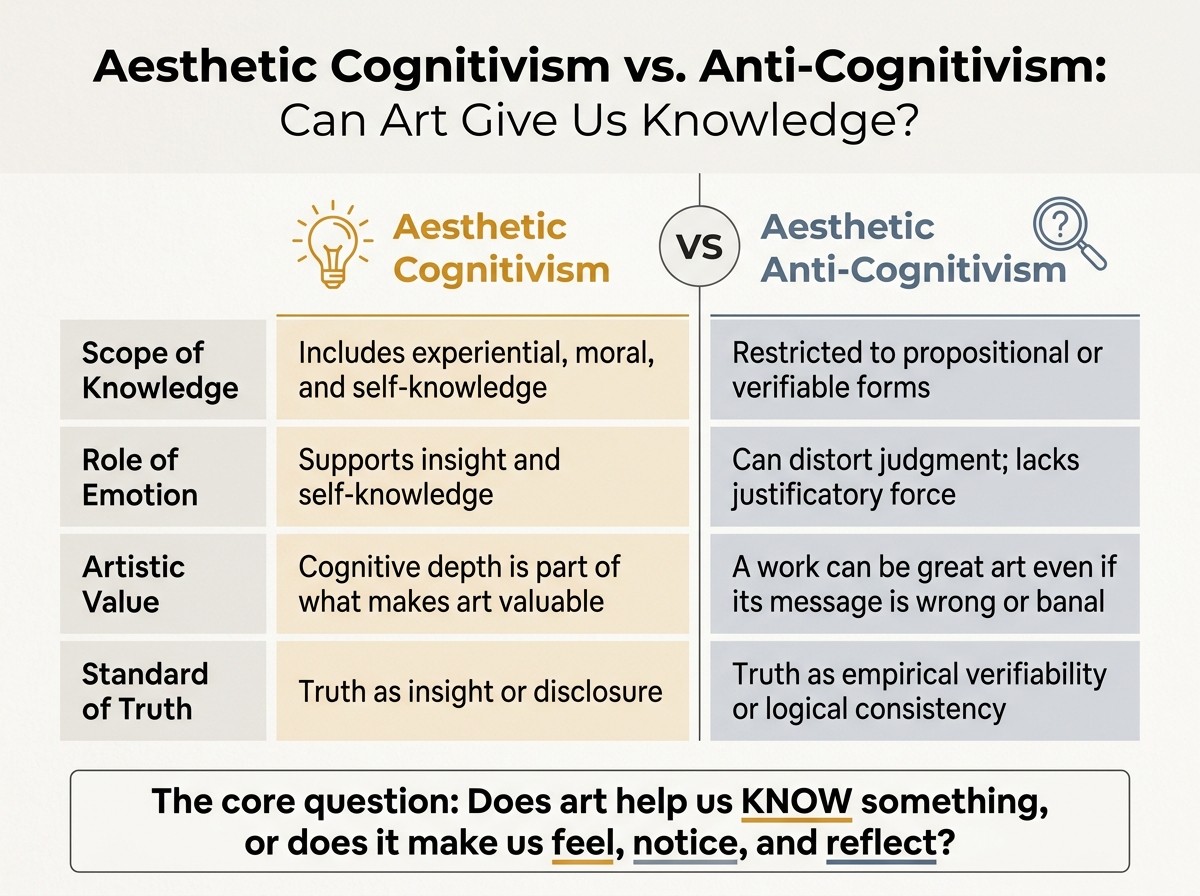
Aesthetic Cognitivism vs. Anti-Cognitivism: Can Art Give Us Knowledge?
Philosophers disagree about a basic issue: does art give us knowledge, or does it mainly give us experience? That split leads to two camps: cognitivists and anti-cognitivists.
What Aesthetic Cognitivism Claims
Aesthetic cognitivism says that art can produce knowledge, understanding, and insight, and that this knowledge-giving role adds to a work’s artistic value.
The knowledge art offers usually falls into three main groups:
Factual knowledge: information about the world or history
Self-knowledge: art as a way of understanding ourselves
Moral and experiential knowledge: art can sharpen judgment and show us what certain experiences are like
In this view, art does more than stir feeling. It can teach, clarify, and deepen how we see both the world and our own lives.
Why Anti-Cognitivists Are Skeptical
Anti-cognitivists push back on one key point: knowledge requires justified belief, not just a strong reaction. So even if art expresses ideas or emotions, they argue that it does not justify beliefs in the way knowledge demands.
They also argue that many of the “truths” we take from art are too broad or familiar to count as new knowledge. And some critics go even further. They say a work’s epistemic content may have little to do with its value. A painting, poem, or novel can still be great art even if its implied message is false or banal.
Cognitivism vs. Anti-Cognitivism: A Direct Comparison
Feature | Aesthetic Cognitivism | Aesthetic Anti-Cognitivism |
|---|---|---|
Scope of knowledge | Includes experiential, moral, and self-knowledge | Restricted to propositional or verifiable forms |
Role of emotion | Supports insight and self-knowledge | Can distort judgment; lacks justificatory force |
Insight and artistic value | Cognitive depth is part of what makes art valuable | A work can be great art even if its message is wrong or banal |
Standard of truth | Truth as insight or disclosure | Truth as empirical verifiability or logical consistency |
So the debate isn’t just about whether art matters. It’s about how it matters. Does art help us know something, or does it simply make us feel, notice, and reflect? That tension leads straight to the next issue: what kinds of knowledge, if any, art can actually provide.
What Kinds of Knowledge Art Can Provide
The next issue isn't whether art matters for knowledge, but what kind of knowledge it gives us. And the short answer is: more than one kind.
Propositional and Interpretive Knowledge
Art can offer propositional knowledge and non-propositional knowledge, including a sense of what something is like. That matters because art often doesn't hand over a neat answer. It works through reflection.
A novel, for example, may put a moral problem in front of you and leave it open. A painting may hint at something about power or beauty without spelling it out. Goodman's point is that artworks don't just reflect the world back to us; they organize and shape interpretation.
Experiential, Embodied, and Affective Knowledge
Direct perception gives us access to qualities that testimony can't fully deliver. Seeing a painting in person is not the same as reading a description of it. You can get the basic facts from words. But the experience itself lands differently.
Beyond perception, art can also give embodied and affective knowledge. Emotions such as awe or wonder aren't just side effects. They can work like cognitive tools, making some ideas stand out and changing how we grasp a situation. In that sense, your emotional response to a piece of music or a sculpture isn't a distraction from understanding - it is part of the understanding.
How Knowledge Claims Differ Across Art Forms
These differences stand out more when you look at each art form on its own.
Art Form | Primary Knowledge Type | How It Works |
|---|---|---|
Literature | Narrative & moral understanding | Explores consciousness and conscience through metaphor and simulated scenarios |
Visual Art | Perceptual & symbolic awareness | Shapes how we classify and perceive the world |
Music & Dance | Affective & embodied understanding | Uses rhythm and movement to shape bodily and emotional awareness |
The categories overlap, of course. Still, they help show what each art form does best. Once we connect knowledge to imagination and form, narrative and moral understanding move to the center.
Imagination, Narrative, and Moral Understanding
Imagination as an Epistemic Capacity
If art gives us knowledge, imagination is one of the main ways it does so. It helps move us from plain perception to actual understanding. Put simply, imagination is an epistemic capacity: it helps us link ideas, spot patterns, and build larger explanations that bare argument can miss.
Art also works through image-based, feeling-centered thought. That gives experience a kind of intelligibility that goes beyond abstraction. In that sense, literature becomes a symbolic space where consciousness and conscience can be tried out, almost like a mental workshop. But this only happens when we give the work close imaginative attention. That kind of attention can lead to direct familiarity and deeper understanding.
You can see this most clearly in narrative, where art tests meaning through example.
Narrative Knowledge and Moral Perception
Narrative art doesn't just point to moral themes from a distance; it lets us try them out in imagined cases. Stories arrange social reality into forms we can examine. They sharpen judgment and let readers weigh ethical choices through simulated situations. They can also support self-knowledge by helping audiences see themselves under new descriptions.
Research adds another layer here: shared artistic experiences can correlate with greater empathy. So art may shape not only personal understanding, but also shared social norms.
Ethical Criticism and Epistemic Risk in Art
Art can mislead just as easily as it can clarify. Narrative framing shapes what feels true, and a persuasive story can skew our understanding of crises like climate change. As researcher Jukka Mikkonen warns:
"Artworks can distort our understanding of environmental crises and the measures required for sustainability transformations."
There's a quieter risk too: mixing up aesthetic appreciation with epistemic evaluation. A work's emotional pull can make a narrative feel true even when it isn't. Art spaces - theaters, museums, and concert halls - can deepen that emotional saturation, which may leave audiences more open to uncritical belief instead of critical reflection. So epistemic value rests on disciplined interpretation, not emotion alone.
Philosophers have mapped out several views on how art and moral judgment connect:
Position | Core Claim | How It Handles Epistemic Risk |
|---|---|---|
Autonomism | Art is judged by aesthetic standards alone; moral defects do not affect aesthetic value. | Risks are treated as outside the aesthetic domain. |
Moralism | Art is a means for the clarification of thought and feeling; its value is tied to moral instruction or improvement. | Misleading art is seen as failing in its purpose. |
Moderate Moralism | Some moral defects are aesthetic defects, but not all. | Critical reading is needed to navigate moral complexity. |
Ethicism | A work's aesthetic value is partly determined by the ethical praise-worthiness of the attitudes it manifests. | Risk is addressed through judgment of the work's ethical perspective. |
That tension sets up the next issue: how art relates to science and philosophy.
Art, Science, and the Study of Philosophy
To see where art fits as a source of knowledge, it helps to put it next to science and next to the study of art itself.
Art and Science as Complementary Epistemic Practices
Science explains things through testable causal claims. Art works in a different way. It can deepen understanding through sensory experience, imagination, and emotion. Science also puts weight on falsifiability and claims that others can check and share in public.
That difference matters. Aesthetic experience doesn't just give people something pleasant to look at. It can shift the way thought operates. Museum appreciation, for example, can prompt abstract thinking and self-transcendent emotion.
As Robert Pippin argues, art can function as self-knowledge by clarifying how we understand ourselves in the world.
The Epistemology of Art as a Field of Study
One distinction matters a lot here: the difference between knowledge about art and knowledge gained through art.
In the first case, the focus stays inside the work. You might study its history, technique, meaning, or formal features. In the second case, the point is different. The insight has to reach beyond the work and connect to life outside it.
Type | What It Covers | Example |
|---|---|---|
Knowledge about art | History, technique, interpretation, and work-internal facts | Knowing a painting's medium or design choices |
Knowledge through art | Insights about the world, human nature, morality, or the self | Learning about shame through a film |
Artistic research sits somewhere between making and studying. It combines creative practice with inquiry and connects tacit process knowledge to explicit theory.
Conclusion: Key Concepts to Keep in Mind
With those distinctions in place, the main ideas become easier to track. Whether art yields genuine knowledge remains contested, and aesthetic cognitivism and anti-cognitivism are still the two central frameworks for that debate. It also matters to separate knowledge about a work from knowledge gained through it. Key primary texts include Aristotle, Kant, Hegel, and Dewey. For sustained study, Logos Philosophy Club offers monthly bilingual, annotated editions of foundational philosophical books.
FAQs
How can art count as knowledge?
Art can count as knowledge because it works on parts of us that plain argument often misses. It doesn't rely only on discursive or propositional logic. It also engages feeling, the senses, and the imagination. That matters, because some kinds of understanding don't arrive as neat statements. They hit us through mood, image, rhythm, or form.
Seen this way, art can lead to insights like self-knowledge and a deeper grasp of the human condition. A novel, painting, or film may not "prove" something in the way a formal argument does. But it can still show us how grief feels, how memory distorts, or how power shapes everyday life. Sometimes that's the kind of knowing that sticks.
Some views take this idea even further. They treat art as a systematic, goal-oriented form of research. On this account, artists don't just express ideas. They can produce, test, and communicate knowledge about the world and about ourselves through their methods, choices, and finished work.
What is the difference between knowledge about art and knowledge through art?
Knowledge about art is knowledge of art: its history, meaning, making, and use.
Knowledge through art is different. It’s the kind of understanding art can give us on its own - about human experience, about ourselves, or about the world.
The first usually comes from research, study, or analysis. The second often comes from feeling, perception, and imagination. That kind of knowledge can bring out truths shaped by context, ones that strict logic or plain language may fail to show.
Can art mislead us as well as teach us?
Yes. Philosophers have argued for a long time that art can do both.
Plato treated art with suspicion. He saw it as something that can mislead us because it imitates reality and stirs emotions in ways that may slip past rational judgment.
At the same time, supporters of aesthetic cognitivism say art can have an epistemic role. In plain English, that means art can shape what we believe and deepen how we understand things. It may help us make sense of experience, even if people still disagree about how far we should trust it as a source of truth.


