Bentham vs Mill on Pleasure and Pain


Bentham asks how much pleasure an action produces; Mill also asks what kind. I use that distinction to compare their views: both seek the greatest overall happiness, count everyone affected, and weigh pain against pleasure.
Bentham: His 7 criteria weigh strength, duration, likelihood, timing, later pleasures, later pains, and the number of people affected.
Mill: He weighs both quantity and quality. People who know both pleasures judge which they prefer, with pleasures of thought and moral feeling ranked above bodily enjoyment.
Both: Pain still counts. Neither a larger group nor a higher pleasure makes someone’s suffering disappear from the calculation.
Quick Comparison
Comparison | Bentham | Mill |
|---|---|---|
Goal | Greatest net happiness for everyone affected | Same goal, with quality included |
How pleasures rank | Amount, assessed through 7 criteria | Amount and kind, judged by experienced people |
How pain counts | Subtracts from total happiness | Still counts against any gain |
Main question | How much pleasure outweighs the pain? | What kind of pleasure, and how much, outweighs the pain? |
My starting point is simple: compare everyone’s gains and losses, then ask whether the kind of pleasure changes the judgment.
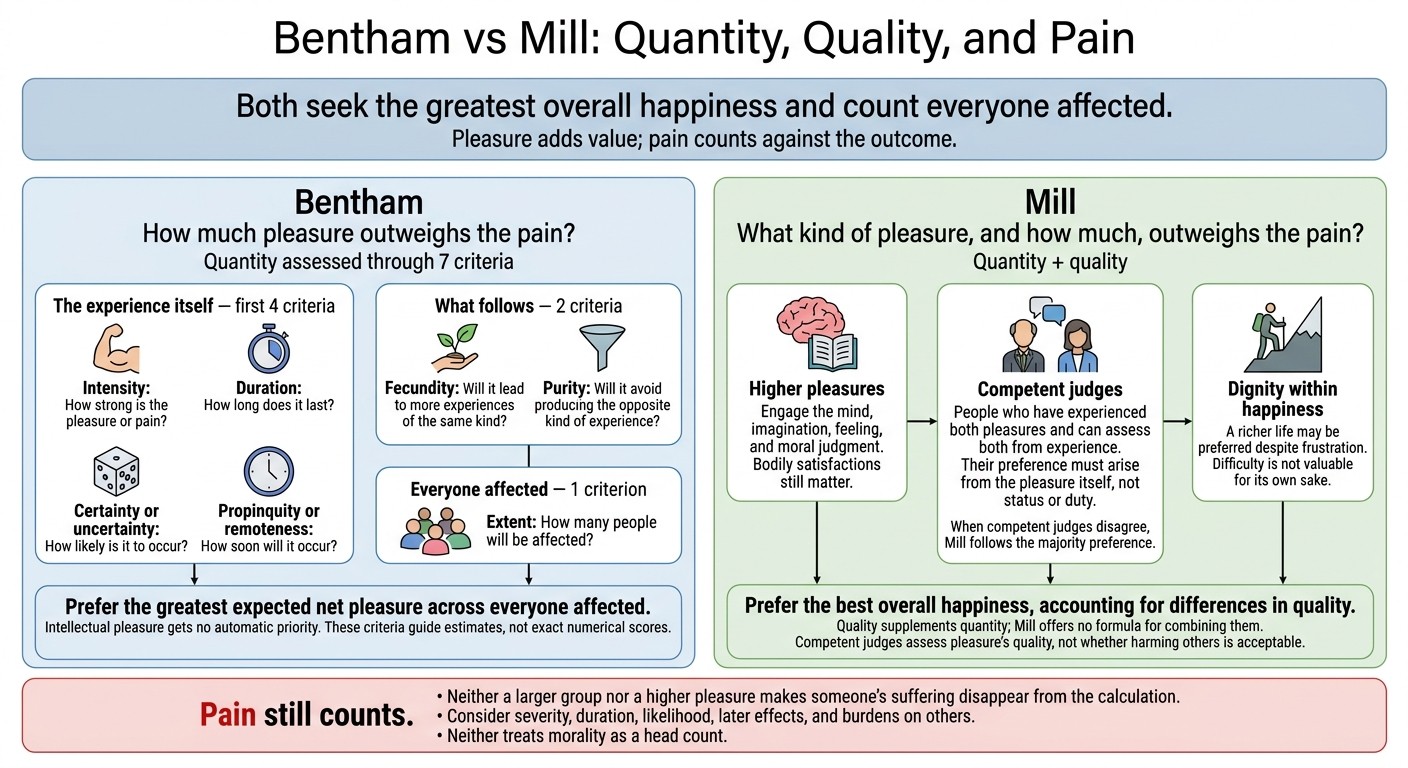
Bentham vs Mill: Quantity, Quality, and Pain
Qualitative vs Quantitative Utilitarianism: Mill vs Bentham Explained
Bentham: Measuring Pleasure and Pain
For Bentham, pleasure and pain explain why people act and provide a way to judge their actions. Motive alone doesn’t settle the moral question. What matters is the good and harm we can foresee. Pain includes fear, humiliation, and insecurity - not just physical suffering.
The 7 Criteria of the Felicific Calculus
Bentham’s felicific calculus uses seven criteria to guide this judgment. They help us make careful estimates; they don’t require us to give feelings exact numerical scores.
Criterion | Question it asks | Role in the assessment |
|---|---|---|
Intensity | How strong is the pleasure or pain? | Measures the strength of the immediate experience. |
Duration | How long does it last? | A longer experience generally contributes more pleasure or pain. |
Certainty or uncertainty | How likely is it to occur? | A highly likely benefit generally counts more than one based on speculation. |
Propinquity or remoteness | How soon will it occur? | Accounts for how far away the experience is in time. |
Fecundity | Will it lead to more experiences of the same kind? | Pleasure may produce more pleasure, while pain may produce more pain. |
Purity | Will it avoid producing the opposite kind of experience? | Pleasure followed by pain has a less favorable overall outcome; pain followed by pleasure has a more favorable one. |
Extent | How many people will be affected? | Counts the experiences of everyone affected. |
The first four criteria assess the experience itself. Fecundity and purity address what follows, while extent counts the people affected. Intellectual pleasure gets no automatic priority. Its weight depends on how it scores under these criteria.
Comparing Outcomes by Net Happiness
Pleasure adds value; pain subtracts it. Bentham begins with each person’s expected net outcome, then combines those outcomes. Immediate discomfort may be justified if it prevents greater suffering or produces more total happiness. But that discomfort still counts against the action.
To use this framework, identify who gains and who bears the costs. Then compare the strength, duration, likelihood, timing, and later effects of their experiences. Head count alone doesn’t decide the issue: severe suffering among fewer people must still count in the balance. Predictions are uncertain, and people differ in their sensitivity to pleasure and pain, so this judgment requires care rather than a mechanical calculation. Mill later challenges this quantitative method.
Mill: Weighing Pleasure by Quality and Quantity
Mill keeps the utilitarian goal but adds another measure: the quality of pleasure. Pleasures differ in both quality and quantity. Quality supplements quantity; it does not replace general happiness with a separate ideal of self-development. Mill still measures pleasure, but he no longer treats all pleasures as equal in kind.
Higher Pleasures and Experienced Judges
Higher pleasures engage the mind, imagination, feeling, and moral judgment. Bodily satisfactions still matter, but Mill rejects the view that equal amounts of pleasant feeling must have equal worth. Neither price nor social prestige determines a pleasure’s quality.
His test relies on competent judges: people who have experienced both pleasures and can assess both from experience. Simply trying both is not enough. Their preference must come from the pleasure itself, not status or duty. They may choose a higher pleasure even if it brings more pain or frustration. When competent judges disagree, Mill follows the majority preference.
Dignity, Happiness, and Discontent
Dignity matters to Mill as part of happiness, not as something above it. Happiness is not mere comfort. People with developed capacities may face more frustration yet prefer a richer life to easier satisfaction. Dignity helps shape which pleasures they prefer. It is neither a separate moral rule that overrides happiness nor a reason to treat difficulty itself as worthwhile.
Pain still counts against a choice, even when dignity is involved. Accepting discomfort must contribute to higher enjoyment or greater long-term happiness. Dignity cannot justify needless suffering. To weigh a choice, consider how much pleasure it brings, which capacities it engages, what competent judges prefer, and whether the pleasure outweighs the pain. Pain remains part of that total balance.
Here Mill parts ways with Bentham: Bentham totals pleasure, while Mill also ranks it.
Bentham vs Mill: Comparing Their Moral Judgments
What Counts and How Pleasures Rank
Bentham and Mill both count everyone affected by an action. They differ in how they weigh pleasure, and that difference shapes their moral judgments.
Question | Bentham | Mill |
|---|---|---|
What counts as value? | Pleasure and the absence of pain. | Pleasure and the absence of pain, considering both quality and quantity. |
How do pleasures rank? | By intensity, duration, certainty, nearness, fecundity, purity, and extent. | By quantity and quality, with quality assessed by competent judges familiar with both alternatives. |
How does pain count? | As a negative contribution to the total, including likely aftereffects. | As a loss of happiness that must still be weighed against any benefit. |
Which outcome is preferable? | The greatest expected net pleasure across everyone affected. | The best overall happiness, accounting for differences in quality. |
Bentham uses a single quantitative scale. Mill also ranks pleasures by quality, but offers no formula for doing so. Neither treats morality as a head count: a minority’s suffering still matters. Mill’s competent judges assess the quality of pleasure; they do not vote on whether harming others is acceptable.
The contrast becomes clearer when pleasure and pain pull in opposite directions.
How Suffering Affects Moral Judgment
Pain needs to be compared across time and across people, weighing its severity, duration, likelihood, lasting harm, and avoidability.
Factor | Bentham’s approach | Mill’s approach |
|---|---|---|
Intensity and duration | Weigh both; neither alone determines which pain is worse. | Count both; a higher pleasure does not erase severe, avoidable harm. |
Future effects | Include later pleasure, recurring pain, and risks. | Include later welfare and effects on people’s ability to enjoy higher pleasures. |
Developed capacities | Count their contribution to pleasure and reduced pain, rather than treating them as a separate category of quality. | Ask whether benefits involve higher capacities, rather than education, culture, or social status alone. |
Burdens on others | Include everyone affected through “extent.” | Include everyone’s welfare, paying attention to security and protection from serious harm. |
For employee training, weigh discomfort, safety risks, consent, compensation, and expected benefits for workers and others. Bentham chooses the option with the highest expected net happiness; Mill also asks whether the claimed benefits are genuinely higher in kind.
Conclusion: Quantity Alone or Quality Too?
The divide is not whether happiness matters, but how to measure it. Bentham asks how much pleasure and pain an outcome produces; Mill also asks what kind of pleasure it provides. For both, pain counts against an action, even when it serves a greater good. Mill’s higher pleasures do not make suffering worth seeking for its own sake.
For Bentham’s quantitative method, read An Introduction to the Principles of Morals and Legislation; for Mill’s reply, read Utilitarianism.
FAQs
Can Bentham and Mill reach different judgments about the same action?
Yes. Both focus on outcomes and maximizing happiness. But Bentham weighs the amount of pleasure, while Mill also weighs its quality. They may judge an action differently when the amount and quality of pleasure point in different directions, or when they give different moral weight to the pain it causes.
How can Mill’s higher pleasures be weighed against severe pain?
For Mill, higher pleasures matter for more than their quantity. Competent judges - people who have experienced both higher and lower pleasures - prefer intellectual and moral pursuits, even when those pursuits bring discomfort.
Severe pain still carries weight in moral judgment. But the dignity and depth of higher pleasures can make some hardships worth enduring. Freedom from suffering, then, is not the only priority.
Can either approach justify harming a minority?
It depends on how the theory is interpreted. Utilitarianism aims to maximize happiness, taking everyone affected into account. Bentham’s approach focuses on the amount of happiness, while Mill’s account also weighs its quality. Both prioritize overall outcomes. Critics debate whether this focus on collective happiness can put a minority’s rights or well-being at risk.

