Boethius and Medieval Language Philosophy
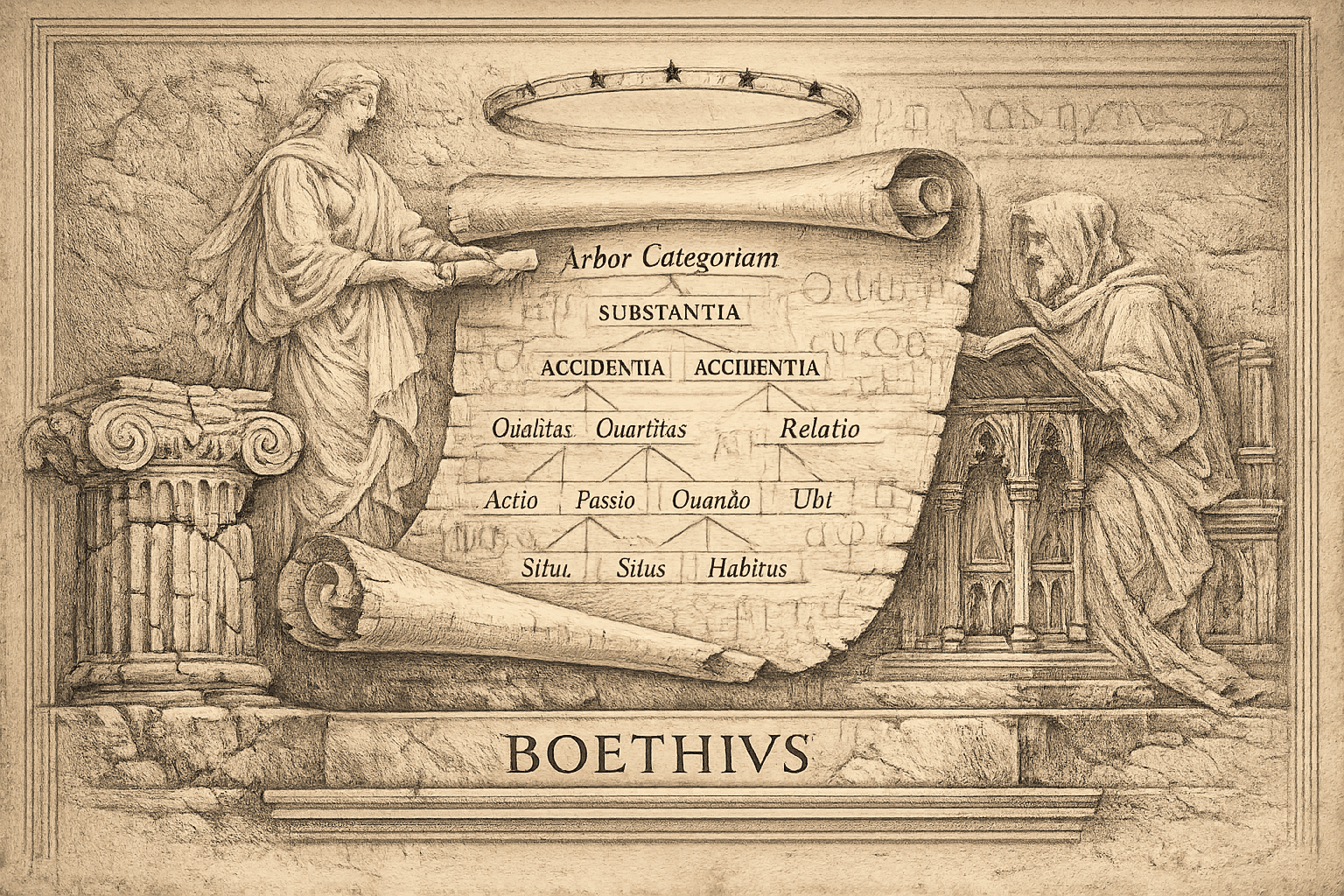

Boethius (c. 480–524 AD) bridged ancient Greek philosophy and medieval thought, profoundly influencing logic, language, and theology. His Latin translations of Aristotle and Porphyry introduced key concepts like the "Problem of Universals" and the "semantic triangle", shaping medieval logic and semantics. His works, including The Consolation of Philosophy, became central to education and theology, blending Aristotelian logic with Christian doctrine. Boethius' definition of "person" and his approach to linguistic precision laid the groundwork for Scholasticism. Later, his ideas were widely disseminated through vernacular translations and influenced figures like Chaucer, who integrated Boethian themes into literature. Today, his legacy endures in discussions on language, logic, and metaphysics.
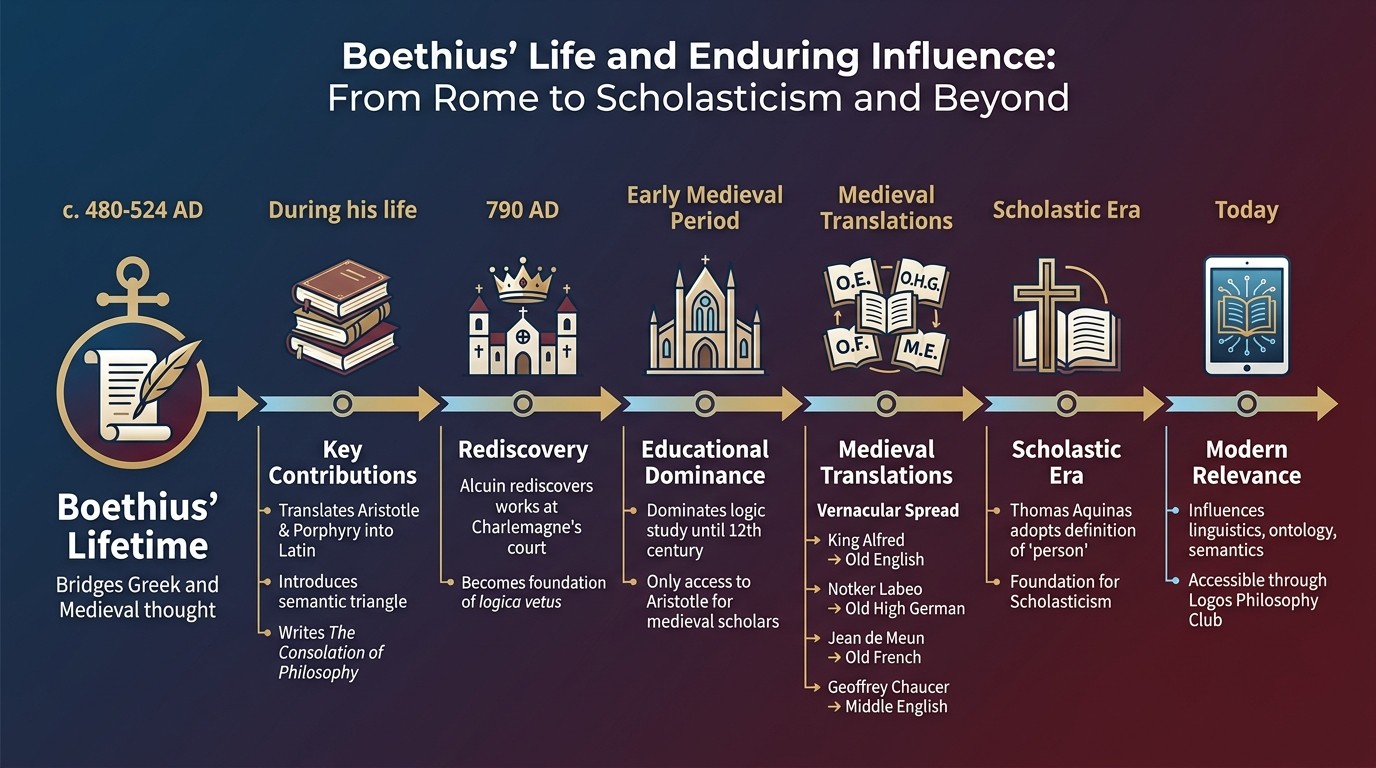
Boethius' Influence Timeline: From Ancient Rome to Medieval Europe
Introduction to Boethius | Medieval Philosophy
Boethius' Theories on Language and Logic
Boethius, often regarded as a crucial link between Roman and medieval philosophy, developed ideas on logic and language that deeply influenced medieval scholarship. Through our curated philosophy editions, modern readers can still engage with these foundational texts.
Logic in Boethius' Philosophy
For Boethius, logic was more than just a tool - it was essential for exploring philosophical and theological questions. He divided logical analysis into three components: definition, division, and deduction. This structured approach allowed medieval thinkers to dissect and evaluate arguments with precision.
One of Boethius' key contributions was applying Aristotelian logic to Christian theology. He used this framework to expose contradictions in heretical views, demonstrating the power of logical reasoning in theological debates. In his work De topicis differentiis, Boethius introduced concepts like "maximal propositions" and "differentiae", which became foundational for crafting convincing theological arguments.
Boethius' Approach to Language and Meaning
Boethius' commentaries on Aristotle's On Interpretation introduced what is now known as the semantic triangle. This model explains how words represent mental concepts, which in turn refer to physical objects in the world.
He also embraced Porphyry's perspective that Aristotelian logic applies to the tangible, sensory world rather than an abstract Platonic realm. To ensure clarity in philosophical discussions, Boethius introduced precise Latin terms like substantia (substance), persona (person), and universalis (universal).
Through his commentary on Porphyry's Isagoge, Boethius brought the Problem of Universals to the Latin-speaking world. This issue, which debates whether universals exist as independent realities or mere abstractions, was pivotal in medieval philosophy. Boethius' stance was that universals are abstractions derived from individual entities but still reflect aspects of reality.
Medieval Reception of Boethius' Language Philosophy
Boethius in Early Medieval Europe
Boethius' writings found their way into prominence during the early medieval period, thanks to Alcuin of Charlemagne's court. In 790 AD, Alcuin rediscovered Boethius' works and introduced them into the educational framework of the time. From that moment, Boethius became the key intermediary for transmitting Aristotelian logic to medieval Europe. His translations and commentaries formed the foundation of the logica vetus (Old Logic), which dominated the study of logic until the 12th century. For most medieval scholars, Aristotle's ideas were accessible only through Boethius' Latin interpretations, making his work a cornerstone of European education and intellectual life.
Figures like Remigius of Auxerre and Nicholas Trevet played a significant role in adapting Boethius' Neoplatonic philosophy to fit Christian theological frameworks. By adding Christian glosses, they reinterpreted his ideas to align with Church teachings. Boethius' definition of a "person" as naturae rationalis individua substantia (an individual substance of a rational nature) became a defining concept in medieval thought. This definition was later adopted by St. Thomas Aquinas and became a standard teaching in medieval schools.
As Boethius' logical writings gained widespread acceptance, they were not confined to academic circles. His works also began to reach broader audiences through translations into vernacular languages.
Vernacular Translations of Boethius
The authority of Boethius in medieval logic paved the way for his works to be translated into various languages, expanding their reach and influence. King Alfred the Great translated The Consolation of Philosophy into Old English, Notker Labeo rendered it into Old High German, Jean de Meun created an Old French version, and Geoffrey Chaucer translated it into Middle English. These translations did more than make Boethius' ideas accessible to lay readers - they also enriched regional vocabularies. Translators crafted new terms and expressions to capture the nuances of Boethius' Latin, laying the foundation for philosophical discussions in their native languages. This effort extended his impact far beyond academic settings, ensuring his philosophy resonated across diverse linguistic and cultural landscapes.
Impact on Later Philosophical and Theological Thought
Boethius in Chaucer's Works
Geoffrey Chaucer's translation of The Consolation of Philosophy into Middle English played a key role in bringing Boethian philosophy into the realm of popular literature. Chaucer didn’t just translate the text; he also incorporated interpretations from prominent medieval commentators like Nicholas Trevet and William of Conches. This blending of text and commentary mirrored how medieval audiences often encountered Boethius. In fact, about 25% of surviving medieval manuscripts of The Consolation include commentary, highlighting the close relationship between the original work and its interpretations.
In his own writings, Chaucer drew heavily on Boethian ideas to delve into themes like divine providence versus human agency and the pursuit of true happiness. The Wheel of Fortune (rota fortunae) became a recurring image in his works, symbolizing the unpredictability of fate. Additionally, Boethius' structured dialogue style and his Principle of Modes of Cognition - which suggests that knowledge is shaped by the perceiver's capacity rather than the object itself - offered Chaucer a framework for tackling intricate emotional and philosophical ideas. By weaving these concepts into vernacular poetry, Chaucer bridged the gap between the logical rigor of scholastic thought and the accessibility of literary storytelling. This literary adaptation mirrored Boethius’ broader influence on theological discussions.
Theological Responses to Boethius
Boethius' impact extended far beyond literature, shaping medieval theological debates through his logical methods. In his Opuscula sacra (Theological Treatises), Boethius employed Aristotelian logic to address controversies about Christ's nature, particularly in opposition to Nestorianism and Eutyches' monophysitism. His precise definitions of theological terms - especially the distinction between "nature" and "person" - provided a foundation for Scholastic discussions.
One of Boethius' key contributions was his nuanced approach to language about God. In contrast to created beings, which can have accidental attributes (e.g., "Socrates is white"), Boethius argued that nothing about God is accidental. Instead, qualities like "great" or "good" are substantial predications because God embodies goodness itself. This careful linguistic distinction became a cornerstone for theologians grappling with how finite human language could convey divine truths. By building on his earlier work on universals, Boethius offered a more precise way to discuss theological language, influencing centuries of theological inquiry.
Conclusion: Boethius' Legacy in Language Philosophy
Boethius' influence, rooted in the medieval world, continues to resonate in contemporary philosophical discussions.
Why Boethius Remains Relevant Today
Boethius played a key role in bringing Greek thought into the Latin-speaking world, especially through his translations and commentaries on Aristotle's Organon. These works laid the groundwork for centuries of philosophical and linguistic exploration. Historian Johannes Fried aptly observed:
The West owes this individual, Anicius Manlius Severinus Boethius, nothing less than its progression toward a culture of reason.
His distinction between the structure of language (how words signify) and their meaning (what they signify) remains central to modern linguistics and philosophy. Furthermore, his engagement with the problem of universals in his commentary on Porphyry's Isagoge continues to influence contemporary ontology. His work also endures in metaphysical debates, particularly those concerning human freedom and divine foreknowledge.
Boethius' idea of mental speech (oratio mentis) - the notion that thought operates through universally accessible concepts - foreshadowed modern theories of universal grammar. Additionally, his definition of signification as "establishing an understanding" (intellectum constituere) has been highlighted by Magee as:
the common starting point for virtually all medieval theories of semantics.
These contributions underscore his lasting relevance in both historical and modern contexts.
Reading Boethius Through Logos Philosophy Club

Today, organizations like Logos Philosophy Club make Boethius' ideas more accessible, much like medieval scholars did through commentaries and glosses. Their bilingual editions follow the tradition of accessus ad auctores - providing introductions and annotations that help readers engage with complex philosophical texts.
For $45 per month or $420 annually, Logos Philosophy Club offers a subscription service that delivers translated and annotated works of Boethius. Each edition includes the Logos Reader, which features essays and commentary designed to bridge the gap between ancient philosophical ideas and modern interpretation. This approach allows readers to explore Boethius' works with the same depth and context medieval scholars once experienced.
FAQs
What is the Problem of Universals?
The Problem of Universals was a central topic in medieval philosophy, focusing on whether universal concepts - like qualities or categories - exist independently of human thought. Boethius tackled this issue in his commentary on Porphyry’s Isagoge, where he argued for moderate realism. According to this view, universals don't exist as separate, independent entities but do have an objective foundation that justifies the general concepts we use. This debate heavily influenced medieval discussions about the relationship between language, thought, and the nature of reality.
How does Boethius’ “semantic triangle” explain meaning?
Boethius’ semantic triangle breaks down meaning into three interconnected parts: the word or sign, the concept it represents, and the real-world object it refers to. This framework illustrates how language links abstract ideas to physical reality, creating a bridge between thought and the tangible world.
Why was Boethius so important to medieval theology?
Boethius played a key role in shaping medieval theology by connecting classical philosophy with Christian thought. His writings, particularly The Consolation of Philosophy, brought Greek philosophical ideas - such as Neoplatonism - into the Latin-speaking world, leaving a lasting mark on theological discussions.
His work in areas like logic, language, and metaphysics also influenced medieval semiotics and theological debates. By ensuring that philosophical reasoning complemented Christian beliefs, Boethius significantly impacted scholasticism and the broader intellectual traditions of the Middle Ages.