Philosophy Subscription Boxes: 5 Key Benefits Explained

Philosophy subscription boxes simplify the challenge of diving into philosophical texts. They deliver carefully selected works, bilingual editions vs. English-only, and study guides directly to your door. Here’s why they’re worth considering:
Curated Texts: Receive high-quality editions of classic philosophy works, eliminating the hassle of choosing and mismatched collections.
Rare Translations: Access updated and bilingual translations, often unavailable elsewhere, ensuring accuracy and depth.
Study Guides: Gain context with expert commentary, essays, and tools to better understand complex ideas.
Extras: Enjoy items like bookmarks, posters, and bonus books that enhance the reading experience.
Structured Learning: Follow a monthly reading plan to help start a philosophy reading habit that fosters focus and connects you with a global community of readers.
These services make philosophy more accessible and engaging, offering a structured way to build your personal library while deepening your understanding of timeless ideas.
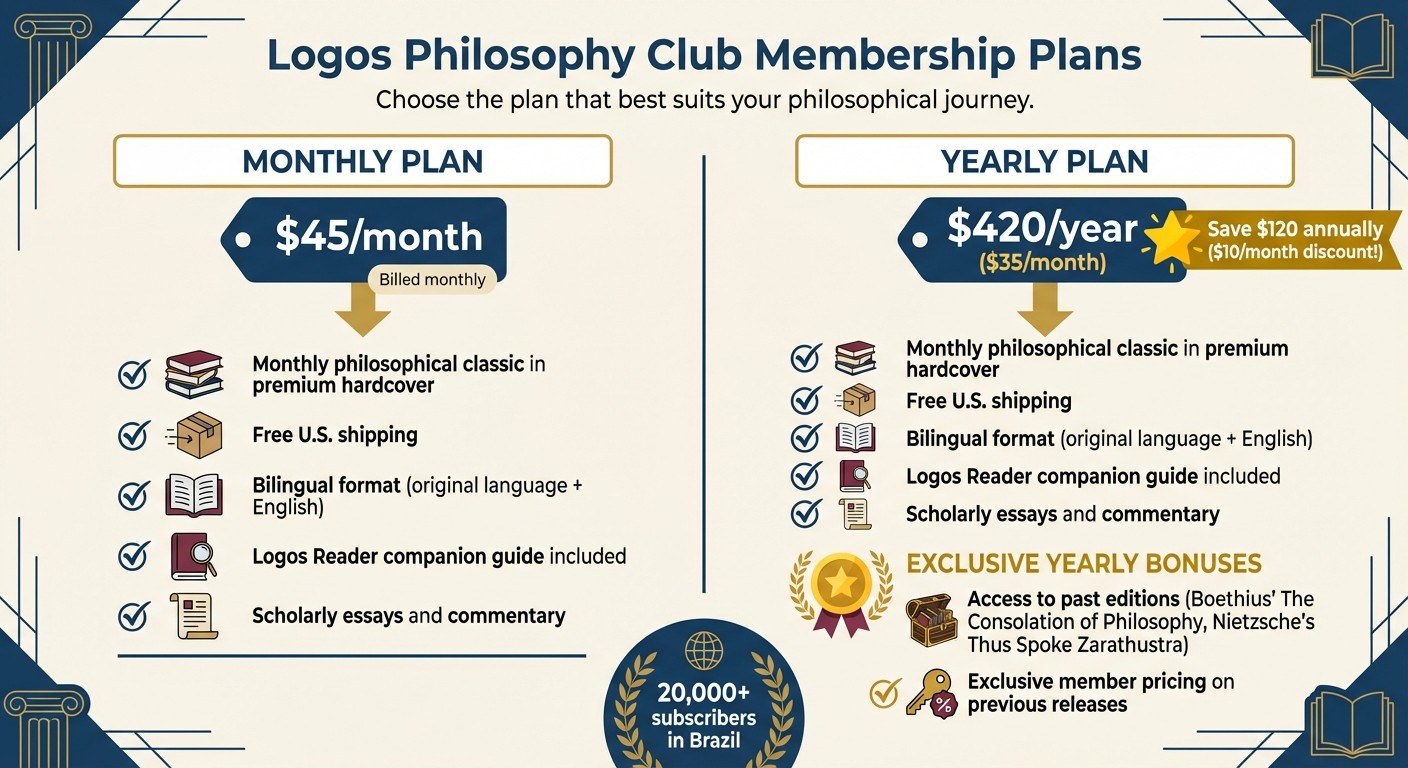
Logos Philosophy Club Membership Plans Comparison
1. Logos Philosophy Club
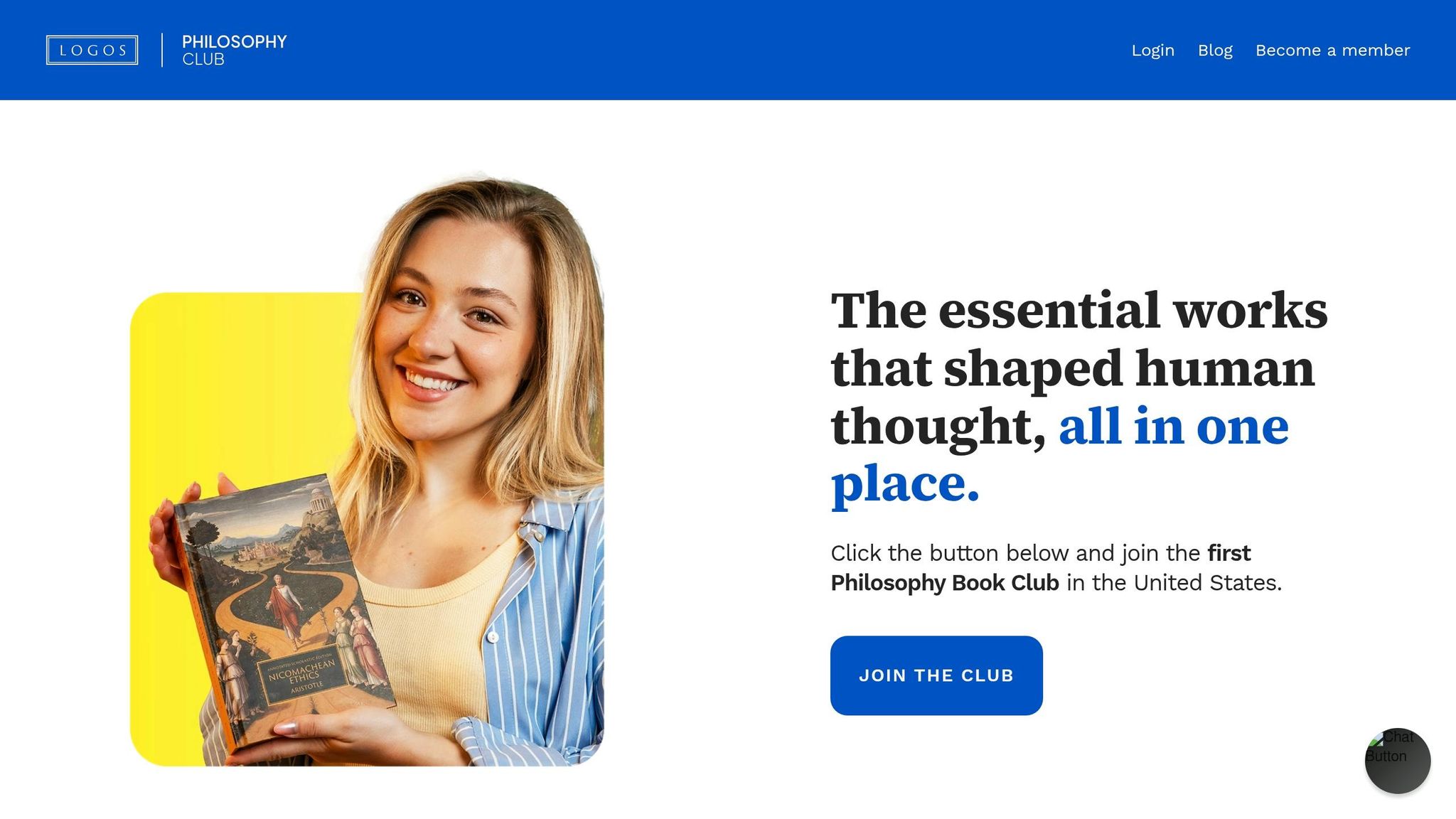
The Logos Philosophy Club is the first subscription-based club in the U.S. dedicated to delivering essential philosophical works straight to your doorstep. Each month, members receive a carefully selected philosophical classic - think Plato’s The Symposium or Aristotle’s Nicomachean Ethics - in a premium hardcover edition designed to last a lifetime.
What makes this club stand out is its bilingual format. Texts are translated directly from their original languages - like Greek, Latin, or German - and often include the original text alongside the English translation. This side-by-side presentation allows readers to engage with the original language while benefiting from a clear English interpretation. Each delivery also includes the Logos Reader, a companion guide packed with scholarly essays, historical context, and expert commentary to help readers read philosophy books effectively. This thoughtful approach not only enhances understanding but also provides members with a transparent and enriching experience.
Membership is offered in two tiers: a $45 monthly plan or a $420 yearly plan (which breaks down to $35 per month). Both options include free U.S. shipping, but annual members enjoy extra perks, like bonus books from past editions - such as Boethius’ The Consolation of Philosophy and Nietzsche’s Thus Spoke Zarathustra - and the opportunity to purchase previous releases at exclusive member prices.
The club’s success builds on a proven model. Its parent company in Brazil already serves over 20,000 monthly subscribers, showing a strong appetite for curated philosophical content. Members in the U.S. have shared glowing reviews, praising both the quality of the books and the additional perks. For instance, John Roche shared:
I love my copy. The book is sturdy and well bound, but so far the scholastic commentary is the real gem.
Another member, Spencer Simons, noted:
The poster is a nice perk I wasn't aware of. I plan to frame it immediately and hang it on my bedroom wall.
2. Access to Curated Philosophical Texts
building your own philosophy library can be a bit of a mess. You might find yourself juggling mismatched editions - like a flimsy paperback of Plato alongside a bulky hardcover of Aristotle. Worse, the translation quality can vary wildly, making it tough to follow a consistent thread. Subscription boxes solve this by offering a cohesive collection of foundational texts in uniform, high-quality editions. This thoughtful arrangement ensures a clear and logical reading sequence.
The selection process focuses on timeless works that have shaped human thought, steering clear of trendy contemporary titles or mass-market editions. For instance, recent shipments have followed a deliberate progression through major philosophical milestones, creating a structured and guided reading experience. This approach eliminates the overwhelm of sifting through countless options, allowing you to focus on a disciplined journey through philosophy.
Translation quality is another game-changer here. Many retail books rely on public domain translations, which can be outdated or even inaccurate. As William F. Vallicella, Ph.D., explains:
Translations are sometimes misleading or inaccurate... To translate Adorno it does not suffice to know German, one must also have read Kant, Hegel and Co.
Curated subscription services prioritize accurate translations directly from the original languages - whether Greek, Latin, or German - ensuring you’re engaging with faithful interpretations of complex ideas.
And let’s not overlook the physical quality. These aren’t your average paperbacks; they’re premium hardcover editions designed to last. With these, you’re not just collecting books - you’re building a philosophy library with intentionality, consistency, and enduring quality.
3. Rare Translations and Hard-to-Find Editions
Standard editions can sometimes miss the mark due to translation errors, which can distort critical philosophical arguments. For example, mistranslating terms like Vermittlung can change the meaning of Hegel's ideas entirely. William F. Vallicella sheds light on this issue:
A translator who knows German but does not know Heidegger may make the significant error of translating both [das Sein and das Seiende] as "being."
Subscription boxes offer a solution by providing bilingual and updated translations that are often unavailable locally. These editions frequently include the original text - whether Greek, Latin, or German - alongside the English translation. This side-by-side format allows readers to assess the translator's choices directly. With these carefully crafted translations, you’ll also find tools that enrich your understanding, such as interpretive essays and glossaries of key terms.
Additionally, these editions incorporate the latest academic research, like new interpretations of Presocratic writings or insights from the Derveni papyrus discoveries. Edward Halper from the University of Georgia emphasizes the value of skilled translators:
Joe Sachs has an extraordinary ability to render ancient Greek into English sentences that are so clear and direct that they help readers to look past Aristotle's technical terminology.
This attention to detail ensures that translations maintain the rigor and depth that philosophical traditions demand.
Beyond translations, these rare editions often include complete, unabridged texts sourced through international collaborations. These partnerships bring together translators, scholars, and publishers to produce comprehensive editions, including sections that are frequently left out of standard anthologies. This approach ensures readers gain access to the full scope of philosophical works, preserving their integrity and complexity.
4. Supplementary Materials and Study Guides
In addition to the curated texts and rare translations, these supplementary materials are designed to enrich your exploration of philosophy. Without proper context, diving into a philosophical text can feel as daunting as wandering through an unfamiliar city without a map. Subscription boxes tackle this issue by including study guides that transform reading into an interactive and meaningful experience. For example, the Logos Reader offers essays and scholarly commentary to help you engage more deeply with foundational works.
These guides often follow structured methods like the Trivium method, which breaks comprehension into three key stages: grammar, logic, and rhetoric. Grammar questions focus on understanding what the author is explicitly saying. Logic questions encourage readers to connect ideas across the text. Finally, Rhetoric questions challenge you to evaluate and critique the author's arguments. This step-by-step system is helpful for everyone, from newcomers to seasoned readers, and pairs perfectly with the premium editions provided.
On top of the commentary, practical tools are included to enhance your study experience. Items like custom bookmarks and high-quality posters are designed to support a focused and organized approach to learning. Some boxes even provide definitions for less common vocabulary, summaries of historical figures referenced in the texts, and highlights of recurring philosophical themes. These thoughtfully chosen study aids are central to the club's goal of making philosophy both accessible and engaging for everyone.
5. Structured Learning and Community Engagement
Reading philosophy on your own can sometimes feel like an isolated experience. But a thoughtfully designed subscription box transforms this solitary activity into a shared, purposeful journey. The Logos Philosophy Club is a great example of this concept in action. Inspired by an editorial tradition in Brazil, where over 20,000 subscribers receive monthly philosophical texts, the club connects readers worldwide, all exploring the same works at the same time. Between December 2025 and March 2026, subscribers followed a structured curriculum, diving into Aristotle's Nicomachean Ethics (December 2025), Boethius's The Consolation of Philosophy (January 2026), Nietzsche's Thus Spoke Zarathustra (February 2026), and Plato's The Symposium (March 2026). This carefully planned schedule creates a clear and progressive learning experience.
Each text builds on the ideas of the previous one, offering a sense of direction and purpose. As Matthew Long puts it:
A curated personal reading program offers structure and purpose to this journey, transforming scattered reading into a deliberate act of self-cultivation.
This approach helps combat the fragmented nature of how we often consume information today. It not only provides clarity to the learning process but also fosters a collective experience, as subscribers move through the material together.
The community aspect takes this journey even further. Educator John Roche, for instance, used the club's scholastic commentary and educational posters in his classroom, showing how these resources can enrich group discussions and collaborative learning. This highlights the club's goal of making philosophy practical and accessible in a communal setting. Additionally, the service connects readers with translators, scholars, and fellow enthusiasts, creating a vibrant network dedicated to reviving philosophy as a living and disciplined tradition.
For those on the Yearly Plan, this commitment to structured learning is further enhanced with access to past releases at special pricing. Subscribers not only deepen their personal understanding of philosophy but also join a growing international community of dedicated readers.
Conclusion
Logos Philosophy Club offers more than just a subscription - it provides a gateway to engaging deeply with foundational philosophical works. With features like curated texts, rare translations, enriched guides, and an active community, the club creates a structured path for exploring complex ideas. By delivering one thoughtfully selected work each month, it helps members build a meaningful philosophy library while fostering a disciplined reading habit.
The club enhances access to ancient texts by offering modern translations that prioritize "accuracy, consistency, and readability". Paired with tools like the Logos Reader - which includes essays, commentary, and scholarly insights - members are equipped to dive into even the most challenging concepts. These resources work together to promote a focused and enriching intellectual journey.
With its strong editorial foundation, Logos Philosophy Club caters to those seeking a guided approach to philosophy. The Yearly Plan not only provides monthly masterpieces but also grants access to past releases at special member rates. As the club puts it:
This is more than a subscription. It is a commitment to restoring philosophy as a disciplined and living tradition.
Whether you're just beginning your philosophical exploration or looking to expand your collection, this subscription transforms reading into a meaningful, purpose-driven experience, ensuring philosophy remains accessible and relevant.
FAQs
Who are these boxes best for - beginners or advanced readers?
These boxes are perfect for those just starting out, offering curated resources and materials that are simple to follow. More experienced readers will also find value in the rare translations and in-depth commentaries, which provide an extra layer of insight for their studies.
How do bilingual editions help if I don’t know Greek or Latin?
Bilingual editions place the original text right next to its translation, making it easier for readers to grasp philosophical works even if they don't know Greek or Latin. This side-by-side layout not only minimizes translation mistakes but also allows readers to engage more closely with the original intent and nuances of the text.
How much time should I plan to read each month’s book?
Plan to set aside 1 to 2 hours each month to dive into your assigned philosophy book. The time you need might change depending on how lengthy or complex the book is, so feel free to tweak your schedule to match your reading speed and comprehension level.