Chinese Philosophy in English: Bias Problems


Most English versions of Chinese philosophy do more than translate words - they steer the reading.
I’d sum up the article like this: if I want to read Confucius, Laozi, or Zhuangzi with less distortion, I need to check term choices, editor notes, and the frame used in the intro. The article shows that bias often enters through familiar English labels like mind, virtue, Heaven, or the Way, which can make Chinese ideas look more like Western philosophy than they are.
Here’s the short version:
I should ask whether the English keeps the Chinese idea in view or swaps it for a familiar label.
Terms like xin, ren, li, dao, de, ziran, wuwei, tian, qi, cheng, and yi often lose part of their meaning in one-word English renderings.
Footnotes, glossaries, and introductions shape meaning before the main text even starts.
A bilingual edition usually makes translation choices easier to spot.
The article ends with a 5-step test: compare translations, watch for loaded labels, check term drift, read notes closely, and ask what context is missing.
A few facts stand out. The article points to 10 key terms that often get narrowed in English, 3 edition types that shape how much bias a reader can see, and 5 direct checks I can use before trusting a translation. That’s the core point: read the text, but also read the editor’s choices.
If I want the least distorted reading, I shouldn’t look for the smoothest English. I should look for the version that makes its choices plain.
What to check | What can go wrong | What I’d look for instead |
|---|---|---|
Key terms | One English word shrinks the Chinese term | Glosses, notes, and original terms kept in view |
Intro framing | Text gets boxed as religion, morality, or metaphysics | Framing tied to the text’s own setting |
Footnotes and glossary | One reading gets treated as fixed | Notes that show other options |
Edition format | Bias stays hidden in English-only text | Facing-page Chinese and English |
Term consistency | Same term shifts with no note | Clear explanation of why wording changes |
That’s the lens I’d use for the rest of the piece.
The Worst Translation of the Dao de Jing
Where Bias Enters: Imported Categories and English Labels
Bias shows up when English labels press Chinese texts into Western boxes, a challenge often addressed by using dual-language editions. It also shows up when a translator reaches for an English frame that feels familiar instead of staying with the text's own ideas. You can see this most clearly in terms like xin, ren, and li.
Religion, Morality, and Metaphysics as Default Frames
When translators tag a Chinese text as "religious", "moral", or "metaphysical", they are using categories shaped inside Western philosophy. That choice matters before the reader even gets to the first line.
Take metaphysics. In many Western settings, it often turns around God, substance, causation, and natural law. When that frame gets applied to another tradition, it can nudge readers toward a substance-based picture of reality. The same thing happens with moral philosophy. That frame, tied to Aristotelian thought, can guide interpretation by defining the good life through virtue, reason, and excellence in action. So the label doesn't just describe the text. It starts steering the reading from the outset.
Mind, Heart, and the Problem of xin
The Chinese term xin is one of the clearest cases of how English habits can bend meaning. English often treats xin through a split between mind and heart, then pulls it toward reason and certainty. But xin doesn't sit neatly inside that split.
That's why no single English word quite does the job. The term carries both cognitive and affective meaning, which is why some translators use "heart-mind." That phrasing at least signals that something more is going on. Still, once a translator lands on a familiar label, readers can stop noticing the harder point: xin needs explanation, not just substitution. The same pattern shows up in other key terms too, especially ren, li, and dao.
How Familiar English Hides Foreign Concepts
Translation studies has a name for this: domestication. It means making a text sound natural in English by smoothing over what feels foreign.
That kind of translation is often easier to read. But ease comes with a cost. It can blur or erase conceptual difference, and the text may start to sound more English than it should. A smooth version can feel finished and clear while quietly swapping the source for an approximation. The next sections show how this plays out in single terms and in editorial notes.
Key Terms That Lose Meaning in Translation
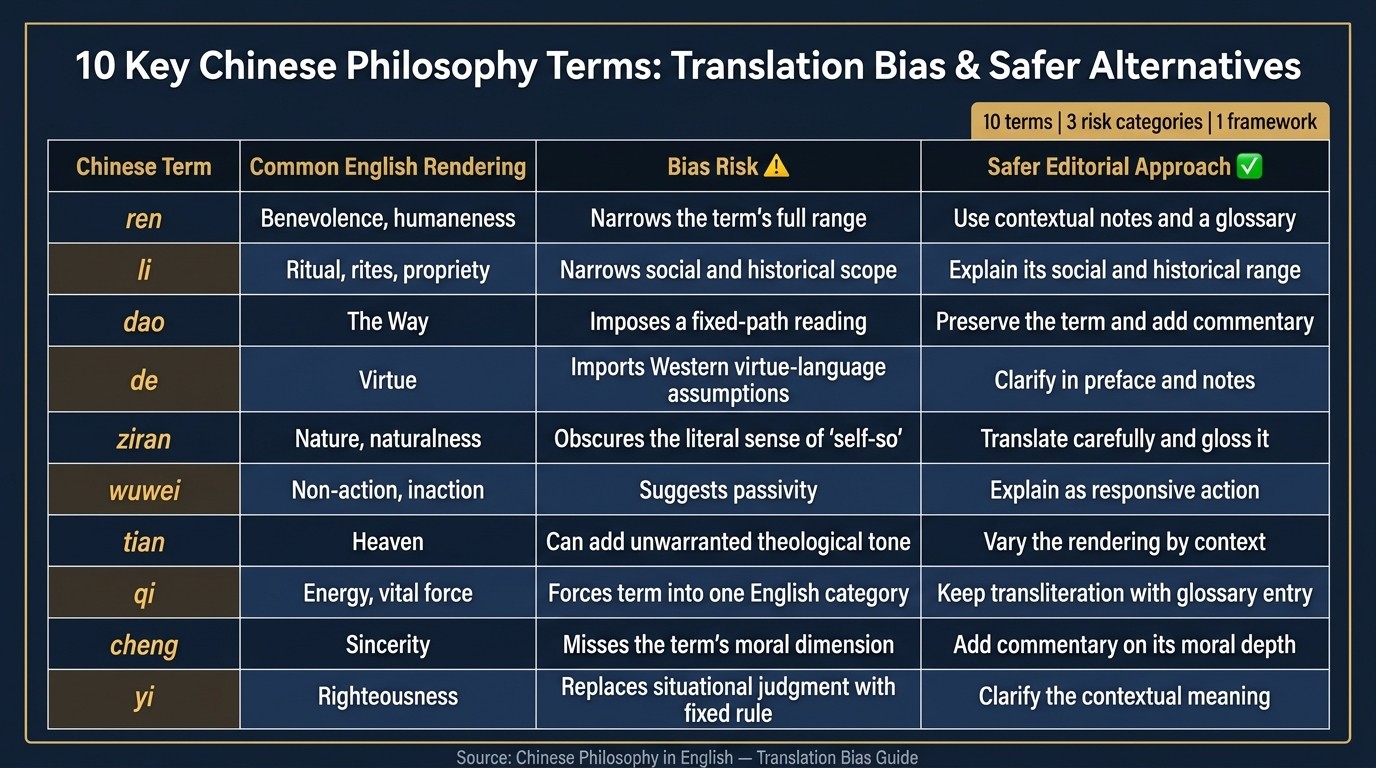
10 Key Chinese Philosophy Terms: Translation Bias & Safer Alternatives
You can see the problem most clearly in a handful of terms that show up again and again. A single English word may look neat on the page, but it can shrink what the Chinese term is doing. The examples below make that plain.
Confucian Terms: ren and li
Ren is often translated as "benevolence" or "humaneness." Those choices help, but they don't cover its full, context-shaped range.
Li is often rendered as "ritual," "rites," or "propriety." Each option points to part of the meaning, yet each one also narrows the term's social and historical range.
Daoist Terms: dao, de, ziran, and wuwei
Dao is commonly translated as "the Way." The trouble is that "the Way" can make it sound like a fixed path. In the Daodejing, it's often better to keep dao when "the Way" pushes readers in that direction.
De is often rendered as "virtue," which can bring in familiar moral ideas that don't quite fit. Ziran is often translated as "nature" or "naturalness," but its literal sense is "self-so," so it usually needs a short gloss. Wuwei, usually translated as "non-action" or "inaction," does not mean passivity. It points to responsive action.
Context-Sensitive Terms: tian, qi, cheng, and yi
These terms depend even more on context. Tian shifts with usage, so translating it every time as "Heaven" can add a theological tone that is not always there.
Qi resists any one-word English match. That's why many editions keep the transliteration and then explain it in a glossary. Cheng is often translated as "sincerity" or "authenticity," but notes are usually needed to show its moral depth. And yi, usually rendered as "righteousness," can swap situational judgment for a fixed rule.
The pattern is steady enough to lay out in a table.
Term | Common English Rendering | Bias Risk | Safer Editorial Approach |
|---|---|---|---|
ren | Benevolence, humaneness | Narrows the term's range | Use contextual notes and a glossary |
li | Ritual, rites, propriety | Narrows its social and historical scope | Explain its social and historical range |
dao | The Way | Imposes a fixed-path reading | Preserve the term and add commentary |
de | Virtue | Imports familiar virtue-language assumptions | Clarify the term in the preface and notes |
ziran | Nature, naturalness | Obscures the literal sense of "self-so" | Translate carefully and gloss it |
wuwei | Non-action, inaction | Suggests passivity | Explain it as responsive action |
tian | Heaven | Can add theological tone | Vary the rendering by context |
qi | Energy, vital force | Forces the term into one English category | Keep the transliteration with a glossary entry |
cheng | Sincerity | Misses the term's moral dimension | Add commentary on its moral depth |
yi | Righteousness | Replaces situational judgment with fixed rule | Clarify the contextual meaning |
How Notes and Editorial Framing Shape What Readers Think the Text Means
Introductions, footnotes, glossaries, and even page layout start shaping meaning before readers get to the main text. That slant is easiest to spot in the way notes and glossaries frame key terms.
Introductions and Footnotes That Steer Interpretation
The editorial apparatus is part of the translation. It isn't just decoration. This is why scholars often review translation and notes as a single package.
A glossary can lock in one rendering of a term as the default way to read it. A note that defines dao as "the Way" can make that same slant seem official. And when an introduction places a text inside one intellectual tradition, it hands readers a lens they may not even notice they're using. That can push them toward one historical or philosophical reading before they've even met the text's main argument.
What Bilingual and Annotated Editions Make Visible
Bilingual and English-only editions make this much easier to see. Readers can compare the English with the original and spot where interpretation enters the picture, instead of taking the English wording at face value.
A glossary that keeps the original terms in view - and explains why a translator picked one English equivalent instead of another - turns edition design into a kind of bias check. It slows the reader down in a good way.
The table below shows how edition format changes how much of that bias readers can actually notice.
Edition Type | Paratext Depth | Note Style | Likely Bias Effect |
|---|---|---|---|
Plain (English only) | Minimal or none | No notes or only basic footnotes | Imported categories go unquestioned |
Annotated (English only) | Introductions, footnotes, glossaries | Explains some choices in English | Contested terms may still be normalized |
Bilingual (facing-page) | Comprehensive scholarly apparatus | Notes expose translation decisions alongside the original | Readers can spot where interpretation is happening |
Logos Philosophy Club shows this model in practice. Those signals become the basis for the five-step test below.
Practical Tests for Editors and Readers, and a Short Conclusion
A 5-Step Test for Translation Bias
Framing choices are easier to judge when you test the edition itself. No translation is neutral. Still, you can spot a lot of bias before it starts shaping your reading.
Here’s a simple way to check any English edition of a Chinese philosophical text:
Compare at least two translations of the same passage. Big differences around terms like ren, dao, or tian usually point to a choice the translator made, not just a style difference.
Watch for loaded labels like “religion” and “morality.” These bring in Western categories. Find the Chinese term underneath and ask whether that label fits, or whether it pushes the text into a frame that wasn’t there to begin with.
Check whether key Chinese terms are glossed the same way throughout. If one term gets rendered in several different ways in the same text without any note, that’s a sign of drift.
Read the footnotes with care. Good notes tell you why a disputed term was translated in a certain way and mention other options.
Ask what’s missing. Does the edition include historical commentary from the tradition itself? If the framing is only modern, that absence will shape your reading too.
What to Look for in a Reliable Edition
A useful checklist helps separate real editorial transparency from surface polish. Bilingual presentation is the clearest sign. When the Chinese text appears next to the English, you can see where interpretation starts to enter.
The next thing to look for is a glossary that keeps the original terms in view and explains why certain English equivalents were chosen. After that, check the preface, notes, glossary, and layout. Do they deal plainly with disputed choices? Do they give enough historical framing? An introduction that places the text within its own intellectual tradition shows care on the editorial side. An index of key concepts also helps.
Logos Philosophy Club puts this approach to work with bilingual editions in which the preface, notes, and glossary are held to the same editorial standard as the translation itself. That makes the edition’s assumptions visible instead of hidden.
Conclusion: Read the Translation, but Also Read Its Assumptions
Translation bias in Chinese philosophy is not some edge case. It is built into the process. English categories can enter through term choices, footnotes, and introductions. They can also flatten terms like xin, qi, and ziran when an edition treats them as if they had plain, one-to-one English matches.
The goal is not a bias-free translation. That kind of translation does not exist. The goal is a translation whose assumptions you can see, test, and account for. Better term choices, honest notes, and more historical context do not remove the problem, but they do make it easier to handle. Read the translation. Then read what the translation is doing.
FAQs
Why can’t key Chinese terms be translated into one English word?
Many key Chinese philosophical terms carry layers of meaning that don’t line up neatly with Western categories. So a direct English match can smooth over nuance and pull the term away from its own philosophical setting.
That’s why translation often needs more than a single word. To keep the meaning intact, it helps to add context through introductions, notes, and glossaries.
How do intros and footnotes bias my reading?
Introductions and footnotes can shape your reading before the main text even gets a fair shot. They often bring in outside categories or ready-made frameworks that flatten the text’s original meaning. And sometimes they nudge you toward a modern or outside academic lens instead of letting the primary work speak in its own voice.
At Logos Philosophy Club, that extra material is there only as a guide. The commentary stays separate from the primary philosophical text, so you can meet the work itself first.
What should I check before trusting a translation?
Check whether the edition stays close to the original language. A bilingual or trilingual version is often the best pick because it lets you compare the text line by line instead of taking the translation on faith.
It also helps to look for a strong scholarly apparatus. That means a translator’s preface, a historical introduction, detailed notes, and editorial support like glossaries or commentary that explain key terms, context, and the text’s original structure and meaning. Logos Philosophy Club offers carefully curated editions made for this kind of rigorous study.