Cambridge vs. Routledge: Philosophy Reprint Series


If you need the philosopher’s own text, pick Cambridge. If you need older scholarship about that text, pick Routledge. That is the whole split in one line.
I’d sum the article up like this:
Cambridge Texts in the History of Philosophy centers on primary texts
Routledge Library Editions in Philosophy centers on scholarly reprints
Cambridge is usually the better fit for course reading, close study, and citation work
Routledge is usually the better fit for research history, literature review, and topic-based library building
The comparison turns on 5 points: editorial aim, content type, editorial support, historical scope, and collecting use
In plain English: one series helps you read Plato, Kant, or Hume. The other helps you read what scholars wrote about Plato, Kant, or Hume.
About 80% of the decision here comes down to one question: Do you need the text itself, or do you need the scholarship around it? Once I frame it that way, the choice gets much easier.
Guide to Philosophy Books: Editions, Translations, and Aesthetics
Quick Comparison
Criteria | Cambridge Texts in the History of Philosophy | Routledge Library Editions in Philosophy |
|---|---|---|
Main job | Study editions of philosophers’ works | Reprints of older academic books |
Content type | Primary texts | Secondary scholarship |
Usual format | New or modern English editions with notes | Reissued monographs and edited collections |
Editorial material | Introduction, notes, glossary, further reading | Original reprint text, sometimes a new preface |
Best for | Classes, close reading, text analysis | Research background, historiography, subject study |
Scope | Major works by major philosophers | Themed sets by period, thinker, or topic |
Best buyer | Students, instructors, scholars | Libraries, faculty, topic-focused researchers |
So if I were buying for a seminar, I’d lean Cambridge first. If I were building a research shelf on a thinker, period, or debate, I’d look at Routledge.
That’s the short answer the rest of the article supports.
Cambridge Texts in the History of Philosophy
Editorial Aim and Standard Format
Cambridge Texts in the History of Philosophy is built to put major philosophical works into reliable English study editions. Instead of reissuing older versions, Cambridge puts out quality philosophy translations and adds editorial material around them. Each volume includes a new introduction, notes, a glossary, and further reading.
The setup is simple: the translated text comes first, and the editorial material supports it. That text-first approach makes the series a strong fit for readers who want a study edition centered on the work itself. This makes them an excellent choice when starting a philosophy reading habit focused on primary sources.
What a Cambridge Volume Includes
A standard volume includes an introduction, footnotes, a glossary, and further reading. These parts help place the text in context and explain key terms without getting in the way of the main work. In most cases, volumes are complete and present the full text.
That study-first format stands out even more when you put it next to Routledge's reprint model.
Routledge Library Editions in Philosophy
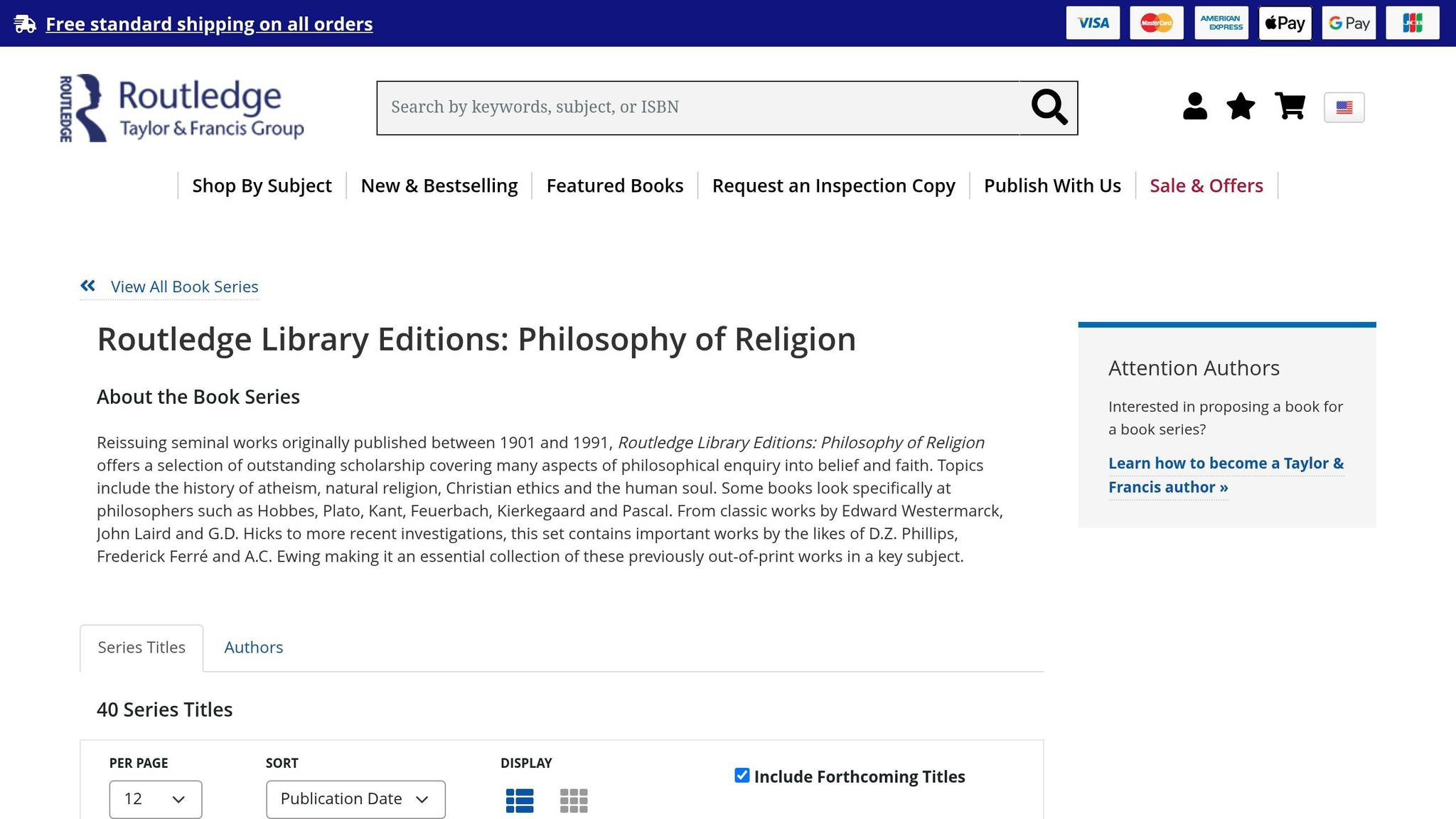
Routledge Library Editions in Philosophy brings older scholarship back into print instead of publishing new study editions. Where Cambridge tends to publish study editions of primary texts, Routledge brings back the scholarship that grew up around those texts.
Reprint Mission and Subject-Based Sets
Routledge Library Editions arranges its reprints into focused subject sets, not one broad student series. Those sets are grouped by historical period, such as Ancient Philosophy, 17th Century Philosophy, and 18th Century Philosophy, or by figure and subfield, including dedicated sets on Kant, Ethics, and Philosophy of Religion.
Each set works like a subject archive for one area. It gathers older academic debates and interpretive work on a single philosopher or topic, rather than the philosopher’s own writings. That difference matters. Sometimes a reader needs to study the text itself; other times, they need the scholarship built around it.
What a Routledge Volume or Set Includes
At the volume level, the reprint model stays the same. A typical Routledge Library Editions volume is a reissued monograph or edited collection that preserves interpretive and contextual scholarship. In plain terms, it helps readers follow philosophical debates and see the intellectual setting in which those debates took shape.
This series fits researchers and collectors of academic scholarship more than classroom introduction. It’s better suited for reference, research context, or historiography than for direct study of a primary text.
Cambridge vs. Routledge: Side-by-Side Comparison
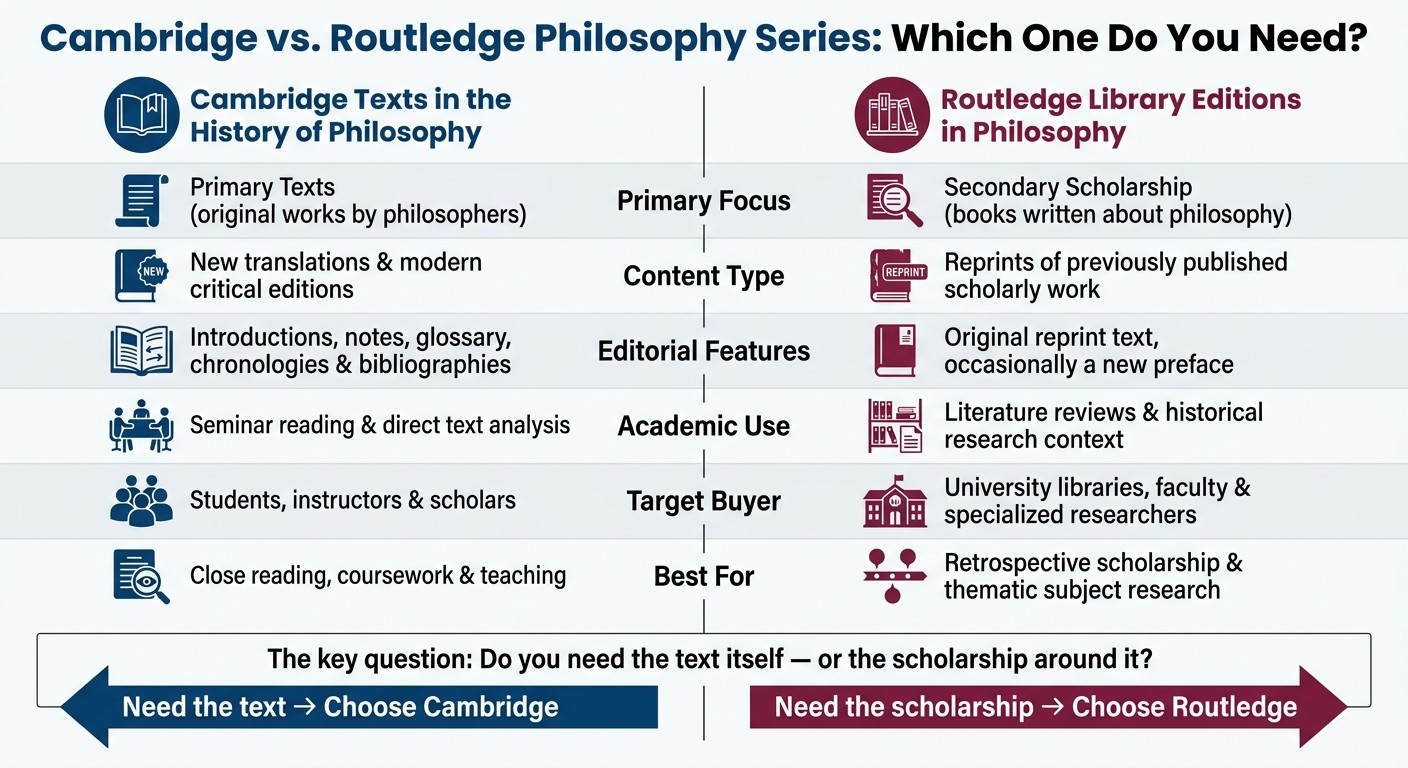
Cambridge vs. Routledge Philosophy Series: Which One Do You Need?
Primary Texts vs. Scholarly Reprints
Both series aim to keep major philosophical writing in circulation, but they do that in different ways.
Cambridge focuses on primary texts - the original works written by philosophers themselves. These editions are made for close reading, careful study, and direct work with the text.
Routledge focuses on secondary scholarship - books written about philosophy. Its volumes bring older academic work back into print, which makes them more useful for historical and interpretive research.
Put simply: if you're doing close textual analysis, the main thing that matters is the text itself. If you're trying to understand how a thinker or topic has been studied over time, the surrounding scholarship matters more.
Annotation, Translation, and Classroom Use
Cambridge editions are built with teaching and study in mind. They usually include introductions, notes, and research aids that help readers work through the text in a classroom setting.
Routledge volumes serve a different job. They keep out-of-print scholarship available for reference and historiography.
Who Each Series Serves Best
That split shapes which series makes more sense for a given research task. The table below sums it up.
Feature | Cambridge Texts in the History of Philosophy | Routledge Library Editions in Philosophy |
|---|---|---|
Primary Focus | Primary texts (original works by philosophers) | Secondary scholarship (books about philosophy) |
Content Type | New translations and modern critical editions | Reprints of previously published scholarly work |
Editorial Features | Introductions, chronologies, bibliographies, and modern annotations | Original text of the reprinted work, sometimes with a new preface |
Academic Use | Seminar reading and direct text analysis | Literature reviews and historical research context |
Target Buyer | Students, instructors, and scholars | University libraries, faculty, and specialized researchers |
Conclusion: Which Series Belongs in Your Philosophy Library
For most readers, the main question is simple: do you need a study edition or a scholarly reprint?
Cambridge Texts in the History of Philosophy is the better choice for close reading, coursework, and teaching. It gives you primary texts with concise editorial support, which makes it a strong pick when the focus is on reading and working through the text itself.
If your focus moves from the primary text to the scholarship around it, Routledge is the better option. Routledge Library Editions fits historical scholarship and subject-based research better, especially through themed sets that bring together older studies on a philosopher, period, or topic.
Put plainly: Cambridge fits study-ready primary texts, while Routledge fits retrospective scholarship and thematic context.
FAQs
How do I know if I need a primary text or secondary scholarship?
Choose a primary text when you want to work straight from a philosopher’s own arguments and line of reasoning, especially in a rigorous, annotated edition.
Choose secondary scholarship or editorial commentary when you need more context, historical framing, or help pulling together difficult ideas. Logos Philosophy Club supports both approaches with high-quality primary texts and supplementary material like the Logos Reader.
Are Routledge reprints suitable for beginners or undergraduates?
Usually, no. Routledge reprints mostly bring older academic scholarship back into print, including monographs first published decades ago. They often go deep, but they’re generally not meant to serve as introductory textbooks for first-year undergraduates.
They’re a better fit for advanced students and researchers. For guided study of core philosophical works, Logos Philosophy Club offers curated bilingual editions with scholarly translations, original-language texts, and annotations.
Can I use Cambridge and Routledge together for the same topic?
Yes. Scholars often use Cambridge and Routledge together to get a deeper grasp of a topic.
That makes sense in philosophy, where it helps to look at an idea from more than one scholarly angle. One source may bring key material together, another may review past research, and another may deal with clashing readings. Using both can give you a broader view.