Ultimate Guide to Historical Philosophy Resources


Philosophy thrives when understood in its historical setting. Without context, major works like Plato's dialogues or Kant's critiques can feel disconnected. This guide highlights key tools - books, encyclopedias, digital platforms, and subscription services - to help you study philosophy alongside its historical roots.
Key Takeaways:
Primary Texts & Sourcebooks: Start with works like Philosophy Before Socrates for accurate translations and commentary.
Survey Histories: Books like A.C. Grayling's The History of Philosophy or Copleston's 11-volume series provide structured overviews.
Digital Tools: Platforms like PhilPapers, Lyceum, and the Digital Loeb Classical Library offer access to rare texts and translations.
Subscription Services: Logos Philosophy Club delivers annotated, bilingual editions vs. English-only of essential texts monthly.
Organize your resources by era or theme (e.g., ethics, metaphysics) for a clearer understanding of philosophy's evolution. Dive into digital archives or curated collections to uncover rare insights. Ready to build your library? This guide has you covered.
Key Print and Digital Resources for Historical Philosophy
Philosophical Encyclopedias and Dictionaries
When diving into historical philosophy, a reliable encyclopedia is a great starting point. The Routledge Encyclopedia of Philosophy (REP) stands out, offering expert commentary, learning objectives, and self-review questions tied to classic texts like Plato's Republic and Aristotle's Nicomachean Ethics. It’s organized for easy exploration, whether you’re interested in Ancient, Medieval, Renaissance, or 20th-century philosophy, or want to focus on specific regions or traditions like Buddhist, Islamic, or Latin American philosophy.
What sets REP apart is its depth. It’s not just a dictionary of terms - it’s a gateway to deeper understanding. Available through subscription, REP also offers free trials and periodically unlocks curated articles, such as themed collections celebrating philosopher anniversaries. Choice magazine praised it as:
"The leading work in its field… an important resource for students and faculty wherever philosophy is taught."
Additionally, REP received a platinum award in the 2022 Modern Library Awards from LibraryWorks. Reviewers highlighted its "signed entries, linked subject classifications, and searchability" as standout features.
Using resources like REP can seamlessly guide you into broader narratives about philosophy's evolution, especially when you learn from the great thinkers through curated editions.
Historical Companions and Surveys
For a structured narrative approach, Anthony Kenny’s The Oxford History of Western Philosophy is a solid choice. It provides a comprehensive overview, complete with detailed bibliographies to help readers transition from general surveys to more focused studies.
Bertrand Russell’s History of Western Philosophy, first published in 1946, remains a classic. As the best-selling philosophy book of the 20th century, its engaging and distinctive style makes even complex ideas accessible and keeps readers invested.
To fully appreciate these narratives, it’s helpful to place philosophers within their historical timelines.
Biographical and Chronological Tools
Understanding when philosophers lived and worked is just as important as grasping their arguments. The Philosophy Pages Timeline is a free digital tool that maps Western philosophers from 600 B.C.E. (Thales) to 2000 C.E., covering 2,600 years of intellectual history. It’s particularly useful for identifying contemporaries. For example, seeing that Spinoza, Locke, and Newton were all active in the mid-to-late 1600s helps contextualize their ideas within the same intellectual era.
Here’s a comparison of key tools for exploring philosopher timelines and biographies:
Resource | Format | Scope | Best For |
|---|---|---|---|
Philosophy Pages Timeline | Digital/Free | 600 B.C.E. – 2000 C.E. | Visualizing chronological overlaps |
Routledge Encyclopedia (REP) | Digital/Subscription | Global, all periods | Updated biographical research |
Grayling's The History of Philosophy | Print/Ebook | Western & Eastern | Quick-reference overviews |
Copleston's A History of Philosophy | Print/Digital Archive | Western, Ancient to Modern | In-depth academic research |
The Condensed Copleston | Western, Ancient to Modern | Simplified for modern readers |
Grayling’s single-volume history, which spans over 2,500 years and includes more than 100 thinkers, has been described by Publishers Weekly as:
"Grayling's superb work is an indispensable resource for any 'serious student of ideas.'"
Interactive Timeline of the History of Philosophy
Digital Platforms and Subscription Services
Best Historical Philosophy Resources: Tools, Platforms & Services Compared
Open-Access Resources and Educational Platforms
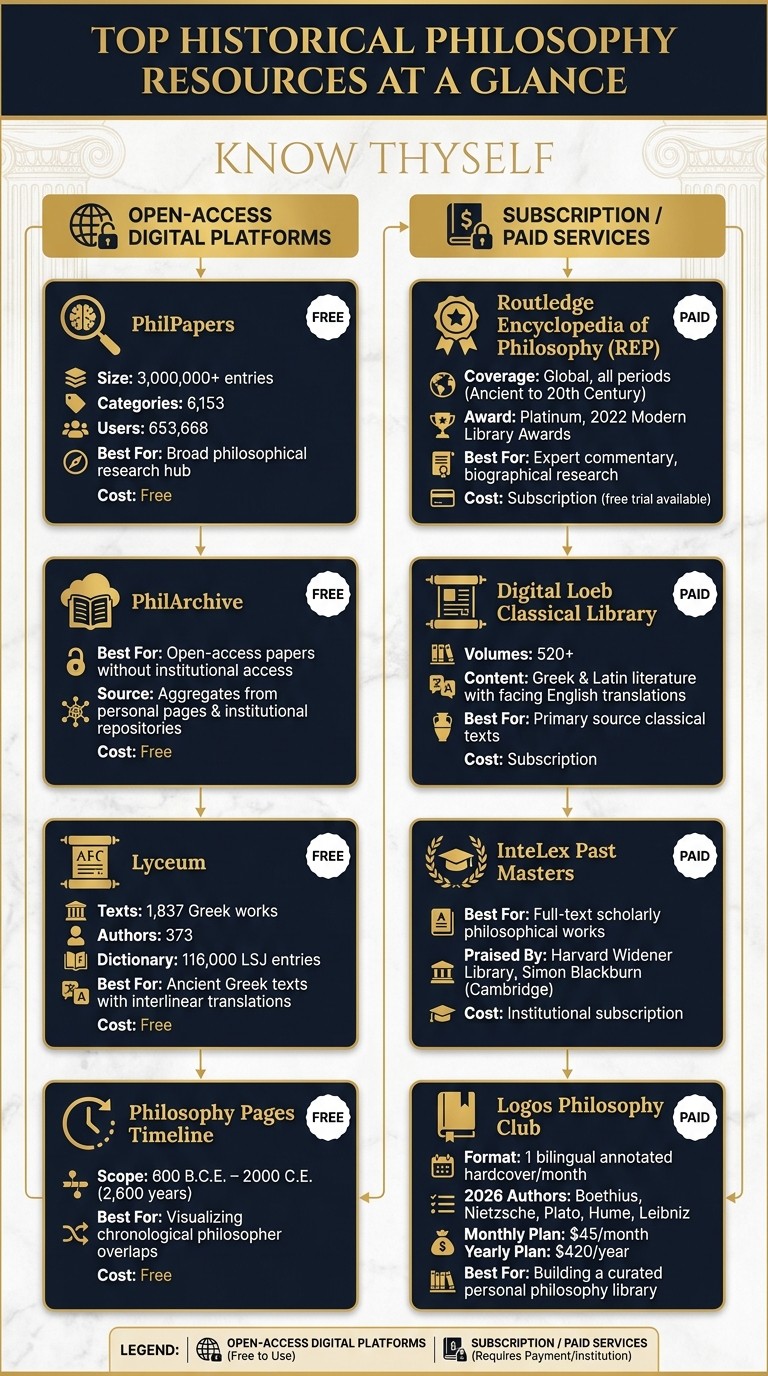
Digital platforms have revolutionized research, offering resources far beyond traditional print materials. Take PhilPapers, for example. According to the PhilPapers Foundation:
"PhilPapers plays an important and unique role as the main hub of research in philosophy."
As of May 2026, PhilPapers boasts over 3 million entries across 6,153 categories, with a user base of 653,668. Its companion site, PhilArchive, aggregates open-access papers from thousands of personal pages and institutional repositories. For researchers without institutional access, PhilArchive is an invaluable starting point.
If your focus is Ancient Greek texts, Lyceum is a resource worth noting. It provides access to 1,837 Greek works by 373 authors, complete with interlinear translations, morphological analysis, and vocabulary tools referencing 116,000 entries from the LSJ Dictionary. This platform is particularly helpful for those navigating between translations and the original Greek text.
While open-access platforms are excellent for broad exploration, subscription services often provide curated, in-depth content.
Specialized Subscription Services
For a more tailored experience, services like the Logos Philosophy Club offer curated selections of philosophical texts. Subscribers receive one bilingual, annotated work each month, accompanied by The Logos Reader, a guide designed to enhance understanding of the text. The 2026 schedule includes works by Boethius (The Consolation of Philosophy), Nietzsche, Plato, Hume, and Leibniz (Discourse on Metaphysics), among others.
Membership options include a Monthly Plan for $45 or a Yearly Plan for $420, with discounted access to past editions. Subscribers praise the quality, as John Roche notes:
"The book is sturdy and very well bound, but so far the scholastic commentary is the real gem."
For those building a personal library of essential philosophical works, this curated approach offers a level of depth that's hard to achieve independently.
Using Digital Archives and Text Collections
In addition to subscription services, digital archives provide access to primary sources for deeper research. Platforms like Early English Books Online (EEBO) and Early European Books offer page images and transcriptions of texts from the 15th to 18th centuries - key resources for Renaissance and early modern philosophy. Meanwhile, the Digital Loeb Classical Library includes over 520 volumes of Greek and Latin literature with English translations on facing pages.
For older archives, such as the Internet History Sourcebooks Project, broken links can often be retrieved using the Wayback Machine at archive.org. When searching library catalogs, adding "correspondence" to an author's name in the SUBJECT field can uncover letters and unpublished materials that provide valuable insights into the evolution of their ideas.
For institutional users, InteLex Past Masters stands out as a premier resource for full-text philosophical works. Harvard's Widener Library highlights its:
"strong search engine" and "highly-respected, complete, scholarly editions."
Simon Blackburn from the University of Cambridge also praises it:
"Intelex was the pioneer of high class web based text resources in philosophy... it is an invaluable tool for philosophical research."
Before purchasing a subscription, check if your university library already provides access - many institutions include it in their database offerings.
Building and Organizing a Historical Philosophy Library
Choosing Scholarly Editions
When selecting texts for your philosophy library, it's essential to focus on editions that offer accurate translations and thorough academic features. Look for editions that include contextual essays, annotated glossaries, and thematic indices to deepen your understanding. As Lee Rice points out, translators should avoid imposing bias or modernizing texts excessively.
For instance, the Focus Philosophical Library provides glossaries that delve into "concepts central to each dialogue", helping readers to "see beyond the words into concepts". Features like these make it easier to grasp the philosophical ideas in their original context.
Additionally, opt for editions designed to last. The 2026 Aristotle: Complete Works from Hackett Publishing is a great example, offering cloth covers, ribbon markers, and acid-free matte paper - perfect for long-term study and preservation.
Once you've gathered these high-quality editions, organizing them thoughtfully will further enhance your research and study experience.
Organizing by Historical Period or Theme
After curating your collection, how you arrange it can significantly impact your ability to engage with the material. Organizing by historical period provides a chronological perspective, allowing you to follow the development of philosophical thought over time. For example, grouping texts into eras like Ancient Greek, Medieval, Modern, and 19th Century offers a clear timeline of ideas.
Alternatively, organizing by theme - such as Metaphysics, Ethics, Epistemology, or Logic - enables focused study of specific philosophical branches. Many readers find a hybrid approach effective: first arranging by period, then grouping works thematically within each era. This dual method aligns with the importance of understanding philosophy in its historical and conceptual contexts.
Here’s a quick example of how you might structure your library:
Historical Period | Key Works | Thematic Focus |
|---|---|---|
Ancient Greek | Plato's Symposium, Aristotle's Nicomachean Ethics | Foundational Metaphysics & Ethics |
Medieval | Boethius's Consolation of Philosophy | Transmission of Classical Thought |
Modern | Hume's Enquiry, Leibniz's Discourse on Metaphysics | Epistemology & Rationalism |
19th Century | Nietzsche's Thus Spoke Zarathustra | Critique of Morality & Existentialism |
For periods with limited surviving texts, like Presocratic philosophy, supplement your collection with sourcebooks that compile fragments and testimonia. These resources provide additional historical context and help bridge gaps in the primary material.
Integrating Logos Philosophy Club into Your Collection

Developing a robust philosophy library takes time and careful selection, and the Logos Philosophy Club offers a convenient way to expand your collection. By subscribing, you receive one bilingual, annotated philosophical work each month, steadily building a comprehensive library.
As Logos Publishing explains:
"When you join the Logos Philosophy Club, you receive one essential work of philosophy at home each month. Over time, you build a personal philosophical library with high-quality editions - translated directly from the original language."
Each monthly addition integrates seamlessly into your existing organization, complementing your chronological and thematic structure. This approach makes it easier to develop a well-rounded collection while maintaining a steady pace of study and exploration.
Conclusion: Next Steps for Studying Historical Philosophy
Now that you have a roadmap, your journey into historical philosophy can continue with purpose and structure.
Studying historical philosophy requires dedication and thoughtful planning. This guide has shown how to progress from general overviews and encyclopedias to exploring detailed digital archives that cover centuries of philosophical works. Platforms like PhilPapers are especially useful for keeping up with new research across thousands of years of thought.
To deepen your understanding, blend primary texts, expert commentary, and a well-organized library. Learning how to read philosophy effectively ensures you get the most out of these complex materials. Bilingual editions are particularly valuable, as side-by-side translations help reduce the risk of misinterpretation. For addressing gaps in historical records, resources like Richard McKirahan's Philosophy Before Socrates are essential. As A. A. Long from UC Berkeley describes, these works offer "impeccable translations of primary texts with commentary that is historically responsible and philosophically stimulating".
In addition to digital tools, building a philosophy library can be an enriching part of your study. Logos Publishing emphasizes the importance of creating a curated collection:
"The difference between buying books and building a library... Logos offers something different: a curated monthly philosophy club built around premium hardcover volumes designed to be read, kept, and collected."
With their bilingual, annotated editions delivered monthly, the Logos Reader also provides guided study to help you expand your knowledge systematically.
Move forward by combining digital resources, scholarly editions, and a thoughtfully curated library to make your exploration of historical philosophy both comprehensive and rewarding.
FAQs
What’s the best order to start studying historical philosophy?
When deciding where to start, it all depends on your goals and how familiar you are with philosophy. If you're new to the subject, you might want to begin with an accessible overview like Will Durant's The Story of Philosophy. For those who prefer a chronological journey, ancient thinkers such as Plato and Aristotle are great starting points. To enrich your understanding, consider pairing primary texts with guides, like those offered by Logos Philosophy Club. A blend of chronological study and thematic exploration often gives the most balanced and insightful perspective.
How do I choose a scholarly edition worth buying?
To choose a top-notch scholarly edition, focus on accurate translations, insightful annotations, and a sturdy format. Editions recognized by experts or tailored for in-depth study - such as those from Logos Philosophy Club - are excellent options. Make sure the edition fits your purpose, whether it's for academic research or personal exploration. A thoughtfully assembled edition not only deepens comprehension but also contributes to a meaningful collection.
Which digital resources help most when I don’t have library access?
When library access isn’t an option, there are plenty of digital resources to keep philosophy studies on track. PhilPapers is a treasure trove, offering a wide-ranging index of research, including open-access articles and primary texts. The Internet Encyclopedia of Philosophy is another great option, featuring professionally written articles that are easy to dive into.
For those interested in ancient Greek texts, Eulogikon provides free downloads of essential works. Other platforms like the Internet History Sourcebooks Project and Internet Archive host a wealth of public domain materials and classic texts, ensuring you can continue your research even without stepping into a library.