Loeb Classical Library vs. Modern Bilingual Editions


If you're deciding between bilingual editions and English-only versions, or choosing between the Loeb Classical Library and modern bilingual editions, here's the quick breakdown:
Loeb Classical Library: Compact, color-coded volumes (green for Greek, red for Latin) with the original text on one page and a straightforward English translation on the other. Great for beginners or those seeking broad access to ancient texts. Over 558 volumes available, spanning works from Homer to the Byzantine era. Digital access is also available for $195 in the first year, then $65 annually.
Modern Bilingual Editions: Larger formats with updated translations, detailed notes, and extensive scholarly tools. Ideal for advanced researchers or those diving deep into specific historical periods or texts. Examples include the I Tatti Renaissance Library (Renaissance Latin) and Dumbarton Oaks Medieval Library (Medieval and Old English).
Key Differences:
Loeb focuses on literal translations and compact design.
Modern editions prioritize clarity, modern language, and deeper annotations.
Quick Comparison:
Feature | Loeb Classical Library | Modern Bilingual Editions |
|---|---|---|
Translation Style | Literal, straightforward | Contemporary, with nuanced interpretations |
Annotations | Minimal | Detailed introductions and critical notes |
Format | Pocket-sized | Larger, often less portable |
Digital Access | Fully searchable ($195/year) | Varies by publisher |
Price | ~$26 per volume | Varies significantly |
If you're a casual reader or student, Loeb provides accessible entry points. For scholars, modern editions offer deeper insights and tools. Choose the best curation of philosophy based on your goals and how much detail you need.
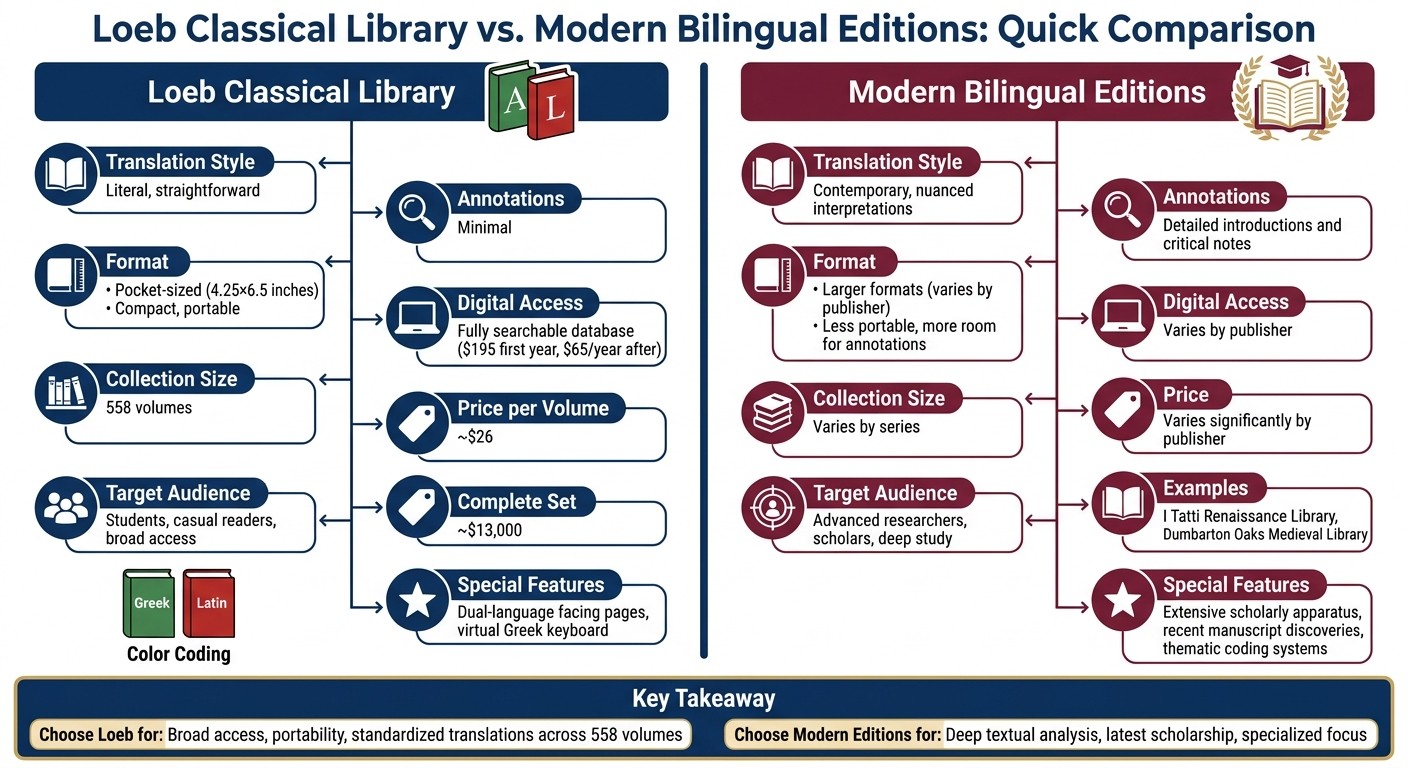
Loeb Classical Library vs Modern Bilingual Editions Comparison
What Is the Loeb Classical Library?
History and Legacy
The Loeb Classical Library was created with a simple yet transformative goal: to make classical literature accessible to everyone. In 1911, James Loeb, a German-American banker and philanthropist, began the series to bring Greek and Latin texts to a broader audience. At the time, most classical works were expensive and tailored for academic experts, leaving the general public without access to these timeless writings.
The first 20 volumes debuted in 1912, co-published by William Heinemann in London and G.P. Putnam's Sons in New York. By 1933, when Loeb entrusted the project to Harvard University along with a $300,000 endowment, the collection had grown to over 300 volumes. Harvard University Press took over global publishing in 1989 and continues to release four to five new or updated volumes annually.
This series not only became a staple in university courses worldwide but also inspired similar bilingual collections, such as the I Tatti Renaissance Library, the Dumbarton Oaks Medieval Library, and the Murty Classical Library of India. Today, the Loeb Classical Library includes 558 volumes, covering works from Homer to the Fall of Constantinople. Its range spans poetry, prose, history, philosophy, and drama. For those looking to dive into these works, following a philosophy reading habit checklist can help structure your study. In 2014, Harvard introduced the Digital Loeb Classical Library, a fully searchable online platform that cost over $1 million to develop and earned the 2015 PROSE Award for Best Humanities eProduct.
These achievements have cemented the Loeb Classical Library's reputation as a unique and enduring resource for exploring ancient literature.
Key Features
Each compact volume (4.25×6.5 inches) is instantly recognizable by its color-coded covers - green for Greek works and red for Latin - and its dual-language format, with the original text on the left and an English translation on the right.
The books are printed on acid-free paper with reinforced bindings to ensure durability. The translations prioritize clarity over literary elegance, serving as straightforward "cribs" to help readers understand the original text. Modern editions have also moved away from the censorship of earlier ones. For instance, older versions of Longus’s Daphnis and Chloe rendered sexually explicit passages in Latin rather than English to shield readers, but contemporary editions present the text in full.
The digital platform enhances the experience with features like searchable text, annotation tools, and personal workspaces. These tools have made the library invaluable for both students and researchers. As Jeffrey Henderson, General Editor of the Loeb Classical Library, explained:
"For the first time, readers without knowledge of Greek and Latin will be able to explore a vast range of the classical literary heritage online through high-quality, modern translations".
Modern Bilingual Editions: An Overview
What Makes Modern Editions Different
Modern bilingual editions have moved beyond the compact, pocket-sized format popularized by the Loeb Classical Library. While the Loeb series sticks to its classic 4.25×6.5-inch dimensions, newer collections often opt for larger formats, offering more room for text, annotations, and additional scholarly tools. This change reflects a shift in how publishers approach classical texts.
What sets these modern editions apart isn’t just their size. They also feature a fresh approach to translation. Earlier 20th-century editions often used what critics described as "stilted" or overly formal English, but today’s translations aim for clear, modern language that remains faithful to the original. Gone are the days of bowdlerizing explicit content - where older editions would leave sexually explicit passages untranslated in Latin or Italian, modern versions present the text in full, unfiltered English.
Another major improvement is the inclusion of more extensive scholarly tools. Traditional Loeb volumes were created with minimal critical notes, catering to general readers. In contrast, modern editions come packed with translator’s notes, detailed introductions, and comprehensive glossaries. Some digital editions go even further. For example, the 2022 bilingual version of La Princesse de Clèves by Lever Press includes interactive features like georeferenced historical maps and word frequency charts. This edition earned the 2024 Scholarly Edition in Translation Award and was also a finalist for the 2023 PROSE Award for Best eProduct. These advancements are redefining what bilingual editions can offer, opening the door to a new generation of publishers and readers.
Publishers Offering Modern Editions
Several publishers are stepping up to meet the demand for these enhanced bilingual editions, combining innovative features with rigorous scholarship. One standout is the Logos Philosophy Club, which offers a subscription service for bilingual editions of foundational philosophical texts. Each monthly release includes carefully crafted translations, detailed annotations, and durable hardcover bindings designed for serious study. Subscribers also gain access to the Logos Reader, which provides essays, commentary, and exclusive collectible items. The annual subscription, priced at $420, includes member pricing on past releases, making it a modern way to build a personal library of philosophical works.
Comparing Translation Quality
Literal vs. Interpretive Translations
The Loeb Classical Library has long been known for its literal translation style, presenting the original Greek or Latin text on the left page and the English translation on the right. This approach was intended to give students a dependable guide for studying classical texts. Many students find that curated philosophy plans help organize these readings. However, many early translations in the Loeb series felt rigid and overly formal, resembling a transcription more than readable literature.
In contrast, modern bilingual editions aim for clarity and relatability, using contemporary language to convey the original text's tone and meaning while maintaining accuracy. For instance, in Plato's Republic, Allan Bloom's literal translation preserves the phrase "The god", while newer interpretive translations choose "gods" to align with modern expectations. Both approaches have their merits: literal translations capture the subtleties of the original language, often navigating untranslatable philosophical terms, while interpretive ones focus on making the text accessible to current readers.
This evolution also extends to how sensitive material is handled. Today’s editions include passages that were once censored. Jeffrey Henderson's updated Loeb edition of Aristophanes restores the humor and explicit language earlier translators had toned down. Bruce Whiteman observed this shift, stating:
"Today the Loeb is quite content to call a spade a spade, and does not even forbear to use the four-letter words that have become common even in the newspaper press".
Modern translations, therefore, balance style, tone, and integrity, reflecting a broader acceptance of the original works' candidness.
Incorporating Recent Scholarship
While translation style shapes readability, incorporating recent scholarship ensures accuracy and relevance. Early Loeb volumes often relied on outdated translations or manuscripts that have since been improved. Modern editions, however, benefit from advancements like papyrological discoveries, reconstructed manuscripts, and decades of refined philological research.
A striking example of this progress is John Fitch's updated Loeb translation of Seneca's tragedies. Critics praised it as:
"more readable, more accurate, and more scholarly".
This improvement reflects the integration of updated source materials and a deeper grasp of Seneca's language. Additionally, newer editions enhance the reading experience with detailed notes and introductions, which far surpass the earlier 20th-century versions. By combining Loeb's traditional framework with modern academic insights, these translations highlight how bilingual editions continue to evolve, offering both fidelity to the original and accessibility for contemporary audiences.
Tour of Harvard University Press (Loeb Classical Library, I Tatti, Dumbarton Oaks, Murty)
Usability for Scholars and Readers
Both the Loeb series and modern editions go beyond mere translation by incorporating thoughtful design and tools that enhance the experience for both scholars and casual readers.
Design and Format
Loeb volumes are instantly recognizable with their compact, dual-language format and color-coded covers - green for Greek texts and red for Latin. This design ensures clarity and ease of use for readers. Modern series from Harvard, such as the I Tatti Renaissance Library and Dumbarton Oaks Medieval Library, maintain the facing-page layout but use a larger physical format compared to the traditional Loeb volumes. While the larger size may reduce portability, it can improve readability, especially for those spending long hours with a single text.
For digital users, the platform offers a fully searchable database and even includes a virtual Greek keyboard for precise searches. Subscription costs for the digital library start at $195 for the first year and drop to $65 annually after that. If you're interested in the complete printed set, expect a price tag of around $13,000.
Beyond the physical and digital formats, these editions also stand out for their expanded annotations and tools, which significantly benefit both casual readers and academic researchers.
Annotations and Supplemental Resources
Earlier Loeb editions were known for their minimal critical apparatus, a limitation noted by scholars like Birgitta Hoffmann:
"Unfortunately the first thing that happens in bilingual versions like the Loebs is that most of this apparatus vanishes and, if you use a translation, there is usually no way of knowing that there were problems with the text in the first place".
Recent editions, however, have addressed this issue by adding more robust scholarly resources. For example, the nine-volume Early Greek Philosophy set includes thematic outlines, section headings, and a 39-page glossary of key Greek and Latin terms. It also uses a coding system - P for Person/biography, D for Doctrine/fragments, R for Reception, and T for Text/thematic passages - to help scholars navigate different types of content.
The digital platform enhances usability further by allowing searches across not only the original text and translations but also the introductions and notes, turning it into an efficient tool for research. For those seeking even deeper editorial resources, the Logos Philosophy Club (https://logospublishing.com) offers monthly bilingual editions with meticulous translations, detailed annotations, and exclusive materials tailored for advanced study.
Comparison Table: Loeb vs. Modern Editions
Side-by-Side Comparison
The table below highlights the key differences between the Loeb Classical Library and modern bilingual editions, summarizing their unique features and strengths:
Feature | Loeb Classical Library | Modern Bilingual Editions |
|---|---|---|
Translation Style | Focuses on literal translations that closely mirror the original text. | Offers a range of styles - interpretive, poetic, or contemporary. |
Critical Apparatus | Minimal, with limited notes on textual variants. | Includes detailed scholarly notes and extensive manuscript history. |
Annotations | Provides brief annotations aimed at general readers. | Features comprehensive introductions and supplemental essays. |
Physical Format | Compact, pocket-sized volumes for portability. | Formats vary; often larger editions like I Tatti or Dumbarton Oaks. |
Digital Access | Fully searchable database since 2014, including a virtual Greek keyboard. Subscription costs: $195 for the first year, $65 annually afterward. | Digital availability depends on the publisher; not all editions offer online versions. |
Philosophy Study | Covers a broad range of philosophers with standardized terminology. Specialized collections like the 9-volume Early Greek Philosophy include tools like 39-page glossaries and thematic coding. | Focuses on in-depth scholarship, offering nuanced analysis of specific philosophical terms. |
Cost | Individual volumes priced around $26.00. Complete printed set costs approximately $13,000. | Pricing varies significantly depending on publisher and scholarly detail. |
Target Audience | Initially created for "amateur readers" or "gentleman scholars", but now appeals to both general readers and professionals. | Often tailored to either advanced academic research or casual readers seeking contemporary language. |
The Loeb Classical Library's standardized format and extensive collection - spanning over 520 volumes - make it a dependable resource for quick reference. On the other hand, modern editions stand out for their depth and specialized focus on specific texts or periods.
Which Edition Should You Choose?
The choice between the Loeb Classical Library and modern bilingual editions really depends on your goals. If you're looking for a reliable, side-by-side guide to read alongside the original Greek or Latin, the Loeb volumes are an excellent option. Their layout - original text on the left and translation on the right - was specifically created to help readers "gather an elementary knowledge" of the original language.
On the other hand, if your work requires more in-depth textual analysis, you'll likely need additional resources. For scholarly research, modern editions often have the advantage. They integrate recent manuscript discoveries and include extensive critical tools that scholars depend on, along with detailed notes to clarify complex philosophical terms. As mentioned earlier, traditional bilingual editions often lack the critical apparatus needed to address textual issues, a gap that specialized modern editions are designed to fill.
It's also wise to avoid budget reprints. Many of these inexpensive public domain versions rely on outdated translations, often riddled with archaic language and based on flawed manuscripts that modern research has since corrected.
For those pursuing serious scholarship, the Logos Philosophy Club offers a subscription service at $45 per month. This service provides high-quality bilingual editions complete with detailed annotations, editorial support, supplemental essays, and commentary tailored for in-depth study. Subscribers even receive exclusive collectible items, adding an extra layer of value.
Alternatively, the digital Loeb Classical Library subscription ($195 for the first year, $65 annually after that) is a fantastic tool for research. Its searchable database spans over 520 volumes, allowing users to trace specific Greek or Latin phrases across centuries of literature. Bruce Whiteman aptly describes this resource as:
"a godsend to all sorts of people, not just to or even primarily to classicists".
Conclusion
The Loeb Classical Library and modern bilingual editions each bring unique strengths to the study of classical texts, balancing translation quality with usability for scholars. Since the 1980s, the Loeb series has undergone a remarkable transformation. Once dismissed as a "gentleman's crib", it has become a respected "edition of reference", standing alongside works like the Diels-Kranz for Presocratic philosophy. The translations are often described as "workmanlike", prioritizing clarity and factual accuracy.
On the other hand, modern bilingual editions cater to more specialized needs. They typically include a richer critical apparatus, detailed annotations, and the latest scholarship - essential tools when dealing with texts where even small variations carry significant philosophical weight. This distinction highlights the trade-off between broad accessibility and the depth required for focused analysis.
The choice between these resources depends on what you're looking for. If your research spans multiple authors and historical periods, the Loeb series offers unparalleled breadth. But for those delving deeply into philosophical texts, modern bilingual editions provide the precision and scholarly tools necessary for in-depth study.
Both approaches play an important role in understanding classical works. Whether you prefer the comprehensive scope of the Loeb series or the detailed focus of modern bilingual editions, investing in annotated translations ensures a strong foundation for studying ancient literature. For those seeking expertly translated, well-annotated texts, Logos Philosophy Club provides a subscription service tailored to serious scholars, offering reliable and contemporary interpretations that reflect the highest standards of scholarship.
FAQs
Which Loeb volumes have the most up-to-date translations?
The latest Loeb translations are generally available in the most recent editions published by Harvard University Press. These editions undergo regular revisions to stay current. For specific titles, it's best to refer to the publication dates listed directly on the publisher's website.
Is Loeb good enough for academic citations?
The Loeb Classical Library is a well-regarded resource for classical texts, offering the original Greek or Latin text alongside an English translation. This format makes it accessible for general readers and students. However, the translations have faced criticism for occasionally lacking nuance or precision. For more detailed academic research, editions such as the Oxford Classical Texts or the Teubner series are often preferred due to their higher level of accuracy and scholarly rigor.
How do I choose between print and digital Loeb?
Print editions give readers the classic feel of a physical book, offering portability and a sense of tradition. They're perfect for those who enjoy collecting books or prefer studying with something tangible in hand.
Digital editions, on the other hand, offer instant access on your devices, advanced tools for searching and annotating, and easy library organization. They also maintain the side-by-side text and translation format, making them practical for modern readers who value convenience. The choice ultimately depends on whether you lean toward the tactile appeal of physical books or the flexibility of digital formats.