How Roman Grammarians Defined Latin Syntax


Roman grammarians treated syntax as the rule for putting Latin words together the right way. If I had to boil the article down fast, I’d say this: they cared less about fixed word order and more about agreement, case endings, and correct construction.
Here’s the short version:
Syntax in Rome was practical. It was about writing and speaking correct Latin.
Early grammar focused on word forms, because Latin often shows meaning through endings, not position.
Varro, Donatus, and Priscian each pushed the subject forward in different ways.
Romans used terms like oratio, constructio, ordinatio, and latinitas to explain how sentences work.
That school model lasted for centuries and shaped how Latin was taught long after Rome. Today, we continue to support students of classical philosophy and language through our curated editions.
One key point stands out to me: although Latin could use fairly loose word order, Roman teachers still treated sentence mistakes as serious errors. In fact, they drew a clear line between a fault in a word form and a fault in word combination. That split helped turn syntax into a teachable part of grammar.
Quick comparison
Figure | Main role in the story | Simple takeaway |
|---|---|---|
Varro | Early language analysis | Treated word combination as part of grammar |
Donatus | School grammar | Tied syntax to correct Latin and classroom rules |
Priscian | Detailed sentence study | Gave the most complete Roman account of construction |
So if you want the direct answer, here it is: Roman grammarians defined Latin syntax as the correct joining and ordering of words inside a meaningful utterance, judged by the standard of proper Latin. The rest of the article explains how that idea grew, what terms they used, and why it stayed in use for so long.
How Syntax Developed Within Roman Grammar
Roman grammatica started as the study of correct Latin and close reading. Syntax came into view later, not all at once, but bit by bit. That slow start helps explain why the first Roman grammarians didn't treat syntax as a field of its own. For them, it sat inside a much broader study of language.
Roman grammatica as a Study of Language and Literature
Roman grammatica was the first school subject built to analyze Latin. It gave students technical rules: how words inflect, how forms shift, and what counted as correct usage. At the same time, it helped them read literature and poetry with care.
So this wasn't just grammar in the narrow sense. Students were learning how to use Latin correctly and how to interpret texts.
Varro and the Early Treatment of Word Combination
The first large attempt to analyze Latin in a systematic way came from Marcus Terentius Varro. Around 43 BCE, Varro finished De Lingua Latina, a large work dealing with etymology, morphology, and word combination.
He did not treat word combination as a separate subject. Instead, he handled it as a natural part of language study. That move mattered. It set the stage for later grammarians, who would take that half-formed idea and state it more directly.
Why Early Grammarians Focused on Forms Rather Than Sentences
Latin had a fairly free word order, so correctness depended less on fixed sentence position and more on proper inflection. A noun's case ending showed its role in the sentence. In plain terms, the form of the word often did more work than its place in the line.
Because of that, early grammarians leaned toward morphology. Declensions and conjugations were simpler to list, teach, and test.
Still, they were not blind to sentence-level error. Roman grammarians drew a line between barbarism, an error in word form, and solecism, an error in how words combine. That distinction shows they were already thinking past the single word. From there, Donatus and Priscian could define syntax in a more exact way.
The Grammarians Who Shaped Latin Syntax
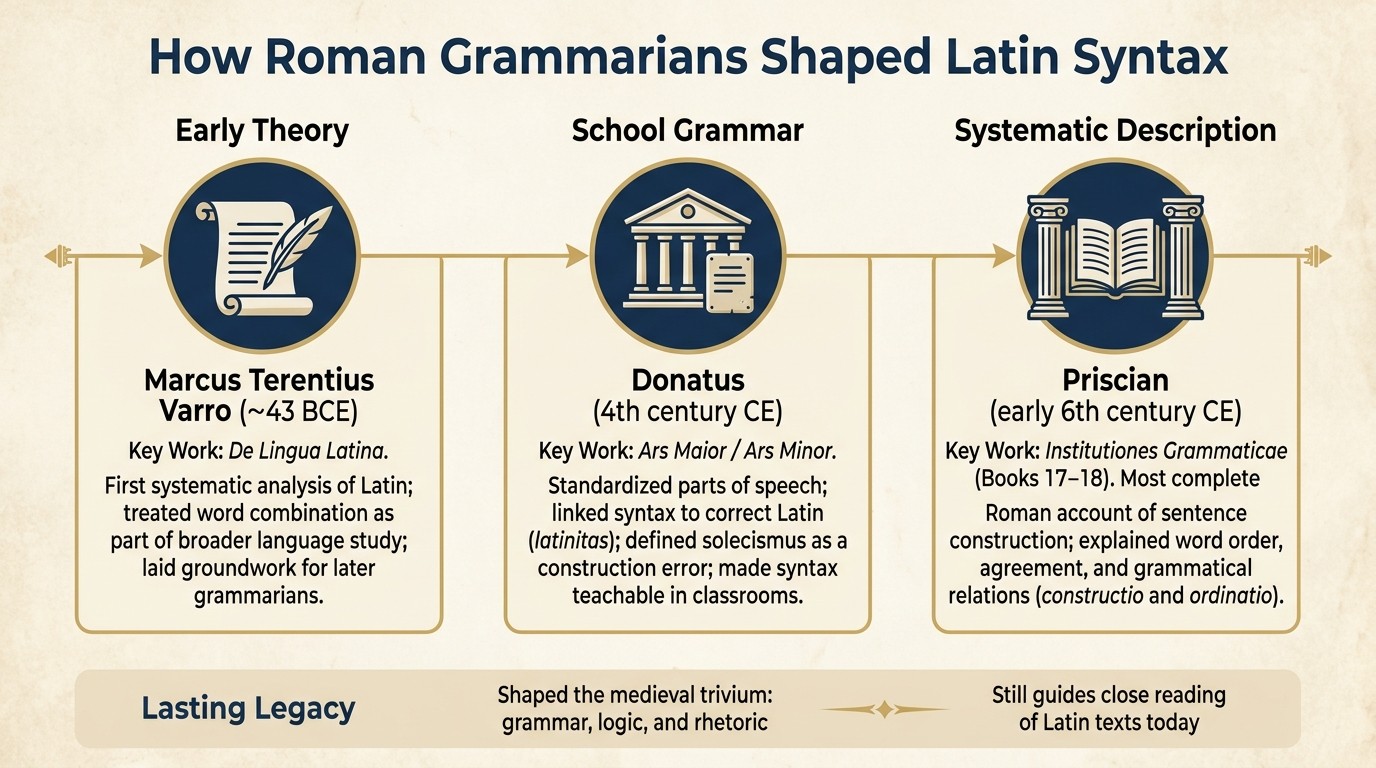
How Roman Grammarians Shaped Latin Syntax: Varro to Priscian
Once Roman grammarians separated form error from construction error, syntax became much easier to teach. Three figures stand out here: Varro, Donatus, and Priscian. Each worked at a different stage of Latin grammar - basic theory, classroom teaching, and detailed description.
Varro's Early Theory of How Words Join
Marcus Terentius Varro looked at Latin as something that could be studied piece by piece. He treated word combination as one part of a larger account of language, not as its own separate subject. That matters because it gave later grammarians a starting point for thinking about how words fit together in a sentence.
His framework came first. Later teachers then trimmed it down for school use.
Donatus and the School Tradition of Correct Latin
Donatus had a big effect on classroom Latin. He standardized the parts of speech and linked syntax to correct usage. In his teaching model, word combination was handled through latinitas and the school view of proper expression. He worked within a line of thought that treated solecismus as a major vice of style when the signified meaning was at odds with the sentence's structure.
For Donatus, syntax was mainly about correctness. Priscian took that same area of study and turned it into a much fuller account of how sentences work.
Priscian's Full Account of Latin Construction
Priscian gave the fullest account of Latin construction. In his Institutiones Grammaticae - above all in Books 17 and 18 - he explained word order, agreement, and the grammatical relations that hold a sentence together. Donatus put the stress on correctness and error; Priscian showed how a sentence is actually built.
Grammarian | Primary Focus | Key Work |
|---|---|---|
Varro | Word combination | De Lingua Latina |
Donatus | School correctness | Ars Maior / Ars Minor |
Priscian | Sentence construction | Institutiones Grammaticae (Books 17–18) |
Those ideas rested on a technical vocabulary that included terms like oratio, constructio, and latinitas.
The Terms Romans Used to Define Syntax
Roman grammarians used a small set of technical terms to explain syntax and sentence structure. With those terms, they could treat sentence analysis as a rule-based system.
Oratio as a Complete and Meaningful Utterance
The key term is oratio. Roman grammarians used it for a complete utterance that expressed a full thought. It wasn’t just a pile of words. It had to make sense as a whole. Its Greek counterpart was logos.
Constructio and ordinatio as Sentence Arrangement
Once grammarians had oratio as the main unit, they needed words for how that unit was put together. Constructio referred to the joining of words into a structured whole, including agreement and case control. Ordinatio dealt with the order and placement of words.
Put simply, these two terms map closely to what we now call syntax.
Term | Meaning | Function |
|---|---|---|
Oratio | A complete utterance that conveyed a full thought | Defines the sentence as both a grammatical and semantic unit |
Constructio | The joining of words into a structure | Governs how words combine through agreement and government |
Ordinatio | The order and placement of words | Focuses on word order and the logical flow of the sentence |
Latinitas | Correct Latin usage | Acts as the benchmark against which syntactic errors are judged |
Partes orationis and latinitas as Rules of Correctness
The eight partes orationis, or parts of speech, gave grammarians the categories they needed to apply constructio and ordinatio in actual analysis. That framework let them spell out rules about which words could go together and where they could appear.
Latinitas set the standard for correct Latin usage. In plain English, it was the yardstick for judging whether a construction was right or wrong. That vocabulary gave Roman grammar a way to standardize correct Latin in schools.
How Roman Syntax Became a Standard and Why It Still Matters
School Grammar and the Spread of Standard Latin
Under the Roman Empire, grammar and rhetoric became part of formal schooling through state-backed teaching posts and set curricula across the empire. In plain terms, schools were teaching from the same playbook.
Those textbooks gave teachers and students a shared model of correct Latin. That mattered a lot. Even after Latin stopped being anyone's first language, the classroom kept its written form steady. Quintilian put grammar and syntax at the center of early education too, which shows how early this training began.
Later Influence on Grammar, Commentary, and Study
Once Roman grammar became the school standard, its categories lasted far beyond the empire. Roman grammar shaped medieval learning through the trivium - grammar, logic, and rhetoric.
You can see that carryover in Isidore of Seville's Etymologiae, completed around 630 CE. He leaned heavily on Roman grammatical categories to organize knowledge for medieval readers.
That long chain of teaching and commentary still matters now. For modern readers of Latin, standardized syntax - especially declensions and conjugations - is key to decoding meaning and sorting out ambiguity in ancient texts. The Roman grammarians, in a very direct sense, built the tools that still let readers make sense of those texts.
Conclusion: The Main Points to Retain
Taken together, these developments turned syntax into something that could be taught, repeated, and passed on. Roman grammarians treated syntax as a practical set of rules for putting words together correctly. And the movement from Varro's early theory to Donatus's classroom categories to Priscian's systematic account of construction gave that standard its long life.
Their terms - oratio, constructio, ordinatio, and latinitas - spelled out what a correct Latin sentence was supposed to look like and why it worked. That framework shaped education for centuries and still guides close reading of Latin today.
FAQs
Why did Roman grammarians focus more on endings than word order?
Roman grammarians put a lot of weight on endings because Latin is a highly inflected language. Declensions and conjugations tell you what job a word is doing in the sentence, including its case, gender, number, tense, and mood.
That matters because, in Latin, the ending often carries the main signal. As a result, word order can move around much more than it does in English. So grammarians paid close attention to these forms to keep meaning clear and usage standard.
How is a solecism different from a barbarism?
In Roman grammar, a barbarism means breaking accepted usage in speech. A solecism is an expression whose meaning or logic doesn't fit together.
Both were treated as faults of style. The key difference is simple: a barbarism violates established usage, while a solecism disrupts the logical sense of the words.
Why does Priscian matter more than earlier grammarians?
The sources here don’t mention Priscian, and they don’t explain why he would matter more than earlier grammarians. Instead, they stay focused on Varro, Cicero, and Quintilian, especially in relation to etymology, rhetoric, and education.
For related study, Logos Philosophy Club offers annotated bilingual editions of foundational philosophical books for serious readers.


