Wittgenstein on Language and Its Limits
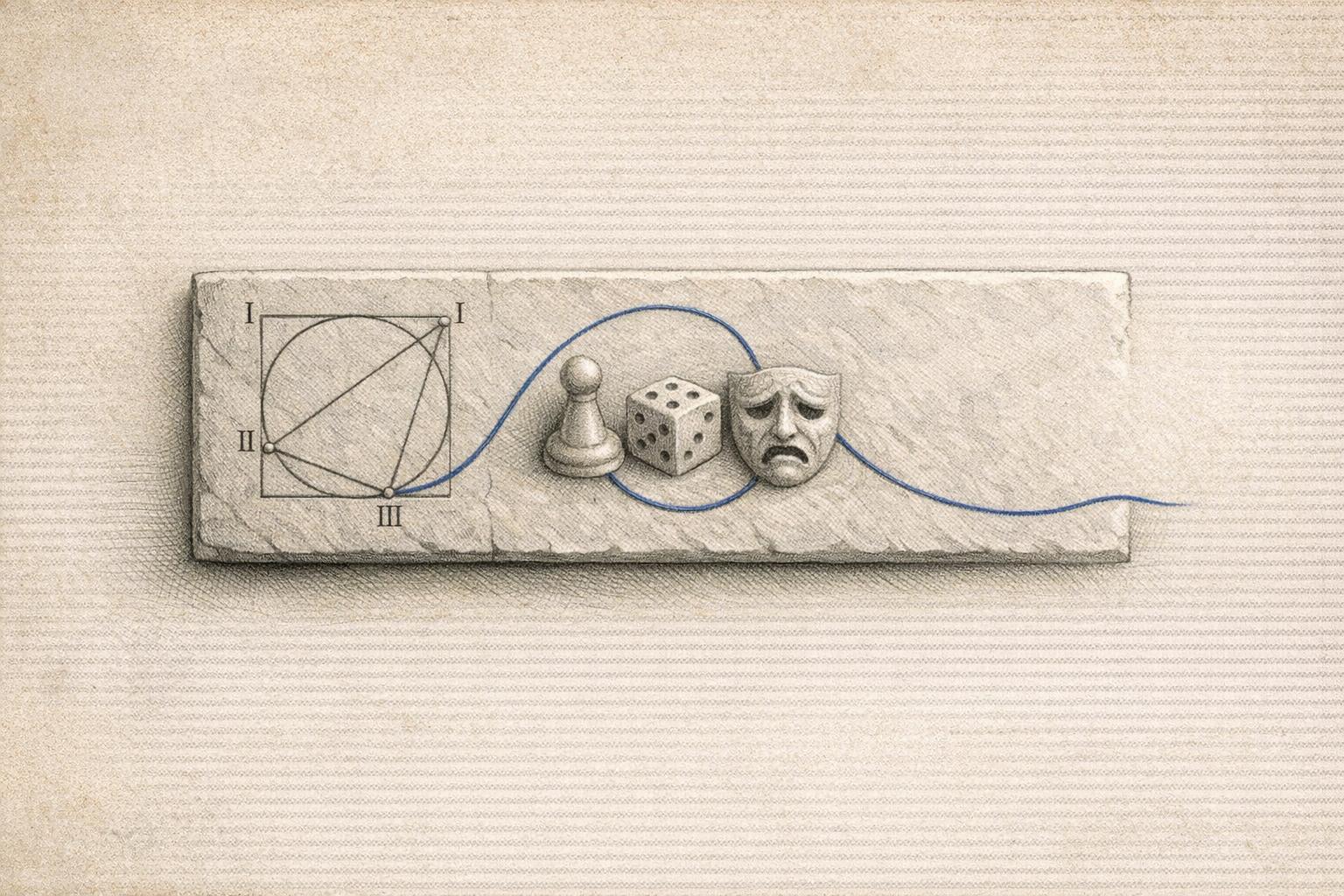

Ludwig Wittgenstein's philosophy of language explores how language shapes thought and understanding. His work is divided into two phases:
Early Phase (Tractatus Logico-Philosophicus, 1921): Language mirrors reality, meaning arises from logical correspondence with facts, and topics like ethics and metaphysics are deemed inexpressible. Famous quote: "The limits of my language mean the limits of my world."
Later Phase (Philosophical Investigations, 1953): Language gains meaning through use and context via "language-games", rejecting rigid logic and focusing on practical, shared activities.
Key contrasts:
Tractatus: Language as a strict logical system; clear boundaries between sense and nonsense.
Philosophical Investigations: Language as flexible and rooted in everyday use; meaning shaped by context and shared practices.
Both works address how language's limitations define human understanding, influencing fields like AI, ethics, and sociology. To study Wittgenstein effectively, bilingual editions and curated plans are recommended for capturing nuances in his original German texts.
The Early Wittgenstein: Logical Form and the Limits of Sense
Logical Atomism and the Picture Theory of Language
In the Tractatus, Wittgenstein argues that the world consists of facts rather than objects. For him, language reflects the structure of reality. This idea is captured in his picture theory of language, which proposes that a meaningful proposition functions as a "picture" of a state of affairs in the world.
Think of a musical score: it represents a symphony through its structured notation, much like how a proposition mirrors reality. A statement is meaningful only if its logical structure corresponds to the structure of the fact it describes. Without this alignment, the statement becomes meaningless.
"The proposition is a picture of reality." - Ludwig Wittgenstein, Tractatus Logico-Philosophicus
The Tractatus is built around seven main propositions, each unpacked through a series of 525 numbered statements. This meticulous structure highlights Wittgenstein's belief in the precision and clarity of logical reasoning.
This focus on structure also leads to his exploration of what language can articulate and what lies beyond its reach.
What Can Be Said and What Can Only Be Shown
Expanding on the idea that propositions mirror facts, Wittgenstein draws a line between what language can express and what it cannot. Statements that describe possible states of affairs - like scientific observations or physical events - fall into the realm of the "sayable." On the other hand, topics like ethics, aesthetics, and metaphysics resist precise expression. These concepts can only be shown indirectly, rather than explicitly stated.
His famous conclusion captures this distinction succinctly:
"Whereof one cannot speak, thereof one must be silent." - Ludwig Wittgenstein, Tractatus Logico-Philosophicus
This boundary underscores his belief that some of the most significant aspects of human experience exist outside the limits of language.
Critiques of the Tractatus on the Limits of Language
The Tractatus faced immediate scrutiny. Critics questioned whether Wittgenstein's own propositions adhered to the standards he set. If meaningful language must "picture" facts, what fact does the picture theory itself represent? This apparent paradox has fueled ongoing debate among scholars.
Two major interpretations have emerged. One traditional view suggests that Wittgenstein's concept of "showing" hints at deep, unspeakable truths that transcend language. A second, more radical interpretation sees the Tractatus as a kind of intellectual exercise - its propositions are meant to be recognized as nonsensical and then discarded. This tension between interpretations continues to shape discussions about Wittgenstein's early work.
These critiques and debates laid the groundwork for Wittgenstein's later shift toward examining language in the context of everyday life.
Wittgenstein - The Unsayable & Limits of Thought
The Later Wittgenstein: Language-Games and How Meaning Works
In Philosophical Investigations, Wittgenstein shifts away from viewing language as a strict logical framework, presenting it instead as a set of practices deeply tied to everyday life. This new approach highlights how language functions as a tool, shaped by its use rather than by rigid logical structures.
Language-Games and Forms of Life
Take the example of a builder shouting "slab." The assistant immediately understands and brings one. This simple interaction shows that meaning depends on context. Language, in Wittgenstein's view, isn't confined to logical representation but spans the full range of human activities.
"The speaking of language is part of an activity, or a form of life."
Ludwig Wittgenstein, Philosophical Investigations (§23)
Instead of assuming that language has a universal logical form, as he proposed in the Tractatus, Wittgenstein now sees it as a collection of "games", each with its own rules. Whether you're giving instructions, cracking a joke, or asking a question, each activity operates within its unique framework. For example, a single word like "Water!" can mean vastly different things depending on whether it's a request, a warning, or an observation. Meaning, therefore, isn't fixed but emerges from use in specific contexts.
These language-games are grounded in what Wittgenstein calls "forms of life" (Lebensformen) - the shared social and cultural practices that enable people to understand one another. Understanding someone’s meaning isn’t just about interpreting words; it’s about participating in a shared way of life. As Wittgenstein famously notes, "To imagine a language means to imagine a form of life."
The Private Language Argument
Wittgenstein challenges the idea of a private language through his "beetle in a box" thought experiment. Imagine everyone has a box with something called a "beetle" inside, but no one can see into anyone else’s box. The actual content of the box becomes irrelevant because the word "beetle" functions based on its use in public discourse, not on the unseen object itself.
"An 'inner process' stands in need of outward criteria."
Ludwig Wittgenstein, Philosophical Investigations
This illustrates how meaning depends on shared, external criteria. Without common standards, it would be impossible to determine whether someone is genuinely following a rule. Meaning isn’t rooted in private, internal experiences - it’s tied to shared practices and public life, reinforcing Wittgenstein’s broader point about the limits of language.
Philosophy as a Therapeutic Activity
Wittgenstein’s later work redefines philosophy as an activity aimed at clarifying confusion rather than constructing theories. For him, philosophy isn’t about solving ancient puzzles but about untangling the misunderstandings that arise when language is misapplied. By examining how words are used in practical contexts, philosophy can dissolve many of the problems that seem so perplexing.
"Philosophy is a battle against the bewitchment of our understanding by means of language."
Ludwig Wittgenstein, Philosophical Investigations
Through this lens, Wittgenstein’s work encourages us to rethink not just the structure of language but also the way we communicate and live our lives. By returning language to its everyday use, many of the questions that once seemed difficult simply fade away.
Early vs. Later Wittgenstein: A Comparison
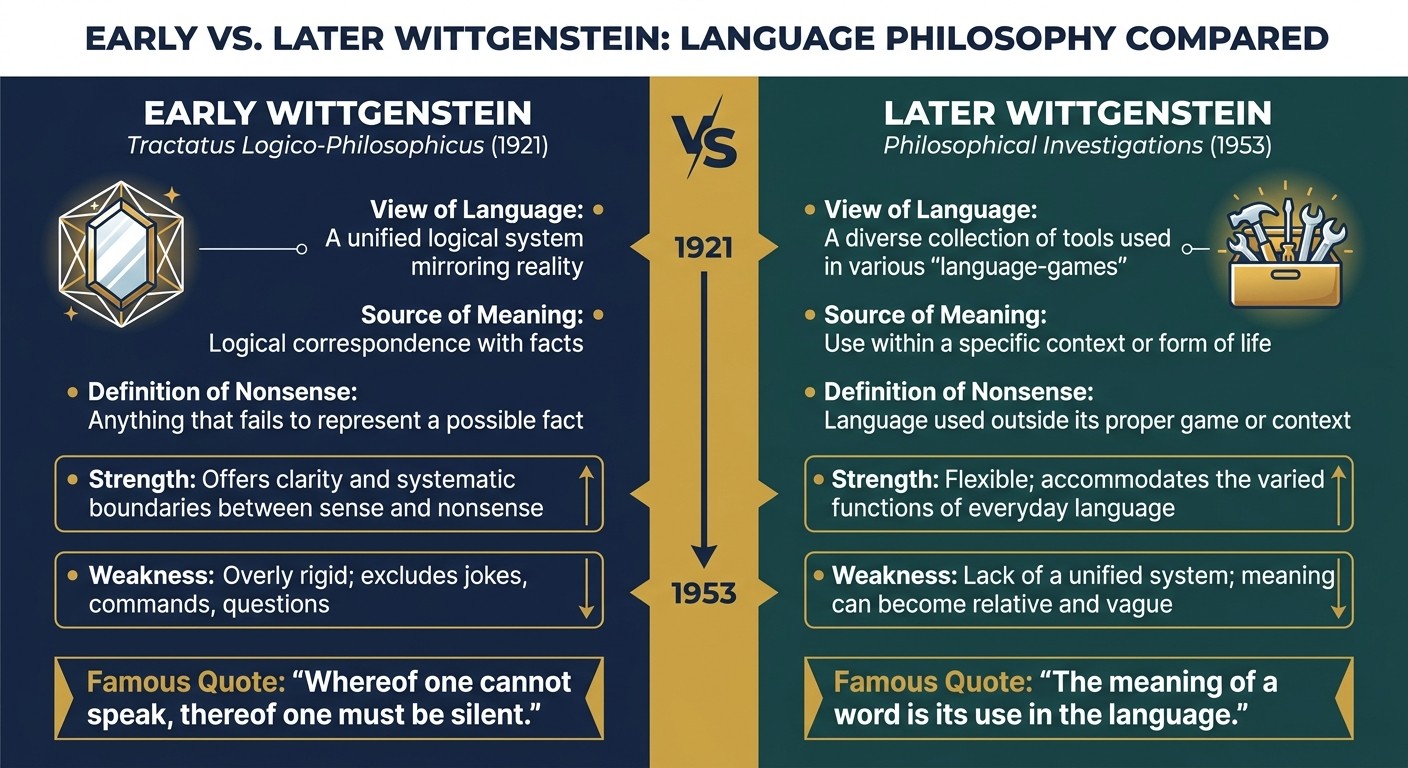
Early vs. Later Wittgenstein: Key Differences in Language Philosophy
Continuities Across Wittgenstein's Work
Even with a dramatic shift in his philosophical method, Wittgenstein consistently viewed philosophy as an activity rather than a fixed set of doctrines. Both the Tractatus and Philosophical Investigations approach philosophical problems as stemming from linguistic confusion rather than genuine mysteries about the world. Instead of solving these issues with new theories, Wittgenstein sought to dissolve them entirely.
Another shared theme is the acknowledgment that some aspects of life resist explicit articulation. In the Tractatus, Wittgenstein argued that ethics and logic could only be "shown" but not directly expressed. Similarly, in the Philosophical Investigations, he posited that shared "forms of life" underpinning language require no further justification. These recurring ideas provide a foundation for examining how his approach to language evolved over time.
Key Differences Between the Two Approaches
While there are continuities, the two works diverge sharply in their treatment of language's boundaries. In the Tractatus, Wittgenstein defined these limits through logical form. He saw language as a unified system mirroring reality, where anything failing to represent a possible fact was dismissed as nonsense.
By contrast, the Philosophical Investigations embraced a more adaptable view. Language's boundaries were no longer tied to a rigid logical structure but instead arose from the grammar of specific "language-games" - the social contexts where words gain meaning. Here, nonsense is not about failing to align with logical form but about using words outside their appropriate contexts. This shift was partly influenced by critiques, such as economist Piero Sraffa's challenge to the picture theory of language.
Strengths and Weaknesses of Each Framework
Feature | Tractatus | Philosophical Investigations |
|---|---|---|
Strength | Offers clarity and systematic boundaries between sense and nonsense | Adapts to the complexity and variety of language use |
Weakness | Overly rigid; struggles with non-declarative uses like jokes or commands | Lacks systematic precision; harder to apply rigorously |
View of language | A unified logical system | A collection of overlapping practices without a single defining essence |
Definition of nonsense | Anything that fails to represent a possible fact | Misuse of words outside their proper context |
The Tractatus shines in its precision, providing clear distinctions between meaningful and meaningless statements. However, this clarity comes at the cost of excluding much of everyday language, such as questions, commands, or humor. The Philosophical Investigations, on the other hand, embraces the messiness of language, treating its diversity as a fundamental feature. Yet, its concepts - like "family resemblances" and "forms of life" - can feel less concrete and harder to formalize.
This comparison highlights the evolution in Wittgenstein's thinking about language, offering deeper insight into how he grappled with its limits and possibilities throughout his career.
Studying Wittgenstein Today
Wittgenstein's Influence on Modern Philosophy
Wittgenstein's ideas continue to shape modern philosophical discussions. His concept of "forms of life" (Lebensformen) has found a significant place in anthropology and sociology, where it's used to explore how shared cultural practices create meaning. In the philosophy of mind, his rejection of essentialist thinking influenced Gilbert Ryle's critique of Cartesian dualism and J.L. Austin's development of speech act theory.
One of the liveliest debates in the philosophy of language today originates from Saul Kripke's 1982 interpretation of Wittgenstein, often referred to as "Kripkenstein." This interpretation introduced a skeptical paradox about meaning that continues to challenge philosophers. At the same time, scholars like Cora Diamond and James Conant have promoted a "resolute reading" of Wittgenstein's Tractatus, suggesting that the work is entirely therapeutic in nature - meant to guide readers away from metaphysical thinking altogether.
These ongoing discussions highlight the lasting impact of Wittgenstein's work on both philosophy and broader intellectual traditions.
Why Annotated and Bilingual Editions Matter
Relying solely on translations of Wittgenstein's work can obscure his arguments. Some German terms he used carry nuances that are hard to capture in English. For instance, Bild implies a dynamic process of "forming" or "shaping" that the English word "picture" doesn't quite convey. Similarly, early translations of the Tractatus rendered Sachverhalt as "atomic fact", a term now considered less accurate than "state of affairs".
This is why bilingual (en face) editions - featuring both the German text and its English translation side by side - are considered indispensable for serious study. These editions allow readers to discern whether a difficulty arises from Wittgenstein's argument or the translator's interpretation. The 4th edition of Philosophical Investigations, edited by P.M.S. Hacker and Joachim Schulte, is widely regarded as a benchmark text. It incorporates Wittgenstein's original marginal notes (Randbemerkungen), corrects numerous errors from earlier translations, and includes re-numbered remarks for easier reference.
For those seeking high-quality, bilingual editions, Logos Philosophy Club offers a subscription service that delivers these works directly to readers. Each volume includes annotations, editorial commentary, and a Logos Reader with supporting essays. Subscriber John Roche shared his experience: "I love my copy. The book is sturdy and very well bound, but so far the scholastic commentary is the real gem." Subscription plans start at $45/month, with an annual option at $420/year, which includes access to past editions at member pricing.
This level of precision and care is crucial for engaging with Wittgenstein's complex ideas.
Applying Wittgenstein's Ideas to Current Questions
Wittgenstein's distinction between saying (representing facts) and showing (participating in a form of life) offers valuable insights into modern debates. His framework informs discussions in fields like AI, ethics, and cross-cultural studies. For example, questions about whether large language models genuinely "understand" meaning, or how moral principles are lived rather than abstractly derived, often draw on his ideas. Additionally, his reflections on ineffability resonate with traditions such as Mahayana Buddhism. As he famously wrote:
"To imagine a language means to imagine a form of life."
This idea - that language and life are deeply intertwined - ensures that Wittgenstein's work remains relevant far beyond the confines of academic philosophy.
Conclusion: The Limits of Language in Wittgenstein's Philosophy
Wittgenstein spent much of his career probing the boundaries of meaningful language. In the Tractatus, he argued that language derives its meaning from its ability to represent facts logically. Later, in Philosophical Investigations, he shifted focus, emphasizing how meaning is rooted in social and practical contexts.
Both perspectives highlight a common thread: many philosophical puzzles stem from misinterpreting language. When words are pulled out of the contexts that give them their meaning, what seem like profound problems often unravel into mere linguistic confusion.
This idea is captured in one of Wittgenstein's most quoted statements:
"The limits of my language mean the limits of my world." - Ludwig Wittgenstein
Here, Wittgenstein doesn’t just reflect on grammar or semantics. He suggests something deeper: our ability to think, experience, and understand is fundamentally shaped by the structure and limits of our language. When we push language beyond these limits, clarity fades, and confusion takes its place.
Wittgenstein's insights remain relevant today. Whether we’re analyzing how artificial intelligence interprets meaning or grappling with experiences that resist precise description, his philosophy offers a sharp tool for separating real issues from linguistic missteps. His work challenges us to examine not only the way we use language but also the very foundations of how we think and understand the world.
FAQs
Did Wittgenstein reject the Tractatus later?
Ludwig Wittgenstein later revisited and critiqued the ideas he presented in the Tractatus Logico-Philosophicus. His later work, Philosophical Investigations, is often seen as a thorough examination - and in many ways, a rejection - of his earlier positions.
After returning to Cambridge, Wittgenstein's focus shifted dramatically. He moved away from the rigid structures of formal logic that defined the Tractatus and began examining how language operates in everyday life. While the Tractatus concentrated on the boundaries of language, his later philosophy delved into how language is used in practical, real-world contexts. This marked a significant transformation in his approach to understanding meaning and communication.
What counts as “nonsense” in each phase?
In the Tractatus, one perspective interprets nonsense as stemming from clashes between logical categories, hinting at the possibility of truths that cannot be expressed. On the other hand, the austere view treats nonsense as the absence of meaning altogether - where the components of a sentence fail to convey any intelligible sense. Later, in Philosophical Investigations, Wittgenstein takes a different approach, emphasizing that a private language cannot exist because shared meanings are essential for communication.
How do language-games relate to AI “understanding”?
In Wittgenstein’s perspective, language-games are deeply rooted in human activities and derive their meaning from how words are used in specific contexts - whether it’s giving orders, telling jokes, or engaging in everyday conversation. These activities are inseparable from the broader tapestry of human life. On the other hand, AI operates by processing data according to predefined rules, without participating in the lived experiences that give language its richness and nuance. For Wittgenstein, genuine understanding requires grasping how words function within the complexities of human practices - something AI, being disconnected from these forms of life, fundamentally cannot replicate.