Renaissance Rhetoric: Origins and Evolution
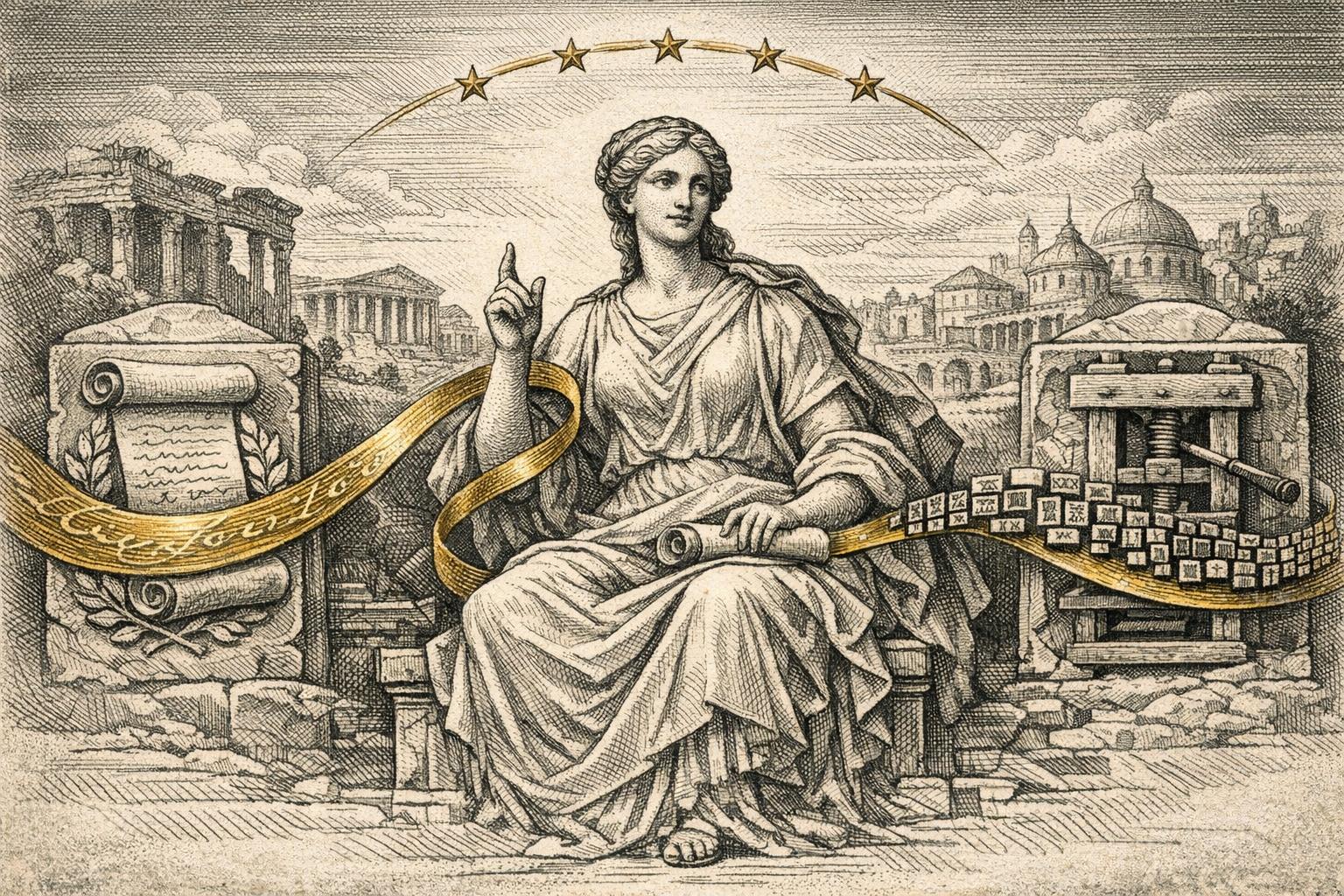

Renaissance rhetoric reshaped how people communicated, learned, and engaged with society. Spanning the 14th to 17th centuries, this intellectual revival revisited classical texts like Quintilian’s Institutio oratoria, Cicero’s works, and Aristotle’s Rhetoric. These texts, rediscovered and widely distributed thanks to the printing press, transformed rhetoric from rigid medieval rules into a dynamic tool for education, politics, and everyday life.
Key takeaways:
Rediscovery of Classics: Quintilian, Cicero, and Aristotle’s works redefined the role of the orator, emphasizing education and civic responsibility.
Humanism's Influence: Thinkers like Lorenzo Valla and Erasmus shifted rhetoric toward practical applications, focusing on persuasion and moral teaching.
Printing Press Impact: Over 12,300 editions of rhetorical texts were printed, making these ideas accessible to broader audiences.
Peter Ramus's Reforms: He narrowed rhetoric’s scope, separating invention and arrangement from style and delivery, influencing modern communication theories.
Rhetoric became central in education and civic life, shaping political, legal, and religious discourse. Its principles remain relevant today, influencing modern communication, critical thinking, and persuasive writing.
The Revival of Classical Rhetoric
Rediscovery of Classical Texts
The Renaissance saw a dramatic shift in rhetoric, sparked by the rediscovery of complete classical texts. In 1416, a full version of Quintilian's Institutio oratoria was uncovered, portraying the orator as someone whose entire life adhered to rhetorical principles. This marked a clear break from medieval traditions, where Cicero's rhetoric was often reduced to the rigid guidelines found in De inventione. However, the 15th-century rediscovery of Cicero’s more expansive works, such as De oratore and Brutus, inspired a new wave of humanist thought, influencing both civic and intellectual practices.
The fall of Constantinople in 1453 further amplified this revival. Byzantine Greek scholars fleeing to Italy brought with them original Greek texts, including Aristotle’s Rhetoric. Between 1400 and 1620, this influx of classical works fueled a surge in writings by figures like Coluccio Salutati, George of Trebizond (1433–1444), and Lorenzo Valla (1435–1444). These texts weren’t simply preserved as historical artifacts - they became practical guides for tackling contemporary issues in politics, law, and economics.
This access to classical literature sparked debates that redefined rhetoric, setting the foundation for the humanist transformations that followed.
Humanism and Rhetoric
Renaissance humanists elevated rhetoric as a rival to the dialectic taught in medieval universities, drawing on the now-available classical insights. Professor Fosca Mariani Zini highlights this shift:
"Humanists consider that the art of rhetoric must enter in competition with the dialectic of medieval universities, since it must resolve the controversies of any disputed subject".
This change wasn’t just theoretical. The growing urban middle class needed practical skills in argumentation for everyday matters like political discussions, legal cases, and financial negotiations. Humanists reimagined rhetoric, moving it away from the abstract theological focus of the Middle Ages. Instead, it became a practice centered on human experience, intellectual freedom, and individual expression. The studia humanitatis curriculum - covering grammar, rhetoric, history, poetry, and moral philosophy - was designed to shape individuals into eloquent communicators and active participants in civic life. As The Cambridge Dictionary of Philosophy observes:
"It has been said that medieval thinkers philosophised on their knees, but, bolstered by the new studies, they dared to stand up and to rise to full stature".
What Is The History Of Rhetoric? - The Language Library
This historical overview is essential for students of philosophy seeking to understand how classical thought shaped modern communication.
Key Figures and Their Works
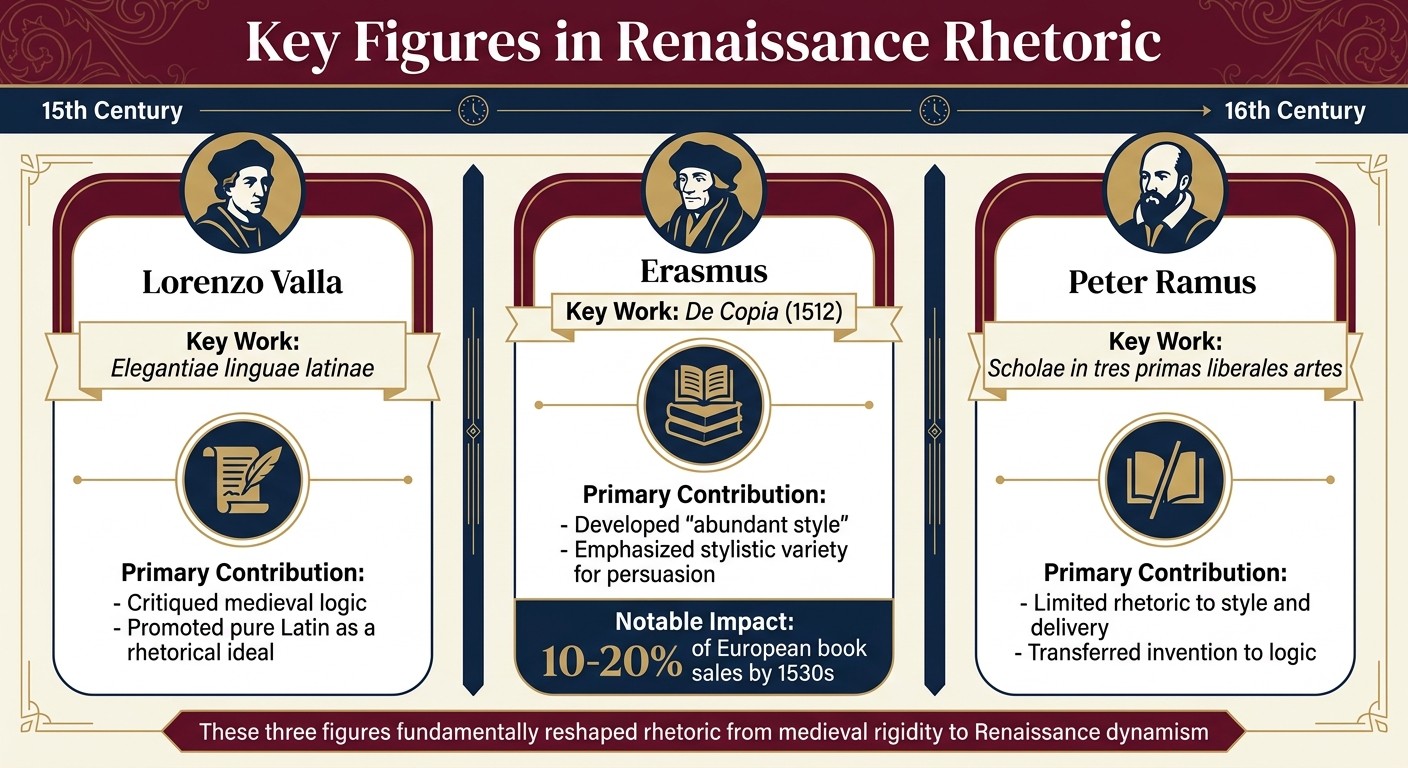
Key Renaissance Rhetoric Figures and Their Contributions
Lorenzo Valla and the Elegance of Language
During the revival of classical texts, Lorenzo Valla emerged as a pivotal figure, reshaping how rhetoric was understood and used. He argued that rhetoric, rather than abstract dialectic, should be the cornerstone of practical discussions in areas like politics, law, and morality. His groundbreaking work, Elegantiae linguae latinae, set a new benchmark for communication by emphasizing pure, refined Latin. Valla criticized the "corrupt" Latin of medieval scholars, claiming it muddled clear thinking. Using detailed philological analysis, he challenged both scholastic philosophy and religious texts. In Repastinatio dialectice et philosophie, he sought to reform dialectic itself, framing it through a rhetorical perspective and highlighting the importance of language mastery in intellectual exploration. His ideas laid the groundwork for future thinkers.
Erasmus and the Praise of Eloquence
Erasmus of Rotterdam built on Valla's foundation, advancing the cause of Christian humanism through his works. His 1512 treatise, De Copia (De duplici copia verborum ac rerum), became a widely used textbook across Europe, teaching students how to achieve stylistic variety and persuasive impact. The concept of copia - or abundance in expression - focused on mastering various figures of speech and tailoring language to suit different audiences. By the 1530s, Erasmus's writings accounted for an estimated 10% to 20% of European book sales. He championed the idea that eloquence wasn't just decorative but a vital tool for moral teaching and religious reform. However, his vision of rhetoric stood in contrast to the reforms proposed by Peter Ramus.
Peter Ramus and the Reforms of Rhetoric
In the 16th century, Peter Ramus (also known as Pierre de la Ramée) took a starkly different approach to rhetoric. He restructured the liberal arts curriculum by separating rhetoric from dialectic, assigning invention and arrangement - two of rhetoric's traditional canons - to logic. This left rhetoric with only elocutio (style) and pronuntiatio (delivery). Additionally, Ramus eliminated memory as a distinct element of rhetoric, merging it with arrangement, and excluded the study of emotions, delegating that to moral philosophy. His reforms narrowed rhetoric's scope, reducing it to a focus on ornamentation and stylistic devices rather than treating it as a comprehensive tool for discovery.
The table below summarizes the contributions of these influential figures:
Figure | Key Work | Primary Contribution |
|---|---|---|
Lorenzo Valla | Elegantiae linguae latinae | Critiqued medieval logic; promoted pure Latin as a rhetorical ideal |
Erasmus | De Copia (1512) | Developed "abundant style"; emphasized stylistic variety for persuasion |
Peter Ramus | Scholae in tres primas liberales artes | Limited rhetoric to style and delivery; transferred invention to logic |
The Evolution of Renaissance Rhetoric
Rhetoric in Education and Curriculum
During the Renaissance, rhetoric transitioned from a rigid set of rules to a central pillar of education, influencing both small-town schools and prestigious universities. Classical texts served as the foundation, embedding rhetoric into both public and private spheres of life. Educators adapted these ancient principles to address new forms of communication, with specialized theories emerging for preaching (ars praedicandi) and formal letter writing (ars dictaminis). The arrival of the printing press revolutionized how rhetorical texts were distributed, reshaping teaching practices.
Teachers expanded the curriculum by introducing new genres like explanation (genus enarrans), instruction (genus docens), and commentary (ratio commentandi), which supplemented the traditional trio of judicial, political, and ceremonial rhetoric. The use of progymnasmata - preparatory exercises - encouraged students to experiment with different viewpoints and personas. This educational shift positioned rhetoric as a key influence in shaping religious and political thought.
Impact on Religious and Political Discourse
Rhetoric became a powerful force in religious and political arenas, particularly during the Reformation. Thinkers like Lorenzo Valla used rhetorical and linguistic analysis to challenge church authority, famously exposing the Donation of Constantine as a forgery. Philipp Melanchthon, often called the "Teacher of Germany", adapted classical rhetoric for Protestant education through widely used textbooks. The humanist movement's focus on returning to original sources (ad fontes) renewed interest in the Greek New Testament and early church writings, providing reformers with a linguistic and theological foundation.
Both reformers and their opponents wielded rhetoric as a tool of persuasion and propaganda. Reformers rejected the complex disputes of medieval scholastic logic in favor of a style that emphasized moral clarity and a Christ-centered faith. Figures like Martin Luther even equated the papacy with the Ottoman Sultan, portraying both as embodiments of the Antichrist. Meanwhile, the rise of an educated middle class spurred the development of rhetorical techniques essential for navigating political, legal, and economic disputes.
Transition to Modern Rhetorical Theory
As rhetoric gained prominence in civic life, its theories evolved, laying the groundwork for modern communication practices. The focus shifted from addressing a universal audience to tailoring messages for specific groups, while rhetorical figures began to be seen as reflections of deeper cognitive processes. Francis Bacon's 17th-century push for a scientific approach to gesture inspired studies of nonverbal communication and the concept of "silent language".
Reforms by scholars like Petrus Ramus introduced a significant shift by dividing rhetorical theory. He separated invention and arrangement from style and delivery, a move that influenced the modern distinction between written composition and speech. The 18th-century elocutionary movement further advanced rhetorical theory by emphasizing the interpretation of discourse over its creation, paving the way for modern literary analysis and criticism.
Rhetorical invention also transformed, moving from spontaneous oral composition to a more reflective, internalized process of "inward dialogue." The rise of vernacular languages in rhetorical texts reflected growing national identities and a new awareness of language as a tool for shaping culture and self-expression.
Conclusion
Renaissance rhetoric reshaped how people communicated, thought, and learned. Its impact is still visible today, influencing everything from classroom essays to political debates. By merging the rediscovery of classical texts with humanist ideas, the Renaissance created a communication framework that balanced persuasion with intellectual adaptability.
The rise of printed works played a huge role in spreading rhetorical ideas. Over 3,800 books on rhetoric, printed in 12,300 editions across 310 towns, helped embed these concepts in education and civic life. This made rhetorical theory more accessible, reaching beyond the academic elite and into the broader structure of Western education.
Modern communication owes much to these Renaissance developments. For instance, the separation of speech and composition departments in universities traces back to Petrus Ramus's division of logic and style. Practices like structuring paragraphs, thematic organization, and audience consideration stem from Renaissance efforts to adapt classical ideas for a print-dominated world. Even our focus on diverse viewpoints and critical analysis reflects Erasmus's idea of copia - the notion that linguistic richness fosters deeper thinking.
A key principle of Renaissance rhetoric remains central today: every act of communication is crafted to influence a specific audience in a specific context. This transformed rhetoric from a rigid set of rules into a dynamic tool for addressing social, political, and intellectual challenges. Whether you're dissecting a political speech, drafting a business proposal, or interpreting a novel, you're likely using rhetorical strategies refined during the Renaissance.
For those curious about the philosophical roots of Renaissance rhetoric, the Logos Philosophy Club offers bilingual editions of classical and Renaissance texts. These annotated volumes shed light on how figures like Erasmus and Valla used language to question authority and reshape intellectual traditions, encouraging readers to engage critically with these foundational works. This enduring legacy underscores the transformative power of Renaissance rhetoric.
FAQs
How was Renaissance rhetoric different from medieval rhetoric?
Renaissance rhetoric placed a strong focus on persuasion, eloquence, and practical argumentation. It reshaped rhetorical practices to tackle everyday disputes and challenges. On the other hand, medieval rhetoric was centered around religious preaching, Christian teachings, and employing rhetoric primarily for theological and moral guidance. The Renaissance signaled a move toward more secular and pragmatic uses of rhetorical techniques.
How did the printing press change who could learn rhetoric?
The invention of the printing press during the Renaissance completely changed the way rhetoric was taught and learned. Before this groundbreaking technology, rhetorical texts were rare and typically restricted to the wealthy elite or those studying in specialized institutions. With the ability to mass-produce books, works by influential thinkers like Cicero and Aristotle became available to a much larger audience. This shift not only encouraged literacy among the growing middle class but also helped establish rhetoric as an art form practiced across various social groups.
Why does Peter Ramus still matter for modern writing and speech?
Peter Ramus holds enduring relevance because of his groundbreaking reforms in logic and rhetoric during the Renaissance. He prioritized clarity, simplicity, and structured reasoning, stepping away from traditional Aristotelian methods. By advocating for the separation of dialectic (logic) from rhetoric and promoting the use of visual tools to present ideas, Ramus left a lasting mark. His ideas continue to influence modern education and communication, emphasizing straightforward expression and adapting messages to connect with varied audiences effectively.