Frege and Wittgenstein on metaphysics


Here’s the short answer: Frege and early Wittgenstein both use logic to limit metaphysics, but they do not do it in the same way. Frege lets metaphysical claims stay in play if logic can state them clearly. Wittgenstein cuts much harder: if a claim cannot picture a possible fact, it falls outside meaningful speech.
If you want the article in one glance, it comes down to this:
Frege ties meaning to objective thought
Frege treats logic as a way to clear up confused language
Frege does not reject reality beyond language
Wittgenstein ties meaning to facts, pictures, and logical form
Wittgenstein splits language into:
empirical propositions that say how things may be
tautologies that say nothing about the world
metaphysical claims that only look like statements
Frege disciplines metaphysics
Early Wittgenstein says much of metaphysics cannot be said at all
One useful way to frame it: the two thinkers share a starting point, but they end with 2 different limits on philosophy. Frege asks whether a claim can be made clear in logic. Wittgenstein asks whether it can represent a possible fact. That single shift changes the whole result.
Quick Comparison
Point | Frege | Early Wittgenstein |
|---|---|---|
Main job of logic | Clarify thought | Set the limit of meaningful language |
Meaning rests on | Objective thought, sense, reference | Picture relation to possible facts |
View of grammar | Often hides logical form | Matters only if a proposition can picture |
Metaphysics | Can remain if clearly stated | Falls outside sense in many cases |
Logic says facts? | Logic studies truth and inference | Tautologies say nothing about the world |
Main boundary | Logical clarity | Sayable vs. showable |
So if you’re comparing them, the plain takeaway is simple: Frege still leaves room for metaphysics under strict logical control, while early Wittgenstein blocks it from meaningful assertion.
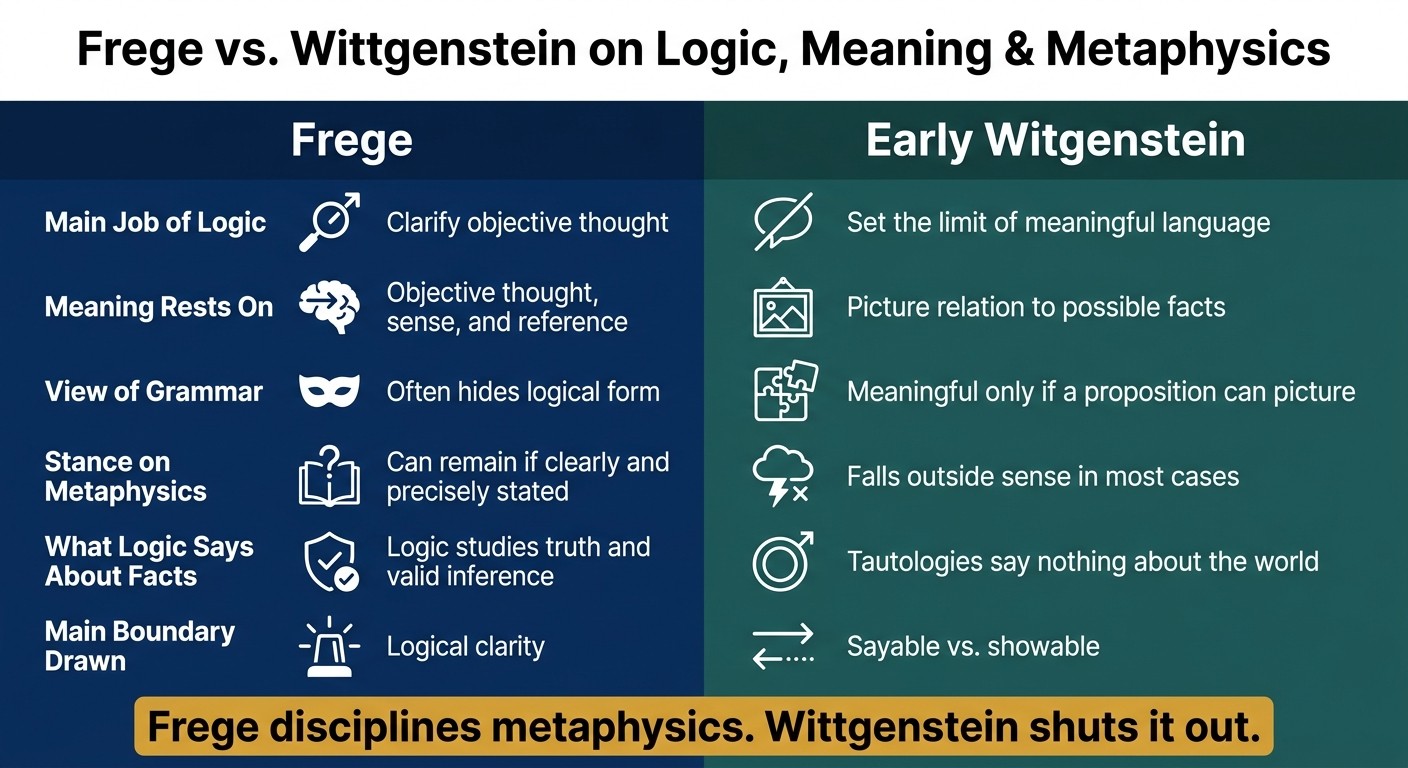
Frege vs. Wittgenstein: Logic, Meaning & Metaphysics Compared
How Frege Changed Philosophy: Analytic vs. Continental Philosophy
Frege: Logic clarifies thought without discarding objective reality
Frege doesn't throw out metaphysics. He puts it under logical discipline. In his view, logical analysis matters because it helps us separate objective content from the misleading surface of grammar.
The context principle, sense, and objective thought
Frege drew a sharp line between a thought and a mental image. A mental image is private. A thought, in Frege's sense, is objective. In the same way, sense is the public way a thought is presented, not a private picture in someone's head. That's why different people can understand the same sentence even if their inner experiences are not the same.
This is where the context principle matters. A word has meaning only within the context of a complete sentence. Meaning is not some private tag stuck onto a word in your mind. It is fixed by the part that word plays in expressing an objective thought. That move blocks psychologism. Logic deals with objective thoughts, not private mental states. So meaning belongs first to complete thoughts, not to isolated words.
Function-argument analysis and the laws of truth
Frege argues that ordinary grammar can hide logical form. Because of that, analysis has to separate surface appearance from underlying structure. Logic is about truth and valid inference, not about psychology.
Why logicism shows Frege was not simply anti-metaphysical
Logicism shows that Frege grounds arithmetic in logic. He places limits on metaphysics by demanding exactness, not by denying objective truth. Wittgenstein pushes this line further by treating some metaphysical claims as unsayable.
Wittgenstein: Logic marks the boundary of what can be meaningfully said
Facts, pictures, and logical form
In the Tractatus, Wittgenstein treats logic as the line that sets the limits of meaning. On his view, only empirical propositions that picture facts count as meaningful. A proposition can do that because it shares a logical form with the world. Put plainly, proposition and world have the same basic structure, which is what lets language picture a possible state of affairs.
Meaningful propositions, logical tautologies, and metaphysical claims that only seem meaningful
Wittgenstein separates empirical propositions from logical tautologies and from metaphysical claims that only look meaningful. Empirical propositions picture facts. Logical tautologies, by contrast, mark the limits of language but say nothing about the world. They don't report facts at all.
Metaphysical statements sit outside the boundary of sense. They do not picture the world, so they cannot count as meaningful propositions.
That creates the next problem in the Tractatus: what Wittgenstein says must itself belong to what cannot be said.
Frege vs. Wittgenstein: Where they diverge on logic, meaning, and metaphysics
The split between Frege and Wittgenstein comes into focus when they ask a basic question: what is logic for?
Frege puts limits on metaphysics by asking for thoughts that are objective and open to logical analysis. Wittgenstein puts limits on it in a harsher way. If a claim cannot picture a possible fact, then it does not count as meaningful in the first place. So Frege uses logic to discipline metaphysical questions. Wittgenstein pushes many of those questions outside the boundary of sense.
Logic as a discipline versus logic as a condition of representation
For Frege, logic works like a tool for clearing things up. It cuts through the messiness of ordinary language and shows the objective form of thought underneath. On this view, metaphysical questions do not get thrown away. They just have to meet a stricter test.
Wittgenstein takes a different path. Logic is not something we apply to thought from the outside, like a set of rules laid over language after the fact. It is what makes representation possible at all. That changes everything. Frege uses logic to keep philosophy in line. Wittgenstein uses it to show where philosophy hits a wall.
Sense and reference versus picture and showing
Frege’s distinction between sense and reference keeps meaning tied to objective thought and to what words and expressions point to in the world. Meaning, for him, is public and structured, but it still reaches beyond language toward reality.
Wittgenstein’s picture theory is tighter. A proposition has meaning only if it can represent a possible state of affairs. If it cannot do that job, the problem is not that the statement is vague or poorly framed. The problem is that it falls outside the boundary of sense altogether.
What happens to metaphysics in each system
In Frege’s system, metaphysical claims can survive logical scrutiny if they are stated with precision. In Wittgenstein’s system, the old questions of metaphysics cannot be stated at all. They seem to point at something, but that something can only be shown, never said.
That leaves us with two very different ways of setting limits on philosophy.
Conclusion: Two different ways of limiting philosophy
The split isn’t about whether philosophy should have limits. It’s about what kind of limit it should have.
Frege used logic to make thought clearer without giving up objective reality. Wittgenstein used logic to draw a line around meaningful language, separating what can be said from what can only be shown.
That leads to two different ways of limiting philosophy. Frege puts metaphysics under discipline. Wittgenstein shuts it out. Frege’s logicism was not anti-metaphysical. Early Wittgenstein is stricter: propositions that try to move past logical form fall outside sense. These claims apply only to early Wittgenstein.
Key points for readers of logic and philosophy
Put simply:
Both philosophers limit metaphysics through logic, but in different ways. Frege links meaning to objective thought; Wittgenstein links it to logical form.
Frege keeps objective thought and truth in place. His logicism was not anti-metaphysical.
Early Wittgenstein limits meaningful assertion through logical form. If a claim cannot represent a possible fact, it is not a statement at all.
Seeing where these two thinkers meet - and where they split - gives readers a clear way into the problems of logic, language, and the limits of philosophy.
FAQs
Why does Frege allow metaphysics?
The sources provided here do not spell out Frege’s own position on metaphysics or explain why he makes room for it. Instead, they deal with Leibniz, Aristotle, Boethius, and broad philosophy course content.
If you want to dig into questions like this in more depth, Logos Philosophy Club offers bilingual editions of major philosophical texts for close reading and study.
Why does Wittgenstein reject many metaphysical claims?
Wittgenstein pushes back on many metaphysical claims because, in his view, they try to put into words something language can’t properly say. That’s the heart of his point: the limits of language are the limits of the world.
Once a claim goes past those limits, it doesn’t become wrong in the usual sense. It becomes nonsensical - not false, but outside what can be said in a meaningful way.
What is the difference between sense and picture?
The provided sources don’t define this difference.
They focus on the history of philosophy, key texts, and Logos Philosophy Club offerings, but they don’t include the technical philosophical definitions needed to answer the question.