Intersubjectivity and Empathy: 5 Texts Compared


Understanding someone does not automatically mean caring for them. I compare these 5 texts through three questions: How do I encounter another person, how do we share a world, and what do I owe them?
My reading guide and plans are simple: choose Stein for empathy, Husserl for shared objectivity, Scheler for feeling and value, Merleau-Ponty for bodily expression, and Levinas for responsibility before full understanding. The key is to keep access to another person separate from <u>an obligation to respond</u>.
Quick Comparison
Text | How I encounter others | What makes a world shared | Ethical focus |
|---|---|---|---|
Stein, On the Problem of Empathy | I experience another’s feelings as theirs, not mine | Recognition of separate persons | Understanding alone does not establish duty |
Husserl, Cartesian Meditations | Another body appears as a fellow subject | A world available beyond my perspective | An account of others, not a full theory of duty |
Scheler, The Nature of Sympathy | Expression reveals feeling | Shared feeling and value | Care requires more than matching emotions |
Merleau-Ponty, Phenomenology of Perception | Gesture, speech, and action carry meaning | Bodily participation and shared activity | My reading of others can be wrong |
Levinas, Totality and Infinity | Another person addresses me beyond what I know | Responsibility and justice among many people | I owe a response without requiring one in return |
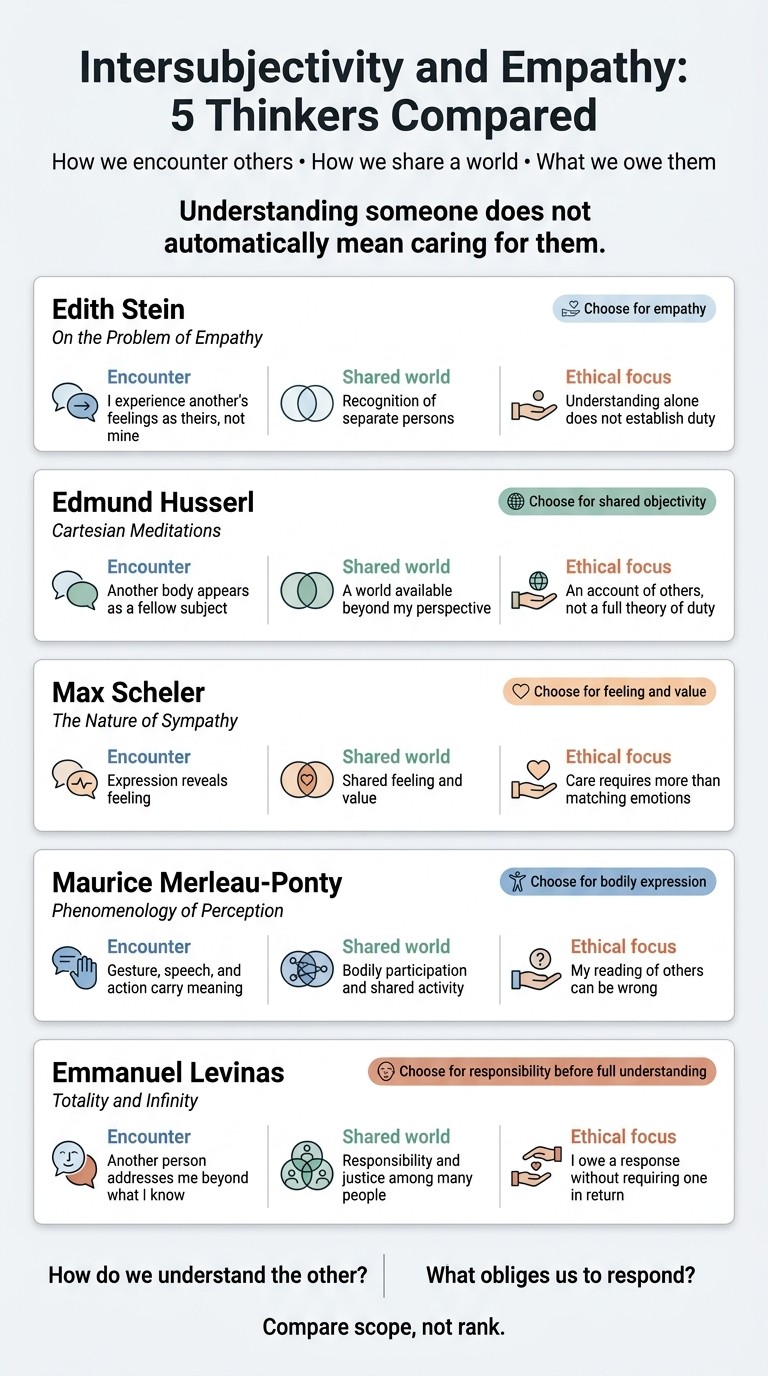
Intersubjectivity and Empathy: 5 Thinkers Compared
1. Edith Stein, On the Problem of Empathy
Encounter and Access to Others
Stein submitted On the Problem of Empathy as her dissertation in 1916. It offers a phenomenological analysis of empathy, asking how we gain access to another person’s experience before addressing objectivity or ethics.
For Stein, empathy is an intentional act directed toward another person’s experience, not emotional contagion or mere concern. I live my own act of empathy directly, but the other person’s experience appears as theirs - not mine. Bodily expression allows this access, though the person’s own words can correct my understanding.
A Shared World
Empathy reveals others as independent centers of experience. This makes a shared world possible without merging our separate perspectives. Through someone’s expressions, actions, and responses, empathy also reveals a personal identity that continues over time.
Ethical Responsibility
Stein explains how we encounter another person as a subject, but access alone does not establish moral obligation. The next question is whether that access can ground a shared world or a stronger ethical demand.
2. Edmund Husserl, Cartesian Meditations
Encounter and Access to Others
In the Fifth Meditation, Husserl sets aside ordinary assumptions about the world to ask how we experience another subject. He then isolates the primordial sphere: what is given within one’s own lived experience, including the lived body (Leib). The question shifts from how empathy gives us access to another person to how a shared world becomes possible at all.
At this transcendental level, Husserl explains why another person appears as more than an object. Through pairing, I associate another person’s bodily presence with my own lived embodiment before conscious reflection - not by drawing conclusions from behavior. Through appresentation, their inner life is given indirectly, rather than directly as my own is. Their body appears as the expression of another experiencing subject.
A Shared World
For Husserl, intersubjectivity is a condition of objective validity. An objective world must be available to other subjects whose perspectives extend beyond my own. Constitution explains how the world gains meaning and validity; it does not mean that consciousness invents reality. Others also allow me to understand myself as one person in a common world.
Here, the focus moves from Stein’s analysis of empathic experience to the transcendental question of how shared objectivity is possible. Both describe structures of experience rather than reduce empathy to causal psychology. Husserl’s distinction is best read as one between private appearance and publicly testable validity: objectivity requires more than certainty or agreement. This account makes objectivity possible, but does not yet establish obligation.
Ethical Responsibility
The Fifth Meditation does not provide a full ethics, but it does rule out treating others as mere objects. It supports openness to correction without yet offering a theory of duty.
3. Max Scheler, The Nature of Sympathy
Encounter and Access to Others
Where Husserl explains how others belong to a common world, Scheler asks how feeling reveals another person. For Scheler, we grasp another person’s feelings directly through their face, gestures, and voice - not through projection, imitation, or analogy. But direct access does not rule out mistakes.
Understanding is not emotional matching. Emotional contagion means taking on another person’s mood as your own. Understanding, by contrast, preserves that feeling as theirs. Fellow-feeling adds a response to a feeling already recognized. Scheler’s terms do not map neatly onto English usage, so follow the relationship each term describes rather than the label alone.
A Shared World
Scheler separates feeling together about the same object from sympathy for another person’s feeling. These distinctions show how feeling - not just cognition - reveals social life. Shared feeling also reveals value, but it guarantees neither truth nor justice. How value comes into view shapes whether a response stays emotional or becomes an evaluation.
Ethical Responsibility
Sympathy can prompt care, but that care may remain selective. Love plays a more basic role: it reveals a person’s value and directs attention toward the realization of that value, rather than simply matching their current feelings. Shared feeling alone cannot produce an ethical response.
Keep three questions separate: Do we understand the feeling, share it, or respond to it as a claim of value? This distinction leads to the next question: not just how we feel others’ emotions, but how we encounter them as persons.
4. Maurice Merleau-Ponty, Phenomenology of Perception
Encounter and Access to Others
In Phenomenology of Perception (1945), Maurice Merleau-Ponty places the lived body at the center of perception, action, and expression. We encounter others through bodies whose movements already carry meaning in context - not by first inferring a mind hidden behind them. The question shifts from how we access another person’s private experience to how our bodies already share a field of meaning.
Rather than focusing on empathy’s access to others, Merleau-Ponty examines the bodily conditions that make access possible: posture, movement, facial expression, and gesture. This bodily understanding also carries into language and coordinated action.
A Shared World
Speech extends bodily expression. Tone, rhythm, style, and words work together to make meaning as people interact. Coordinated action also relies on timing, learned habits, and mutual adjustment. Through this participation, people form a shared world without needing identical perspectives or agreement.
Ethical Responsibility
Embodied understanding can be mistaken. Culture, disability, and context shape how people express themselves. The practical lesson is to ask before assuming - and adjust your response when understanding fails. This provides guidance for responding to others rather than a full ethics, leaving a stricter account of responsibility to the next text.
5. Emmanuel Levinas, Totality and Infinity
Encounter and Access to Others
Merleau-Ponty explains how embodied encounter becomes possible. Levinas asks what it demands of us. In Totality and Infinity (1961), Emmanuel Levinas places ethical responsibility - not understanding - at the start of our relation to others. The face names the other person’s vulnerable presence, which no image, category, or theory can fully contain. Ethical encounter begins when that person addresses me beyond what I can know.
A Shared World
The demand extends beyond the person before me. The third party names everyone else whose claims also matter. Their presence brings comparison, fairness, law, and institutions into the picture. The focus shifts from the encounter to justice, extending intersubjectivity into social life.
Ethical Responsibility
The face brings vulnerability together with a demand not to harm. Responsibility begins before any promise of reciprocity: another person can make a claim on me without offering anything in return. This asymmetry means obligation, not domination or self-erasure.
Stein examines how we gain access to another person’s experience, while Scheler distinguishes forms of fellow-feeling. Levinas asks what we owe someone even when understanding or shared feeling fails. Understanding still matters, but respect cannot depend on it. For the broader comparison that follows, this marks a shift from what I know to what I owe.
Empathy: philosophical debates and phenomenology
Encounter: How We Meet Others
Access is not identity. These texts ask how another person becomes present to me without becoming an extension of me. They differ on what makes that access possible - and whether understanding should begin with access at all.
Text | Mode of encounter | Role of embodiment | What each text rejects |
|---|---|---|---|
Stein, On the Problem of Empathy | Indirect access: I know another person’s experience without living it myself. | Expression and bodily presence reveal someone else’s experience. | Empathy as projection or fusion. |
Husserl, Cartesian Meditations | Indirect presence: the body presents another subject without giving me direct access to their experience. | Bodily “pairing” with my own lived body lets me recognize another subject - not through conscious deduction. | Treating the other as a mere object. |
Scheler, The Nature of Sympathy | Expression reveals feeling without making that feeling mine. | Voice, gesture, and facial expression reveal emotional meaning. | Sympathy as emotional contagion or detached inference. |
Merleau-Ponty, Phenomenology of Perception | Bodily perception reveals meaning in another person’s action. | Embodiment places distinct people within a shared situation. | Treating the other as a hidden mind behind an inert body. |
Levinas, Totality and Infinity | The other’s address exceeds what I can understand. | The face expresses vulnerability and an ethical demand, not just an appearance. | Reducing the other to an object of knowledge, something to possess, or the self’s categories. |
These differences shape whether meeting another person opens onto a shared world, a social relation, or an ethical obligation. The next step is to examine that shared world: objectivity, common life, and justice.
A Shared World: Objectivity, Common Life, and Justice
A shared world doesn’t require shared opinions. It requires a reality that different subjects can encounter and act within.
Text | Basis of commonality | Contribution: objectivity, shared feeling, shared action, or justice | Scope |
|---|---|---|---|
Husserl, Cartesian Meditations | Empathic access to other subjects and intersubjective constitution | Explains how objects and the world gain validity beyond one person’s perspective | Transcendental: conditions for any subject’s experience |
Stein, On the Problem of Empathy | Recognition of other persons’ experiences without erasing their differences | Connects personal identity, self-understanding, and a common reality | Mainly interpersonal, with effects on communal life |
Scheler, The Nature of Sympathy | Fellow-feeling and the apprehension of values | Shows how emotional participation reveals moral meaning | Interpersonal and communal |
Merleau-Ponty, Phenomenology of Perception | Embodied participation in shared surroundings | Explains practical coordination through perception, language, and habits | Everyday life, shared practices, and interpersonal relations |
Levinas, Totality and Infinity | Responsibility to others, including the third | Makes shared life a question of justice among many others | Ethical, extending from face-to-face encounters to social justice |
These texts differ less over whether we share a world than over what makes that world shared: validity, feeling, embodiment, or responsibility.
For Husserl, objectivity rests on validity - not agreement. Stein places distinct persons at the center of common life, linking our understanding of ourselves to our recognition of others.
Scheler shows how feeling gives value a place in social life. Merleau-Ponty turns to embodiment to explain not just how we perceive others, but how we already live alongside them through language, habits, and shared surroundings.
For Levinas, justice requires us to compare the claims of many others, even though no general category can fully describe a person. This shifts attention from how others enter a common world to what living in that world asks of us.
Conclusion: Ethical Response and Reading Choices
Understanding another person does not guarantee care. Stein and Husserl explain how we gain access to another’s experience. Scheler connects feeling with value, while Merleau-Ponty roots understanding in bodily experience. For Levinas, responsibility comes before reciprocity.
The table keeps the comparison focused on what helps guide reading. Use it to compare scope, not rank.
Text | Method | Account of empathy | Conception of the other | Role of embodiment | Contribution to the shared world | Ethical scope |
|---|---|---|---|---|---|---|
Stein, On the Problem of Empathy | Descriptive phenomenology | Experience directed toward another | A separate experiencing subject | Access through expression | Mutual understanding | Understanding, not full obligation |
Husserl, Cartesian Meditations | Transcendental phenomenology | Pairing and appresentation | Co-subject | The lived body grounds recognition | Objectivity through intersubjective constitution | Grounds the account without prescribing duties |
Scheler, The Nature of Sympathy | Phenomenology of feeling and value | Sympathy, not contagion | Person revealed through value | Affective expression | Shared feeling and value | Moral motivation that requires judgment |
Merleau-Ponty, Phenomenology of Perception | Embodied phenomenology | Understanding through gesture and action | Bodily subject | Embodied coexistence | Practical coordination | Situated understanding that can be mistaken |
Levinas, Totality and Infinity | Ethical phenomenology | Responsibility before understanding | Irreducible Other | Face as vulnerability, not data | Justice among many others | Asymmetrical responsibility |
Use the table to keep two questions separate: how we understand the other, and what obliges us to respond.
FAQs
How is intersubjectivity different from empathy?
In these texts, empathy means the emotional or cognitive ability to connect with or understand another person’s feelings or experience. Engaging with narratives often sharpens this ability.
Intersubjectivity describes the broader framework of a shared world and ethical encounters between people. Empathy connects two inner perspectives. Intersubjectivity addresses what makes those encounters possible - and how people respond to the ethical demands of the Other.
Can empathy help me understand someone across cultural differences?
Yes. Narrative art and shared artistic experiences can build empathy and help you understand people whose backgrounds differ from your own. Stories let you examine ethical choices and social realities, sharpening your moral judgment and understanding of yourself.
Research also links shared artistic experiences to increased empathy. These experiences go beyond facts: they add emotional depth and a sense of lived experience that can help bridge differences in personal perspectives and social norms.
How can I balance responsibility to others with personal boundaries?
Balance your responsibility to others with personal boundaries by reflecting on what’s right, rather than relying on emotion alone. Aristotle stresses virtue and reason: your choices and actions shape your character. Narrative art gives you a way to examine ethical choices in imagined situations and sharpen your judgment without facing the consequences in daily life.
Logos Philosophy Club offers annotated editions of core texts to support serious study and help readers develop moral clarity.

