Marcus Aurelius
Marcus Aurelius
Meditations
Meditations
The most private book in ancient philosophy.
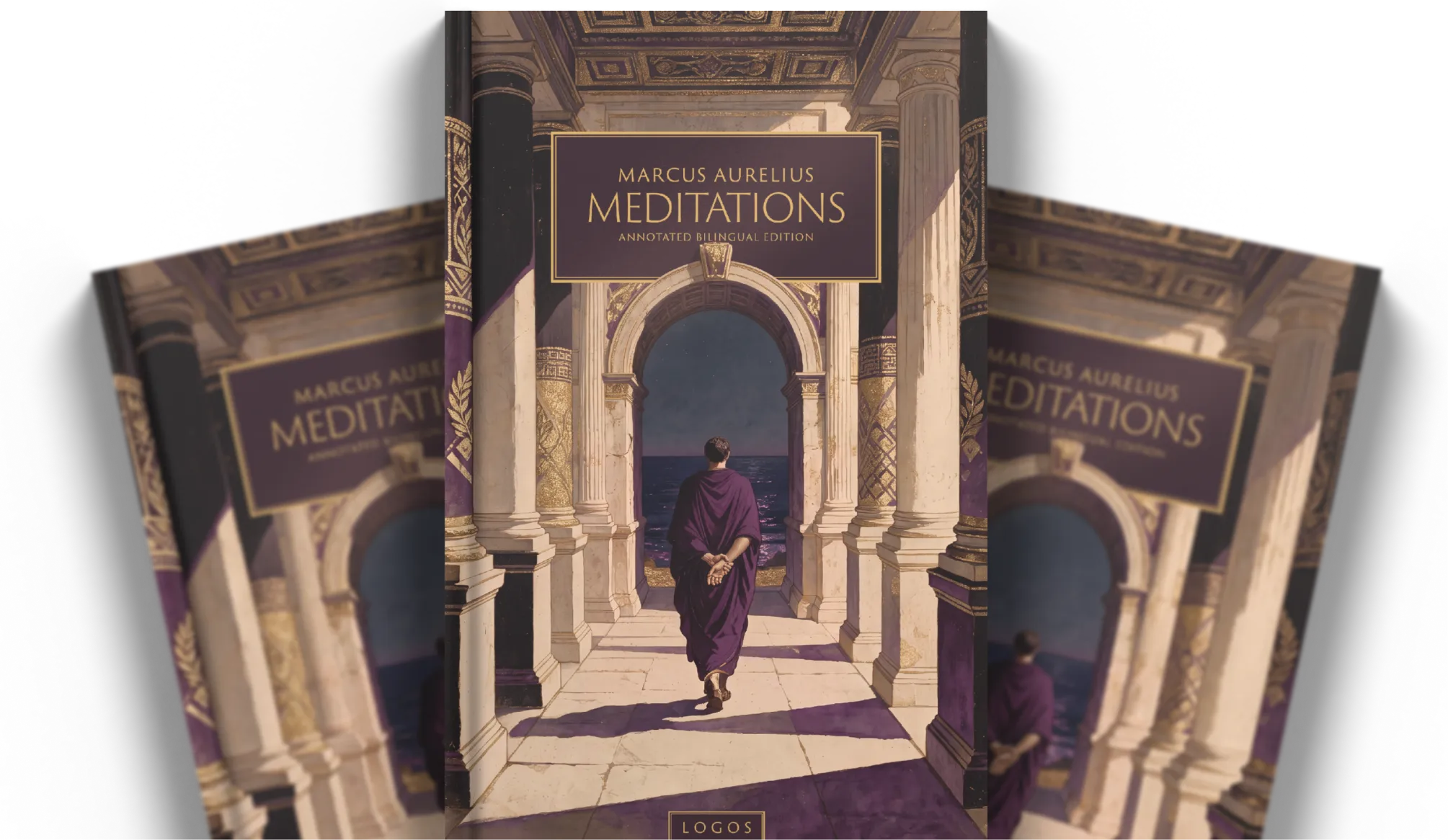
Discover what’s inside the box
Discover what’s inside the box
Details that make
the difference:
Details that make
the difference:

Bilingual edition
The Greek text appears on the left-hand page; the English translation faces it on the right, throughout all twelve books. The Greek is J. H. Leopold's 1908 Teubner text, established from the Codex Vaticanus Graecus 1950 and the readings of the lost Codex Palatinus preserved in Xylander's 1559 editio princeps. The English is C. R. Haines's 1916 Loeb translation, lightly modernized for this edition.
The Greek text appears on the left-hand page; the English translation faces it on the right, throughout all twelve books. The Greek is J. H. Leopold's 1908 Teubner text, established from the Codex Vaticanus Graecus 1950 and the readings of the lost Codex Palatinus preserved in Xylander's 1559 editio princeps. The English is C. R. Haines's 1916 Loeb translation, lightly modernized for this edition.
Two layers of annotation
The footnotes run in two distinct layers: Haines’s own notes, identifying persons, places, and ancient sources, and a selection from Gataker’s landmark 1652 commentary. Each note is attributed to its source. The apparatus totals around three hundred and fifteen notes across the twelve books.
The footnotes run in two distinct layers: Haines’s own notes, identifying persons, places, and ancient sources, and a selection from Gataker’s landmark 1652 commentary. Each note is attributed to its source. The apparatus totals around three hundred and fifteen notes across the twelve books.
Opening essay by Matthew Arnold
“An Essay on Marcus Aurelius,” published in the Victoria Magazine in November 1863 and collected in Essays in Criticism (London: Macmillan, 1865). The essay that fixed the English-speaking world’s image of Marcus Aurelius for over a century and a half.
“An Essay on Marcus Aurelius,” published in the Victoria Magazine in November 1863 and collected in Essays in Criticism (London: Macmillan, 1865). The essay that fixed the English-speaking world’s image of Marcus Aurelius for over a century and a half.
Glossary of Greek terms
A glossary of ninety-three Greek philosophical terms covering the Stoic vocabulary that runs throughout the twelve books, including the key concepts of the hegemonikon, the logikon, and the distinction between what depends on us and what does not.
A glossary of ninety-three Greek philosophical terms covering the Stoic vocabulary that runs throughout the twelve books, including the key concepts of the hegemonikon, the logikon, and the distinction between what depends on us and what does not.
Subject index
An index keyed by book and section rather than by page number, making every reference valid in any edition of the Meditations.
An index keyed by book and section rather than by page number, making every reference valid in any edition of the Meditations.
Hardcover binding
Durable, premium hardcover with a ribbon marker, designed for sustained reading and a lifetime on the shelf. 376 pages, 150 × 225 mm.
Durable, premium hardcover with a ribbon marker, designed for sustained reading and a lifetime on the shelf. 376 pages, 150 × 225 mm.
Logos Reader included
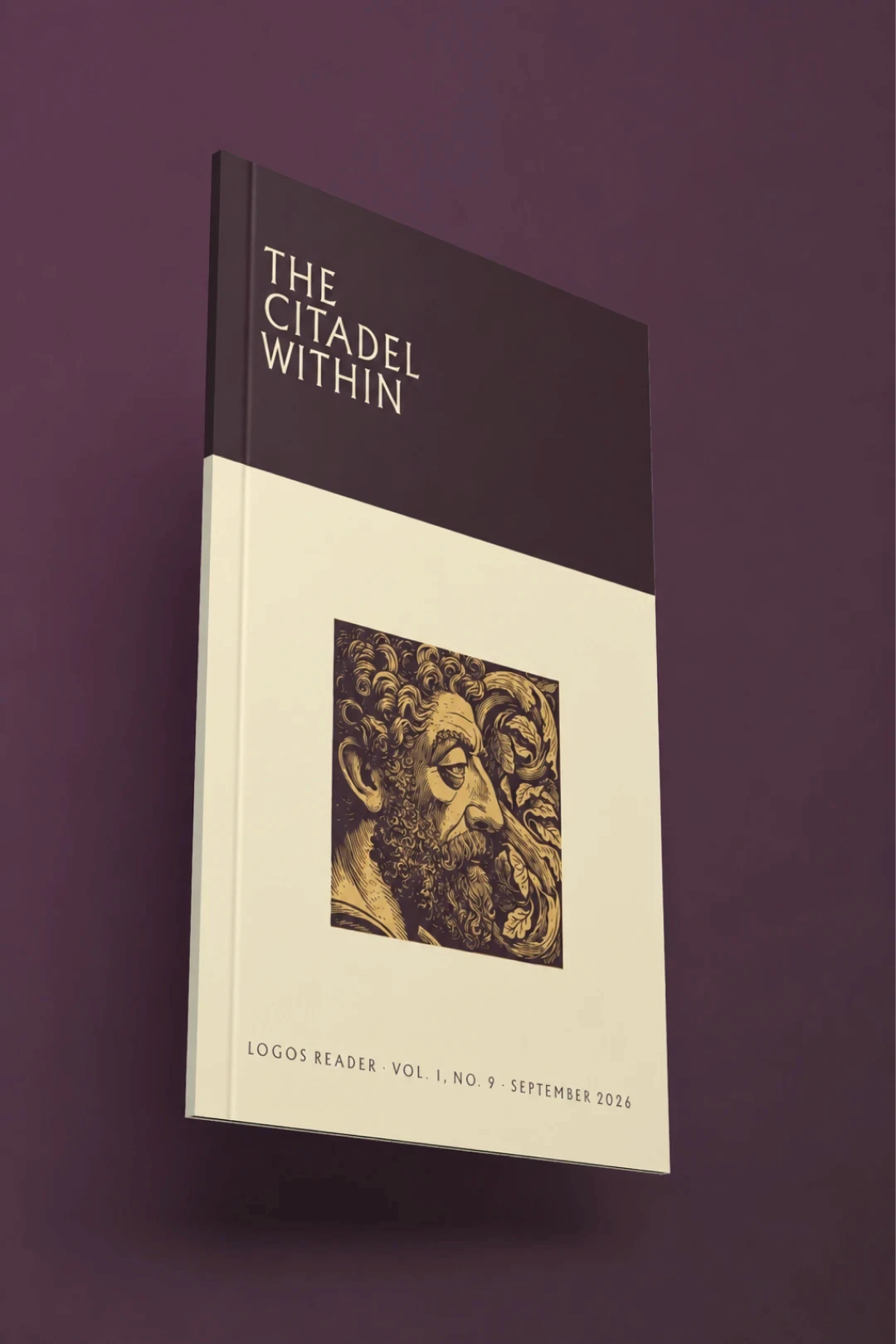
Includes The Citadel Within, Logos Reader vol. 1, no. 9—64 pages on Marcus Aurelius.
Includes The Citadel Within, Logos Reader vol. 1, no. 9—64 pages on Marcus Aurelius.

Meditations
The private notebook of the emperor of Rome, written in Greek during the final decade of his life, partly while he was on campaign along the Danube frontier.
Marcus Aurelius never gave this book a title. The Greek title Ta eis heauton means “To Himself.”
The book is twelve collections of brief reflections returning again and again to the same questions. What is actually within my control? How much of what disturbs me depends entirely on how I interpret it? What does living well require from someone who holds this much power and knows he will not hold it forever? Marcus recalls that his teacher Rusticus introduced him to the writings of Epictetus, whose influence runs throughout the book. The repetition is the method: Marcus returns to the doctrines of his school as a musician returns to scales, to possess what is already known.
The book was never intended for publication. Marcus made no apparent effort to preserve it, and spends considerable space arguing against the desire for posthumous fame. He was wrong about himself in a way he could not have predicted.
The book was never intended for publication. Marcus made no apparent effort to preserve it, and spends considerable space arguing against the desire for posthumous fame. He was wrong about himself in a way he could not have predicted.
Marcus Aurelius: A mind that governed both Rome and itself
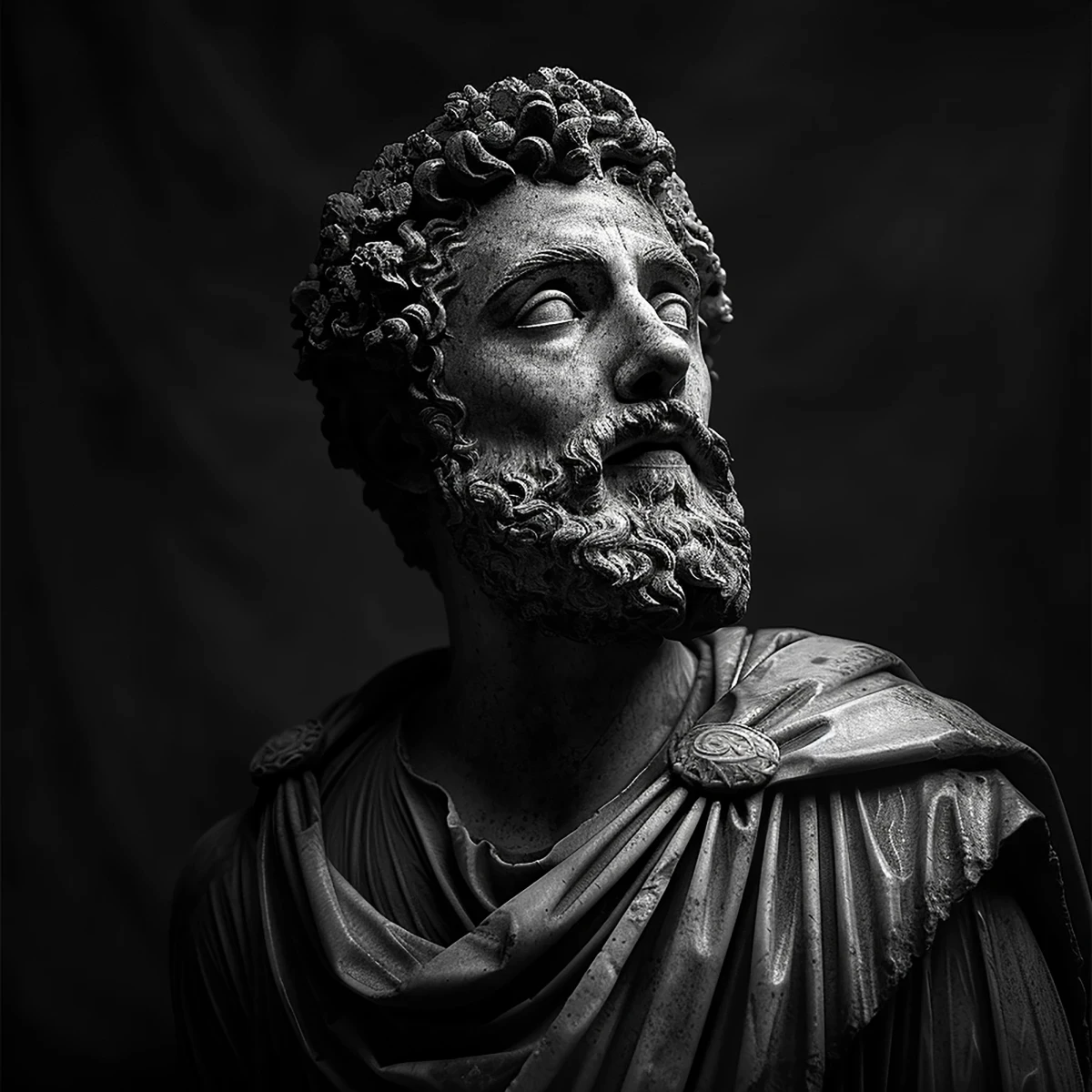
Marcus Aurelius: A mind that governed both Rome and itself
Marcus was born in Rome on April 26, 121, into a senatorial family with roots in Hispania that had risen to patrician rank under Vespasian. His father died young, when Marcus was still a child. The emperor Hadrian noticed him early and, playing on his family name Verus, took to calling him Verissimus—“the most truthful.” Hadrian arranged his succession by adopting Antoninus Pius under the condition that Antoninus in turn adopt both Marcus Aurelius and Lucius Verus.
Marcus Aurelius became emperor in 161, ruling jointly with Lucius Verus until Verus’s death in 169. His reign was defined above all by war: the Parthian War of 162–166, and then the Marcomannic Wars, the sustained conflict with Germanic and Sarmatian peoples on the Danube frontier that would occupy the last decade of his life and produce the Meditations.
Marcus Aurelius became emperor in 161, ruling jointly with Lucius Verus until Verus’s death in 169. His reign was defined above all by war: the Parthian War of 162–166, and then the Marcomannic Wars, the sustained conflict with Germanic and Sarmatian peoples on the Danube frontier that would occupy the last decade of his life and produce the Meditations.
He had studied philosophy seriously since his teens, eventually under Quintus Junius Rusticus, who introduced him to the lectures of Epictetus. In the Meditations he writes that Rusticus was the one who persuaded him to abandon rhetoric for philosophy. Petrarch, writing twelve centuries later, said that Marcus preferred the title of philosopher to the title of Caesar.
He had studied philosophy seriously since his teens, eventually under Quintus Junius Rusticus, who introduced him to the lectures of Epictetus. In the Meditations he writes that Rusticus was the one who persuaded him to abandon rhetoric for philosophy. Petrarch, writing twelve centuries later, said that Marcus preferred the title of philosopher to the title of Caesar.
Matthew Arnold, in his 1863 essay on Marcus, called him “perhaps the most beautiful figure in history.“ Galen was his physician and left detailed accounts of his character. Dio Cassius and Herodian, the closest historical sources to his reign, both wrote of him with exceptional admiration.
He died on campaign in Pannonia on March 17, 180.
Matthew Arnold, in his 1863 essay on Marcus, called him “perhaps the most beautiful figure in history.“ Galen was his physician and left detailed accounts of his character. Dio Cassius and Herodian, the closest historical sources to his reign, both wrote of him with exceptional admiration.
He died on campaign in Pannonia on March 17, 180.
Inside the Logos Reader
Inside the Logos Reader
The Citadel Within: Marcus Aurelius and the Government of the Soul
The Citadel Within: Marcus Aurelius and the Government of the Soul
This issue includes an original Logos essay, and three complementary historical texts:
This issue includes an original Logos essay, and three complementary historical texts:
Marcus Aurelius and the Philosophy of the Meditations A Logos Reader original covering Marcus Aurelius's life and intellectual formation, the Stoic inheritance and the debt to Epictetus, the distinction between what depends on us and what does not, the doctrine of nature and the logos, the image of the inner citadel, duty toward others, impermanence and death, and the encounter of Stoic philosophy with the rise of Christianity.
Marcus Aurelius and the Philosophy of the Meditations A Logos Reader original covering Marcus Aurelius's life and intellectual formation, the Stoic inheritance and the debt to Epictetus, the distinction between what depends on us and what does not, the doctrine of nature and the logos, the image of the inner citadel, duty toward others, impermanence and death, and the encounter of Stoic philosophy with the rise of Christianity.
“A Discourse of Marcus Aurelius,” by Walter Pater From Marius the Epicurean (1885). Pater has the young Marius witness Marcus Aurelius addressing the Roman Senate—almost entirely de contemptu mundi—and lets the reader feel simultaneously the nobility of the Stoic position and its coldness. It remains the most penetrating portrait of Marcus Aurelius in English after Matthew Arnold.
“The Individualism of Marcus Aurelius,” by W. A. Watt Published in the International Journal of Ethics, 1904. Watt asks whether the emperor’s interiority—for all its grandeur—does not ultimately leave the self alone: whether a philosophy of self-governance can give the self anything outside itself on which to rest.
“Individualism and Religion in the Early Roman Empire,” by Clifford Herschel Moore A lecture published in the Harvard Theological Review, 1909. Moore places Marcus Aurelius within the full religious history of his epoch, tracing the conditions that made possible both the Stoic reflection of the Meditations and the simultaneous spread of Christianity.
Further Reading Academic references for deeper study.
Further Reading Academic references for deeper study.
What is the Philosophy Club?
What is the Philosophy Club?
A philosophy box delivered
to your door every month.
A philosophy box delivered
to your door every month.
A philosophy box delivered to your door every month.
When you join the Logos Philosophy Club, you receive one essential work of philosophy at home each month. Over time, you build a personal philosophical library with high-quality editions—translated directly from the original language and, when possible, presented in bilingual format.
When you join the Logos Philosophy Club, you receive one essential work of philosophy at home each month. Over time, you build a personal philosophical library with high-quality editions—translated directly from the original language and, when possible, presented in bilingual format.
Our community
Our community
Growing a global movement
Growing a global movement
Growing a global movement
The Logos Philosophy Book Club is an intellectual community dedicated exclusively to foundational philosophical works.
The Logos Philosophy Book Club is an intellectual community dedicated exclusively to foundational philosophical works.
Built on the experience of our publishing group in Brazil, where readers, translators, scholars, and publishers now share a common mission: to produce high-quality philosophical editions faithfully translated, carefully edited, designed for serious reading.
Built on the experience of our publishing group in Brazil, where readers, translators, scholars, and publishers now share a common mission: to produce high-quality philosophical editions faithfully translated, carefully edited, designed for serious reading.
This is more than a subscription. It is a commitment to restoring philosophy as a disciplined and living tradition.
This is more than a subscription. It is a commitment to restoring philosophy as a disciplined and living tradition.


How Does It Work?
How Does It Work?
Here’s how your subscription
works, step by step:
Here’s how your subscription
works, step by step:
Here’s how your subscription
works, step by step:
01
Choose your membership
Choose the plan that fits you best, monthly or annual. Past editions are available for purchase as well. Subscribers can purchase past editions at a discounted rate in the members area.
01
Choose your membership
Choose the plan that fits you best, monthly or annual. Past editions are available for purchase as well. Subscribers can purchase past editions at a discounted rate in the members area.
02
How shipping works
Each month we announce a new edition. Your first shipment arrives around the 15th of the following month.
02
How shipping works
Each month we announce a new edition. Your first shipment arrives around the 15th of the following month.
03
Monthly shipping
Monthly shipping
From that point on, as a member, a new philosophy box is shipped each month. All boxes are dispatched during the month following the release cycle.
03
Monthly shipping
From that point on, as a member, a new philosophy box is shipped each month. All boxes are dispatched during the month following the release cycle.

Is this for me?
Is this for me?
So, who is the
Philosophy Club for?
So, who is the
Philosophy Club for?
So, who is the
Philosophy Club for?
For those who want to engage deeply with the legacy of the greatest thinkers in history.
For those who want to engage deeply with the legacy of the greatest thinkers in history.
For readers who want to build a solid, lasting philosophy library.
For readers who want to build a solid, lasting philosophy library.
For students engaged in higher education or simply interested in the great books of our shared history.
For students engaged in higher education or simply interested in the great books of our shared history.
For professionals who understand that serious work requires a broad and rigorous intellectual formation.
For professionals who understand that serious work requires a broad and rigorous intellectual formation.
Our BOOKS
Our BOOKS
Explore the works we’ve released so far
Explore the works we’ve released so far
Explore the works we’ve released so far
The Logos Philosophy Club publishes major philosophical works, carefully edited and presented in bilingual editions designed for serious study.
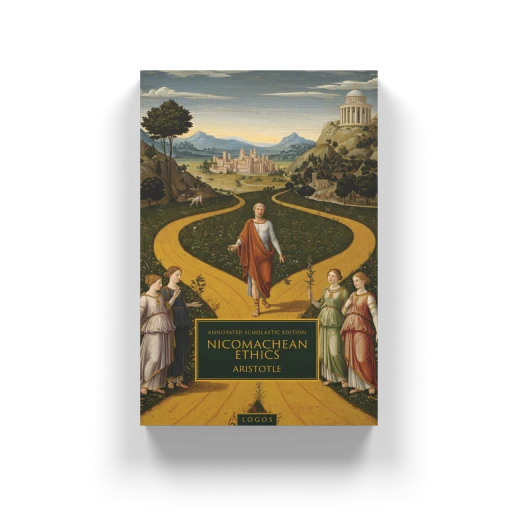
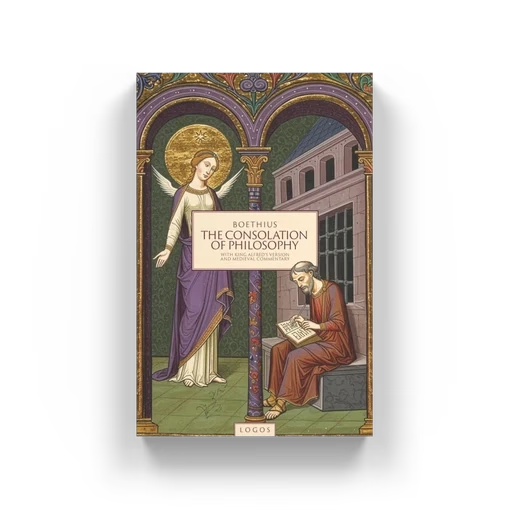

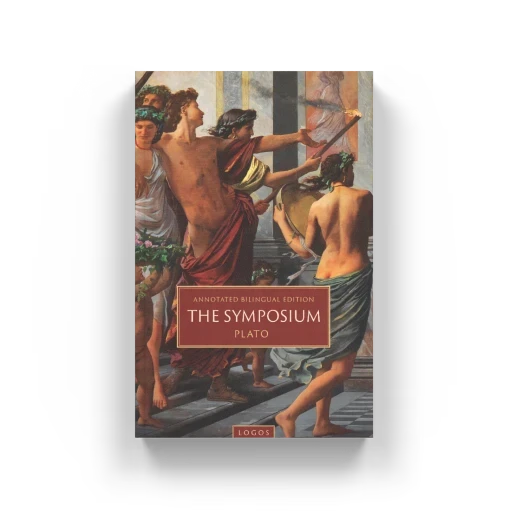



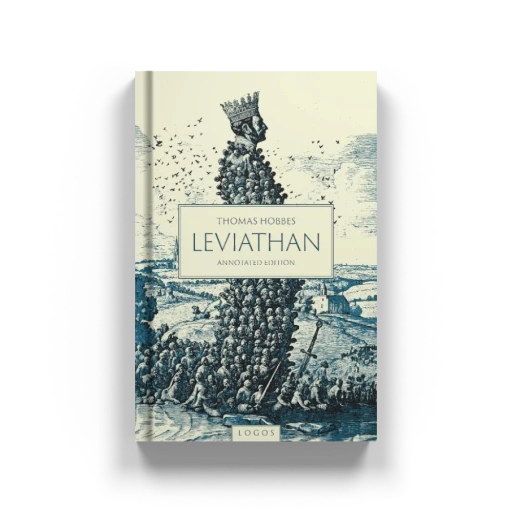


With an Annual Membership, you receive the current release, gain access to all future editions while your plan remains active, and can purchase past releases at exclusive member pricing.
With an Annual Membership, you receive the current release, gain access to all future editions while your plan remains active, and can purchase past releases at exclusive member pricing.
Why join the Club?
Why join the Club?
See what our members have to say
See what our members have to say

John Roche
I love my copy. The book is sturdy and very well bound, but so far the scholastic commentary is the real gem. I laminated the poster and hung it in my classroom. I hope Consolation of Philosophy comes with a poster too!
John Roche
I love my copy. The book is sturdy and very well bound, but so far the scholastic commentary is the real gem. I laminated the poster and hung it in my classroom. I hope Consolation of Philosophy comes with a poster too!

Nicolás Carreño Román
Wow! This looks like the kind of book subscription that's worth it!
Nicolás Carreño Román
Wow! This looks like the kind of book subscription that's worth it!

Spencer Simons
Got mine. Love it already. The poster is a nice perk I wasn’t aware of. I’m gonna grab a frame tomorrow and hang it on my bedroom wall.
Spencer Simons
Got mine. Love it already. The poster is a nice perk I wasn’t aware of. I’m gonna grab a frame tomorrow and hang it on my bedroom wall.
FAQ
FAQ
Frequently Asked Questions
Frequently Asked Questions
What am I subscribing to?
When will I receive my books?
When will I receive the next books in the Club?
Is shipping available everywhere in the U.S.?
Will I receive tracking information?
Are taxes and shipping included?
What is the difference between the Monthly and Yearly memberships?
How does billing work for the Yearly Membership?
Will I be charged on the same date every month?
What happens if my payment fails (card declined)?
Can I cancel my subscription?
Can I pause my membership?
Can I switch between Monthly and Yearly?
Do you offer refunds if I forget to cancel?
Can I gift a membership?
How do you choose the monthly books?
Can I skip a month if I already own the book?
What is your returns and damages policy?
Can I change my shipping address after subscribing?
How can I contact support?
What am I subscribing to?
When will I receive my books?
When will I receive the next books in the Club?
Is shipping available everywhere in the U.S.?
Will I receive tracking information?
Are taxes and shipping included?
What is the difference between the Monthly and Yearly memberships?
How does billing work for the Yearly Membership?
Will I be charged on the same date every month?
What happens if my payment fails (card declined)?
Can I cancel my subscription?
Can I pause my membership?
Can I switch between Monthly and Yearly?
Do you offer refunds if I forget to cancel?
Can I gift a membership?
How do you choose the monthly books?
Can I skip a month if I already own the book?
What is your returns and damages policy?
Can I change my shipping address after subscribing?
How can I contact support?
What am I subscribing to?
When will I receive my books?
When will I receive the next books in the Club?
Is shipping available everywhere in the U.S.?
Will I receive tracking information?
Are taxes and shipping included?
What is the difference between the Monthly and Yearly memberships?
How does billing work for the Yearly Membership?
Will I be charged on the same date every month?
What happens if my payment fails (card declined)?
Can I cancel my subscription?
Can I pause my membership?
Can I switch between Monthly and Yearly?
Do you offer refunds if I forget to cancel?
Can I gift a membership?
How do you choose the monthly books?
Can I skip a month if I already own the book?
What is your returns and damages policy?
Can I change my shipping address after subscribing?
How can I contact support?