
Ludwig Wittgenstein

Ludwig Wittgenstein

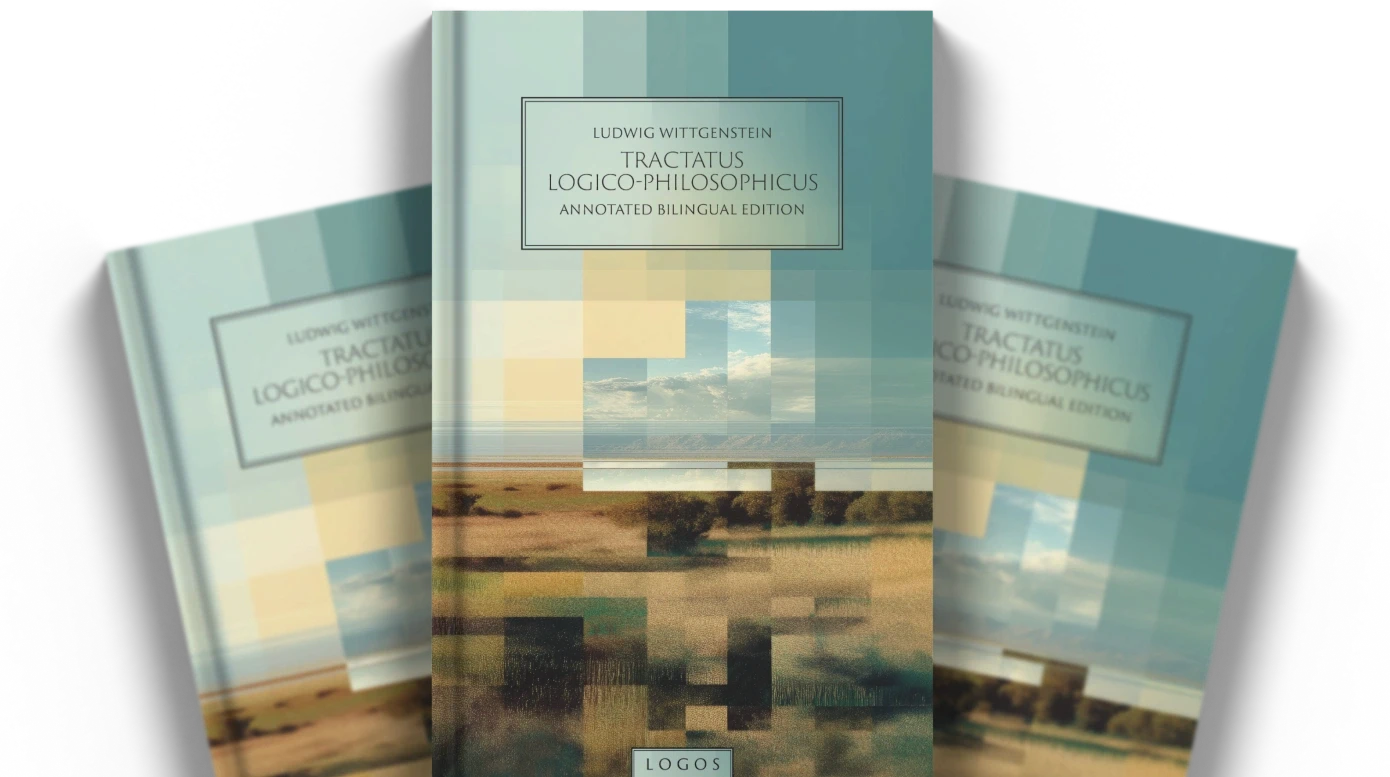
Tractatus Logico-Philosophicus

Tractatus Logico-Philosophicus

Tractatus Logico-Philosophicus

The book that claimed to have solved every problem of philosophy

The book that claimed to have solved every problem of philosophy

Discover what’s inside the box

Discover what’s inside the box

Details that make

the difference

Details that make

the difference

Bilingual edition 

German and English on mirrored pages, in the layout Ogden himself set in 1922 — German on the left, English on the right, proposition numbers anchoring both columns.

German and English on mirrored pages, in the layout Ogden himself set in 1922 — German on the left, English on the right, proposition numbers anchoring both columns.

Supporting texts

Bertrand Russell's original 1922 introduction, reproduced in full, alongside an opening essay reconstructing the crisis in the foundations of mathematics that produced the book.

Bertrand Russell's original 1922 introduction, reproduced in full, alongside an opening essay reconstructing the crisis in the foundations of mathematics that produced the book.

Editorial apparatus

Over 300 footnotes keyed to proposition number, a glossary of logical notation written for readers with no background in logic, and an index that follows the same numbering.

Over 300 footnotes keyed to proposition number, a glossary of logical notation written for readers with no background in logic, and an index that follows the same numbering.

Translation

Charles Kay Ogden's 1922 translation — the only English version Wittgenstein ever reviewed himself, prepared with F. P. Ramsey's assistance.

Charles Kay Ogden's 1922 translation — the only English version Wittgenstein ever reviewed himself, prepared with F. P. Ramsey's assistance.

Hardcover binding

Durable, premium hardcover with a ribbon marker, designed for sustained reading and a lifetime on the shelf. 288 pages, 135 × 210 mm.

Durable, premium hardcover with a ribbon marker, designed for sustained reading and a lifetime on the shelf. 288 pages, 135 × 210 mm.

Logos Reader included

The World and Its Limits, Logos Reader vol. 1, no. 10. A companion text to deepen your reading.

The World and Its Limits, Logos Reader vol. 1, no. 10. A companion text to deepen your reading.

Tractatus Logico-Philosophicus

Tractatus Logico-Philosophicus

The book that proved most of philosophy meaningless

The book that proved most of philosophy meaningless

Written in the trenches of the First World War and finished in a prisoner-of-war camp, the Tractatus is made out of seven numbered propositions that Wittgenstein believed solved every problem philosophy had ever had.

His argument starts from a simple claim: the world is not made of things, but of facts — everything that is the case. A proposition is a picture of a fact, and it works the way an actual photograph works: right if its structure matches what happened, wrong if it doesn't, with nothing else needed to settle which.

A proposition can only say what could be pictured that way. Ethics, the meaning of a life, God — none of it can be pictured as a fact, so none of it can actually be said. He says more: these aren't even real questions, just language mistaking itself for sense.

Wittgenstein doesn't call this a loss. He thought silence protected what mattered most — though within a decade, the Vienna Circle would read that same silence as permission to discard it, and build logical positivism from a book that meant the opposite. He said what he meant to say anyway: Whereof one cannot speak, thereof one must be silent.


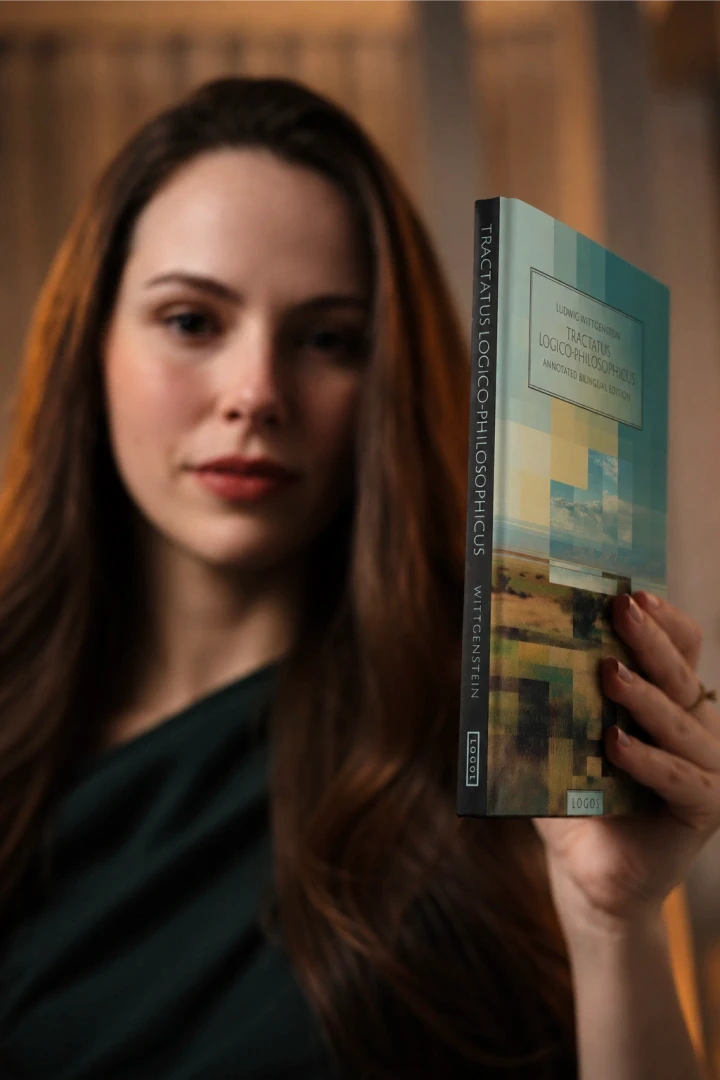
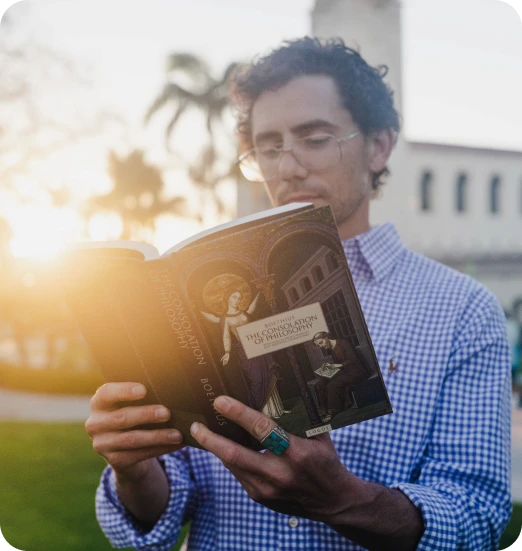
A woman with long hair and a black blazer holds a copy of Boethius's "The Consolation of Philosophy" next to her face, published by Logos.

—Ludwig Wittgenstein

—Ludwig Wittgenstein

A prodigy of modern philosophy.

A prodigy of modern philosophy.

Born in Vienna in 1889 into a wealthy family, Wittgenstein trained as an engineer and went to Manchester in 1908 to research aeronautics. The mathematics behind his research led him to Bertrand Russell at Cambridge in 1911.

Born in Vienna in 1889 into a wealthy family, Wittgenstein trained as an engineer and went to Manchester in 1908 to research aeronautics. The mathematics behind his research led him to Bertrand Russell at Cambridge in 1911.

At the end of his first year, he asked Russell to tell him honestly whether he was a complete fool — if so, he said, he'd become an aeronaut instead of a philosopher. Russell set him an assignment over the vacation; after reading the first sentence, he told him to forget aeronautics.

At the end of his first year, he asked Russell to tell him honestly whether he was a complete fool — if so, he said, he'd become an aeronaut instead of a philosopher. Russell set him an assignment over the vacation; after reading the first sentence, he told him to forget aeronautics.

Within a few years, the student had become one of the most original philosophers of the century. By the time the Tractatus was finished, he was already a critic of the very framework his masters had given him.

Within a few years, the student had become one of the most original philosophers of the century. By the time the Tractatus was finished, he was already a critic of the very framework his masters had given him.

Once the book was published, Wittgenstein gave away the fortune he'd inherited, trained as a primary school teacher, and spent six years teaching children in remote Austrian villages, convinced philosophy had nothing left to solve. He would spend the rest of his life proving himself wrong.

Once the book was published, Wittgenstein gave away the fortune he'd inherited, trained as a primary school teacher, and spent six years teaching children in remote Austrian villages, convinced philosophy had nothing left to solve. He would spend the rest of his life proving himself wrong.

Inside the Logos Reader

Inside the Logos Reader

The World and Its Limits: Wittgenstein and the Logic of Language

The World and Its Limits: Wittgenstein and the Logic of Language

This issue includes an original Logos essay, and three complementary historical texts:

This issue includes an original Logos essay, and three complementary historical texts:

Wittgenstein and the Tractatus: A Logos Reader original covering Wittgenstein's life and intellectual formation, the architecture of the book's seven propositions, the picture theory, the break with Frege and Russell, what lies beyond the sayable, and the reversal of the Investigations.

Critical Notices of the Tractatus, by F. P. Ramsey: Published in Mind, October 1923. Ramsey was twenty when he wrote it, and had already helped prepare the English translation himself — he would die at twenty-six. He credits the book's account of logical propositions and the picture theory, and presses on the points where the argument leans on form, internal relation, and what can only be shown.

The Turning Point in Philosophy, by Moritz Schlick: Originally "Die Wende der Philosophie," Erkenntnis 1 (1930/31), translated for this edition. Schlick, founder of the Vienna Circle, sets out the program that received Wittgenstein's book: philosophy as an activity of clarification rather than a body of doctrine, and traditional metaphysics as an attempt to say what can only be shown.

Logical Positivism: A New Movement in European Philosophy, by Albert E. Blumberg and Herbert Feigl. The Journal of Philosophy, May 1931. The article that introduced the term "logical positivism" to English-speaking readers.

Further Reading Twelve academic references for deeper study.

Further Reading Twelve academic references for deeper study.

What is the Philosophy Club?

What is the Philosophy Club?

A philosophy box delivered

to your door every month.

A philosophy box delivered to your door every month.

A philosophy box delivered

to your door every month.

When you join the Logos Philosophy Club, you receive one essential work of philosophy at home each month. Over time, you build a personal philosophical library with high-quality editions—translated directly from the original language and, when possible, presented in bilingual format.

When you join the Logos Philosophy Club, you receive one essential work of philosophy at home each month. Over time, you build a personal philosophical library with high-quality editions—translated directly from the original language and, when possible, presented in bilingual format.

Our community

Our community

Growing a global movement

Growing a global movement

Growing a global movement

The Logos Philosophy Book Club is an intellectual community dedicated exclusively to foundational philosophical works.

The Logos Philosophy Book Club is an intellectual community dedicated exclusively to foundational philosophical works.

Built on the experience of our publishing group in Brazil, where readers, translators, scholars, and publishers now share a common mission: to produce high-quality philosophical editions faithfully translated, carefully edited, designed for serious reading.

Built on the experience of our publishing group in Brazil, where readers, translators, scholars, and publishers now share a common mission: to produce high-quality philosophical editions faithfully translated, carefully edited, designed for serious reading.

This is more than a subscription. It is a commitment to restoring philosophy as a disciplined and living tradition.

This is more than a subscription. It is a commitment to restoring philosophy as a disciplined and living tradition.

How Does It Work?

How Does It Work?

Here’s how your subscription

works, step by step:

Here’s how your subscription

works, step by step:

Here’s how your subscription

works, step by step:

01

Choose your membership

Choose the plan that fits you best, monthly or annual. Past editions are available for purchase as well. Subscribers can purchase past editions at a discounted rate in the members area.

01

Choose your membership

Choose the plan that fits you best, monthly or annual. Past editions are available for purchase as well. Subscribers can purchase past editions at a discounted rate in the members area.

02

How shipping works

Each month we announce a new edition. Your first shipment arrives around the 15th of the following month.

02

How shipping works

Each month we announce a new edition. Your first shipment arrives around the 15th of the following month.

03

Monthly shipping

Monthly shipping

From that point on, as a member, a new philosophy box is shipped each month. All boxes are dispatched during the month following the release cycle.

03

Monthly shipping

From that point on, as a member, a new philosophy box is shipped each month. All boxes are dispatched during the month following the release cycle.

Is this for me?

Is this for me?

So, who is the

Philosophy Club for?

So, who is the

Philosophy Club for?

So, who is the

Philosophy Club for?

For those who want to engage deeply with the legacy of the greatest thinkers in history.

For those who want to engage deeply with the legacy of the greatest thinkers in history.

For readers who want to build a solid, lasting philosophy library.

For readers who want to build a solid, lasting philosophy library.

For students engaged in higher education or simply interested in the great books of our shared history.

For students engaged in higher education or simply interested in the great books of our shared history.

For professionals who understand that serious work requires a broad and rigorous intellectual formation.

For professionals who understand that serious work requires a broad and rigorous intellectual formation.

Our BOOKS

Our BOOKS

Explore the works we’ve released so far

Explore the works we’ve released so far

Explore the works we’ve released so far

The Logos Philosophy Club publishes major philosophical works, carefully edited and presented in bilingual editions designed for serious study.
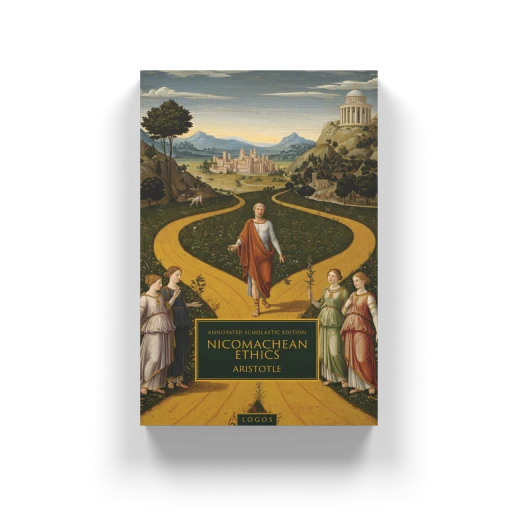
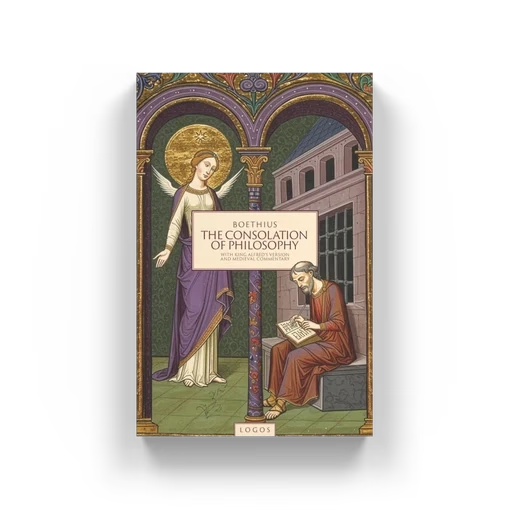
With an Annual Membership, you receive the current release, gain access to all future editions while your plan remains active, and can purchase past releases at exclusive member pricing.

With an Annual Membership, you receive the current release, gain access to all future editions while your plan remains active, and can purchase past releases at exclusive member pricing.

Why join the Club?

Why join the Club?

See what our members have to say

See what our members have to say

John Roche

I love my copy. The book is sturdy and very well bound, but so far the scholastic commentary is the real gem. I laminated the poster and hung it in my classroom. I hope Consolation of Philosophy comes with a poster too!

John Roche

I love my copy. The book is sturdy and very well bound, but so far the scholastic commentary is the real gem. I laminated the poster and hung it in my classroom. I hope Consolation of Philosophy comes with a poster too!

Nicolás Carreño Román

Wow! This looks like the kind of book subscription that's worth it!

Nicolás Carreño Román

Wow! This looks like the kind of book subscription that's worth it!

Spencer Simons

Got mine. Love it already. The poster is a nice perk I wasn’t aware of. I’m gonna grab a frame tomorrow and hang it on my bedroom wall.

Spencer Simons

Got mine. Love it already. The poster is a nice perk I wasn’t aware of. I’m gonna grab a frame tomorrow and hang it on my bedroom wall.

FAQ

FAQ

Frequently Asked Questions

Frequently Asked Questions

What am I subscribing to?

When will I receive my books?

When will I receive the next books in the Club?

Is shipping available everywhere in the U.S.?

Will I receive tracking information?

Are taxes and shipping included?

What is the difference between the Monthly and Yearly memberships?

How does billing work for the Yearly Membership?

Will I be charged on the same date every month?

What happens if my payment fails (card declined)?

Can I cancel my subscription?

Can I pause my membership?

Can I switch between Monthly and Yearly?

Do you offer refunds if I forget to cancel?

Can I gift a membership?

How do you choose the monthly books?

Can I skip a month if I already own the book?

What is your returns and damages policy?

Can I change my shipping address after subscribing?

How can I contact support?

What am I subscribing to?

When will I receive my books?

When will I receive the next books in the Club?

Is shipping available everywhere in the U.S.?

Will I receive tracking information?

Are taxes and shipping included?

What is the difference between the Monthly and Yearly memberships?

How does billing work for the Yearly Membership?

Will I be charged on the same date every month?

What happens if my payment fails (card declined)?

Can I cancel my subscription?

Can I pause my membership?

Can I switch between Monthly and Yearly?

Do you offer refunds if I forget to cancel?

Can I gift a membership?

How do you choose the monthly books?

Can I skip a month if I already own the book?

What is your returns and damages policy?

Can I change my shipping address after subscribing?

How can I contact support?

What am I subscribing to?

When will I receive my books?

When will I receive the next books in the Club?

Is shipping available everywhere in the U.S.?

Will I receive tracking information?

Are taxes and shipping included?

What is the difference between the Monthly and Yearly memberships?

How does billing work for the Yearly Membership?

Will I be charged on the same date every month?

What happens if my payment fails (card declined)?

Can I cancel my subscription?

Can I pause my membership?

Can I switch between Monthly and Yearly?

Do you offer refunds if I forget to cancel?

Can I gift a membership?

How do you choose the monthly books?

Can I skip a month if I already own the book?

What is your returns and damages policy?

Can I change my shipping address after subscribing?

How can I contact support?