Lords of Crime: Organized Crime as a Metastasis of Globalization
Lords of Crime: Organized Crime as a Metastasis of Globalization

Logos Publishing
Logos Publishing
Politics
The Sociology of Jean Ziegler
Swiss, born in 1934, Jean Ziegler has made his life an uncomfortable fight against the gears that crush human dignity. A sociologist, politician, and UN rapporteur, his work is not an academic critique but a cry against the power structures that normalize hunger, misery, and violence as mere side effects of progress. Ziegler is not just an observer; he is an accuser. In the late 1990s, as the West celebrated the fall of the Berlin Wall and the cultural victory of the free market, Ziegler published a book that sounded like a fire alarm in the midst of the party: Lords of Crime. The work could embitter even the most optimistic neoliberal. In it, Ziegler asked us to look away from the old movie mobsters and face the new monsters: global criminal corporations that were born, grew, and operated with the efficiency of a multinational.
The bomb that Ziegler drops in the readers' laps is simple and devastating: modern organized crime is not the "other side" of capitalism. It is not a parasite attacking a healthy body. It is the conclusion of an already sick system. For Ziegler, the three pillars of neoliberalism—financial deregulation, the weakening of the state, and unfettered globalization—are not just about economics, but represent the act of letting the fox guard the henhouse. The collapse of the Soviet bloc flooded the market with weapons and unemployed criminals. Tax havens, with their mode of operation, became temples where dirty money is laundered and receives the blessing of the financial system.
What Ziegler forces us to ask is: what does "legality" mean when dirty money from drug trafficking can, with a few clicks, be transformed into shares of a technology company or the financing of a luxury resort? The line between the licit and the illicit blurs, becoming a convenient illusion. Crime ceases to be a police matter and reveals itself for what it has always been: a question of political and economic power. It is with this conceptual tool that we must analyze a peculiar and frightening Brazilian materialization of Ziegler's thesis: the First Command of the Capital (PCC).
PCC - From Prison Gang to Crime Holding Company
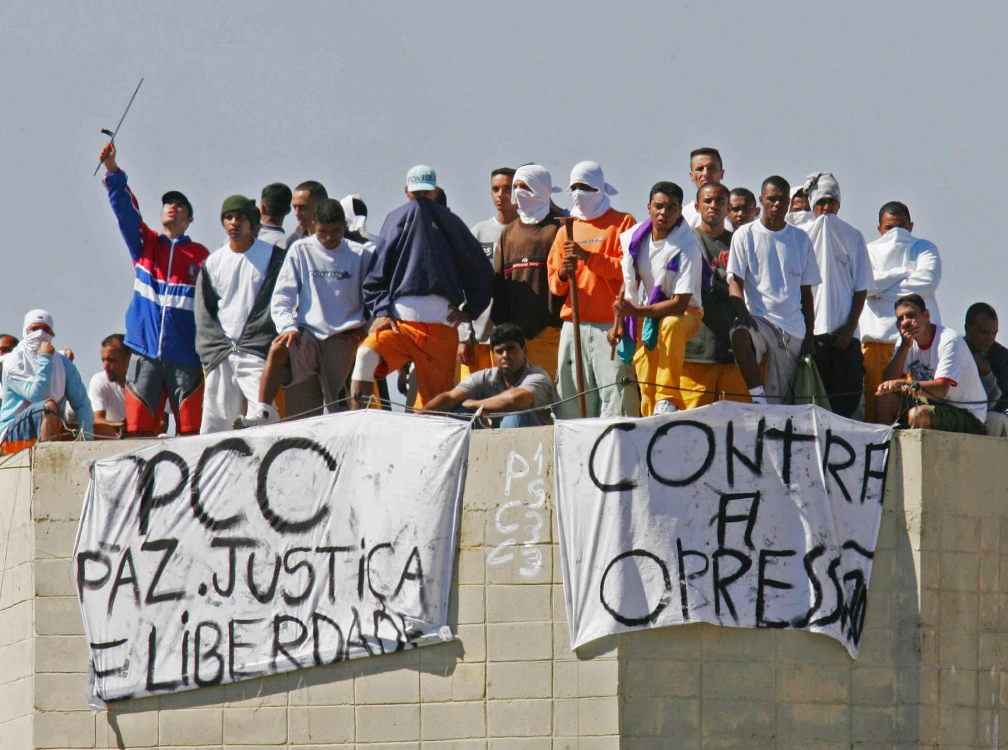
To understand the PCC, one must return to its cradle: hell. More specifically, the hell of the São Paulo prison system in the 1990s, whose peak of brutality was the Carandiru Massacre. The "Party of Crime" was not born from a business plan, but from a survival pact. There was an original ideal, expressed in their slogan "Peace, Justice, and Liberty," which was a direct response to the barbarism and oppression imposed by the state itself inside the prisons. It was a kind of minimal parallel state, born to regulate life where the official state only offered social obstacles, violence, and humiliation.
However, like a dark narration from the pages of Ziegler, the organization quickly realized that real power was not just in controlling the prison yards, but in controlling capital flows. Survival gave way to greater ambitions. The modus operandi of the inmates, based on force and violence, began to transform into a business. The PCC underwent an impressive metamorphosis: it went from being a "crime syndicate" to a true transnational holding company.
Here, Ziegler's thesis materializes in every detail of the PCC's operation. The faction learned and applied, with frightening efficiency, the main lessons of globalized capitalism. The PCC first monopolized crime within São Paulo, imposing a certain "discipline" and reducing chaotic violence to optimize profits. Then, like any corporation in search of new markets, it expanded throughout Brazil and, crucially, abroad, establishing itself as a central player on the cocaine routes connecting South America to Europe and Africa.
The success of the PCC is not only due to violence but to its logistical competence. The faction operates like a giant import-export company, managing ports, containers, planes, and "mules" with a precision that rivals that of many legal companies. Subsequently, we have the money laundering scheme, which is the central point of connection with Ziegler. The PCC understood that dirty money, in large volumes, is a problem. It needs to be laundered, "investing" in the formal market. The faction started by applying it in traditional businesses—gas stations, stores, real estate—and later the operation scaled up. The infiltration into the financial market, through investment funds and fintechs, is not a deviation, but the natural evolution of the capitalism. It is the moment when the Lord of Crime sits at the table with the banker, and the distinction between the two begins to disappear.
Many of the men who run the great banks and multinationals of the planet share, deep down, the same mentality as the mafia bosses. They have in common greed, the obsession with profit, the will to power, the secret contempt (sometimes aversion) for the law, and the taste for opacity. [...] The borderline that separates them—the operating modes—is thin. (ZIEGLER, 2003, p. 18)
Thus, the myth of the "parallel state" is debunked. The PCC does not operate parallel to the Brazilian state; it operates through it and despite it. It uses its infrastructure (roads, ports), corrupts its agents, and, most importantly, exploits the loopholes and tools of the financial system—fintechs, for example, do not report information to the Federal Revenue. It is not an anti-state, but a shadow company that flourishes in the contradictions and hypocrisy of a peripheral capitalism.
The Debate - Is the System or Human Nature to Blame?
The rise of the PCC from a prison brotherhood to a corporation operating on Faria Lima forces us to ask a fundamental question: how do we interpret this social distortion? Is it a flaw in the system or its purest expression? On one side, we have the perspective of the critical left, represented here by the Brazilian historian Jones Manoel. For him, it is impossible to understand the PCC without first understanding the nature of Brazilian dependent capitalism. In this view, Brazil is not simply "poor," but structurally peripheral, condemned to a cycle of exploitation that generates a mass of young people, mostly black, for whom the system offers absolutely nothing. No promise of mobility, no decent job, no full citizenship. The state denies them education and health, and the market denies them a place.
And what happens then? To guarantee this order, which is an order of dependence, of overexploitation of the workforce, of denial of rights, of the absence of a national project, they need a state that is, fundamentally, a police state. A state that guarantees the private property of the means of production at all costs and that violently represses any type of contestation.
"The Brazilian bourgeoisie hates Brazil. It does not have a national project. It does not have a national development project. It does not see itself as a ruling class that will lead a process of affirming the country's sovereignty, of developing the productive forces, of creating a strong internal market, of income distribution, of universalization of public services... The project of the Brazilian bourgeoisie has always been to associate itself in a subordinate manner with imperialism, to guarantee the overexploitation of the workforce here—that is, to pay very low wages and deny rights—and, from there, to accumulate as much capital as possible and send it abroad. Tax havens, buying a mansion in Miami, in Lisbon(...) So, they are not worried if Brazil will have industry, if Brazil will have a cutting-edge science and technology system, if we will have a universal, free, and quality educational system.(...). Their concern is the profit rate. And what happens then? To guarantee this order, which is an order of dependence, of overexploitation of the workforce, of denial of rights, of the absence of a national project, they need a state that is, fundamentally, a police state. A state that guarantees the private property of the means of production at all costs and that violently represses any type of contestation. So, you don't have a state focused on guaranteeing social rights, on being an inducer of development. You have a state that is a big business counter for their interests and a big machine of repression to control the 'rabble,' to control the people. It is in this cultural broth, in this Brazil that they built, that organized crime flourishes. Because organized crime is also a form of enterprise within this logic of denying a future to the majority." (Jones Manoel on Flow, August 2025)
In this vacuum of meaning and future, organized crime arises not as an abstract "choice," but as the only possible path of "entrepreneurship" and power. The PCC offers what the state and the market deny: a career, a code of conduct, access to consumer goods, and, above all, a form of power. For Jones Manoel, the infiltration into the formal economy is just the final proof that crime and legal capital speak the same language: that of accumulation and consumption. In this way, there is no moral distinction between the drug dealer and the banker; there is only a difference in social status. The root of the problem, therefore, is not necessarily a character flaw, but the very logic of a system that necessarily produces its own criminal shadow.
The Liberal View
In a liberal-conservative view, which dominates much of the Brazilian public debate, Jones Manoel's analysis is a dangerous inversion of values, a rhetorical trick to victimize the criminal and blame society. The problem, here, is not the economic system, but a tripod of decay: moral, state, and legal. The opinion of the Brazilian journalist Rodrigo Constantino is emblematic of this view, which rejects what he calls "victimism" and refocuses on individual responsibility:
“The festive left, with its Marxist DNA, has always sought social causes for criminality, treating the bandit as a victim of society. This is a flawed theoretical framework, which serves to absolve the marginal of his individual responsibility. The human being has free will. Poverty does not produce bandits, because if it did, Africa would be the most violent continent in the world, and it is not. What produces bandits is the certainty of impunity, the lack of moral values, the inversion of values.” (CONSTANTINO, 2017).
First, the moral and individual flaw. The criminal is not a "product of the environment," but an agent with free will who chooses the path of evil. The primary cause of crime would be the collapse of traditional values: the breakdown of the family, the loss of religious faith, and the absence of a work ethic and responsibility. The problem is not the lack of opportunities, but the lack of character. Second, the failure of the state, but for a reason opposite to that pointed out by the left. The state is not oppressive, it is bloated, inefficient, and corrupt. For the more liberal wing, excessive bureaucracy and high taxes stifle free enterprise, creating an environment where illegal markets flourish as an alternative. The PCC would be, in this view, an enterprise that thrives precisely where the free market is prevented from acting. Third, and perhaps the point most warned about by conservatives, is legal failure and impunity. A penal system considered "lax," with sentence progressions, temporary releases, and a human rights discourse that supposedly protects the bandit more than the victim, would be the main culprit for the power of the factions. The solution would not be a social revolution, but the toughening of the Penal Code, the construction of more prisons, and the strengthening of the state's repressive apparatus. To confuse the PCC with a legitimate company is, for this view, an absurdity, an offense to the citizen who "plays by the rules."
Thus, we have a great gap. On one side, crime as a symptom of an exclusionary system. On the other, crime as an individual choice fueled by impunity. The diagnosis determines the solution: either the structure of society is changed, or the fight against the individual is strengthened.
The Lords of Crime in Brazil

We return to Jean Ziegler. What the saga of the PCC and the Brazilian ideological impasse show us is that his thesis was not heard, and the problem has spread. The differences between the left and right views on crime are, in themselves, a symptom of the crisis. Both narratives, in their extremes, seem insufficient. The purely repressive response of the right has proven ineffective for decades, only overcrowding prisons that function as recruitment centers for the very crime it aims to combat. On the other hand, the structural analysis of the left, although powerful in its diagnosis, often fails to offer effective solutions that dialogue with the urgency and fear of the population.
The PCC, in its business modernization, exposes the fallacy of both sides. It is not only the result of misery, as many in misery do not become crime lords. Nor is it merely the fruit of impunity, as its structure survives and thrives even with its leaders incarcerated. Perhaps the most controversial point is that the PCC is not the opposite of order; it is a new form of order. A criminal corporation that offers its members a clearer and more meritocratic career plan than many legal companies, and imposes in its territories more stability (albeit armed) than the state itself. It is the dark reflection of globalized capitalism, reflecting its most essential characteristics: logistical efficiency, a relentless search for new markets, portfolio diversification, and the ability to turn anything—drugs, weapons, lives—into a commodity.
The question that remains is no longer whether the PCC will be defeated. The question is whether Brazil still has a national project capable of competing with the proposal of power, belonging, and financial prosperity that the faction offers to a youth for whom all doors have been closed. As long as legal and illegal capital continue to drink from the same source and do business in the opaque hall of the financial system, Ziegler's warning will serve as an epitaph on the tomb of our sovereignty, for we have been the architects of our own ruin, governed by lords not of the law, but of force: "Where the lords of crime prosper, democracy dies. Where they rule, the law of the strongest replaces the rule of law."(Ziegler, 2003)
By Peter Webster - Philosophy Teacher and Logos Publishing Editor
Bibliography
Constantino, Rodrigo. "Crime Doesn't Pay? In Brazil, It Does. And a Lot!" Gazeta do Povo, July 25, 2017. https://www.gazetadopovo.com.br/rodrigo-constantino/artigos/o-crime-nao-compensa-no-brasil-compensa-e-muito/.
Feltran, Gabriel. The Entangled City: Crime as Urban Fabric in São Paulo. Manchester: Manchester University Press, 2020.
Flow News. "Jones Manoel Talks About Milei, Bolsonaro in the Economist, and Faria Lima Dominated by the PCC - Flow News #004." YouTube video, 2:00:38. August 30, 2025. https://www.youtube.com/watch?v=zGLRpNnYiS0.
Manso, Bruno Paes, and Camila Nunes Dias. The War: The Rise of the PCC and the World of Crime in Brazil. São Paulo: Todavia, 2018.
Studart, Hugo. "PCC: The Faction." Revista Oeste, February 18, 2022. https://revistaoeste.com/revista/edicao-100/pcc-a-faccao/.
Ziegler, Jean. The Lords of Crime: The New Mafias Against Democracy. Translated by Rosemary Sheed. New York: Alfred A. Knopf, 1998.
The Sociology of Jean Ziegler
Swiss, born in 1934, Jean Ziegler has made his life an uncomfortable fight against the gears that crush human dignity. A sociologist, politician, and UN rapporteur, his work is not an academic critique but a cry against the power structures that normalize hunger, misery, and violence as mere side effects of progress. Ziegler is not just an observer; he is an accuser. In the late 1990s, as the West celebrated the fall of the Berlin Wall and the cultural victory of the free market, Ziegler published a book that sounded like a fire alarm in the midst of the party: Lords of Crime. The work could embitter even the most optimistic neoliberal. In it, Ziegler asked us to look away from the old movie mobsters and face the new monsters: global criminal corporations that were born, grew, and operated with the efficiency of a multinational.
The bomb that Ziegler drops in the readers' laps is simple and devastating: modern organized crime is not the "other side" of capitalism. It is not a parasite attacking a healthy body. It is the conclusion of an already sick system. For Ziegler, the three pillars of neoliberalism—financial deregulation, the weakening of the state, and unfettered globalization—are not just about economics, but represent the act of letting the fox guard the henhouse. The collapse of the Soviet bloc flooded the market with weapons and unemployed criminals. Tax havens, with their mode of operation, became temples where dirty money is laundered and receives the blessing of the financial system.
What Ziegler forces us to ask is: what does "legality" mean when dirty money from drug trafficking can, with a few clicks, be transformed into shares of a technology company or the financing of a luxury resort? The line between the licit and the illicit blurs, becoming a convenient illusion. Crime ceases to be a police matter and reveals itself for what it has always been: a question of political and economic power. It is with this conceptual tool that we must analyze a peculiar and frightening Brazilian materialization of Ziegler's thesis: the First Command of the Capital (PCC).
PCC - From Prison Gang to Crime Holding Company
To understand the PCC, one must return to its cradle: hell. More specifically, the hell of the São Paulo prison system in the 1990s, whose peak of brutality was the Carandiru Massacre. The "Party of Crime" was not born from a business plan, but from a survival pact. There was an original ideal, expressed in their slogan "Peace, Justice, and Liberty," which was a direct response to the barbarism and oppression imposed by the state itself inside the prisons. It was a kind of minimal parallel state, born to regulate life where the official state only offered social obstacles, violence, and humiliation.
However, like a dark narration from the pages of Ziegler, the organization quickly realized that real power was not just in controlling the prison yards, but in controlling capital flows. Survival gave way to greater ambitions. The modus operandi of the inmates, based on force and violence, began to transform into a business. The PCC underwent an impressive metamorphosis: it went from being a "crime syndicate" to a true transnational holding company.
Here, Ziegler's thesis materializes in every detail of the PCC's operation. The faction learned and applied, with frightening efficiency, the main lessons of globalized capitalism. The PCC first monopolized crime within São Paulo, imposing a certain "discipline" and reducing chaotic violence to optimize profits. Then, like any corporation in search of new markets, it expanded throughout Brazil and, crucially, abroad, establishing itself as a central player on the cocaine routes connecting South America to Europe and Africa.
The success of the PCC is not only due to violence but to its logistical competence. The faction operates like a giant import-export company, managing ports, containers, planes, and "mules" with a precision that rivals that of many legal companies. Subsequently, we have the money laundering scheme, which is the central point of connection with Ziegler. The PCC understood that dirty money, in large volumes, is a problem. It needs to be laundered, "investing" in the formal market. The faction started by applying it in traditional businesses—gas stations, stores, real estate—and later the operation scaled up. The infiltration into the financial market, through investment funds and fintechs, is not a deviation, but the natural evolution of the capitalism. It is the moment when the Lord of Crime sits at the table with the banker, and the distinction between the two begins to disappear.
Many of the men who run the great banks and multinationals of the planet share, deep down, the same mentality as the mafia bosses. They have in common greed, the obsession with profit, the will to power, the secret contempt (sometimes aversion) for the law, and the taste for opacity. [...] The borderline that separates them—the operating modes—is thin. (ZIEGLER, 2003, p. 18)
Thus, the myth of the "parallel state" is debunked. The PCC does not operate parallel to the Brazilian state; it operates through it and despite it. It uses its infrastructure (roads, ports), corrupts its agents, and, most importantly, exploits the loopholes and tools of the financial system—fintechs, for example, do not report information to the Federal Revenue. It is not an anti-state, but a shadow company that flourishes in the contradictions and hypocrisy of a peripheral capitalism.
The Debate - Is the System or Human Nature to Blame?
The rise of the PCC from a prison brotherhood to a corporation operating on Faria Lima forces us to ask a fundamental question: how do we interpret this social distortion? Is it a flaw in the system or its purest expression? On one side, we have the perspective of the critical left, represented here by the Brazilian historian Jones Manoel. For him, it is impossible to understand the PCC without first understanding the nature of Brazilian dependent capitalism. In this view, Brazil is not simply "poor," but structurally peripheral, condemned to a cycle of exploitation that generates a mass of young people, mostly black, for whom the system offers absolutely nothing. No promise of mobility, no decent job, no full citizenship. The state denies them education and health, and the market denies them a place.
And what happens then? To guarantee this order, which is an order of dependence, of overexploitation of the workforce, of denial of rights, of the absence of a national project, they need a state that is, fundamentally, a police state. A state that guarantees the private property of the means of production at all costs and that violently represses any type of contestation.
"The Brazilian bourgeoisie hates Brazil. It does not have a national project. It does not have a national development project. It does not see itself as a ruling class that will lead a process of affirming the country's sovereignty, of developing the productive forces, of creating a strong internal market, of income distribution, of universalization of public services... The project of the Brazilian bourgeoisie has always been to associate itself in a subordinate manner with imperialism, to guarantee the overexploitation of the workforce here—that is, to pay very low wages and deny rights—and, from there, to accumulate as much capital as possible and send it abroad. Tax havens, buying a mansion in Miami, in Lisbon(...) So, they are not worried if Brazil will have industry, if Brazil will have a cutting-edge science and technology system, if we will have a universal, free, and quality educational system.(...). Their concern is the profit rate. And what happens then? To guarantee this order, which is an order of dependence, of overexploitation of the workforce, of denial of rights, of the absence of a national project, they need a state that is, fundamentally, a police state. A state that guarantees the private property of the means of production at all costs and that violently represses any type of contestation. So, you don't have a state focused on guaranteeing social rights, on being an inducer of development. You have a state that is a big business counter for their interests and a big machine of repression to control the 'rabble,' to control the people. It is in this cultural broth, in this Brazil that they built, that organized crime flourishes. Because organized crime is also a form of enterprise within this logic of denying a future to the majority." (Jones Manoel on Flow, August 2025)
In this vacuum of meaning and future, organized crime arises not as an abstract "choice," but as the only possible path of "entrepreneurship" and power. The PCC offers what the state and the market deny: a career, a code of conduct, access to consumer goods, and, above all, a form of power. For Jones Manoel, the infiltration into the formal economy is just the final proof that crime and legal capital speak the same language: that of accumulation and consumption. In this way, there is no moral distinction between the drug dealer and the banker; there is only a difference in social status. The root of the problem, therefore, is not necessarily a character flaw, but the very logic of a system that necessarily produces its own criminal shadow.
The Liberal View
In a liberal-conservative view, which dominates much of the Brazilian public debate, Jones Manoel's analysis is a dangerous inversion of values, a rhetorical trick to victimize the criminal and blame society. The problem, here, is not the economic system, but a tripod of decay: moral, state, and legal. The opinion of the Brazilian journalist Rodrigo Constantino is emblematic of this view, which rejects what he calls "victimism" and refocuses on individual responsibility:
“The festive left, with its Marxist DNA, has always sought social causes for criminality, treating the bandit as a victim of society. This is a flawed theoretical framework, which serves to absolve the marginal of his individual responsibility. The human being has free will. Poverty does not produce bandits, because if it did, Africa would be the most violent continent in the world, and it is not. What produces bandits is the certainty of impunity, the lack of moral values, the inversion of values.” (CONSTANTINO, 2017).
First, the moral and individual flaw. The criminal is not a "product of the environment," but an agent with free will who chooses the path of evil. The primary cause of crime would be the collapse of traditional values: the breakdown of the family, the loss of religious faith, and the absence of a work ethic and responsibility. The problem is not the lack of opportunities, but the lack of character. Second, the failure of the state, but for a reason opposite to that pointed out by the left. The state is not oppressive, it is bloated, inefficient, and corrupt. For the more liberal wing, excessive bureaucracy and high taxes stifle free enterprise, creating an environment where illegal markets flourish as an alternative. The PCC would be, in this view, an enterprise that thrives precisely where the free market is prevented from acting. Third, and perhaps the point most warned about by conservatives, is legal failure and impunity. A penal system considered "lax," with sentence progressions, temporary releases, and a human rights discourse that supposedly protects the bandit more than the victim, would be the main culprit for the power of the factions. The solution would not be a social revolution, but the toughening of the Penal Code, the construction of more prisons, and the strengthening of the state's repressive apparatus. To confuse the PCC with a legitimate company is, for this view, an absurdity, an offense to the citizen who "plays by the rules."
Thus, we have a great gap. On one side, crime as a symptom of an exclusionary system. On the other, crime as an individual choice fueled by impunity. The diagnosis determines the solution: either the structure of society is changed, or the fight against the individual is strengthened.
The Lords of Crime in Brazil
We return to Jean Ziegler. What the saga of the PCC and the Brazilian ideological impasse show us is that his thesis was not heard, and the problem has spread. The differences between the left and right views on crime are, in themselves, a symptom of the crisis. Both narratives, in their extremes, seem insufficient. The purely repressive response of the right has proven ineffective for decades, only overcrowding prisons that function as recruitment centers for the very crime it aims to combat. On the other hand, the structural analysis of the left, although powerful in its diagnosis, often fails to offer effective solutions that dialogue with the urgency and fear of the population.
The PCC, in its business modernization, exposes the fallacy of both sides. It is not only the result of misery, as many in misery do not become crime lords. Nor is it merely the fruit of impunity, as its structure survives and thrives even with its leaders incarcerated. Perhaps the most controversial point is that the PCC is not the opposite of order; it is a new form of order. A criminal corporation that offers its members a clearer and more meritocratic career plan than many legal companies, and imposes in its territories more stability (albeit armed) than the state itself. It is the dark reflection of globalized capitalism, reflecting its most essential characteristics: logistical efficiency, a relentless search for new markets, portfolio diversification, and the ability to turn anything—drugs, weapons, lives—into a commodity.
The question that remains is no longer whether the PCC will be defeated. The question is whether Brazil still has a national project capable of competing with the proposal of power, belonging, and financial prosperity that the faction offers to a youth for whom all doors have been closed. As long as legal and illegal capital continue to drink from the same source and do business in the opaque hall of the financial system, Ziegler's warning will serve as an epitaph on the tomb of our sovereignty, for we have been the architects of our own ruin, governed by lords not of the law, but of force: "Where the lords of crime prosper, democracy dies. Where they rule, the law of the strongest replaces the rule of law."(Ziegler, 2003)
By Peter Webster - Philosophy Teacher and Logos Publishing Editor
Bibliography
Constantino, Rodrigo. "Crime Doesn't Pay? In Brazil, It Does. And a Lot!" Gazeta do Povo, July 25, 2017. https://www.gazetadopovo.com.br/rodrigo-constantino/artigos/o-crime-nao-compensa-no-brasil-compensa-e-muito/.
Feltran, Gabriel. The Entangled City: Crime as Urban Fabric in São Paulo. Manchester: Manchester University Press, 2020.
Flow News. "Jones Manoel Talks About Milei, Bolsonaro in the Economist, and Faria Lima Dominated by the PCC - Flow News #004." YouTube video, 2:00:38. August 30, 2025. https://www.youtube.com/watch?v=zGLRpNnYiS0.
Manso, Bruno Paes, and Camila Nunes Dias. The War: The Rise of the PCC and the World of Crime in Brazil. São Paulo: Todavia, 2018.
Studart, Hugo. "PCC: The Faction." Revista Oeste, February 18, 2022. https://revistaoeste.com/revista/edicao-100/pcc-a-faccao/.
Ziegler, Jean. The Lords of Crime: The New Mafias Against Democracy. Translated by Rosemary Sheed. New York: Alfred A. Knopf, 1998.
How Logos Philosophy Club Supports Your Reading
How Logos Philosophy Club Supports Your Reading

Diving into philosophy on your own can feel like navigating a maze - dense arguments, unfamiliar terms, and complex ideas can leave you feeling stuck. That’s where Logos Philosophy Club steps in, transforming solitary study into a guided and enriched journey. As the first philosophy subscription book club in the U.S. focused exclusively on foundational works, it’s backed by a parent publishing group in Brazil with over 20,000 monthly subscribers.
Each month, members receive bilingual editions of foundational texts, meticulously translated from their original languages. These side-by-side editions allow you to compare the translation with the source text, which is especially helpful when tackling works like Plato’s The Symposium (set for March 2026) or Aristotle’s Nicomachean Ethics (coming December 2025). This format not only enhances understanding but also reflects the club’s dedication to providing high-quality materials.
Tags
Recent Blogs

Biographies
Socrates: the incarnation of philosophy

Metaphysics Logic
How myth made philosophy possible
Subscribe to our newsletter
Subscribe to our newsletter
New editions, new authors, new releases.
Subscribe to our newsletter and be the first to know what’s coming next from Logos Publishing.
Biographies
Socrates: the incarnation of philosophy
Metaphysics Logic
How myth made philosophy possible
In Book XI of the Odyssey, Odysseus descends to the underworld...
Logos Publishing
Metaphysics Logic
How myth made philosophy possible
VIEW ALL ARTICLES