Sapere Aude: What is Enlightenment in Immanuel Kant? (Full Essay)
Sapere Aude: What is Enlightenment in Immanuel Kant? (Full Essay)

Logos Publishing
Logos Publishing
Ethics
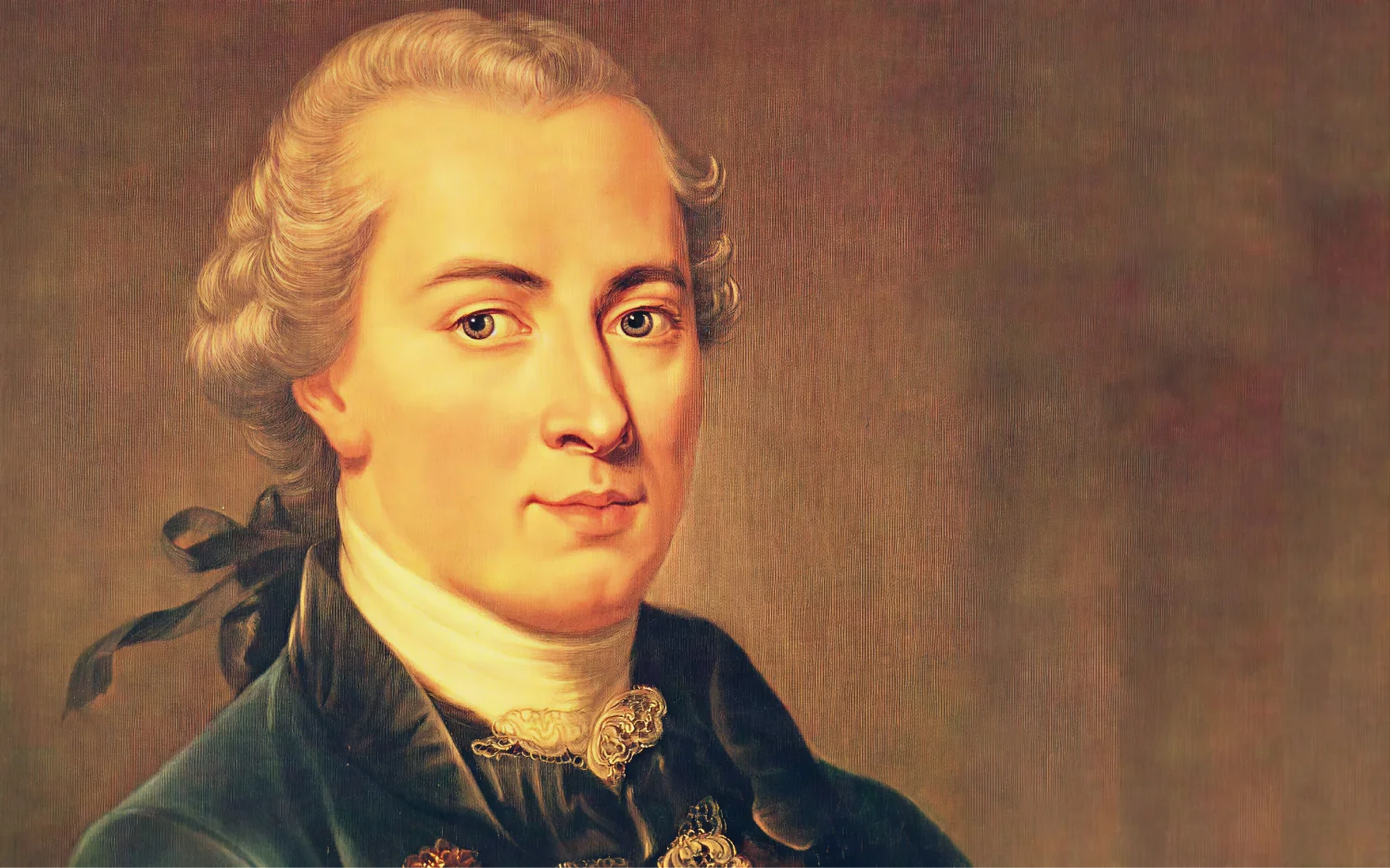
This article proposes an immersion into one of the most fundamental texts of Western philosophy: “What is Enlightenment?", written by Immanuel Kant in 1784. We combine the vigor of Kant’s original thought with a contemporary analysis, deconstructing concepts that, although centuries old, continue to echo in our discussions on liberty, politics, and individual responsibility. First, we present the original text in its entirety, respecting the power of his words:
An Answer to the Question: What is Enlightenment?
By Immanuel Kant
Enlightenment is man's emergence from his self-incurred immaturity. Immaturity is the inability to use one's own understanding without the guidance of another. This immaturity is self-incurred if its cause is not lack of understanding, but lack of resolution and courage to use it without the guidance of another. Sapere aude! Have courage to use your own understanding!—that is the motto of enlightenment.
Laziness and cowardice are the reasons why such a large proportion of men, even when nature has long emancipated them from alien guidance (naturaliter maiorennes), nevertheless gladly remain immature for life. For the same reasons, it is all too easy for others to set themselves up as their guardians. It is so convenient to be immature! If I have a book to serve as my understanding, a pastor to serve as my conscience, a physician to determine my diet for me, and so on, I need not exert myself at all. I need not think, if only I can pay: others will readily undertake the irksome business for me. The great majority of mankind (including the entire fair sex) consider the step into maturity not only as difficult but as very dangerous as well, because those guardians who have so kindly taken upon themselves the supervision of the people have also seen to it that these quiet creatures do not venture a single step without the go-cart in which they are enclosed. Once they have first made their domestic cattle dumb and have made sure that these placid creatures will not dare take a single step without the walker to which they are harnessed, these guardians then show them the danger which threatens them should they attempt to walk alone. Now this danger is not actually so great, for after falling a few times they would finally learn to walk. However, enough such examples make them timid and usually frighten them away from any further attempts.
Thus, it is difficult for any individual man to work himself out of the immaturity that has all but become his nature. He has even become fond of it and is at present really incapable of using his own understanding, because he has never been allowed to make the attempt. Dogmas and formulas, these mechanical instruments for the rational use (or rather, misuse) of his natural gifts, are the fetters of an everlasting immaturity. Whoever threw them off would still make only an uncertain leap over the narrowest ditch, for he is not accustomed to such free movement. Thus, there are only a few who have succeeded, through the cultivation of their own minds, in emerging from immaturity and in walking with a firm step.
That a public should enlighten itself is, however, more possible. Indeed, if only it is allowed freedom, enlightenment is almost inevitable. For even among the entrenched guardians of the great masses, a few will always think for themselves, a few who, after having themselves thrown off the yoke of immaturity, will spread the spirit of a rational appreciation of their own worth and of every man's duty to think for himself. It is particularly noteworthy that the public, which has previously been put under this yoke by these guardians, may later force these very guardians to remain under it themselves—if the public is incited to do so by some of its guardians who are themselves incapable of any enlightenment. This shows how pernicious it is to plant prejudices, for they ultimately take their revenge on those who scattered them or on their successors. Therefore, a public can achieve enlightenment only slowly. A revolution may perhaps bring about the fall of personal despotism or of avaricious and tyrannical oppression, but it can never bring about a true reform of the way of thinking. Rather, new prejudices will serve, just as well as the old, as leading-strings for the unthinking masses.
For this enlightenment, however, nothing is required but freedom. And indeed the most harmless among all the things to which this term can be applied: namely, the freedom to make a public use of one's reason in all matters. Now I hear from all sides the cry: “Don't argue!” The officer says: "Don't argue, drill!" The tax collector says: "Don't argue, pay!" The pastor says: "Don't argue, believe!" (Only one ruler in the world says: "Argue as much as you will and about what you will, but obey!") Everywhere there are restrictions on freedom. But what kind of restriction hinders enlightenment, and what kind does not, or may even promote it? I answer: the public use of one's reason must always be free, and it alone can bring about enlightenment among mankind. The private use of reason may, however, often be very narrowly restricted without particularly hindering the progress of enlightenment.
By the public use of one's own reason I understand that use which anyone makes of it as a scholar before the entire public of the reading world. I call the private use of it that which a person may make of it in a particular civil post or office with which he is entrusted. Now, for many affairs which are conducted in the interest of the commonwealth, a certain mechanism is required by means of which some members of the commonwealth must behave purely passively, so that they may, by an artificial common agreement, be employed by the government for public ends (or at least be restrained from spoiling them). In these situations, one is certainly not allowed to argue; rather, one must obey. But insofar as this part of the machine considers himself at the same time a member of the whole commonwealth—indeed, even of the world republic of citizens—and thus in the role of a scholar who addresses a public through his writings, he may certainly argue without thereby harming the affairs for which he is responsible as a passive member. Thus, it would be very harmful if an officer, who is given an order by his superior, were to argue aloud in service about the suitability or utility of this order; he must obey. But as a scholar he cannot justly be prevented from making remarks on the errors of the military service and from laying these before his public for judgment. The citizen cannot refuse to pay the taxes imposed on him; indeed, an impudent complaint against such levies, when they are to be paid by him, can be punished as an outrage (which could lead to widespread insubordination). Despite this, he does not act against the duty of a citizen if, as a scholar, he publicly expresses his thoughts against the inappropriateness or even the injustice of such levies. In the same way, a clergyman is bound to deliver his sermon to the pupils of his catechism and to his congregation according to the creed of the church he serves, for he was ordained on this condition. But as a scholar he has full freedom—and is even called upon—to communicate to the public all his carefully examined and well-intentioned thoughts about what is erroneous in that creed and his proposals for the better organization of religious and ecclesiastical affairs. There is nothing in this which could be a burden on his conscience. For what he teaches as a consequence of his office as a representative of the church, he represents as something about which he does not have the freedom to teach according to his own lights, but which he is appointed to deliver according to the prescription of another and in the name of another. He will say: "Our church teaches this or that; these are the arguments it uses."
He then extracts all the practical utility for his congregation from precepts to which he himself would not subscribe with full conviction, but to whose delivery he can nevertheless commit himself, because it is not entirely impossible that truth may lie hidden within them. In any case, however, nothing contradictory to inner religion must be found in them. For if he believed he found such a contradiction, he could not in good conscience fulfill his office; he would have to resign. Thus, the use which an appointed teacher makes of his reason before his congregation is merely a private use, because this is always a domestic assembly, no matter how large it may be; and in this respect he, as a priest, is not free and cannot be, because he is executing another's commission. On the other hand, as a scholar who speaks through his writings to the true public—the world—the clergyman in the public use of his reason enjoys unlimited freedom to use his own reason and to speak in his own name. For that the guardians of the people (in spiritual matters) should themselves be immature is an absurdity that would result in the perpetuation of absurdities.
But should a society of clergymen, for example, an ecclesiastical assembly or a venerable "classis" (as the Dutch call it), be entitled to bind itself by oath to a certain unalterable creed, in order to exercise an unceasing guardianship over each of its members and thereby over the people, and even to perpetuate this? I say: that is entirely impossible. Such a contract, concluded to shut out all further enlightenment from the human race for all time, is simply null and void, even if it were confirmed by the supreme power, by parliaments, and by the most solemn peace treaties. One age cannot ally itself and conspire to put the following age in a condition in which it would be impossible for it to enlarge its knowledge (especially in areas of such urgent importance), to purge itself of errors, and generally to progress in enlightenment. That would be a crime against human nature, whose original destiny lies precisely in such progress. Therefore, posterity is fully entitled to reject such decisions as unauthorized and criminal. The touchstone of whatever can be decided as a law for a people lies in the question: whether a people could have imposed such a law upon itself. Now, it might be possible for a specified and short period of time to introduce a certain order, as it were in expectation of a better law. At the same time, every citizen, especially the clergyman in his role as a scholar, should be granted the freedom to make his observations publicly—that is, through writings—about the flaws in current institutions. The established order would meanwhile continue until the understanding of the nature of these things had publicly progressed to the point where, by uniting their voices (even if not all of them), a proposal could be brought before the throne to protect those congregations that had, according to their own better understanding, agreed on an altered religious organization, without however hindering those who wished to remain with the old. But to agree upon a permanent religious constitution which no one may publicly question—even within the lifetime of one man—and thereby to annihilate a period of time in the progress of mankind toward improvement, making it fruitless and even detrimental to posterity, is absolutely forbidden. A man may, for his own person and even then only for a limited time, postpone enlightenment in what he is bound to know; but to renounce it, whether for his own person or even more for posterity, is to violate and trample underfoot the sacred rights of mankind. But what a people may not decide for itself, a monarch may still less decide for it, for his legislative authority rests on his uniting the entire will of the people in his own. If he only sees to it that every true or alleged improvement is compatible with civil order, he can otherwise leave his subjects to do what they find necessary for their soul's salvation. This is not his business, but it is his business to prevent one subject from forcibly hindering another from working to the best of his ability to determine and promote his salvation. It even detracts from his majesty if he interferes in these matters by subjecting the writings through which his subjects attempt to clarify their views to governmental supervision. This applies both when he does this based on his own superior insight—in which case he exposes himself to the reproach: *Caesar non est supra grammaticos*—and even more so when he degrades his supreme power so far as to support the spiritual despotism of a few tyrants in his state against the rest of his subjects.
If it is now asked, “Do we currently live in an enlightened age?” the answer is: “No, but we do live in an age of enlightenment.” As matters now stand, a great deal is still lacking before men as a whole are in a position, or can even be put into a position, to use their own understanding confidently and well in religious matters without the guidance of another. But we do have clear indications that the field is now being opened for them to work freely in this direction, and that the obstacles to general enlightenment or to the emergence from their self-incurred immaturity are gradually becoming fewer. In this regard, this age is the age of enlightenment, or the century of Frederick.
A prince who does not find it beneath him to say that he considers it a duty not to prescribe anything to men in religious matters, but to leave them complete freedom in this regard—who thus rejects even the haughty name of "tolerance"—is himself enlightened and deserves to be praised by a grateful world and by posterity as the one who first liberated the human race from immaturity, at least from the side of government, and left everyone free to use his own reason in all matters of conscience. Under him, venerable clergymen, in their role as scholars and regardless of their official duties, may freely and publicly submit their judgments and views to the world for examination, even where these deviate here and there from the established creed. And this applies even more to anyone else who is not restricted by an official duty. This spirit of freedom is spreading further, even where it must struggle with external obstacles imposed by a government which misunderstands its own interest. For such a government has before it an example showing that, under conditions of freedom, there is not the slightest ground for concern about public peace and the unity of the commonwealth. Men gradually work their way out of barbarism on their own, provided that no one purposefully contrives to keep them in it.
I have emphasized the main point of enlightenment—man's emergence from his self-incurred immaturity—primarily in religious matters, because our rulers have no interest in playing the guardian over their subjects in the arts and sciences, and also because immaturity in religion is not only the most harmful but also the most dishonorable of all. But the way of thinking of a head of state who favors enlightenment goes even further and realizes that there is no danger to his legislation in allowing his subjects to make public use of their own reason and to lay before the world their thoughts about a better formulation of that legislation, even including a courageous criticism of the laws already given. We have a brilliant example of this, for no monarch has yet surpassed the one whom we honor.
But only one who, himself enlightened, is not afraid of shadows, and who at the same time has at hand a large, well-disciplined army to guarantee public peace, can say what a free state dare not venture: "Argue as much as you will and about what you will; only obey!" Here a strange and unexpected pattern in human affairs reveals itself (as is the case elsewhere when they are viewed in the large, where almost everything is paradoxical). A greater degree of civil freedom seems advantageous to a people's spiritual freedom; yet it also sets up insuperable barriers to it. A lesser degree of civil freedom, on the contrary, provides the space for spiritual freedom to expand to its full capacity. Thus, once nature has removed the hard shell from this kernel for which she has most fondly cared, namely, the inclination and vocation to free thinking, the kernel gradually reacts on a people's mentality (whereby they become increasingly capable of acting freely), and finally even on the principles of government, which finds that it can profit by treating man, who is now more than a machine, in accord with his dignity.
Definitions
Enlightenment: The term "Enlightenment" (or *Aufklärung* in the German original) carries multiple meanings: explanation, understanding, and, of course, the philosophical movement of the Age of Reason. Kant defines it as a process of transition. It is not a state one reaches and then becomes stagnant, but rather the act of "emerging" from a condition of submission.
Minority (Immaturity): Kantian "minority" or "immaturity" does not refer to chronological age, but to intellectual immaturity. It is the state in which an individual delegates the task of deciding, choosing, or thinking freely to "guardians"—whether they be books, religious leaders, or experts. Kant is emphatic in attributing the responsibility for this condition to the subject themselves. He points out two great psychological villains: Laziness—it is more convenient to pay others to decide (one's diet, faith, or politics) than to face the effort of processing information—and Cowardice—the fear of making mistakes when walking alone. The "guardians" exploit this fear, pointing out the danger of "falling" outside the walker, even though Kant reminds us that a few falls are necessary to learn how to walk.
Public Use and Private Use of Reason
This is the most sophisticated point of the text and, frequently, the most misunderstood. Kant proposes a harmony between freedom of thought and social order:
Private Use of Reason: Refers to the fulfillment of duties in public offices or institutions (such as the military or the church). Here, the individual acts as part of a "machine" and must obey so that society functions. A soldier must not question an order on the battlefield; a citizen must pay taxes.
Public Use of Reason: Refers to the individual in the role of a Scholar (someone who studies and writes for the world). In this space, freedom must be absolute. The same soldier who obeys the order can, as an educated citizen, write an article criticizing military strategy. The believer who follows a creed can, as a scholar, propose reforms to their church.
Relations with Freedom: Kant states that enlightenment requires only one thing: Freedom. Specifically, the freedom to make public use of one's reason. He praises the model of Frederick II of Prussia (the "enlightened despot"), who allowed intellectual debate under the condition of obedience to civil laws. A fascinating paradox arises here: Too much civil freedom (an absence of laws) can lead to chaos, which ironically limits the spirit; whereas a firm civil order (with clear boundaries) can create the secure environment necessary for the freedom of thought to expand.
Between Will and System
While the Kantian vision is fundamental to the foundation of modern democracy and the secular state, it is important to note the limits of his individualistic optimism. Kant places the burden of immaturity upon the subject's will (laziness and cowardice). However, in our contemporary analysis, we realize that immaturity is often imposed by systemic failures. If a state does not provide access to education or keeps the people in precarious conditions of subsistence, the "lack of courage" becomes, in reality, a material impossibility.
A poor organization of public policies can keep man "in the dark" regardless of his will to grow and liberate himself. Therefore, enlightenment is not just an individual awakening, but a collective project of social and intellectual infrastructure. We are, as Kant said, in an age of enlightenment. The path of reason is made of stumbles, but the possibility of transforming laws and customs through public debate is what differentiates us from machines. Sapere Aude remains an action of paramount importance for any society that intends to be free.
Pedro Webster – Philosophy Professor and LOGOS Writer
---
References:
Kant, Immanuel. “An Answer to the Question: What Is Enlightenment?” In Practical Philosophy, translated and edited by Mary J. Gregor, 11–22. The Cambridge Edition of the Works of Immanuel Kant. Cambridge: Cambridge University Press, 1996.
Foucault, Michel. “What Is Enlightenment?” In The Foucault Reader, edited by Paul Rabinow, 32–50. New York: Pantheon Books, 1984.
Habermas, Jürgen. The Philosophical Discourse of Modernity: Twelve Lectures. Translated by Frederick G. Lawrence. Cambridge, MA: MIT Press, 1987.
This article proposes an immersion into one of the most fundamental texts of Western philosophy: “What is Enlightenment?", written by Immanuel Kant in 1784. We combine the vigor of Kant’s original thought with a contemporary analysis, deconstructing concepts that, although centuries old, continue to echo in our discussions on liberty, politics, and individual responsibility. First, we present the original text in its entirety, respecting the power of his words:
An Answer to the Question: What is Enlightenment?
By Immanuel Kant
Enlightenment is man's emergence from his self-incurred immaturity. Immaturity is the inability to use one's own understanding without the guidance of another. This immaturity is self-incurred if its cause is not lack of understanding, but lack of resolution and courage to use it without the guidance of another. Sapere aude! Have courage to use your own understanding!—that is the motto of enlightenment.
Laziness and cowardice are the reasons why such a large proportion of men, even when nature has long emancipated them from alien guidance (naturaliter maiorennes), nevertheless gladly remain immature for life. For the same reasons, it is all too easy for others to set themselves up as their guardians. It is so convenient to be immature! If I have a book to serve as my understanding, a pastor to serve as my conscience, a physician to determine my diet for me, and so on, I need not exert myself at all. I need not think, if only I can pay: others will readily undertake the irksome business for me. The great majority of mankind (including the entire fair sex) consider the step into maturity not only as difficult but as very dangerous as well, because those guardians who have so kindly taken upon themselves the supervision of the people have also seen to it that these quiet creatures do not venture a single step without the go-cart in which they are enclosed. Once they have first made their domestic cattle dumb and have made sure that these placid creatures will not dare take a single step without the walker to which they are harnessed, these guardians then show them the danger which threatens them should they attempt to walk alone. Now this danger is not actually so great, for after falling a few times they would finally learn to walk. However, enough such examples make them timid and usually frighten them away from any further attempts.
Thus, it is difficult for any individual man to work himself out of the immaturity that has all but become his nature. He has even become fond of it and is at present really incapable of using his own understanding, because he has never been allowed to make the attempt. Dogmas and formulas, these mechanical instruments for the rational use (or rather, misuse) of his natural gifts, are the fetters of an everlasting immaturity. Whoever threw them off would still make only an uncertain leap over the narrowest ditch, for he is not accustomed to such free movement. Thus, there are only a few who have succeeded, through the cultivation of their own minds, in emerging from immaturity and in walking with a firm step.
That a public should enlighten itself is, however, more possible. Indeed, if only it is allowed freedom, enlightenment is almost inevitable. For even among the entrenched guardians of the great masses, a few will always think for themselves, a few who, after having themselves thrown off the yoke of immaturity, will spread the spirit of a rational appreciation of their own worth and of every man's duty to think for himself. It is particularly noteworthy that the public, which has previously been put under this yoke by these guardians, may later force these very guardians to remain under it themselves—if the public is incited to do so by some of its guardians who are themselves incapable of any enlightenment. This shows how pernicious it is to plant prejudices, for they ultimately take their revenge on those who scattered them or on their successors. Therefore, a public can achieve enlightenment only slowly. A revolution may perhaps bring about the fall of personal despotism or of avaricious and tyrannical oppression, but it can never bring about a true reform of the way of thinking. Rather, new prejudices will serve, just as well as the old, as leading-strings for the unthinking masses.
For this enlightenment, however, nothing is required but freedom. And indeed the most harmless among all the things to which this term can be applied: namely, the freedom to make a public use of one's reason in all matters. Now I hear from all sides the cry: “Don't argue!” The officer says: "Don't argue, drill!" The tax collector says: "Don't argue, pay!" The pastor says: "Don't argue, believe!" (Only one ruler in the world says: "Argue as much as you will and about what you will, but obey!") Everywhere there are restrictions on freedom. But what kind of restriction hinders enlightenment, and what kind does not, or may even promote it? I answer: the public use of one's reason must always be free, and it alone can bring about enlightenment among mankind. The private use of reason may, however, often be very narrowly restricted without particularly hindering the progress of enlightenment.
By the public use of one's own reason I understand that use which anyone makes of it as a scholar before the entire public of the reading world. I call the private use of it that which a person may make of it in a particular civil post or office with which he is entrusted. Now, for many affairs which are conducted in the interest of the commonwealth, a certain mechanism is required by means of which some members of the commonwealth must behave purely passively, so that they may, by an artificial common agreement, be employed by the government for public ends (or at least be restrained from spoiling them). In these situations, one is certainly not allowed to argue; rather, one must obey. But insofar as this part of the machine considers himself at the same time a member of the whole commonwealth—indeed, even of the world republic of citizens—and thus in the role of a scholar who addresses a public through his writings, he may certainly argue without thereby harming the affairs for which he is responsible as a passive member. Thus, it would be very harmful if an officer, who is given an order by his superior, were to argue aloud in service about the suitability or utility of this order; he must obey. But as a scholar he cannot justly be prevented from making remarks on the errors of the military service and from laying these before his public for judgment. The citizen cannot refuse to pay the taxes imposed on him; indeed, an impudent complaint against such levies, when they are to be paid by him, can be punished as an outrage (which could lead to widespread insubordination). Despite this, he does not act against the duty of a citizen if, as a scholar, he publicly expresses his thoughts against the inappropriateness or even the injustice of such levies. In the same way, a clergyman is bound to deliver his sermon to the pupils of his catechism and to his congregation according to the creed of the church he serves, for he was ordained on this condition. But as a scholar he has full freedom—and is even called upon—to communicate to the public all his carefully examined and well-intentioned thoughts about what is erroneous in that creed and his proposals for the better organization of religious and ecclesiastical affairs. There is nothing in this which could be a burden on his conscience. For what he teaches as a consequence of his office as a representative of the church, he represents as something about which he does not have the freedom to teach according to his own lights, but which he is appointed to deliver according to the prescription of another and in the name of another. He will say: "Our church teaches this or that; these are the arguments it uses."
He then extracts all the practical utility for his congregation from precepts to which he himself would not subscribe with full conviction, but to whose delivery he can nevertheless commit himself, because it is not entirely impossible that truth may lie hidden within them. In any case, however, nothing contradictory to inner religion must be found in them. For if he believed he found such a contradiction, he could not in good conscience fulfill his office; he would have to resign. Thus, the use which an appointed teacher makes of his reason before his congregation is merely a private use, because this is always a domestic assembly, no matter how large it may be; and in this respect he, as a priest, is not free and cannot be, because he is executing another's commission. On the other hand, as a scholar who speaks through his writings to the true public—the world—the clergyman in the public use of his reason enjoys unlimited freedom to use his own reason and to speak in his own name. For that the guardians of the people (in spiritual matters) should themselves be immature is an absurdity that would result in the perpetuation of absurdities.
But should a society of clergymen, for example, an ecclesiastical assembly or a venerable "classis" (as the Dutch call it), be entitled to bind itself by oath to a certain unalterable creed, in order to exercise an unceasing guardianship over each of its members and thereby over the people, and even to perpetuate this? I say: that is entirely impossible. Such a contract, concluded to shut out all further enlightenment from the human race for all time, is simply null and void, even if it were confirmed by the supreme power, by parliaments, and by the most solemn peace treaties. One age cannot ally itself and conspire to put the following age in a condition in which it would be impossible for it to enlarge its knowledge (especially in areas of such urgent importance), to purge itself of errors, and generally to progress in enlightenment. That would be a crime against human nature, whose original destiny lies precisely in such progress. Therefore, posterity is fully entitled to reject such decisions as unauthorized and criminal. The touchstone of whatever can be decided as a law for a people lies in the question: whether a people could have imposed such a law upon itself. Now, it might be possible for a specified and short period of time to introduce a certain order, as it were in expectation of a better law. At the same time, every citizen, especially the clergyman in his role as a scholar, should be granted the freedom to make his observations publicly—that is, through writings—about the flaws in current institutions. The established order would meanwhile continue until the understanding of the nature of these things had publicly progressed to the point where, by uniting their voices (even if not all of them), a proposal could be brought before the throne to protect those congregations that had, according to their own better understanding, agreed on an altered religious organization, without however hindering those who wished to remain with the old. But to agree upon a permanent religious constitution which no one may publicly question—even within the lifetime of one man—and thereby to annihilate a period of time in the progress of mankind toward improvement, making it fruitless and even detrimental to posterity, is absolutely forbidden. A man may, for his own person and even then only for a limited time, postpone enlightenment in what he is bound to know; but to renounce it, whether for his own person or even more for posterity, is to violate and trample underfoot the sacred rights of mankind. But what a people may not decide for itself, a monarch may still less decide for it, for his legislative authority rests on his uniting the entire will of the people in his own. If he only sees to it that every true or alleged improvement is compatible with civil order, he can otherwise leave his subjects to do what they find necessary for their soul's salvation. This is not his business, but it is his business to prevent one subject from forcibly hindering another from working to the best of his ability to determine and promote his salvation. It even detracts from his majesty if he interferes in these matters by subjecting the writings through which his subjects attempt to clarify their views to governmental supervision. This applies both when he does this based on his own superior insight—in which case he exposes himself to the reproach: *Caesar non est supra grammaticos*—and even more so when he degrades his supreme power so far as to support the spiritual despotism of a few tyrants in his state against the rest of his subjects.
If it is now asked, “Do we currently live in an enlightened age?” the answer is: “No, but we do live in an age of enlightenment.” As matters now stand, a great deal is still lacking before men as a whole are in a position, or can even be put into a position, to use their own understanding confidently and well in religious matters without the guidance of another. But we do have clear indications that the field is now being opened for them to work freely in this direction, and that the obstacles to general enlightenment or to the emergence from their self-incurred immaturity are gradually becoming fewer. In this regard, this age is the age of enlightenment, or the century of Frederick.
A prince who does not find it beneath him to say that he considers it a duty not to prescribe anything to men in religious matters, but to leave them complete freedom in this regard—who thus rejects even the haughty name of "tolerance"—is himself enlightened and deserves to be praised by a grateful world and by posterity as the one who first liberated the human race from immaturity, at least from the side of government, and left everyone free to use his own reason in all matters of conscience. Under him, venerable clergymen, in their role as scholars and regardless of their official duties, may freely and publicly submit their judgments and views to the world for examination, even where these deviate here and there from the established creed. And this applies even more to anyone else who is not restricted by an official duty. This spirit of freedom is spreading further, even where it must struggle with external obstacles imposed by a government which misunderstands its own interest. For such a government has before it an example showing that, under conditions of freedom, there is not the slightest ground for concern about public peace and the unity of the commonwealth. Men gradually work their way out of barbarism on their own, provided that no one purposefully contrives to keep them in it.
I have emphasized the main point of enlightenment—man's emergence from his self-incurred immaturity—primarily in religious matters, because our rulers have no interest in playing the guardian over their subjects in the arts and sciences, and also because immaturity in religion is not only the most harmful but also the most dishonorable of all. But the way of thinking of a head of state who favors enlightenment goes even further and realizes that there is no danger to his legislation in allowing his subjects to make public use of their own reason and to lay before the world their thoughts about a better formulation of that legislation, even including a courageous criticism of the laws already given. We have a brilliant example of this, for no monarch has yet surpassed the one whom we honor.
But only one who, himself enlightened, is not afraid of shadows, and who at the same time has at hand a large, well-disciplined army to guarantee public peace, can say what a free state dare not venture: "Argue as much as you will and about what you will; only obey!" Here a strange and unexpected pattern in human affairs reveals itself (as is the case elsewhere when they are viewed in the large, where almost everything is paradoxical). A greater degree of civil freedom seems advantageous to a people's spiritual freedom; yet it also sets up insuperable barriers to it. A lesser degree of civil freedom, on the contrary, provides the space for spiritual freedom to expand to its full capacity. Thus, once nature has removed the hard shell from this kernel for which she has most fondly cared, namely, the inclination and vocation to free thinking, the kernel gradually reacts on a people's mentality (whereby they become increasingly capable of acting freely), and finally even on the principles of government, which finds that it can profit by treating man, who is now more than a machine, in accord with his dignity.
Definitions
Enlightenment: The term "Enlightenment" (or *Aufklärung* in the German original) carries multiple meanings: explanation, understanding, and, of course, the philosophical movement of the Age of Reason. Kant defines it as a process of transition. It is not a state one reaches and then becomes stagnant, but rather the act of "emerging" from a condition of submission.
Minority (Immaturity): Kantian "minority" or "immaturity" does not refer to chronological age, but to intellectual immaturity. It is the state in which an individual delegates the task of deciding, choosing, or thinking freely to "guardians"—whether they be books, religious leaders, or experts. Kant is emphatic in attributing the responsibility for this condition to the subject themselves. He points out two great psychological villains: Laziness—it is more convenient to pay others to decide (one's diet, faith, or politics) than to face the effort of processing information—and Cowardice—the fear of making mistakes when walking alone. The "guardians" exploit this fear, pointing out the danger of "falling" outside the walker, even though Kant reminds us that a few falls are necessary to learn how to walk.
Public Use and Private Use of Reason
This is the most sophisticated point of the text and, frequently, the most misunderstood. Kant proposes a harmony between freedom of thought and social order:
Private Use of Reason: Refers to the fulfillment of duties in public offices or institutions (such as the military or the church). Here, the individual acts as part of a "machine" and must obey so that society functions. A soldier must not question an order on the battlefield; a citizen must pay taxes.
Public Use of Reason: Refers to the individual in the role of a Scholar (someone who studies and writes for the world). In this space, freedom must be absolute. The same soldier who obeys the order can, as an educated citizen, write an article criticizing military strategy. The believer who follows a creed can, as a scholar, propose reforms to their church.
Relations with Freedom: Kant states that enlightenment requires only one thing: Freedom. Specifically, the freedom to make public use of one's reason. He praises the model of Frederick II of Prussia (the "enlightened despot"), who allowed intellectual debate under the condition of obedience to civil laws. A fascinating paradox arises here: Too much civil freedom (an absence of laws) can lead to chaos, which ironically limits the spirit; whereas a firm civil order (with clear boundaries) can create the secure environment necessary for the freedom of thought to expand.
Between Will and System
While the Kantian vision is fundamental to the foundation of modern democracy and the secular state, it is important to note the limits of his individualistic optimism. Kant places the burden of immaturity upon the subject's will (laziness and cowardice). However, in our contemporary analysis, we realize that immaturity is often imposed by systemic failures. If a state does not provide access to education or keeps the people in precarious conditions of subsistence, the "lack of courage" becomes, in reality, a material impossibility.
A poor organization of public policies can keep man "in the dark" regardless of his will to grow and liberate himself. Therefore, enlightenment is not just an individual awakening, but a collective project of social and intellectual infrastructure. We are, as Kant said, in an age of enlightenment. The path of reason is made of stumbles, but the possibility of transforming laws and customs through public debate is what differentiates us from machines. Sapere Aude remains an action of paramount importance for any society that intends to be free.
Pedro Webster – Philosophy Professor and LOGOS Writer
---
References:
Kant, Immanuel. “An Answer to the Question: What Is Enlightenment?” In Practical Philosophy, translated and edited by Mary J. Gregor, 11–22. The Cambridge Edition of the Works of Immanuel Kant. Cambridge: Cambridge University Press, 1996.
Foucault, Michel. “What Is Enlightenment?” In The Foucault Reader, edited by Paul Rabinow, 32–50. New York: Pantheon Books, 1984.
Habermas, Jürgen. The Philosophical Discourse of Modernity: Twelve Lectures. Translated by Frederick G. Lawrence. Cambridge, MA: MIT Press, 1987.
How Logos Philosophy Club Supports Your Reading
How Logos Philosophy Club Supports Your Reading

Diving into philosophy on your own can feel like navigating a maze - dense arguments, unfamiliar terms, and complex ideas can leave you feeling stuck. That’s where Logos Philosophy Club steps in, transforming solitary study into a guided and enriched journey. As the first philosophy subscription book club in the U.S. focused exclusively on foundational works, it’s backed by a parent publishing group in Brazil with over 20,000 monthly subscribers.
Each month, members receive bilingual editions of foundational texts, meticulously translated from their original languages. These side-by-side editions allow you to compare the translation with the source text, which is especially helpful when tackling works like Plato’s The Symposium (set for March 2026) or Aristotle’s Nicomachean Ethics (coming December 2025). This format not only enhances understanding but also reflects the club’s dedication to providing high-quality materials.
Tags
Recent Blogs
Biographies
Socrates: the incarnation of philosophy

Metaphysics Logic
How myth made philosophy possible
Subscribe to our newsletter
Subscribe to our newsletter
New editions, new authors, new releases.
Subscribe to our newsletter and be the first to know what’s coming next from Logos Publishing.
Biographies
Socrates: the incarnation of philosophy
Metaphysics Logic
How myth made philosophy possible
In Book XI of the Odyssey, Odysseus descends to the underworld...
Logos Publishing
Metaphysics Logic
How myth made philosophy possible
VIEW ALL ARTICLES