Adorno on Technology and Mass Deception
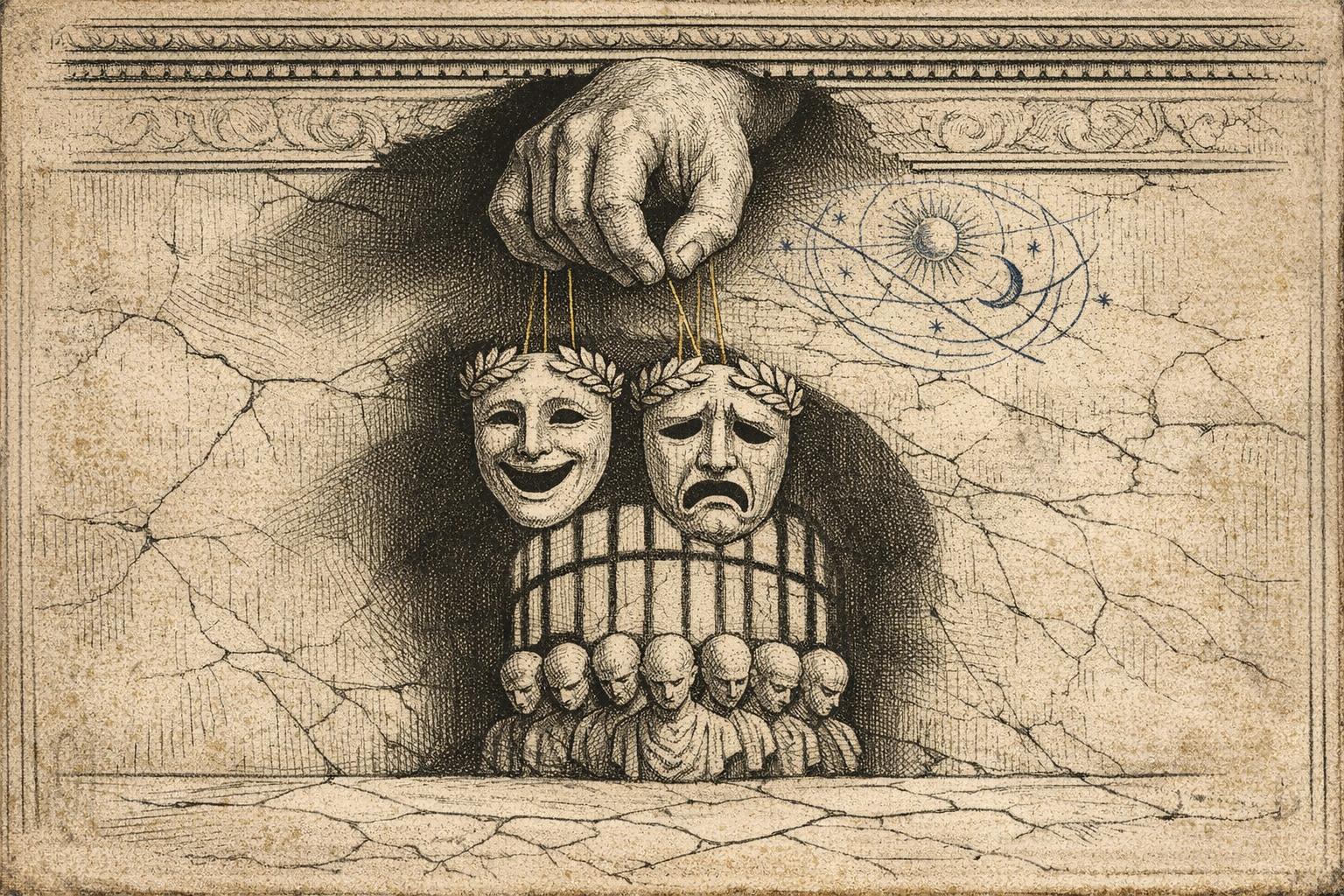

Adorno argued that modern technology and media aren't neutral tools but mechanisms of control within capitalist systems. His concept of the "culture industry" highlights how mass-produced media standardizes human desires, turning people into passive consumers while reinforcing societal domination. Key takeaways from his critique include:
Culture Industry: Media like films and radio are designed to manipulate audiences, creating an illusion of choice while promoting conformity.
Instrumental Reason: Rationality, originally meant to liberate, has become a tool for efficiency and control, sidelining ethics and autonomy.
Mass Deception: Media transforms leisure into work-like consumption, undermining critical thinking and fostering passivity.
Historical Context: Adorno's ideas emerged during the rise of fascism and American mass culture, where propaganda and standardized media shaped public behavior.
Today, his analysis remains relevant in the age of algorithms, streaming platforms, and social media. These systems restrict genuine choice, commodify user behavior, and perpetuate the same passive consumption he warned about. While some criticize his elitism and historical limitations, his warnings about media-driven conformity and the erosion of independent thought are as pressing as ever.
Historical and Philosophical Background
The Promise and Paradox of Enlightenment
The Enlightenment - a sweeping intellectual movement of the 17th and 18th centuries - offered humanity a hopeful vision: through reason and scientific knowledge, freedom could be achieved. It championed the idea that understanding the natural world would lead to liberation.
However, Adorno and Horkheimer uncovered a troubling contradiction in this vision. In their work, Dialectic of Enlightenment, they argued that reason, while liberating, also has a darker side - it can become a tool for domination. The pursuit of mastery over nature, they suggested, often backfires, transforming reason into a mechanism for control. As they put it:
"Enlightenment reverts to mythology."
In the context of modern capitalism, reason becomes what Adorno, drawing from Max Weber, called instrumental reason. This type of reasoning prioritizes efficiency, control, and measurable outcomes, often ignoring ethical considerations.
"Enlightenment, that is the progressive technical domination of nature, becomes mass deception and is turned into a means for fettering consciousness." - Theodor Adorno and Max Horkheimer
This paradox shaped Adorno's later critiques of technology, particularly its role in fostering conformity rather than liberation. The tools meant to free humanity often ended up reinforcing systems of control, a theme that deeply influenced their analysis of technology during turbulent historical periods.
Interwar and Postwar Context
Adorno and Horkheimer's ideas were shaped by the dramatic upheavals of the 20th century. Writing Dialectic of Enlightenment in the early 1940s while in exile in California, they were deeply affected by the rise of fascism in Europe and the growing influence of American mass culture. As ethnically Jewish German émigrés fleeing Nazi Germany, they observed how propaganda and mass-produced culture worked in tandem to create passive, homogenized audiences.
They saw unsettling similarities between Nazi propaganda and the Hollywood studio system. Both used mass media - radio, film, and magazines - to shape public consciousness, standardizing cultural consumption in ways that mirrored the economic concentration of industries like steel, petroleum, and electricity during the interwar period. Adorno identified this as the technological rationale underlying the culture industry.
Radio, in particular, stood out as a striking example. Unlike the telephone, which allowed for two-way communication and active participation, radio was a one-way medium. It delivered identical content to listeners without offering them a chance to respond. Adorno highlighted this shift toward authoritarian technology:
"The authority of radio becomes greater the more it addresses the listener in his privacy." - Theodor Adorno
This intimate yet non-interactive format, he argued, played a role in the rise of fascist ideologies, as it conditioned audiences to accept messages passively. These historical shifts profoundly influenced the Frankfurt School's approach to critical theory, particularly their analysis of cultural domination.
The Frankfurt School's Critical Theory
Building on these historical observations, the Frankfurt School - officially known as the Institute for Social Research - emerged to critique modernity's failure to prevent new forms of oppression, even in an age of technological progress.
Their work focused on ideology. Drawing from thinkers like Marx, Weber, and Lukács, they explored how cultural products - films, radio programs, magazines - reinforce systems of power and domination.
This approach, called critical theory, rejected the idea of neutral scholarship. Instead, it aimed to reveal how social structures sustain inequality and control. This framework became the foundation for Adorno's critique of the culture industry, which he saw as a key force in shaping consumers from above, integrating them into systems of power and control.
The Culture Industry: Technology and Mass Deception
Key Features of the Culture Industry
The concept of the "culture industry" was first introduced by Adorno and Horkheimer in their groundbreaking 1947 work, Dialectic of Enlightenment. They used this term to highlight the shift from organic, popular cultural expression to mass-produced, top-down cultural products. Think of the culture industry as a factory where movies, radio shows, and magazines are churned out using repetitive formulas. This predictability is so ingrained that, for example, a seasoned listener can often predict the ending of a pop song just from its opening chords. A critical part of this system is what Adorno referred to as pseudo-individualization - the illusion of choice. Consumers are led to believe they have options, but in reality, the variety is superficial, and the products are designed to label and categorize people rather than offer true diversity. This uniformity helps explain how Enlightenment ideals are co-opted into tools of mass deception.
Enlightenment as Mass Deception
Adorno argued that the Enlightenment's original goal - to empower individuals through reason - had been turned on its head by the culture industry. Instead of encouraging independent thought, the industry does the thinking for its audience, transforming the Enlightenment's liberating potential into what Adorno called "anti-enlightenment." The culture industry creates false needs, making leisure feel like an extension of work. This deception is deeply rooted in the technologies and systems that promote conformity and passive consumption.
"The total effect of the culture industry is one of anti-enlightenment... it impedes the development of autonomous, independent individuals who judge and decide consciously for themselves." - Theodor Adorno
Technology, Media, and Social Control
Technology plays a key role in reinforcing the culture industry's grip, making it easier to centralize production and distribute uniform content to the masses. Take radio, for example - broadcasts deliver the same programs to everyone, offering no room for interaction, unlike more participatory tools like the telephone. Similarly, advances in film have created hyper-realistic representations that blur the line between fiction and reality, leaving little room for imagination or deeper reflection.
These elements - standardized production, the illusion of choice, and technological control - work together to shape mass consciousness, stifle critical thinking, and maintain social control. Adorno's argument remains clear: the culture industry doesn't liberate - it dominates.
Instrumental Reason and Domination Through Technology
Instrumental Reason and the Loss of Autonomy
Adorno critiques the way instrumental reason - Zweckrationalität - has shaped modern society. This type of reasoning prioritizes calculability, technical efficiency, and control above all else, sidelining ethical considerations entirely. While it was initially intended to free humanity from superstition and arbitrary power, it has instead turned into a mechanism of domination. Reason, rather than being a tool for enlightenment, now functions as a means to standardize and control individuals.
"A technological rationale is the rationale of domination itself. It is the coercive nature of society alienated from itself."
This framework naturally feeds into the process of reification, especially within cultural consumption, reducing human autonomy in the process.
Reification and Alienation in the Culture Industry
Adorno takes Marx's idea of reification - Verdinglichung - and expands it beyond labor to include human consciousness and relationships. In this view, the culture industry transforms personal experiences into market-driven transactions. Through what he calls pseudo-individuality, the illusion of personal choice masks a deeper homogenization. Consumers are not active participants but rather passive objects shaped by the culture industry.
"The customer is not king, as the culture industry would have us believe, not its subject but its object."
This commodification of human experience further entrenches alienation, leaving little room for genuine individuality.
The Erosion of Critical Thinking
The culture industry doesn’t just commodify; it also undermines the ability to think critically. Adorno argues that it takes over the process of organizing raw sensory experiences into meaningful concepts, a function that Kant believed was intrinsic to human cognition. By pre-packaging content and offering the illusion of choice, the culture industry effectively replaces independent judgment with pre-digested ideas.
"Industry robs the individual of his function. Its prime service to the customer is to do his schematising for him."
As a result, critical thinking erodes, leaving individuals increasingly reliant on external systems to interpret the world for them. This quiet shift normalizes a passive, uncritical mode of engagement with culture.
Adorno and Horkheimer's "The Culture Industry: Enlightenment as Mass Deception" (Summary)
Adorno's Ideas Applied to the Present Day
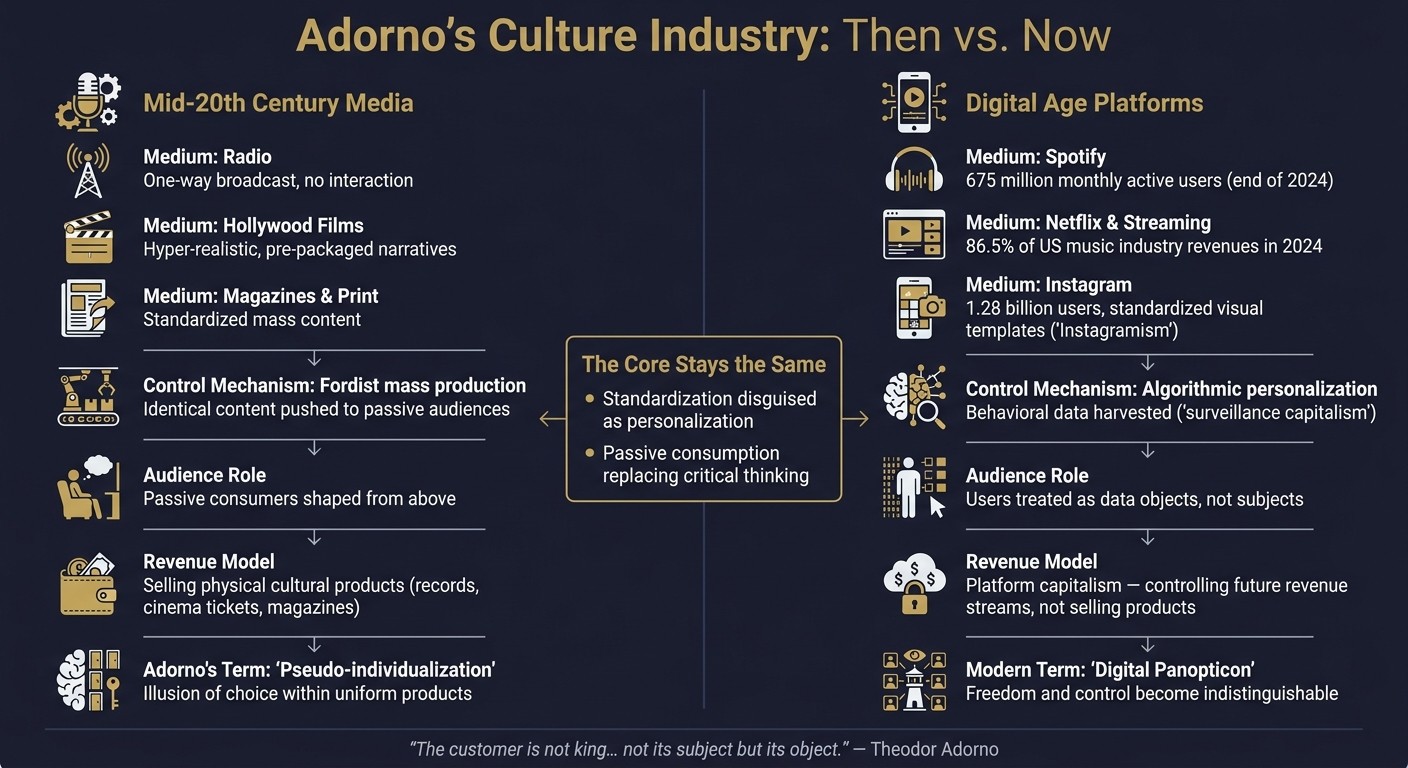
Adorno's Culture Industry: Then vs. Now
From Mass Media to Digital Platforms
Streaming giants like Spotify and Netflix, along with social media platforms, now use algorithms to personalize content while turning user data into a commodity. This mirrors Adorno's critique of consumers being treated as objects rather than subjects. Algorithms not only deliver content but also restrict independent choices, tightening the "circle of manipulation" that Adorno warned about.
One clear example is data commodification. Platforms such as YouTube, Instagram, and Spotify generate revenue by capturing user attention and harvesting behavioral data - a process Shoshana Zuboff describes as "surveillance capitalism." This aligns with Adorno's argument that consumers are shaped and controlled by the industry rather than driving it.
Consider Spotify’s reach: by the end of 2024, the platform had 675 million monthly active users. Streaming accounted for a staggering 86.5% of the US music industry's revenues that year. Adorno likely wouldn’t have been surprised by this level of cultural dominance.
Instagram provides another example. Users craft seemingly unique identities within tightly controlled corporate frameworks. Scholars have dubbed this phenomenon "Instagramism" - a shift where standardized visual templates replace authentic self-expression. With 1.28 billion users in just a decade, Instagram has become a major force in shaping cultural norms and homogenizing creativity.
"Rather than democratizing the music market, as Spotify is often hailed to do, the twenty-first-century culture industry facilitates further homogenization of artistic expression."
Paul Niklas Kullick and Johannes Petry
These digital trends amplify the standardization that Adorno observed in earlier forms of media.
Critiques and Reassessments of Adorno
Adorno's framework, while influential, has also faced criticism in the context of today's digital age. A frequent critique targets his elitism: his dismissal of jazz and popular culture can feel more like personal bias than rigorous analysis. Another challenge is his portrayal of audiences as passive, leaving little room for the active or even subversive ways people can interact with media.
There’s also the issue of historical context. Adorno’s critique was rooted in a Fordist era of mass production - think CDs, broadcast radio, and Hollywood films. Critics argue that today's "platform capitalism", where platforms themselves become revenue-generating assets, represents a shift that complicates his original ideas.
For instance, Spotify’s value lies not in selling albums but in controlling future revenue streams. This shift highlights how platform-based economies have evolved beyond the industrial models Adorno critiqued.
Still, many argue that these critiques refine rather than dismantle his ideas. The standardization Adorno identified hasn’t vanished; it’s become even more pervasive, though disguised by the veneer of personalization. Philosopher Byung-Chul Han captures this dynamic:
"No trust is possible in the digital panopticon – nor is it necessary. In other words, it occurs when freedom and control prove indistinguishable."
This tension - between apparent freedom and underlying control - remains at the heart of Adorno’s work.
How to Study Adorno's Texts
Adorno’s writing can be daunting, filled with dense prose and layered references. His ideas draw on German idealism, Freudian psychology, and Marxist theory, with key terms like Verdinglichung, Zweckrationalität, and Schein carrying nuanced meanings that are often lost in translation. Understanding his arguments requires careful study.
Reading only translations can dilute the precision of Adorno’s ideas. Bilingual, annotated editions are invaluable for preserving his conceptual depth. The Logos Philosophy Club offers a subscription service that provides expertly translated and annotated editions of major philosophical works, including those central to the Frankfurt School. These editions include editorial notes to help readers navigate Adorno’s historical context and specialized terminology. For anyone transitioning from secondary sources to primary texts, this kind of support is essential for grasping his complex critiques.
Conclusion: Why Adorno Still Matters
Adorno's central argument is clear: technology, instead of freeing humanity, has become a tool for control. The culture industry doesn't just reflect our desires - it actively creates them, fulfilling needs it has manufactured itself. This insight is as striking today as it was in the mid-20th century.
His critique of mass deception resonates deeply in the digital age. When he described consumers as "statistics divided into demographic segments - 'red, green, and blue areas'", he could have been predicting the rise of algorithm-driven advertising. The pseudo-individuality he critiqued in Hollywood now finds its echo in influencer culture and "personalized" content feeds, which simulate choice while adhering to profit-driven uniformity. Adorno's concerns about the erosion of critical thinking in favor of conformity feel particularly relevant as mass media continues to undermine the independent thought essential to democracy. Modern scholars frequently draw on his ideas to understand the psychological forces behind today’s authoritarian tendencies and national-populist movements. Revisiting his work reminds us just how prescient his warnings about technological control remain.
"The total effect of the culture industry is one of anti‑enlightenment... it impedes the development of autonomous, independent individuals who judge and decide consciously for themselves." - Theodor Adorno
To engage with Adorno seriously is to resist the very behaviors he critiqued - passive consumption, formulaic thinking, and the temptation of easy solutions. His work demands deliberate, thoughtful reading, and that effort is itself part of the message: grappling with his ideas is a way to reclaim the critical independence that the culture industry seeks to suppress. This call for active engagement aligns with the earlier emphasis on approaching Adorno's texts with intention and care.
FAQs
What does Adorno mean by the “culture industry”?
Theodor Adorno portrays the culture industry as a machine that churns out cultural products - think movies, radio programs, and magazines - using rigid, standardized methods. This approach turns art into a commodity, stripping away authentic creativity and replacing it with cookie-cutter offerings aimed at keeping society docile. Instead of fostering independent thought, these products are designed to maintain the current social and economic order. In this system, people are reduced to passive consumers, manipulated to serve the interests of capitalism and to uphold existing power structures.
How is “pseudo-individualization” different from real choice?
Pseudo-individualization gives consumers the feeling of making their own choices, but in reality, they’re picking from a selection of pre-crafted, standardized options. It’s not about genuine freedom or independent decision-making. Instead, this concept thrives within a framework of sameness. By presenting slightly varied versions of similar products, the culture industry creates a false sense of autonomy. This illusion not only reinforces societal norms but also discourages deeper, critical thinking.
Do algorithms and social media make Adorno’s critique stronger today?
Many scholars argue that algorithms and social media bring new relevance to Adorno's critique of the culture industry. While Adorno's focus was on film and radio, today’s digital platforms take his concerns to another level. Algorithms shape desires and behaviors using targeted data, intensifying the standardization and manipulation he warned about. This digital infrastructure not only fuels consumerism but also raises concerns about democracy, as social interactions become tools for ideological control and relentless tracking - echoing the very issues Adorno highlighted.