Gilbert Ryle: The Ghost in the Machine Through the Lens of Cinema: Blade Runner and The Wizard of Oz.
Gilbert Ryle: The Ghost in the Machine Through the Lens of Cinema: Blade Runner and The Wizard of Oz.

Logos Publishing
Logos Publishing
Aesthetics
Gilbert Ryle: The Ghost in the Machine Through the Lens of Cinema: Blade Runner and The Wizard of Oz.
The British philosopher Gilbert Ryle (1900-1976), in his work The Concept of Mind (1949), is one of the most important name who challenged the Cartesian duality of body and mind, proposing a critique of the idea that the mind is an immaterial entity, a ghost in the machine of the physical body. For Descartes, the mind (res cogitans) and the body (res extensa) were distinct substances, interacting at a specific point, the pineal gland, located in the middle of the human brain. For Ryle, the conception of the mind as an immaterial entity, a kind of ghost in the machine, that inhabits the body, is, in fact, a category mistake in the logic of our thinking. This philosophical line, known as philosophical or analytical behaviorism, argues that there is no internal mental substance separate from the body. Instead, the mind is understood as the set of observable dispositions, actions, and behaviors. Intelligence, for example, is not an invisible entity, but the way an individual acts, reasons, and interacts with the world. The ghost is not hidden in the machine, as the machine itself, in its operation and external manifestations, can already be considered the expression of intelligence:
I am arguing that in describing the workings of a person’s mind we are not describing a second set of shadowy operations. We are describing certain phases of his one career; namely we are describing the ways in which parts of his conduct are managed. (RYLE, 1949, p. 38*)
Blade Runner 2049
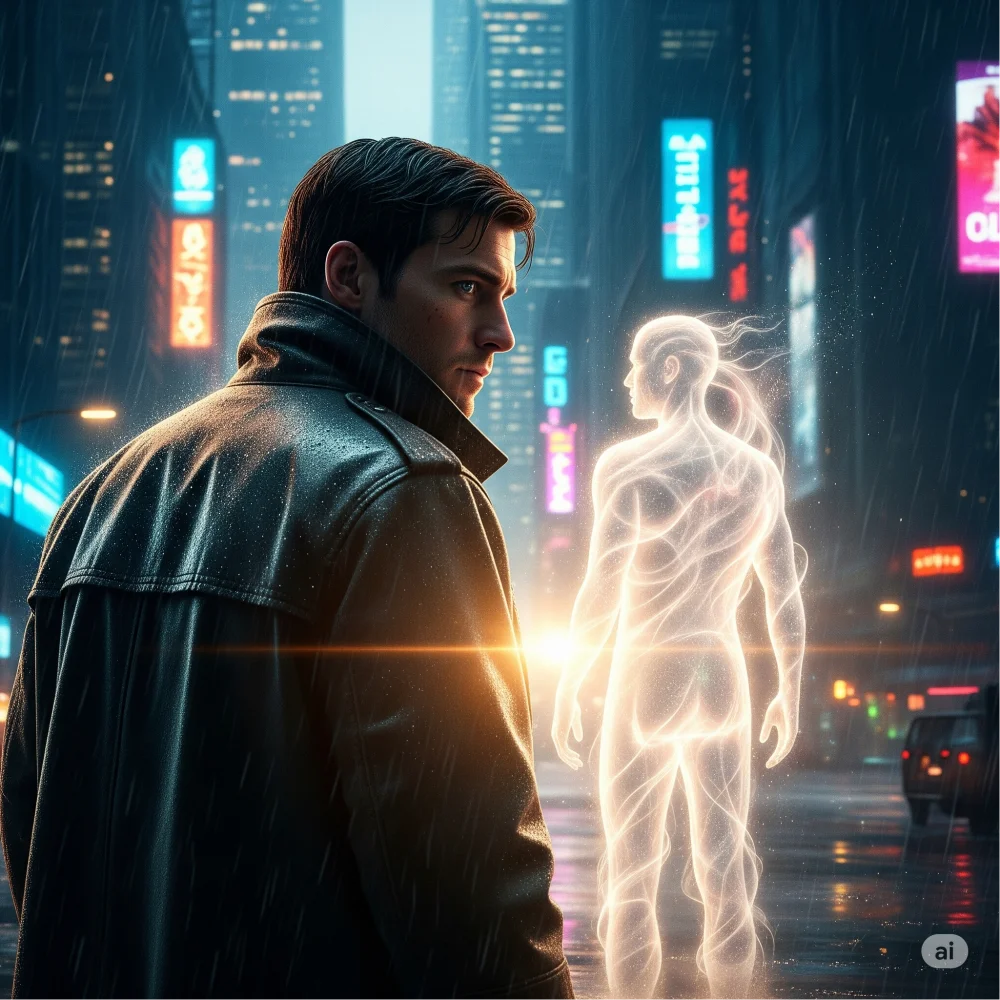
This philosophical critique can be explored in masterpieces of science fiction, especially those that explore the nature of consciousness and identity. Blade Runner 2049 (2017), directed by Denis Villeneuve, is an excellent example of how Ryle's metaphor can be unfolded and explored, revealing the complex layers of what it means to be human. The film introduces us to K, a replicant, an artificial being created to be a machine at the service of humans. K, however, begins to question his own reality after discovering he might be the son of a replicant and a human, leading him to believe he has a soul, a ghost that differentiates him from others of his kind.
K's journey is, in essence, the search for this ghost. He is confronted with implanted memories that mix with the possibility of real memories, and the line between what is “real” and what is “simulated” fades gradually. The film makes us ask: does K's consciousness reside in his biological origin, or in the complexity of his thoughts and actions? If the mind, as Ryle suggests, is what the body does, then K's search for a unique biological origin is, in itself, a category mistake of logic. His humanity would not lie in his internal and invisible soul, but in the way he behaves and makes decisions: But these expressions do not indicate two different species of existence, for ‘existence’ is not a generic word like ‘coloured’ or ‘sexed’. They indicate two different senses of ‘exist’. (Ryle, 1949, p. 11*). In Blade Runner 2049, K's logic is that of a being who transcends his initial programming. He does not need a ghost to become human; he becomes human by acting as such. The film suggests that consciousness is not an inherent property, but rather an emergence of complexity, of relationships, of actions. In the end, K's machine acts so humanly that the question of the presence of a ghost becomes irrelevant. What matters are his choices, his sacrifices, and his capacity to love and suffer. Blade Runner 2049 is a powerful cinematic tool for addressing Ryle's idea, showing that the mind is not a hidden mystery, but the visible and complex manifestation of our existence in the world.
The Wizard of Oz
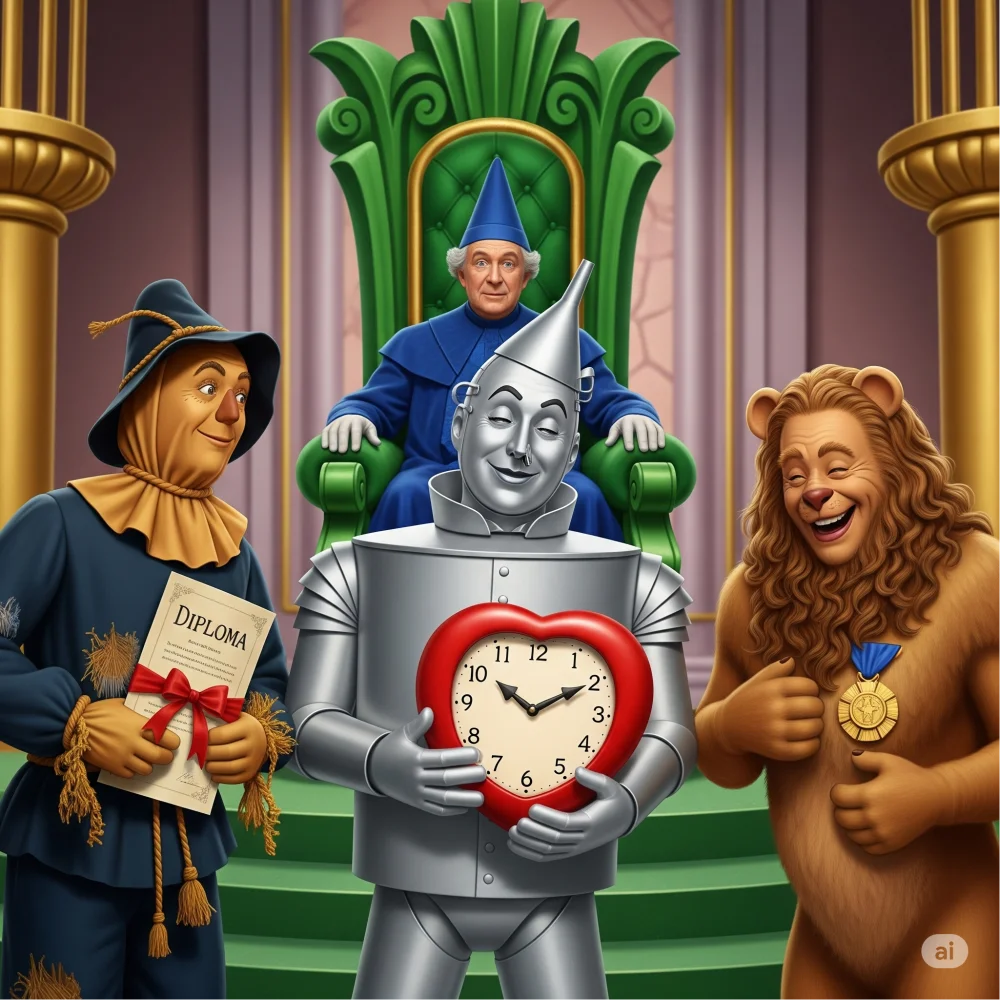
If Ryle's philosophy invites us to see the mind as a set of external dispositions, the film The Wizard of Oz (1939) can present a poetic critique of this view, leading us to consider the ethical approach of the plot. In the story, the Scarecrow, the Tin Man, and the Cowardly Lion respectively seek a brain to possess intelligence, a heart to feel emotions, and the virtue of courage, believing that these qualities are internal objects that need to be acquired. The Wizard, in the end, grants these attributes, but does so symbolically, giving a diploma, a watch, and a medal to the characters. A Rylean interpretation would argue that these qualities were not missing internal things, but were already being expressed through the characters' actions: the Scarecrow, with his cleverness in making plans; the Tin Man, with his compassion for Dorothy; and the Lion, with his bravery in protecting them, not needing objects to represent these qualities.
However, even though the behaviors were present, the characters felt a deep internal absence of these attributes, which suggests the existence of a subjective and invisible dimension, a kind of ghost that is real for the individual. This journey was not just about acting, but about the quest to believe in the possession of these qualities. This internal absence can be analyzed through Axel Honneth's theory of recognition, which argues that our identity is not formed in isolation, but through the validation we receive from others. The Wizard of Oz, by granting the symbolic gifts, acts as an agent of recognition, validating the attributes the characters already possessed: The development of a subject's personal identity presupposes, in principle, certain types of recognition” (HONNETH, 1996, p. 83).
Therefore, the Wizard does not give them the virtues themselves, but grants them the internal belief and mental certification that they possess these qualities, which is fundamental to their satisfaction. The film, in its essence, does not deny the existence of the ghost, but suggests that the fullness of the mind may depend on external validation to manifest itself. In sum, the analysis of these films shows that although Ryle offers a powerful critique of mystical ideas of the mind, the journey of consciousness goes beyond mere behavior. The mind, therefore, may be the sum of our actions, but its fullness and identity depend on a subjective and social confirmation that makes it real for the individual.
Note: I used the term “ghost” in reference to Ryle, not because I think “soul” and “ghost” are synonymous.
By Peter Webster - Philosophy Teacher and Logos Publishing Editor
REFERENCES:
Honneth, Axel. The Struggle for Recognition: The Moral Grammar of Social Conflicts. Cambridge: Polity Press, 1996.
Ryle, Gilbert. The Concept of Mind. Londres: Hutchinson’s University Library, 1949.
Gilbert Ryle: The Ghost in the Machine Through the Lens of Cinema: Blade Runner and The Wizard of Oz.
The British philosopher Gilbert Ryle (1900-1976), in his work The Concept of Mind (1949), is one of the most important name who challenged the Cartesian duality of body and mind, proposing a critique of the idea that the mind is an immaterial entity, a ghost in the machine of the physical body. For Descartes, the mind (res cogitans) and the body (res extensa) were distinct substances, interacting at a specific point, the pineal gland, located in the middle of the human brain. For Ryle, the conception of the mind as an immaterial entity, a kind of ghost in the machine, that inhabits the body, is, in fact, a category mistake in the logic of our thinking. This philosophical line, known as philosophical or analytical behaviorism, argues that there is no internal mental substance separate from the body. Instead, the mind is understood as the set of observable dispositions, actions, and behaviors. Intelligence, for example, is not an invisible entity, but the way an individual acts, reasons, and interacts with the world. The ghost is not hidden in the machine, as the machine itself, in its operation and external manifestations, can already be considered the expression of intelligence:
I am arguing that in describing the workings of a person’s mind we are not describing a second set of shadowy operations. We are describing certain phases of his one career; namely we are describing the ways in which parts of his conduct are managed. (RYLE, 1949, p. 38*)
Blade Runner 2049
This philosophical critique can be explored in masterpieces of science fiction, especially those that explore the nature of consciousness and identity. Blade Runner 2049 (2017), directed by Denis Villeneuve, is an excellent example of how Ryle's metaphor can be unfolded and explored, revealing the complex layers of what it means to be human. The film introduces us to K, a replicant, an artificial being created to be a machine at the service of humans. K, however, begins to question his own reality after discovering he might be the son of a replicant and a human, leading him to believe he has a soul, a ghost that differentiates him from others of his kind.
K's journey is, in essence, the search for this ghost. He is confronted with implanted memories that mix with the possibility of real memories, and the line between what is “real” and what is “simulated” fades gradually. The film makes us ask: does K's consciousness reside in his biological origin, or in the complexity of his thoughts and actions? If the mind, as Ryle suggests, is what the body does, then K's search for a unique biological origin is, in itself, a category mistake of logic. His humanity would not lie in his internal and invisible soul, but in the way he behaves and makes decisions: But these expressions do not indicate two different species of existence, for ‘existence’ is not a generic word like ‘coloured’ or ‘sexed’. They indicate two different senses of ‘exist’. (Ryle, 1949, p. 11*). In Blade Runner 2049, K's logic is that of a being who transcends his initial programming. He does not need a ghost to become human; he becomes human by acting as such. The film suggests that consciousness is not an inherent property, but rather an emergence of complexity, of relationships, of actions. In the end, K's machine acts so humanly that the question of the presence of a ghost becomes irrelevant. What matters are his choices, his sacrifices, and his capacity to love and suffer. Blade Runner 2049 is a powerful cinematic tool for addressing Ryle's idea, showing that the mind is not a hidden mystery, but the visible and complex manifestation of our existence in the world.
The Wizard of Oz
If Ryle's philosophy invites us to see the mind as a set of external dispositions, the film The Wizard of Oz (1939) can present a poetic critique of this view, leading us to consider the ethical approach of the plot. In the story, the Scarecrow, the Tin Man, and the Cowardly Lion respectively seek a brain to possess intelligence, a heart to feel emotions, and the virtue of courage, believing that these qualities are internal objects that need to be acquired. The Wizard, in the end, grants these attributes, but does so symbolically, giving a diploma, a watch, and a medal to the characters. A Rylean interpretation would argue that these qualities were not missing internal things, but were already being expressed through the characters' actions: the Scarecrow, with his cleverness in making plans; the Tin Man, with his compassion for Dorothy; and the Lion, with his bravery in protecting them, not needing objects to represent these qualities.
However, even though the behaviors were present, the characters felt a deep internal absence of these attributes, which suggests the existence of a subjective and invisible dimension, a kind of ghost that is real for the individual. This journey was not just about acting, but about the quest to believe in the possession of these qualities. This internal absence can be analyzed through Axel Honneth's theory of recognition, which argues that our identity is not formed in isolation, but through the validation we receive from others. The Wizard of Oz, by granting the symbolic gifts, acts as an agent of recognition, validating the attributes the characters already possessed: The development of a subject's personal identity presupposes, in principle, certain types of recognition” (HONNETH, 1996, p. 83).
Therefore, the Wizard does not give them the virtues themselves, but grants them the internal belief and mental certification that they possess these qualities, which is fundamental to their satisfaction. The film, in its essence, does not deny the existence of the ghost, but suggests that the fullness of the mind may depend on external validation to manifest itself. In sum, the analysis of these films shows that although Ryle offers a powerful critique of mystical ideas of the mind, the journey of consciousness goes beyond mere behavior. The mind, therefore, may be the sum of our actions, but its fullness and identity depend on a subjective and social confirmation that makes it real for the individual.
Note: I used the term “ghost” in reference to Ryle, not because I think “soul” and “ghost” are synonymous.
By Peter Webster - Philosophy Teacher and Logos Publishing Editor
REFERENCES:
Honneth, Axel. The Struggle for Recognition: The Moral Grammar of Social Conflicts. Cambridge: Polity Press, 1996.
Ryle, Gilbert. The Concept of Mind. Londres: Hutchinson’s University Library, 1949.
How Logos Philosophy Club Supports Your Reading
How Logos Philosophy Club Supports Your Reading

Diving into philosophy on your own can feel like navigating a maze - dense arguments, unfamiliar terms, and complex ideas can leave you feeling stuck. That’s where Logos Philosophy Club steps in, transforming solitary study into a guided and enriched journey. As the first philosophy subscription book club in the U.S. focused exclusively on foundational works, it’s backed by a parent publishing group in Brazil with over 20,000 monthly subscribers.
Each month, members receive bilingual editions of foundational texts, meticulously translated from their original languages. These side-by-side editions allow you to compare the translation with the source text, which is especially helpful when tackling works like Plato’s The Symposium (set for March 2026) or Aristotle’s Nicomachean Ethics (coming December 2025). This format not only enhances understanding but also reflects the club’s dedication to providing high-quality materials.
Tags
Recent Blogs
Biographies
Socrates: the incarnation of philosophy

Metaphysics Logic
How myth made philosophy possible
Subscribe to our newsletter
Subscribe to our newsletter
New editions, new authors, new releases.
Subscribe to our newsletter and be the first to know what’s coming next from Logos Publishing.
Biographies
Socrates: the incarnation of philosophy
Metaphysics Logic
How myth made philosophy possible
In Book XI of the Odyssey, Odysseus descends to the underworld...
Logos Publishing
Metaphysics Logic
How myth made philosophy possible
VIEW ALL ARTICLES