Philosophy as a way of living
Philosophy as a way of living

Logos Publishing
Logos Publishing
Ethics
The word school comes from the Greek skholé — leisure.
You did not attend the Academy just to learn — the schools of antiquity presupposed prior knowledge — but rather to be transformed.
This is the argument Pierre Hadot makes in Philosophy as a Way of Life — one of the most important works of classical scholarship of the twentieth century.
Hadot spent decades studying the ancient philosophical schools and arrived at the following conclusion: ancient philosophy was not primarily theoretical.
It was a set of spiritual exercises — practices of attention, meditation, self-examination, and contemplation through which a person gradually transformed how they perceived and inhabited the world.
The schools as ways of living
Each school organized these practices around a different central commitment.
For the Stoics, the fundamental exercise was the discipline of attention — learning to distinguish what is within your control from what is not, and training yourself, through daily practice, to desire only what depends on you.
Epictetus, a Stoic philosopher who had been a slave, reduced the entire practice to a single distinction: some things are up to us, and some things are not. The philosophical life consisted in learning, slowly and with great difficulty, to act accordingly.
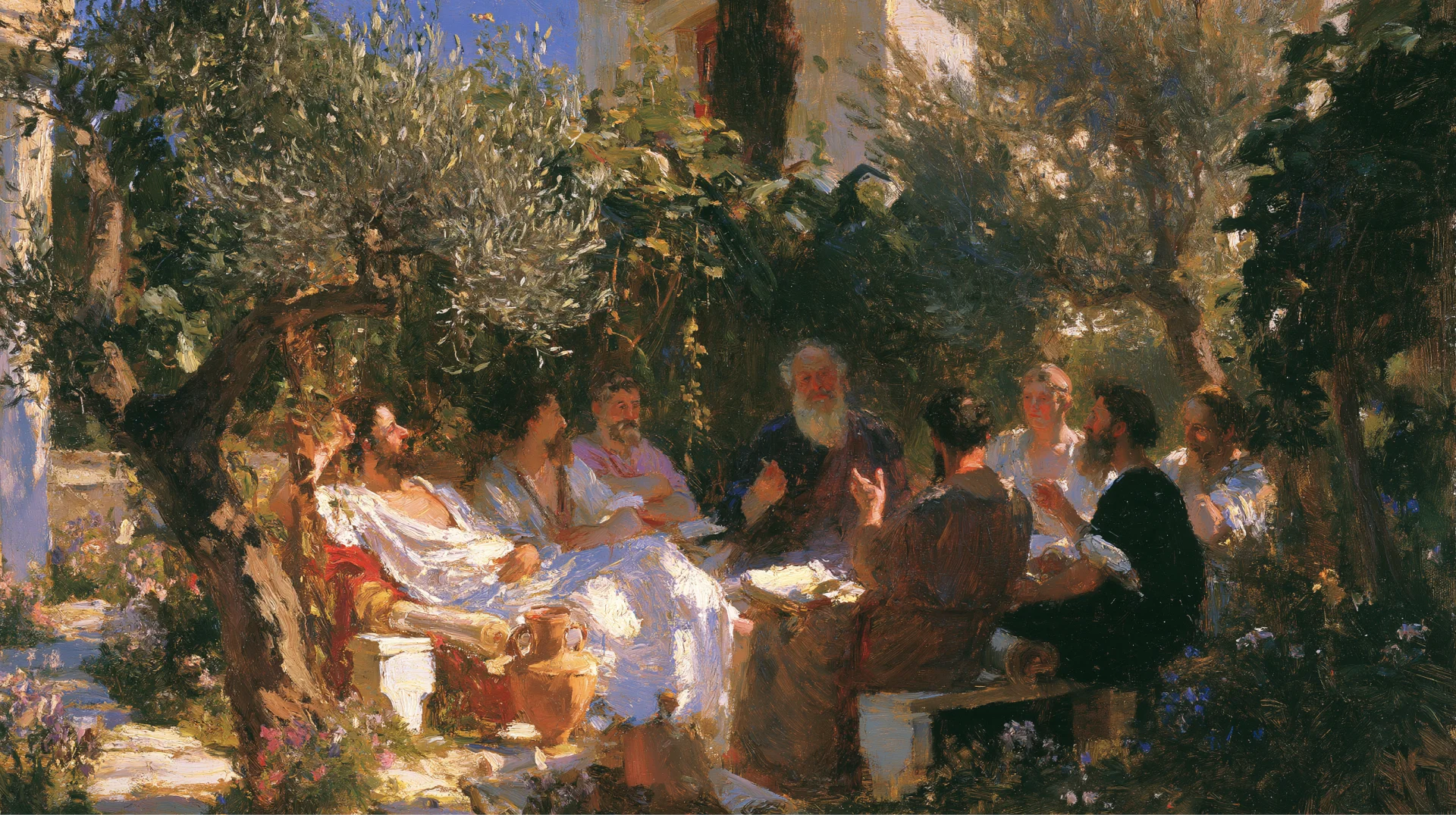
For the Epicureans, the goal was ataraxia — tranquility, freedom from disturbance. Epicurus established a community in a garden outside Athens where his followers lived together, practiced friendship, and cultivated the capacity to find pleasure in simple things.
Philosophy was not a lecture but a therapy: the examination and dissolution of the fears — above all the fear of death — that prevent human beings from living well.
For the Platonists, the practice was contemplation — the gradual assimilation of the soul to the rational order of reality.
In the Timaeus, Plato describes how the Demiurge fashioned the cosmos in the image of the eternal Forms, and how the philosopher, by studying that order, gradually brings their own soul into conformity with it.
For Plato, to contemplate the cosmos was to be transformed by it.
What philosophy inquired into
Alongside this practical dimension, ancient philosophy constituted a structured inquiry into reality in its most fundamental dimensions.
The Greeks asked — with a rigor and a comprehensiveness unmatched in antiquity — about the nature of beauty, justice, goodness, the soul, and being itself.
What is beauty itself? Not beautiful things — not the face, the statue, the sunset — but what makes beautiful things beautiful. What is justice? Not the laws of a particular city, but the principle that makes any law just or unjust. What is the good? Not what any individual happens to desire, but what any rational being, fully understanding their situation, would recognize as genuinely worth pursuing.
Though they appear distinct today, these questions are intimately connected.
For Plato, beauty, justice, and goodness are not three separate subjects but three dimensions of a single reality — the Form of the Good, which is the highest object of philosophical inquiry and the source of all being and all truth.
For Aristotle, the inquiry into the good life is inseparable from the inquiry into human nature: to know what you should do, you must first know what you are.
Why this still matters
The professionalization of philosophy in modern universities largely severed these two dimensions.
Philosophy became a discipline — something you study, publish papers about, teach in seminars — rather than something you practice.
The questions remained, but the commitment to being transformed by them quietly disappeared.
Hadot saw this as a loss. So did Nietzsche, who argued that every great philosophy is ultimately a confession — that the ideas a philosopher defends are inseparable from the life they are living. And so did Wittgenstein, who said that philosophy leaves everything as it is — meaning that it does not change the facts of the world, only how we see them.
For Hadot, this is precisely where ancient philosophy went further: it aimed not just to clarify vision, but to transform the one seeing.
The ancient answer to the question "what is philosophy for?" was simple: it is for living well. Not comfortably. Not successfully. Well — in the full and demanding sense that requires knowing what you are, what the good is, and what it costs to pursue it.
That is where these newsletters have been heading. And it is, in a different register, where every serious philosophical text is heading too
The word school comes from the Greek skholé — leisure.
You did not attend the Academy just to learn — the schools of antiquity presupposed prior knowledge — but rather to be transformed.
This is the argument Pierre Hadot makes in Philosophy as a Way of Life — one of the most important works of classical scholarship of the twentieth century.
Hadot spent decades studying the ancient philosophical schools and arrived at the following conclusion: ancient philosophy was not primarily theoretical.
It was a set of spiritual exercises — practices of attention, meditation, self-examination, and contemplation through which a person gradually transformed how they perceived and inhabited the world.
The schools as ways of living
Each school organized these practices around a different central commitment.
For the Stoics, the fundamental exercise was the discipline of attention — learning to distinguish what is within your control from what is not, and training yourself, through daily practice, to desire only what depends on you.
Epictetus, a Stoic philosopher who had been a slave, reduced the entire practice to a single distinction: some things are up to us, and some things are not. The philosophical life consisted in learning, slowly and with great difficulty, to act accordingly.
For the Epicureans, the goal was ataraxia — tranquility, freedom from disturbance. Epicurus established a community in a garden outside Athens where his followers lived together, practiced friendship, and cultivated the capacity to find pleasure in simple things.
Philosophy was not a lecture but a therapy: the examination and dissolution of the fears — above all the fear of death — that prevent human beings from living well.
For the Platonists, the practice was contemplation — the gradual assimilation of the soul to the rational order of reality.
In the Timaeus, Plato describes how the Demiurge fashioned the cosmos in the image of the eternal Forms, and how the philosopher, by studying that order, gradually brings their own soul into conformity with it.
For Plato, to contemplate the cosmos was to be transformed by it.
What philosophy inquired into
Alongside this practical dimension, ancient philosophy constituted a structured inquiry into reality in its most fundamental dimensions.
The Greeks asked — with a rigor and a comprehensiveness unmatched in antiquity — about the nature of beauty, justice, goodness, the soul, and being itself.
What is beauty itself? Not beautiful things — not the face, the statue, the sunset — but what makes beautiful things beautiful. What is justice? Not the laws of a particular city, but the principle that makes any law just or unjust. What is the good? Not what any individual happens to desire, but what any rational being, fully understanding their situation, would recognize as genuinely worth pursuing.
Though they appear distinct today, these questions are intimately connected.
For Plato, beauty, justice, and goodness are not three separate subjects but three dimensions of a single reality — the Form of the Good, which is the highest object of philosophical inquiry and the source of all being and all truth.
For Aristotle, the inquiry into the good life is inseparable from the inquiry into human nature: to know what you should do, you must first know what you are.
Why this still matters
The professionalization of philosophy in modern universities largely severed these two dimensions.
Philosophy became a discipline — something you study, publish papers about, teach in seminars — rather than something you practice.
The questions remained, but the commitment to being transformed by them quietly disappeared.
Hadot saw this as a loss. So did Nietzsche, who argued that every great philosophy is ultimately a confession — that the ideas a philosopher defends are inseparable from the life they are living. And so did Wittgenstein, who said that philosophy leaves everything as it is — meaning that it does not change the facts of the world, only how we see them.
For Hadot, this is precisely where ancient philosophy went further: it aimed not just to clarify vision, but to transform the one seeing.
The ancient answer to the question "what is philosophy for?" was simple: it is for living well. Not comfortably. Not successfully. Well — in the full and demanding sense that requires knowing what you are, what the good is, and what it costs to pursue it.
That is where these newsletters have been heading. And it is, in a different register, where every serious philosophical text is heading too
How Logos Philosophy Club Supports Your Reading
How Logos Philosophy Club Supports Your Reading

Diving into philosophy on your own can feel like navigating a maze - dense arguments, unfamiliar terms, and complex ideas can leave you feeling stuck. That’s where Logos Philosophy Club steps in, transforming solitary study into a guided and enriched journey. As the first philosophy subscription book club in the U.S. focused exclusively on foundational works, it’s backed by a parent publishing group in Brazil with over 20,000 monthly subscribers.
Each month, members receive bilingual editions of foundational texts, meticulously translated from their original languages. These side-by-side editions allow you to compare the translation with the source text, which is especially helpful when tackling works like Plato’s The Symposium (set for March 2026) or Aristotle’s Nicomachean Ethics (coming December 2025). This format not only enhances understanding but also reflects the club’s dedication to providing high-quality materials.
Tags
Recent Blogs
Biographies
Socrates: the incarnation of philosophy

Metaphysics Logic
How myth made philosophy possible
Epistemology
What is philosophy?
Subscribe to our newsletter
Subscribe to our newsletter
New editions, new authors, new releases.
Subscribe to our newsletter and be the first to know what’s coming next from Logos Publishing.
Biographies
Socrates: the incarnation of philosophy
Metaphysics Logic
How myth made philosophy possible
In Book XI of the Odyssey, Odysseus descends to the underworld...
Logos Publishing
Metaphysics Logic
How myth made philosophy possible
Logos Publishing
Epistemology
What is philosophy?
Metaphysics Logic
How myth made philosophy possible
In Book XI of the Odyssey, Odysseus descends to the underworld...
Logos Publishing
VIEW ALL ARTICLES