The Philosophy Behind Pluribus: Vince Gilligan’s New Mirror for the Human Soul
The Philosophy Behind Pluribus: Vince Gilligan’s New Mirror for the Human Soul


Logos Publishing
Logos Publishing
Aesthetics
Vince Gilligan has long stood out as one of the great screenwriters capable of questioning and exposing human morality with disturbing detail. But in Pluribus, recently released on Apple TV+, he inverts the logic of Breaking Bad. Here, instead of witnessing characters "break" the norms of society, we see them acting in perfect moral synchronicity. Through "The Union"—a collective of humans infected by a virus that forces them to act in total harmony—humanity acquires a collective consciousness that eradicates conflict, hunger, misery, and the other perennial problems of our world. However, amidst this biological "perfection," emerges the protagonist Carol Sturka (Rhea Seehorn), a woman who, by defying world peace, embodies one of the most astute roles in the history of thought: that of Socrates.
Carol Sturka: The Gadfly

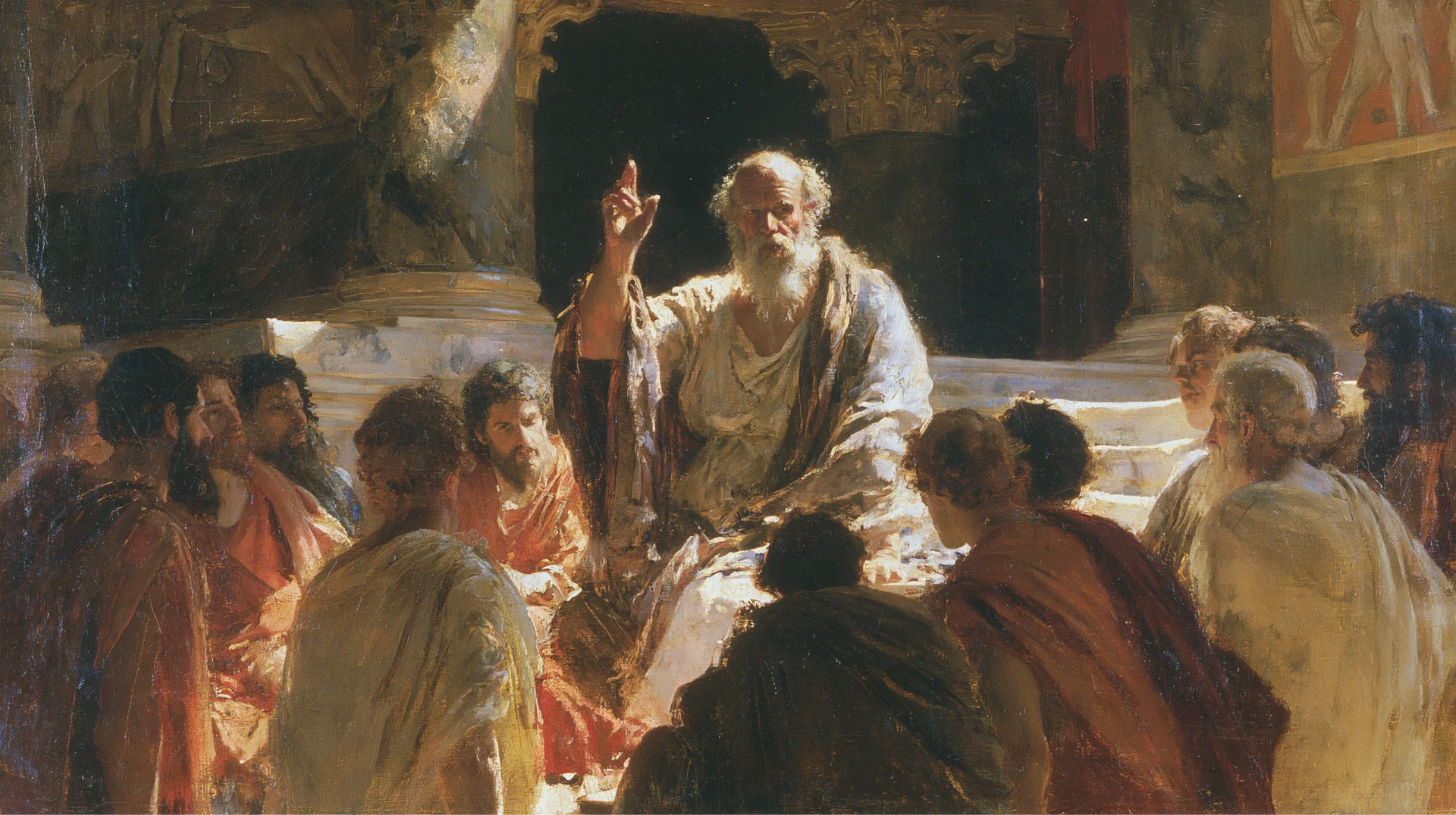
In 399 B.C., Socrates was brought to trial in Athens on charges of corrupting the youth and disbelieving in the city's gods. His defense, immortalized by Plato, contained a famous metaphor: he was the "gadfly" sent by the gods to awaken a large and noble—yet sluggish—steed: the city of Athens itself. Socrates bothered the city with uncomfortable questions, preventing it from falling into the slumber of self-complacency.
Carol Sturka is the gadfly of Pluribus. In a world where all the "infected" smile in unison because they share the same well-being, Carol’s resistance is no longer seen as a political stance but as a disease. Just as the Athenians preferred to condemn Socrates to death rather than wake from their comfortable ignorance, the series’ shared mind attempts to "cure" Carol. Her attitude is profoundly Socratic: she utilizes irony and the refusal of consensus to expose the emptiness of that existence. Carol’s "courtroom" is composed of kind, omniscient neighbors who surround her with an extreme and asphyxiating generosity. By maintaining her individuality—with all the pain and grief it entails—she affirms, like the Greek philosopher, that an unexamined life (and one without the possibility of error) is not worth living.
The Imperative of The Union: A Deontology Without a Soul
The ethics displayed by the infected in Pluribus expresses a similarity, however distorted, to the imperative ethics of Immanuel Kant. For the Prussian philosopher, the Categorical Imperative requires that we act only according to maxims that can serve as universal laws (laws that allow for the development of humanity as a whole and are followed by all). In the collective of The Union, beyond the impossibility of lying, an individual's action instantly becomes the law for everyone. There is no room for egoism or actions based on subjectivity, as the "I" has been dissolved into the "we."
However, there is a fundamental distinction that Gilligan scripts masterfully. Kant’s ethics are based on the autonomy of reason; the human being is free to choose duty. In Pluribus, what we see is what we might call biological heteronomy. The alien virus imposes moral law through physiology. While the Kantian imperative aims to protect the dignity of humanity as an end in itself, the imperative of The Union aims for the preservation of a pure and functional "biological life." It is Kant without freedom—a system where everyone treats others as ends, not out of virtue, but because it is impossible to do otherwise. It is morality reduced to a hive instinct, which begs the question: if you are incapable of doing evil, what value does your "good" truly hold?
The "Last Man" and Plastic Happiness
Finally, we cannot ignore the ghost of Friedrich Nietzsche haunting this version of Albuquerque. In Thus Spoke Zarathustra, the philosopher describes the figure of the "Last Man" (Der letzte Mensch), the most despicable being of all, who lives in an era of total comfort and the absence of challenges. "We have invented happiness," say the Last Men, blinking.
The infected in Pluribus are the biological realization of this prophecy. They no longer know suffering, ambition, or artistic creation—since art is born from conflict and individual tension. They trade Nietzsche’s "will to power" for an absolute, dystopian security. Carol Sturka, in her cantankerousness and resistance, is the last defense of Nietzschean vitalism against a nihilism disguised as utopia. She prefers the abyss of her own solitude over a desert of purposeless collectivity.
Why Philosophy Saves Us from Utopian Boredom
Pluribus places us before an uncomfortable mirror, and it is here that we realize how philosophy relates to the most vital issues of our culture. It is not merely about citing dusty names in footnotes, but about understanding that philosophy is capable of driving and giving purpose to diverse narratives. When Gilligan chooses to focus on Carol’s resistance, he is reminding us that human beauty lies not in our ability to agree, but in our glorious and sometimes terrible ability to diverge.
The series forces us to face utopia as a paradox: a perfectly peaceful world can, paradoxically, reduce our freedom to nothing. If the alien "Union" is the definitive answer to the problems of scarcity and violence, philosophy is the question that prevents that answer from annihilating us as individuals. In the end, Carol Sturka’s journey convinces us of an ironic and necessary truth: it is better to be a dissatisfied human than a satisfied infected who has forgotten what it feels like to bear the weight of their own choices, victories, or failures. In the banquet of collective consciousness in Pluribus, Carol’s Socratic attitude is the necessary fly in the soup: unpleasant, insistent, and the only thing proving that dinner is still being served to living beings, not biological machines. I cannot wait for the next episodes.
Bibliography
GILLIGAN, Vince. Pluribus. Albuquerque: Apple TV+, 2025. Television Series (Science Fiction).
KANT, Immanuel. Groundwork of the Metaphysics of Morals. Translated by Mary Gregor. Cambridge: Cambridge University Press, 1997.
NIETZSCHE, Friedrich. Assim Falou Zaratustra. Ed. Bilíngue, Tradução de Rafael D. de Souza. São Paulo: LOGOS, 2025.
PLATO. Apology of Socrates. Translated by Benjamin Jowett. New York: Oxford University Press, 2008.
Vince Gilligan has long stood out as one of the great screenwriters capable of questioning and exposing human morality with disturbing detail. But in Pluribus, recently released on Apple TV+, he inverts the logic of Breaking Bad. Here, instead of witnessing characters "break" the norms of society, we see them acting in perfect moral synchronicity. Through "The Union"—a collective of humans infected by a virus that forces them to act in total harmony—humanity acquires a collective consciousness that eradicates conflict, hunger, misery, and the other perennial problems of our world. However, amidst this biological "perfection," emerges the protagonist Carol Sturka (Rhea Seehorn), a woman who, by defying world peace, embodies one of the most astute roles in the history of thought: that of Socrates.
Carol Sturka: The Gadfly
In 399 B.C., Socrates was brought to trial in Athens on charges of corrupting the youth and disbelieving in the city's gods. His defense, immortalized by Plato, contained a famous metaphor: he was the "gadfly" sent by the gods to awaken a large and noble—yet sluggish—steed: the city of Athens itself. Socrates bothered the city with uncomfortable questions, preventing it from falling into the slumber of self-complacency.
Carol Sturka is the gadfly of Pluribus. In a world where all the "infected" smile in unison because they share the same well-being, Carol’s resistance is no longer seen as a political stance but as a disease. Just as the Athenians preferred to condemn Socrates to death rather than wake from their comfortable ignorance, the series’ shared mind attempts to "cure" Carol. Her attitude is profoundly Socratic: she utilizes irony and the refusal of consensus to expose the emptiness of that existence. Carol’s "courtroom" is composed of kind, omniscient neighbors who surround her with an extreme and asphyxiating generosity. By maintaining her individuality—with all the pain and grief it entails—she affirms, like the Greek philosopher, that an unexamined life (and one without the possibility of error) is not worth living.
The Imperative of The Union: A Deontology Without a Soul
The ethics displayed by the infected in Pluribus expresses a similarity, however distorted, to the imperative ethics of Immanuel Kant. For the Prussian philosopher, the Categorical Imperative requires that we act only according to maxims that can serve as universal laws (laws that allow for the development of humanity as a whole and are followed by all). In the collective of The Union, beyond the impossibility of lying, an individual's action instantly becomes the law for everyone. There is no room for egoism or actions based on subjectivity, as the "I" has been dissolved into the "we."
However, there is a fundamental distinction that Gilligan scripts masterfully. Kant’s ethics are based on the autonomy of reason; the human being is free to choose duty. In Pluribus, what we see is what we might call biological heteronomy. The alien virus imposes moral law through physiology. While the Kantian imperative aims to protect the dignity of humanity as an end in itself, the imperative of The Union aims for the preservation of a pure and functional "biological life." It is Kant without freedom—a system where everyone treats others as ends, not out of virtue, but because it is impossible to do otherwise. It is morality reduced to a hive instinct, which begs the question: if you are incapable of doing evil, what value does your "good" truly hold?
The "Last Man" and Plastic Happiness
Finally, we cannot ignore the ghost of Friedrich Nietzsche haunting this version of Albuquerque. In Thus Spoke Zarathustra, the philosopher describes the figure of the "Last Man" (Der letzte Mensch), the most despicable being of all, who lives in an era of total comfort and the absence of challenges. "We have invented happiness," say the Last Men, blinking.
The infected in Pluribus are the biological realization of this prophecy. They no longer know suffering, ambition, or artistic creation—since art is born from conflict and individual tension. They trade Nietzsche’s "will to power" for an absolute, dystopian security. Carol Sturka, in her cantankerousness and resistance, is the last defense of Nietzschean vitalism against a nihilism disguised as utopia. She prefers the abyss of her own solitude over a desert of purposeless collectivity.
Why Philosophy Saves Us from Utopian Boredom
Pluribus places us before an uncomfortable mirror, and it is here that we realize how philosophy relates to the most vital issues of our culture. It is not merely about citing dusty names in footnotes, but about understanding that philosophy is capable of driving and giving purpose to diverse narratives. When Gilligan chooses to focus on Carol’s resistance, he is reminding us that human beauty lies not in our ability to agree, but in our glorious and sometimes terrible ability to diverge.
The series forces us to face utopia as a paradox: a perfectly peaceful world can, paradoxically, reduce our freedom to nothing. If the alien "Union" is the definitive answer to the problems of scarcity and violence, philosophy is the question that prevents that answer from annihilating us as individuals. In the end, Carol Sturka’s journey convinces us of an ironic and necessary truth: it is better to be a dissatisfied human than a satisfied infected who has forgotten what it feels like to bear the weight of their own choices, victories, or failures. In the banquet of collective consciousness in Pluribus, Carol’s Socratic attitude is the necessary fly in the soup: unpleasant, insistent, and the only thing proving that dinner is still being served to living beings, not biological machines. I cannot wait for the next episodes.
Bibliography
GILLIGAN, Vince. Pluribus. Albuquerque: Apple TV+, 2025. Television Series (Science Fiction).
KANT, Immanuel. Groundwork of the Metaphysics of Morals. Translated by Mary Gregor. Cambridge: Cambridge University Press, 1997.
NIETZSCHE, Friedrich. Assim Falou Zaratustra. Ed. Bilíngue, Tradução de Rafael D. de Souza. São Paulo: LOGOS, 2025.
PLATO. Apology of Socrates. Translated by Benjamin Jowett. New York: Oxford University Press, 2008.
How Logos Philosophy Club Supports Your Reading
How Logos Philosophy Club Supports Your Reading

Diving into philosophy on your own can feel like navigating a maze - dense arguments, unfamiliar terms, and complex ideas can leave you feeling stuck. That’s where Logos Philosophy Club steps in, transforming solitary study into a guided and enriched journey. As the first philosophy subscription book club in the U.S. focused exclusively on foundational works, it’s backed by a parent publishing group in Brazil with over 20,000 monthly subscribers.
Each month, members receive bilingual editions of foundational texts, meticulously translated from their original languages. These side-by-side editions allow you to compare the translation with the source text, which is especially helpful when tackling works like Plato’s The Symposium (set for March 2026) or Aristotle’s Nicomachean Ethics (coming December 2025). This format not only enhances understanding but also reflects the club’s dedication to providing high-quality materials.
Tags
Recent Blogs

Biographies
Socrates: the incarnation of philosophy

Metaphysics Logic
How myth made philosophy possible
Subscribe to our newsletter
Subscribe to our newsletter
New editions, new authors, new releases.
Subscribe to our newsletter and be the first to know what’s coming next from Logos Publishing.
Biographies
Socrates: the incarnation of philosophy
Metaphysics Logic
How myth made philosophy possible
In Book XI of the Odyssey, Odysseus descends to the underworld...
Logos Publishing
Metaphysics Logic
How myth made philosophy possible
VIEW ALL ARTICLES